A study found links between COVID-19 and a higher risk for developing a variety of circulatory conditions months after infection.
Long COVID-19 is scary and unpredictable. While researchers are trying their best to understand the disease and its behavior, there’s still much that remains mysterious. A new study found evidence that long COVID-19 is related to serious health conditions developed afterwards, among them: the presence of blood clots.
The study, published in the BMJ. It was a big study, looking over the results of over a million people in Sweden who’d contracted COVID-19 between February 2020 and May 2021. These results were then compared to people of their same gender and age group, who had not contracted COVID-19.
The results showed that patients who’d had COVID-19 had higher risks of deep vein thrombosis, pulmonary embolism, and bleeding, the three conditions that researchers set out to find. Despite patients clearing their infections, these risks remained for months later.
This isn’t the first study to connect long COVID-19 with a variety of health conditions, including cardiovascular and clotting issues. While infections are related to clotting issues, in the case of COVID-19, this situation is made worse by the severity of the virus. Researchers speculate that COVID-19’s inflammatory response on the immune system could be responsible.
While the study’s results are pretty concerning, it’s important to know that a significant percentage of the data that was gathered occurred during a time where there was no access to vaccines in Sweden. Vaccines are proven to lower the risk of severe COVID-19 infection and would likely influence the amount of people experiencing these type of circulatory problems.
Studies on the effect of long COVID-19 not only help us understand the disease, helping us be more careful about contracting it, but also providing orientation for health care professionals. Knowing that cardiovascular conditions are a risk for people who’ve contracted COVID-19 can help treat others in similar situations and provide faster treatment, saving more lives in the long run.
Last week, a viral announcement revealed that the richest man in the world had acquired 9.2% of the total shares of Twitter. This announcement has to be one of the most unexpected purchases in the stock market. Hours after this information went viral, Twitter stocks went over the roof.
There is speculation about what this announcement could mean for cannabis advertising on Twitter. Given that Elon Musk is one of the country’s most well-known supporters of cannabis use, There’s a photo of the tech expert smoking weed at a podcast show on the internet.
Cannabis Promotion on Social Media
Cannabis is a federally prohibited drug. Based on this classification, media companies do not allow adverts for the different forms of cannabis products to be published on their platforms. Many cannabis operators face the challenge of advertising their products on mainstream platforms. The prohibition of such advertisements has made it difficult to spread information about cannabis or even get in touch with existing or potential customers. Cannabis businesses can increase profits with social media advertising, more so than with regular brick-and-mortar stores.
Different studies have proved that cannabis is a beneficial drug. However, until the federal laws acknowledge these studies, social media platforms may be forced to maintain their prohibition. Twitter is not the only social media behemoth opposed to cannabis advertisements. Instagram and Facebook also restrict the promotion of the plant. Although some people find ways to work around the restrictions, moderators on the platform quickly delete such posts or accounts as soon as they see them.
Musk’s New Role In Twitter’s Corporation
Elon Musk is one of the most influential people across various social media platforms. He has always been a frontrunner for freedom of speech, and he proved this by refusing to deny Russia access to its servers during the first days of the ongoing Ukraine war.
Musk’s intention for the social media platform is not clear at the moment. But all indicators suggest that he’s here to improve the platform’s adherence to free speech. Last month, he organized a Twitter poll for his followers to state whether or not Twitter practiced adequate free speech. The poll results showed the majority believed the platform was too restrictive.
During his time as a regular tweep, Musk is famous for using his account to post memes and reply to business critics. Now that he is a board member, the majority hope he’ll stick to his principles of free speech. Twitter’s spokesperson disclosed that the board has little to do with the day-to-day operations of the platform. They only serve as an advisory to the management and employees. However, this doesn’t eliminate Musk’s ability to effect change on the platform. A day after he was announced as the majority shareholder of Twitter stocks, the tech mogul created another poll for his followers to choose whether or not a Twitter edit button was necessary. The majority selected yes.
Hope for Cannabis and Cryptocurrencies
Many predict that Musk will turn around Twitter’s restrictions on cannabis and cryptocurrency promotions for users in the U.S.
Elon Musk is an avid lover of cryptocurrencies. He even holds the nickname “the Father of Dogecoin” due to his instrumental involvement in raising the coin’s valuation in the last year. His interest in cannabis is also not hidden, thanks to his picture on Joe’s podcast, which shows him smoking.
The newly appointed board member will most definitely have specific changes he plans to make during his time as a board member. His penchant for free speech might result in Twitter foregoing some restrictions against cryptos and cannabis. Not for anything, but for Musk’s belief that both products are important to the future. Musk often refers to himself as a “free speech absolutist.” What better way to seal this description than to make sure Twitter begins to accept crypto and cannabis promotions?
What He Truly Wants
One of Musk’s favorite arguments is for Twitter to make its algorithm more accessible to the public and also reduce the requirements needed for the verification of accounts. With a seat at the table, Musk can now begin to push toward this.
On a lighter note, it won’t be surprising to see Musk calling for the removal of crypto scam bots in the coming weeks, what with his dislike for the bots on Twitter. A communications professor at Syracuse University joked that Musk could secretly be planning to destroy the platform rather than make changes. The Tesla and SpaceX CEO now have a war of top managers on Twitter’s platform. With 80 million Twitter followers, he is one of the most followed public figures with no affiliation with the entertainment industry.
Photo by Loren Elliott/Stringer/Getty Images
The Position Of Other Shareholders
Most Twitter investors say they are encouraged by Musk’s new appointment to Twitter’s 12-man board. They believe that Musk would have several ideas to improve how the company and its platform are run. Being as successful as Elon Musk means there is no room for failure.
A few investors claim the new development raises room for concern. This is due to the reports of Musk’s company, Tesla, treating its black workers in a less than acceptable manner. Meredith Benton commented that Musk could indirectly undermine years of thoughtful and strategic management practices that keep the company running as it should.
Bottom Line
Parag Agrawal, Chief Executive Officer of Twitter, tweeted about the board’s delight in having Musk on board. These praises suggest that senior board members and stakeholders in the corporation would be acting on Musk’s different ideas. Note that Elon Musk alone cannot or does not have the authority to add the edit feature to the platform or change the rules and policies of the forum to permit cannabis or crypto promotions. However, he’s in the right spot to induce change from within. Now, he’ll be able to influence other board members and stakeholders on the benefits of the edit button and cannabis acceptance on the social media giant.
Hopefully, Musk will reveal his next step in the coming weeks.
According to one political scientist, Biden “would be hard-pressed to veto” legislation that supports cannabis use because he can’t allow losing the younger generation of voters.
The House of Representatives approved the Marijuana Opportunity, Reinvestment, and Expungement (MORE) Act, H.R. 3617 on April 1, sending it to Senate. The MORE Act removes cannabis from the federal Controlled Substances Act, allowing states to legalize cannabis, its production and sale, free from federal interference.
What’s next? It’s up to the Senate of course. And, while many industry experts doubt the Senate will approve federal marijuana reform this year, the question also is: What will happen if the MORE Act does pass?
The hierarchy says it’s up to President Joe Biden. So, the next question is: Will Biden use his presidential veto to nix the cannabis legalization bill if it reaches his desk?
Risk Of Losing Young Votes
According to Paul Quirk, a political scientist at the University of British Columbia in Canada, Biden “would be hard-pressed to veto” legislation that supports cannabis use because he can’t allow losing the younger generation of voters, reported Newsweek.
“Legalization is favored by two-thirds of all Americans, an even higher percentage of Democrats, and the vast majority of younger people,” Quirk said. “The 18-39-year-old age group is exactly where Biden has lost the most support since his inauguration.”
“Vetoing marijuana legalization would make Biden public-official enemy No. 1 to many of the young voters whose support he badly needs to win back,” he added.
Marsha Cohen, a law professor at UC Hastings College of the Law agrees that signing the MORE Act would enable Biden to get back some young voters, although she also thinks chances are slim that the bill will be approved in the Senate.
“Young people may also be those least likely to be responsive to pollsters right now because they might not care. This [bill] might ‘talk’ to them,” Cohen told Newsweek.
There’s also Lisa Jordan, vice president of marketing at cannabis consultancy firm Canna Advisors, who also doubts there’s a chance Biden will refuse to sign the bill, because of “growing” public support for federal marijuana legalization in the country.
“Signing the bill would be positive for the cannabis industry and serve as a unifying topic across party lines,” Jordan said. “Without a doubt taking the final step to remove federal prohibition on cannabis would make a noticeable improvement in his ratings.”
What Is Biden’s Stance On Cannabis Legalization?
The truth is, it’s not really clear although during his 2020 presidential campaign, Biden repeatedly said he wanted to see marijuana decriminalized and prior cannabis convictions automatically expunged.
After a full year in the Oval Office, Americans have seen neither.
Although the president has been under pressure from all sides, he hasn’t budged despite numerous letters from marijuana advocates, lawmakers, celebrities, and those who have been, and still are, negatively affected by the war on drugs including those who are behind bars for marijuana-related convictions.
A poll conducted in January by YouGov and The Economist revealed that the majority of U.S. residents don’t hold out much hope that the President will make progress on this important reform in 2022. As per the survey, 54% believe that Biden made little to no progress on marijuana decriminalization; 23% said they don’t know and another 23% think he made some or a lot of progress on the matter.
Expectations? Not Many
58% of respondents overall do not expect Biden to make progress on cannabis decriminalization in 2022, with 26% unsure what to expect and only 16% optimistically believing he’ll make some or a lot of progress on the issue. It is important to note that 58% of respondents confirmed they support marijuana decriminalization and 25% do not.
On the other hand, the Biden administration recently expanded its employee conduct guidelines to potentially decline security clearances to people who supported marijuana-related businesses. Some industry experts see this as an indication of possible or imminent federal legalization and the government being prepared with its policies so as to avoid conflicts of interest.
Photo by Chip Somodevilla/Getty Images
The same day the MORE Act passed in the House of Representatives on April 1, White House Press Secretary Jen Psaki noted that the President thinks there should be a different approach to cannabis laws.
“As the president said during the campaign, our current marijuana laws are not working. He agrees that we need to rethink our approach, including to address the racial disparities and systemic inequities in our criminal justice system, broaden research on the effects of marijuana and support the safe use of marijuana for medical purposes,” Psaki said.
It is also important to note that if the MORE Act does not reach the President’s desk, there are many other cannabis-related bills in line to be considered by the Senate, like Cannabis Administration & Opportunity Act – sponsored by Senate Majority Leader Chuck Schumer (D-NY) and the States Reform Act – sponsored by Rep. Nancy Mace (R-SC).
Is it possible that none of them will be signed by President Biden?
Texas Original Compassionate Cultivation (TXOG) announced that 14-year-old patient James Challenger has gone two years without experiencing a seizure. He has also stopped taking all oral seizure pills as of March 2022—a reduction of more than 20 pills a day to none after introducing medical cannabis into his treatment plan.
As one of TXOG’s original medical cannabis patients, James’ milestone represents the proven efficacy of medical cannabis in managing epilepsy as well as symptoms of autism.
“Medical cannabis is the only remedy that has worked wonders for James, and our family is grateful for this encouraging treatment option that allowed him to avoid surgery and harsh seizure medications,” stated Mikelle and Mike Challenger, James’ parents. “Since James started his TXOG prescription, we’ve seen an incredible improvement in his daily life, and we’re thrilled to celebrate his two-year anniversary without a seizure last month. We strongly believe medical cannabis is a healthy option that should be available to all Texans who want to gain control over their debilitating conditions and symptoms.”
The Challenger family advocates for increasing access to medical cannabis in Texas and supports expanding the state’s Compassionate Use Program (CUP) to enable more people to benefit from the medicine. By removing CUP’s restriction on qualifying conditions—and eliminating the THC cap—the family hopes physicians will have greater authority to decide what is best for their patients. The Challengers know that an expanded program would mean more Texans could experience the improvements that James has seen.
TXOG’s gummies, tincture and lozenge products are available for statewide delivery at their dispensary in Austin, Texas, and through the company’s pick-up locations in Addison, Corpus Christi, Dallas, El Paso, Fort Worth, Houston, Lubbock, North Austin, San Antonio and Wichita Falls.
It’s been two years since the pandemic struck, and while for many of us life has gone back to normal, there are still thousands of people who have or are going to get COVID-19.
But thanks to science, vaccines, and medications, even more lives have been saved. However, that doesn’t mean the fight is over. The virus still very much exists around us and that’s why we need more advanced treatments. Thankfully, researchers have found that cannabis, hemp, and its therapeutic cannabinoids, has the potential to fight and treat COVID-19.
Photo by Amfer75/Getty Images
Now a company has developed the first product based on cannabinoid acids designed to prevent and treat COVID-19. Van Breemen, which makes plant-based and wellness products, has created the hemp-based Original Wellness Formula, a blend founded by researcher Dr. Richard van Breemen of the Oregon State’s Global Hemp Innovation Centre, College of Pharmacy and Linus Pauling Institute, reports Benzinga.
Dr. van Breemen launched his company after it was discovered that some cannabinoid acids within the hemp plant are beneficial for treating and preventing coronavirus.
Last January, Dr. van Breemen’s research paper titled “Cannabinoids Block Cellular Entry of SARS-CoV-2 and the Emerging Variants” was published in Journal of Natural Products. It was a breakthrough for the industry and the world as a whole, as scientists were still struggling to find means of preventing and treating this mysterious virus. They intend to submit the formula to the Food and Drug Administration (FDA) soon for approval.
“We believe in elevating the conversation by bringing doctors and scientists to the table and delivering a product we can stand behind,” company co-founder & CEO, Jacob Crabtree, told Benzinga. “Van Breemen’s Wellness Formula is that product.”
“Our goal is to achieve optimal health with the use of plants and science, transforming the way we view complementary medicine,” van Breemen said. “Cannabinoids such as CBGA and CBDA are not controlled substances like THC, the psychoactive ingredient in marijuana. These cannabinoids are abundant in hemp and have a positive safety profile in humans. We are extremely proud to offer our first such hemp-based product to consumers.”
The Wellness Formula Product’s original flavor is pineapple, with more flavors to be developed soon. It’s designed to be applied sublingually, and is a full-spectrum cannabis product with 124mg in each serving. The suggested retail price is currently at $49.99.
The Study
Dr. van Breemen led the study which found that CBDA and CBGA were the most promising cannabinoids for fighting the SARS-CoV-2 spike glycoprotein. In the trials, they found that it was successful in blocking the human epithelial cell when a pseudovirus expressed the spike glycoprotein.
It was also significant that both cannabinoids derived from hemp were successful stopping the infection, as well as its variants including the beta and alpha strain. The study authors indicated that the concentrations needed to stop the infections of 50% of the viruses was achievable clinically. Additionally, data on CBDA bioavailability indicated that serum concentrations and micromolar plasma can be used for tolerability and efficacy.
Photo by Yarygin/Getty Images
“Because we believe that the primary binding site for CBGA is allosteric, there may even be reduced evolutionary pressure for SARS-CoV-2 to mutate their binding sites compared to the orthosteric binding sites typically favored by neutralizing antibodies,” said the authors.
“Clinical trials are absolutely necessary to prove that the mechanism of action that we’ve identified in small molecules actually can prevent infection in humans, or shorten the course of our COVID infection in humans,” Dr. van Breemen told The Sun.
Can Cannabis Really Treat COVID?
The use of cannabis for treating and preventing COVID-19 is nothing short of controversial. It has garnered strong media attention, but we think this is warranted. After all, cannabis is renowned for its numerous therapeutic and anti-viral properties. But we can’t deny what the science says.
Another recent study suggests that CBD may help prevent or treat the dreaded virus. According to the University of Chicago’s Marsha Rosner, lead researcher of a team who discovered that CBD helped to treat the virus in laboratory experiments, CBD does make a strong case without claiming that it would work.
For their study, the researchers used small doses of purified CBD, similar to what patients with severe epilepsy would medicate with. Rosner and her team discovered that instead of CBD preventing the virus from infecting cells, CBD acted immediately once the virus entered the cells though it blocked it from replicating copies of itself through its effects on interferon, an inflammatory protein.
Meanwhile, in 2020, another animal study discovered that CBD could be effective in reducing the cytokines, which helped improve clinical symptoms in mice models that had symptoms similar to COVID-19.
No Support From FDA
The FDA as well as the Federal Trade Commission (FTC) is warning consumers against using CBD for treating COVID-19. They have issued 7 warning letters for hemp-CBD companies against claiming that their products can “mitigate, prevent, treat, diagnose, or cure” a disease.
“The FDA has not approved or authorized any drug containing CBD for the treatment or prevention of COVID-19,” they said.
“We request that you take immediate action to cease the sale of any unapproved and unauthorized products for the mitigation, prevention, treatment, diagnosis, or cure of COVID-19,” writes the FDA.
For consumers, it’s best to consult with cannabis-knowledgeable doctors before self-medicating with cannabis for such a life-threatening condition. However, we do hope that more research can be done to save more lives.
A new study found a link between licorice and prostate cancer. Here’s why researchers think this information is worth investigating.
Love it or hate it, a new study discovered that licorice root is good for your health and could even prevent and treat cancer.
The discovery was made by researchers from the University of Chicago, who found links between the root that licorice comes from (Glycyrrhiza glabra) and a group of benefits related to cancer. The study, published in the journal Pharmacological Research, focused on prostate cancer, but researchers think these benefits could extend to other forms of cancer.
Gnanasekar Munirathinam, associate professor and study lead, discussed the findings in a press release, breaking down some of the effects of the plant. “When we look at the research out there and our own data, it appears that glycyrrhizin and its derivative glycyrrhetinic acid have great potential as anti-inflammatory and anti-cancer agents,” he said. “More research is needed into exactly how these could best be used to develop therapies, but this appears to be a promising area of cancer research.”
While these results may prompt licorice lovers to overindulge in their favorite sweet, researchers explain that more study is necessary, even if they think there’s nothing wrong with consuming it occasionally. Licorice isn’t only made up of its root; it contains sugar and other elements that may mess with people’s blood pressure and systems if consumed in disproportionate amounts.
There are plenty of foods that have been associated with cancer prevention. Foods such as nuts, broccoli, carrots, cinnamon, beans and berries have been linked with anti-carcinogenic effects. While it’s unlikely that someone will prevent the disease or cure it by merely consuming these foods, it’s never a bad idea to know these facts, and to add them as a part of a healthy and balanced diet.
Probably not all Republicans agree on everything regarding marijuana legalization, but some of them are known for supporting it. At least, under specific regulations.
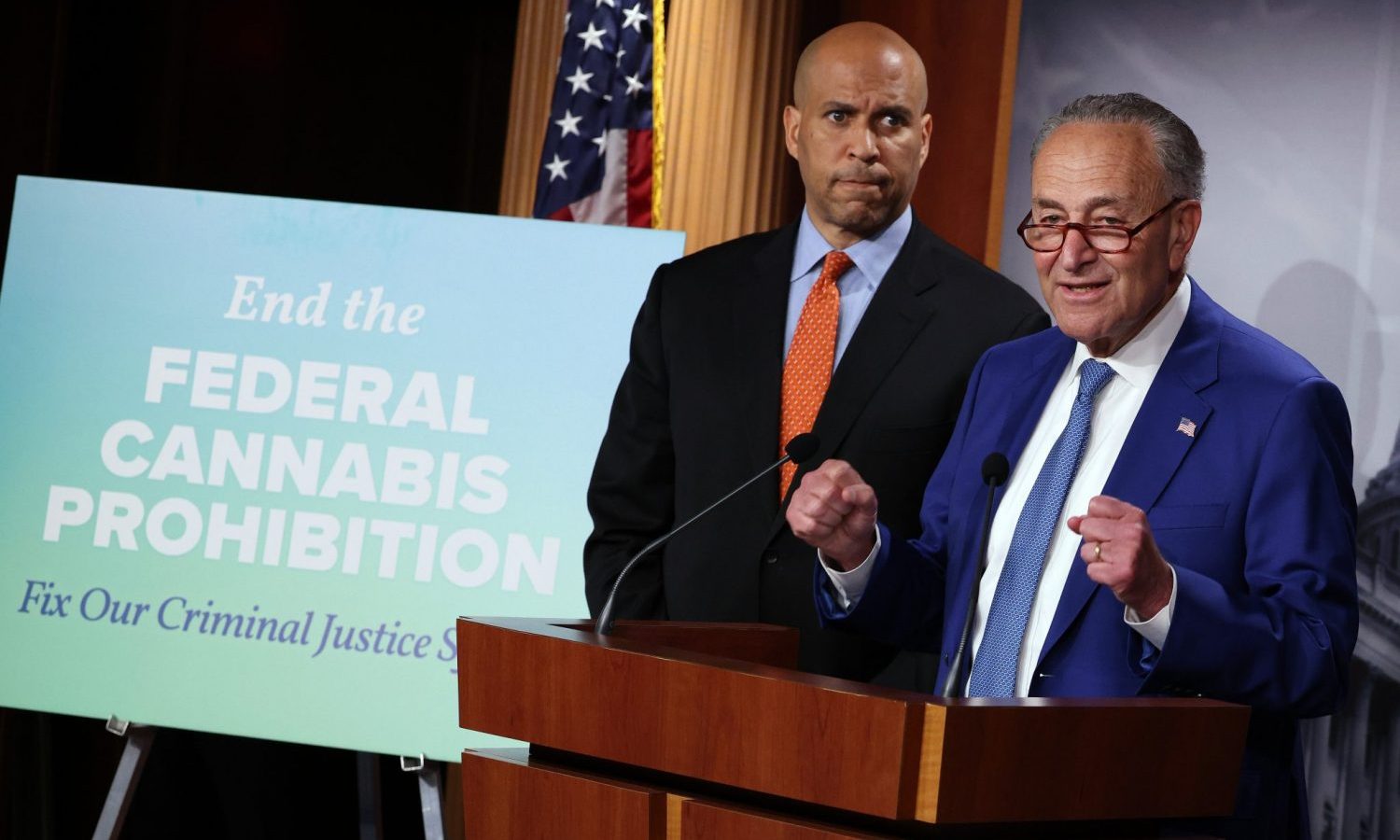
Senate Majority Leader Chuck Schumer (D-NY) confirmed this week that, together with his colleagues, he is planning to consult with Republican senators to find out what “they want” to see included in a bill to federally legalize cannabis, which he should present this month.
The news comes on the heels of the U.S. House of Representatives approving a different bill to end federal cannabis prohibition, the MORE Act, sponsored by House Judiciary Committee Chairman Jerrold Nadler (D-NY).
Photo by Jonathan Ernst/Pool/Getty Images
“We hope to [file the bill] towards the end of April,” Schumer said, as reported by Marijuana Moment. The leader added that he, Senate Finance Committee Chairman Ron Wyden (D-OR) and Sen. Cory Booker (D-NJ) “are talking about it and, in fact, we’re trying to reach out” to other lawmakers about the measure.
“I’ve reached out already to a few Republicans to see what they want,” he said.
What Do Republicans Want?
Probably not all Republicans agree on everything regarding marijuana legalization, but some of them are known for supporting it. At least, under specific regulations.
For example, Rep. Nancy Mace (R-SC), viewed as one of the leaders among GOP representatives in favor of removing cannabis from the list of federally controlled substances, voted against the MORE Act. Why?
“The MORE Act forces a system on South Carolinians and other states they do not want. By comparison, my bill, the States Reform Act, removes the federal government from the equation and allows states to decide for themselves,” Mace explained.
She presented her bill — the States Reform Act — in November last year, but the measure failed in 12 committees and seven subcommittees without a hearing.
According to Mace, House passage of the MORE act may be a good start for creating bipartisan consensus around legislation that would remove cannabis from the Controlled Substances Act.
According to Mace, many don’t understand that her bill doesn’t actually legalize cannabis at the federal level, instead, it offers full control to each state. Mace has said she believes that giving control to states and treating cannabis like alcohol is the only way for marijuana reform to obtain Republican support.
Photo by Dmitriy83/Getty Images
What Does Schumer’s Bill Propose?
Schumer and fellow Sens. Cory Booker and Ron Wyden introduced the outline of the proposed Cannabis Administration & Opportunity Act in July last year.
The proposal included plans to remove marijuana from the Controlled Substances Act. If passed, the bill would also expunge prior convictions and allow people who are serving time for applicable crimes to petition for resentencing.
In addition, states would retain their rights to set their own marijuana policies and help those who’ve been criminalized over the cannabis plant.
In February, the trio asked senators to help them complete the marijuana legalization bill expected to be filed in April. To that end, the top Senate Democrats sent letters to their colleagues encouraging them to get into the drafting process and help finalize this legislation.
“In order to appropriately address such a nuanced issue, we respectfully request the input, advice, and guidance of Chairs and Ranking Members of relevant committees as well as senators who have dealt with the challenges and realities of legalization in their own states,” the three senators wrote. “We would deeply appreciate your willingness to share your expertise on the intersections between your committees’ jurisdictions, your states’ experiences, and comprehensive cannabis reform and invite you to join the process of perfecting this legislation. We would welcome the opportunity to discuss this issue with you in the weeks ahead.”
Furthermore, the senators accepted public comment on the draft to help them revise the bill before presenting it this month.
And while many industry experts doubt there will be federal marijuana reform this year, it’s obvious that cannabis legalization is slowly but steadily gaining wider support. In addition to the MORE Act, this week the House of Representatives passed the Medical Marijuana Research Act, which will substantially expand scientific research on marijuana, including allowing scientists to study products from dispensaries.
COVID-19 boosters show no sign of stopping. Here’s what researchers know in terms of the effects of repeated vaccination.
Federal authorities have approved a second COVID-19 booster following full immunization, totaling four shots. These immunizations were approved for people over the age of 50 or who have underlying health conditions.
If you’ve been keeping track of boosters, you’ll realize that the time between each shot has been getting shorter, from the predicted initial eight months to now four months.
Can you have too many boosters in your body? Will they become harmful at some point?
Researchers don’t have enough evidence to know what will happen if we continue to get boosters, but most think that it’s unlikely for there to be significant negative side effects. Still, there are some issues that could pop up.
In a news briefing, the Head of Vaccines Strategy of the European Medicines Agency Marco Caliveri said that taking boosters every four months might compromise immune response. “We are rather concerned about a strategy that entangles repeated vaccination within a short term. We cannot really continuously give a booster dose every 3 or 4 months,” he said.
Studies on viruses like HIV show that T cells, which are responsible for protecting the body, become dysfunctional when they’re exposed repeatedly to the same virus. Still, some researchers don’t think this is the case with COVID-19.
“T cells become dysfunctional when they repeatedly see antigen in certain contexts,” said Dr. Sarah Fortune, professor at Harvard University. She makes it clear that HIV is different than COVID-19; in the case of the latter, people’s bodies are exposed to the virus occasionally, when they get their shots or by catching the disease. This situation is different than HIV, where the virus lives in people’s bodies over prolonged periods of time, thus damaging the T cells.
Currently, the CDC recommends a booster at least 5 months after the last previous dose. Those who are immunocompromised or over a certain age can get their shots four months after their last dose.
The rise of the Omicron variant is largely responsible for new waves of boosters. While the booster is perfectly equipped to handle previous variants, Omicron is just different enough to sneak past a relatively protected immune system. With there being a new Omicron variant in the mix (BA.2), we’ll just have to wait and see how the virus reacts and whether or not infection rates skyrocket, prompting responsible authorities to campaign for more boosters.
States where weed is legal generated over $3.7 billion in cannabis tax revenue from adult-use sales in 2021—a 34% increase in revenue compared to 2020.
A new report reveals some big numbers when it comes to cannabis tax revenue generated from legal weed states, which collected more than $3.7 Billion in 2021. This is a 34% increase when compared to 2020.
The updated report, compiled by the Marijuana Policy Project (MPP) and published on Wednesday, also found that, as of March 2022, legal marijuana has earned over $11.2 Billion in tax revenue since 2014, when marijuana was first legalized in Colorado and Washington.
“Our report is further evidence that ending cannabis prohibition offers tremendous financial benefits for state governments,” said Tori Hutchinson, President and CEO of the MPP. “The legalization and regulation of cannabis for adults has generated billions of dollars in tax revenue, funded important services and programs at the state level, and created thousands of jobs across the country. Meanwhile, the states that lag behind continue to waste government resources on enforcing archaic cannabis laws that harm far too many Americans.”
One of the main draws of legal cannabis is the fact that these tax revenues can be utilized for a variety of services that concern and benefit the state, like education, veterans’ services, job training, reinvesting in communities that have been impacted by the war on drugs, and more.
Every year, federal legal marijuana seems like a clearer possibility, even if the process is slow going. Last week, the House passed the Medical Marijuana Research Act, which expands the research that’s available on marijuana and could benefit legal marijuana in the long term.
“Cannabis has a wide range of therapeutic applications, but researchers have consistently faced significant roadblocks to conducting studies. Research is key to evaluating and unlocking the full potential of cannabis, and we applaud the House for passing legislation that would greatly expand the eligible supply of cannabis for studies,” said U.S. Cannabis Council CEO Steven Hawkins.
The MORE Act, which was also recently passed by the House, could help remove marijuana from the list of controlled substances and eliminate conflicts between federal and state laws, allowing states to make their own rules regarding cannabis.
The bill would have allowed for self-certification for adults 21+ to use medical cannabis and established a tax holiday for medical cannabis products during April.
District of Columbia Council Chairman, Phil Mendelson, introduced a new emergency bill to reform the medical marijuana market in the nation’s capital where cannabis is fully legal but sales are banned, by a congressional spending bill rider that’s been annually renewed, prohibiting the use of local taxes to implement a system of recreational cannabis commerce.
“The important part of the legislation is that it’s making it easier for the legal medical marijuana businesses, which we are licensing, to be able to maintain their customer base,” Mendelson said on Monday. “The legal shops have seen a substantial erosion of their business to the legal market and I want to be clear, this is not a gray market, it’s an illegal market.”
The bill would have allowed for self-certification for adults 21+ to use medical cannabis and established a tax holiday for medical cannabis products during April. However, on Tuesday, the District Council rejected a resolution to allow expedited action on the bill.
The bill was criticized by the advocacy group D.C. Marijuana Justice (DCMJ) over a proposed civil enforcement action: a $30,000 fine for unregistered businesses that “gift” marijuana to people who purchase unrelated products and services. Advocates are concerned about the bankruptcy effect of the fines on businesses owned by minorities.
In addition, the bill was criticized for not lifting the cap on medical cannabis providers to include current operators gifting cannabis.
“The solution is to remove the rider,” Mendelson noted. “Both chambers of Congress have proposed lifting the rider from Rep. Andy Harris (R-MD), but last year’s appropriations bill maintained the ban, and President Joe Biden last month proposed for the second time a budget that would continue the cannabis restriction,” reported Marijuana Moment.
Bill supporters include Dr. Chanda Macias, CEO of the National Holistic Healing Center. “As one of the four Black-owned dispensaries in D.C., this emergency legislation will help us continue to serve these vulnerable patients with safe, tested products from licensed regulated operators,” said Dr. Macias, who is a guest speaker at the upcoming Benzinga Cannabis Capital Conference in Miami April 20-21.