Other states have seen creative workarounds, such as food delivery or food trucks parked outside. However, with either option, the cannabis company is giving up some potential profit.
The biggest issue with the suggested rules is the inability to sell anything but cannabis — no food or alcohol.
“I often tell my clients that a lounge will operate more like a hospitality environment rather than a retail environment,” said Sara Stewart, founder of Ritual Cannabis Hospitality, who helps cannabis owners build consumption lounges. “Your profit margins are lower, and instead of averaging $60 a person, it’s more like $30.” That means these operators need additional revenue streams, which the current New Jersey rules don’t allow for.
“If you don’t have food, that’s a huge hurdle for the profitability of a lounge,” Stewart said.
Photo by Goodboy Picture Company/Getty
She speaks from experience. Stewart built the Lowell Cafe in California (now called the Original Cannabis Cafe), which serves food and beverages, but she also built one for Green Thumb Industries (OTC: GTBIF) in Illinois without that add on.
“I saw the direct correlation that food brings to a lounge. I saw the normalness. I saw the profitability,” Stewart said.
She noted that Nevada is moving forward with food at consumption lounges — a lead that New Jersey could follow.
Some states that have legalized consumption lounges without food have seen creative workarounds, such as food delivery or food trucks parked outside. However, with either option, the cannabis company is giving up some potential profit.
Stewart also noted that building a commercial kitchen from scratch is expensive, and that’s why most restaurants take over a previously built-out space. Cannabis operations might not be able to find such a space available. It’s a difficult puzzle to solve for the owners.
Another issue with lounges without other forms of entertainment or food and beverages? Overconsumption. Stewart thinks that a lounge with food that sells smaller amounts of cannabis, such as pre-rolls, would allow an operation to make a profit without overselling to the customer.
“Imagine a bar that outsourced liquor but sold food on site. It wouldn’t be profitable,” Stewart pointed out.
Lounges that sell larger amounts run into problems with either not allowing customers to leave with unused products (motivating them to overconsume) or leaving with extra products which put them into competition with dispensaries.
Photo by Jamie Grill/Getty Images
New Jersey’s Lounge Laws
The rules are currently in a 60-day public comment period, after which officials plan to finalize the regulations. The operations are being called marijuana consumption areas (MCA).
Here are some of the proposed rules:
The MCA endorsement is valid for one year and may be renewed annually upon the renewal of the marijuana retail license or the medical marijuana dispensary’s permit.
Consumers can bring their own cannabis to the lounge – either medical or adult-use products.
A lounge can allow free samples of medical or adult-use cannabis.
Customers can take any unconsumed cannabis with them, but it must be repackaged to meet state requirements.
Strict sales limits to prevent overselling.
Customers must be 21 and up.
The proposed rules carry a $1,000 application fee for all applicants but, if approved, microbusinesses will face an additional $1,000 licensing fee, while a standard consumption lounge business license would cost $5,000.
Big No-Nos
No alcohol or cigarettes can be consumed or sold in the lounge.
No retail food operations.
Employees can’t consume while on the job.
Any cannabis left by consumers at the lounge must be destroyed.
Tax revenue from pot sales is forecasted to reach $50.7 million in the 2024 fiscal year, and $57.7 million in 2025 for the general fund, as per the new budget proposal.
Which vice brings in more in taxes — weed or alcohol? It depends on the state, the local trend and the taxes set up on each. But with marijuana becoming legal, it comes as no surprise that Montana is projecting tax revenue from cannabis to go up, while wine and beer should remain at the same level, over the next couple of years.
New revenue projections from Governor Greg Gianforte’s budget proposal show that taxes on alcohol should slightly increase, while income from taxes on tobacco is expected to go down, reported Daily Montana.
Photo by Nikolay Ponomarenko/Getty Images
Cannabis is projected to make hefty contributions to state coffers, though still accounting for a small part of the total general fund collection.
“Total stimulus spending directed to Montana individuals, businesses, and government entities amounted to $11.8 billion,” the budget proposal said.
Tax revenue from pot sales is forecasted to reach $50.7 million in the 2024 fiscal year, and $57.7 million in 2025 for the general fund, as per the new budget proposal.
In 2023, the first full year of adult-use cannabis program implementation in the Treasure State, $30.7 million in tax revenue is expected. The budget proposal also projects for the gross revenue on marijuana to hit $61.1 million in 2023 and $91.9 in 2025.
Revenue From Liquor Taxes
For comparison, general fund revenue from liquor taxes is estimated to reach $32.6 million in the 2025 fiscal year, which is slightly above $30.1 million in 2023.
Interestingly, the number of alcohol bottles sold increased by 3.7% a year on average from 2016 to 2019, and then, thanks to the COVID pandemic liquor sales skyrocketed. In 2020, 2021, and 2021 the same sales went up 16.9%, 20.7%, and 10.6%, respectively. They are now back to the previous pace.
When it comes to tobacco, the budget proposal estimates the total revenue from taxes to reach $35.5 million in 2025, up from $36.3 million in 2023.
“I anticipate that the tax revenue will increase a little year over year and level out after about ‘25, ‘26,” Pepper Petersen, president and CEO of the Montana Cannabis Guild, said.
Photo by Moussa81/Getty Images
A 25% total tax on recreational cannabis in a state is “ludicrously high,” he added. “On any other item, people would burn the Capitol down… Montanans hate sales taxes.”
About 58% of voters said yes to the initiative during the November election. The initiative legalized the possession and use of one ounce or less of cannabis or eight grams or less of marijuana concentrate by adults over the age of 21.
In addition, retail marijuana sales for adults 21 and older started in Montana on Jan. 1, 2021.
Until September 2022, dispensary operators in Montana, a state that is home to about 1.1 million residents, have sold more than $201 million worth of cannabis ($133 million from adult-use sales). Those sales have provided the state with nearly $29.3 million in tax revenue.
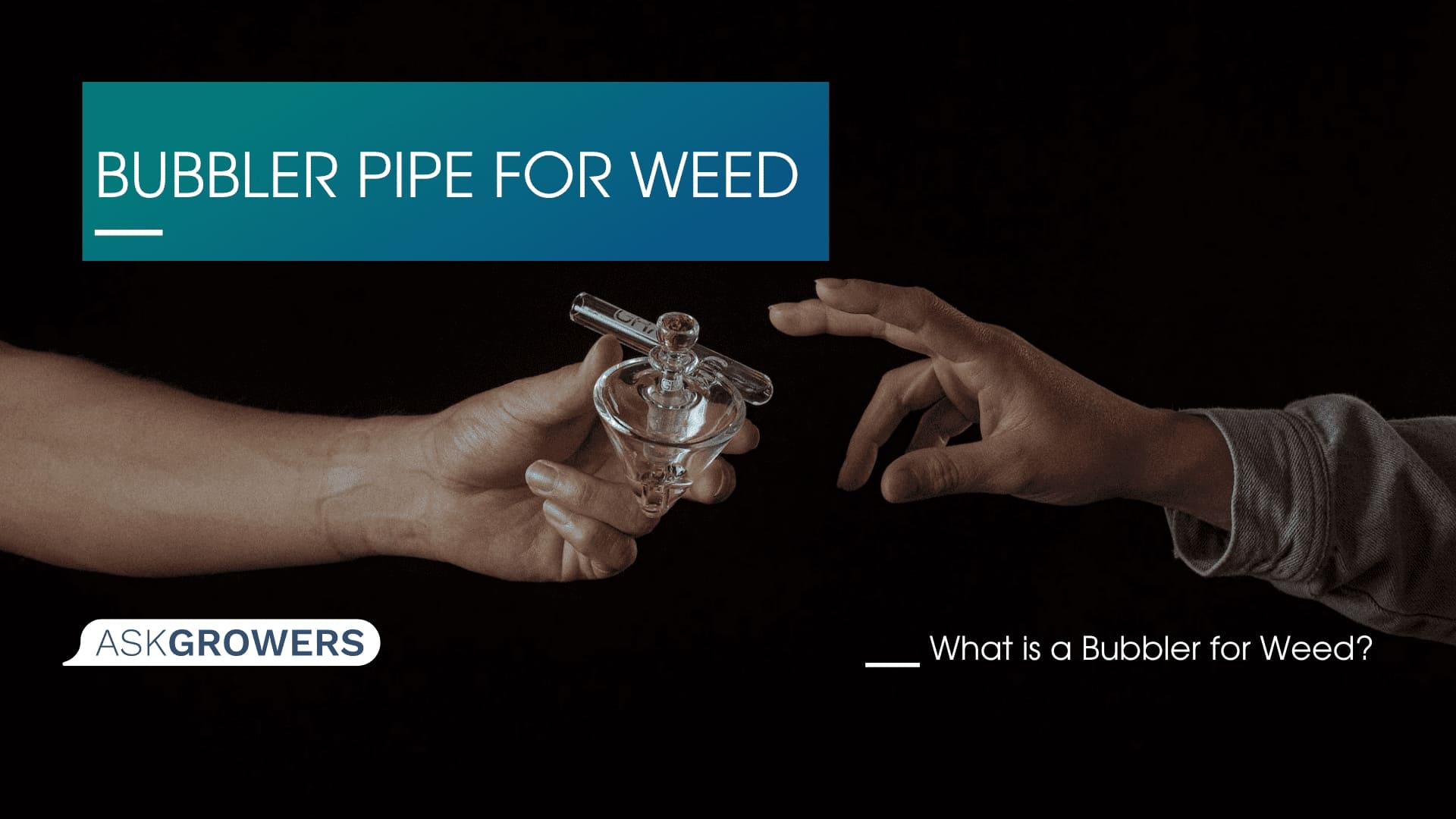
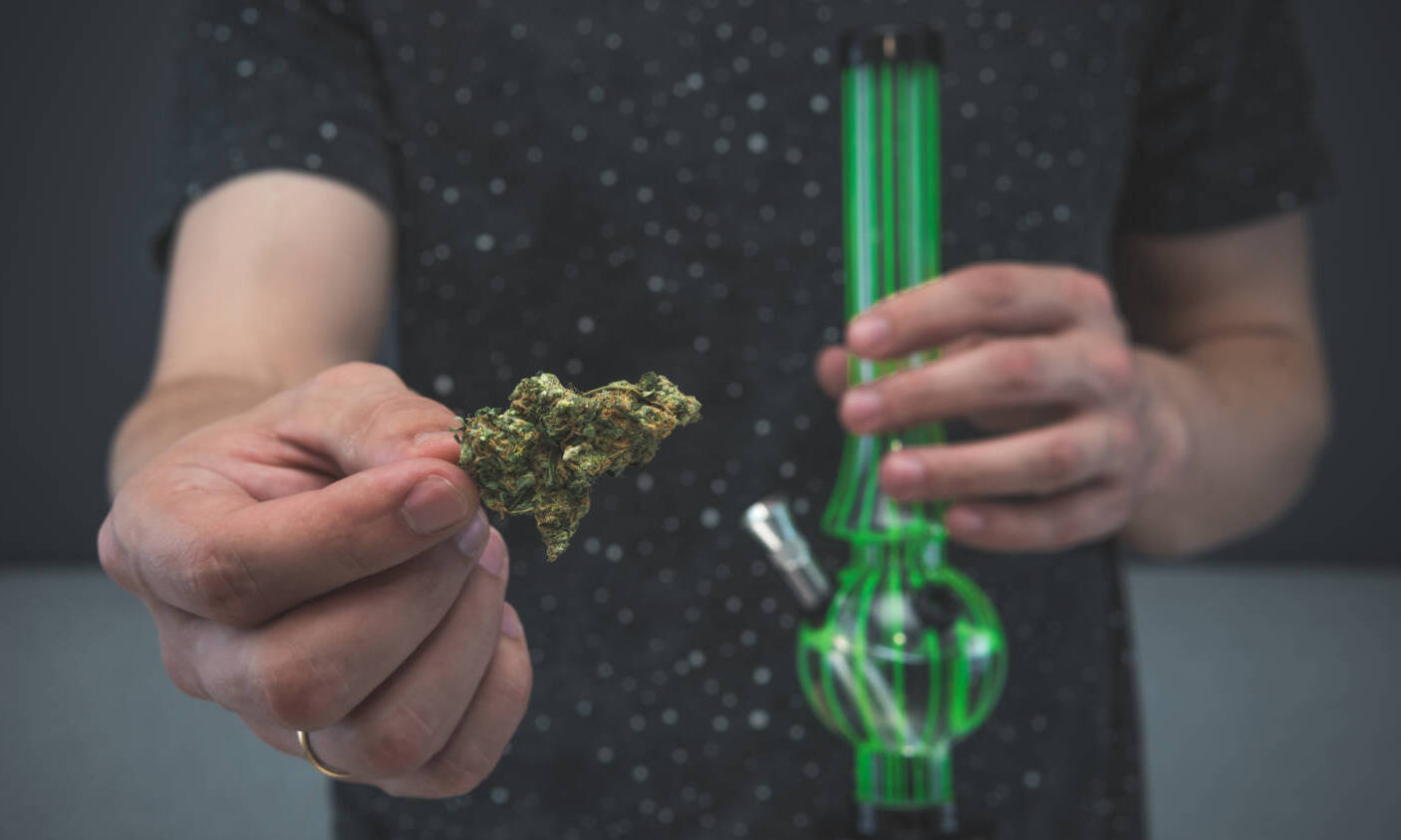
A simple bubbler pipe is a device that uses water to extend the length of your smoking experience, as well as cool down the smoke coming out of the bowl so that you can enjoy it to the fullest.
Bubblers are a type of cannabis smoking accessory that combines the smoothness of a bong experience with the convenient usage of a regular pipe. They are a great way to upgrade your smoking experience, as they offer a smoother smoke than other methods while reducing the harshness of dry-herb smoke. Here is how to use a marijuana bubbler pipe.
They have a lower water filtration rate than most water pipes, which makes it possible to enjoy a more impressive and robust flavor profile. Bubblers are often used by smokers who prefer a milder and more natural taste of their marijuana flowers.
Just a head’s up though, it’s not a good idea to smoke out of a bubbler if you haven’t done it before. The hit is much stronger than a joint, and it takes some practice to get it right.
A Brief History and Anatomy of Weed Bubblers
Water filtration smoking devices have been around for several thousand years. Some smoking devices resembling modern-day half bongs have been found in archaeological excavations dating from the 11th to 14th centuries.
There are several theories explaining the origin of the device, but no one knows for sure. One of them claims that the bong is an ancient, modified form of a hookah. The latter mentioned originated in Asia. “Baung” in Thai is pronounced the same as “bong,” which also refers to a bamboo pipe or water pipe. Besides, Central Asia is where the history of cannabis smoking is deepest.
According to another theory, African countries are the origin of the smoking aggregates. During excavations in Ethiopia, researchers found a tube with vegetable residues inside. In African cultures where the psychoactive effects of “divine flowers” were used in religious practices, smoking devices were positioned on the floor and not moved so that users would not accidentally bump into them.
No matter how simple and inexpensive a bubbler may be, it will have at least four parts:
A bowl used for mixing dry ingredients, often equipped with a net or an internal thimble.
A stem is a pipe that takes the smoke from a bowl to the water. It is the source of the smoke that produces the bubbles.
A water flask to pour the liquid into.
A mouthpiece is a pipe that delivers purified smoke to the lungs.
Bubblers vs. Pipes vs. Bongs: What’s the Difference?
Pipes are handy for smoking dry weed as they do not produce as much smoke as a bubbler or bong. However, a pipe contains less marijuana than either a joint or a blunt when it comes to dry-smoking methods. Pipes are popular among inexperienced smokers because they are so easy to carry around, produce minimal noise, and can be easily disguised as a tobacco pipe. And it’s easy to use one: all you need is the pipe itself, the product you want to consume, and either a lighter or matches.
One of the first noticeable traits of bongs is their different appearance from bubblers. Bongs have a vertical construction and must be kept upright while they are being used. The user can make puffs that are longer than the ones he or she can make while using the bubbler. Because they are so powerful, bongs tend to be more popular among experienced smokers.
Bubbler pipes, or half-sized bongs, are a popular choice for those who like the portability and convenience of a handheld pipe but dislike the harshness of inhaling the smoke through a standard straight pipe stem. If you are wondering, “Do bubblers waste weed?” the good news is that a bubbler pipe actually helps preserve your cannabis for more sessions. The waste in using a bubbler is really just the way people always load full bowls and let it just smolder out or worse yet, keep burning.
Another question that may come to your mind is, “Do bubblers burn weed fast?” The thing is, water-filter smoking devices burn faster when you take bigger hits. This means you have to hold the smoke in longer. It also gives you less time between hits.
Advantages of Bubblers
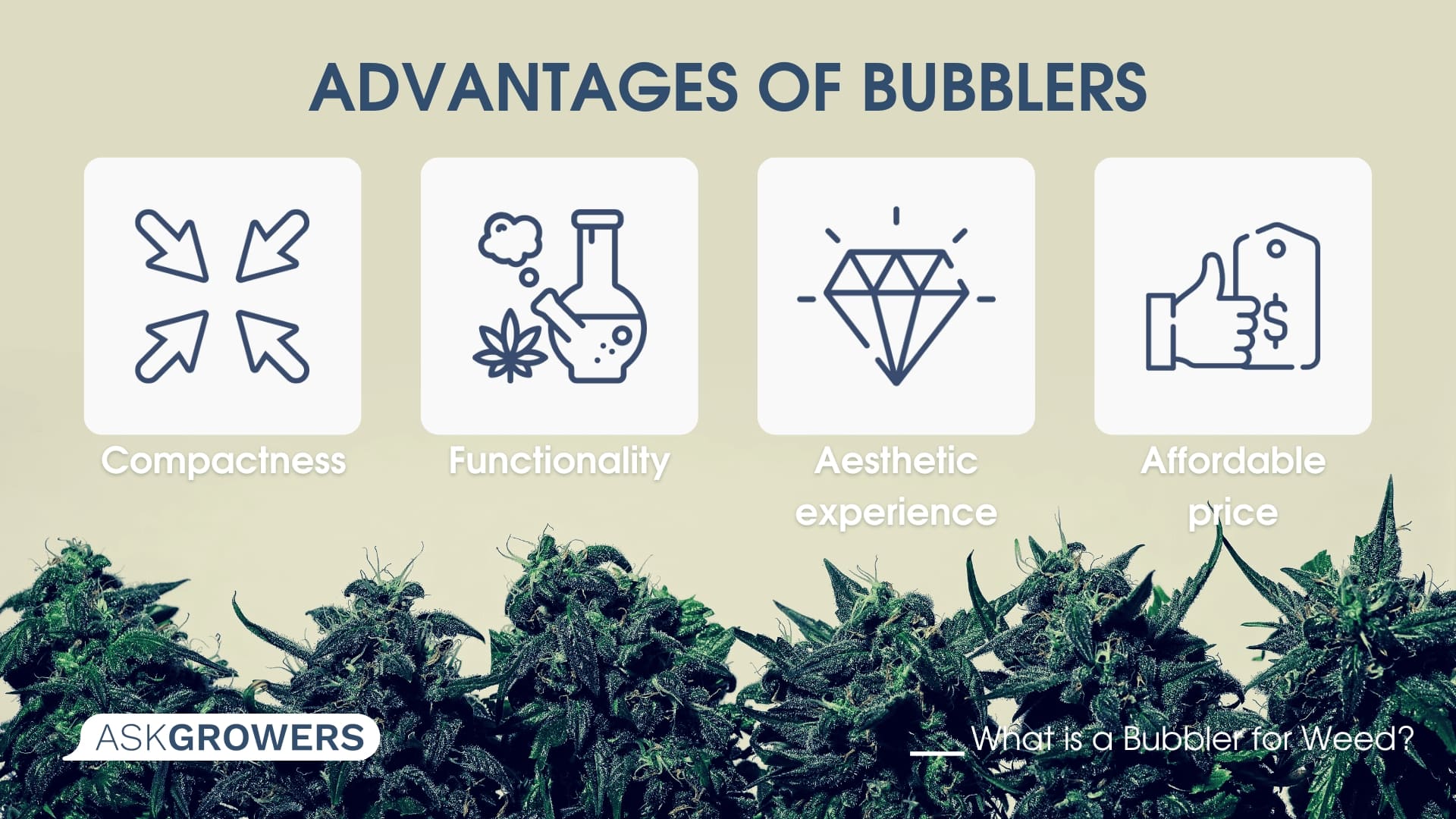
The most noteworthy advantages bubbles offer over other types of water dispensers can be clearly seen. They can be summed up as follows:
Compactness makes it easy to carry them on a road trip or short walk.
Functionality like standard bongs, which makes smoking more enjoyable.
Smokers can enjoy the smoothness of smoke while feeling comfortable because the shape and size of the bubbler allow for a wide range of smoking positions.
Aesthetic experience: there are a great variety of bubblers’ shapes and colors, and every bubbler is a work of art.
Affordable price compared to a larger bong.
Drawbacks of Bubblers
Although there are many positive aspects to the use of bubblers, there are some downsides to them too. Things that could be improved:
It takes more effort to clean a bubbler than it takes to clean a bong.
You can’t customize or add accessories to the original design.
The small size of the bowl means that it is less convenient to smoke through a bubbler in a large company.
What Kinds of Bubblers Out There?
The best material for a bubbler bong is a personal choice, crystalline glass and silicone being two of the most popular options. They are completely safe for use, resistant to heat and fire, and do not release any toxic emissions.
Borosilicate glass is the most popular material for producing not only bubblers but also chemical dishes and other smoking units — it does not react in any way with acids, alkalis, alcohols, odors and doesn’t absorb the smell. It’s also great at absorbing abrasives, and it can be restored to its original state by cleaning and polishing. However, the major drawback of glass devices is that they are easily broken and rarely survive a fall.
A food silicone is also often used in the production of children’s toys and heat-resistant dishes — it exhibits excellent thermoforming properties (one can mold rubber into forms for cupcakes, for example). Thanks to its flexibility, you can wash it easily in hot soapy water or in the dishwasher. But there’s a downside: silicone absorbs the smell well. It should often be washed without the use of most solvents (it may cause stains, cracks; material flexibility will be affected; and, as a result, a new bubbler will have to be ordered).
Step by Step Guide on How to Smoke Weed Bubbler
Smoking a bubbler pipe is easy once you know how to use it. However, there’s a bit of a learning curve when it comes to using them. If you are smoking out of a bubbler for the first time, then make sure to follow these instructions and be careful to avoid the most common mistakes people make when using them. So, how to smoke out of a bubbler?
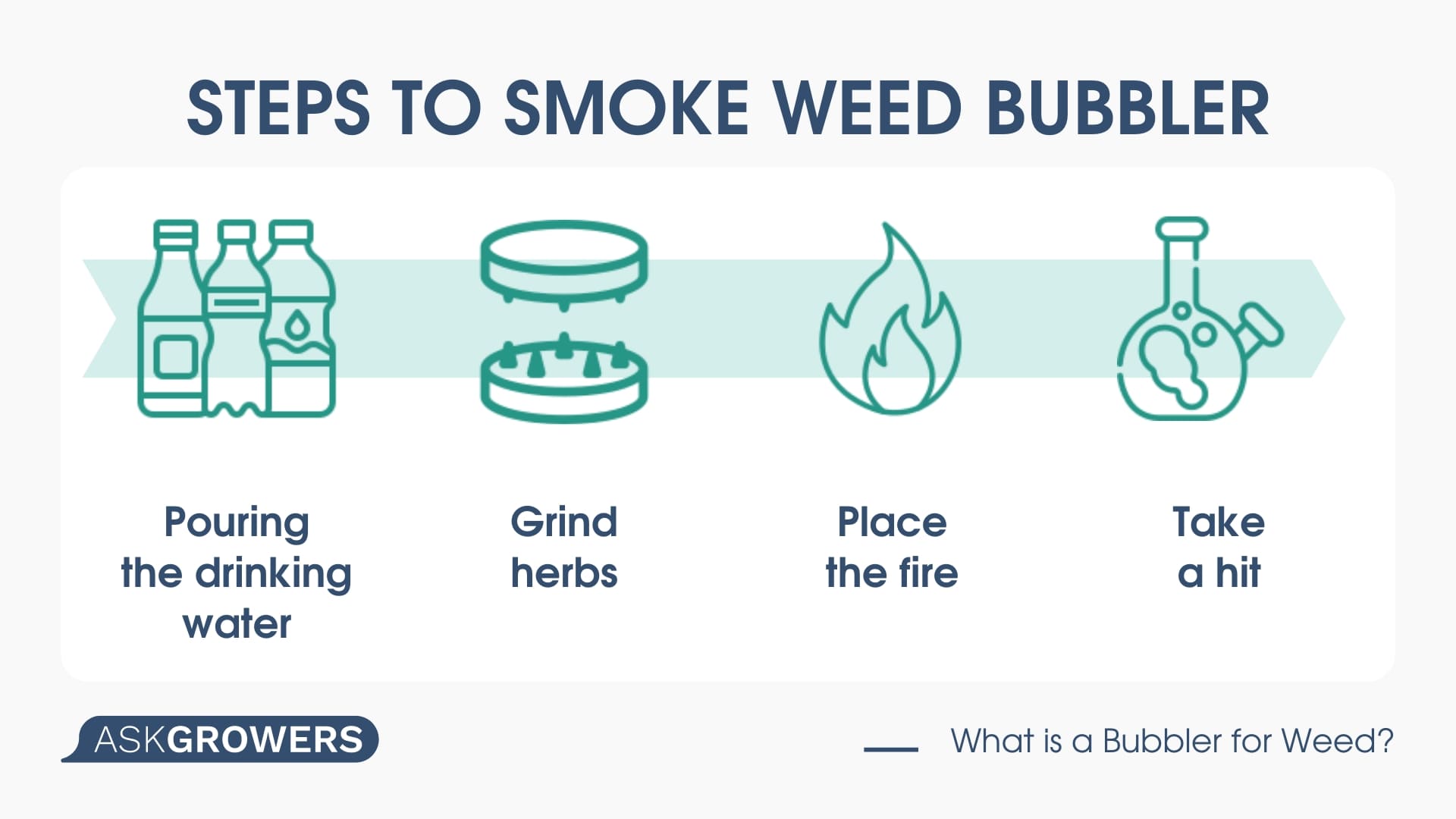
Step 1
Let’s start with pouring the drinking water. Some people add honey or alcohol to it, or they replace it with juice and milk — these variations change the flavor of the smoke. The amount of liquid you use depends on the size and shape of your bubbler, so just fill it in half and then correct yourself as you go — it should not be over the edges, and there should be no large spray when smoking. It takes a couple of sessions to learn to pour it by eye.
Step 2
Grind herbs with stems and seeds out of your blend until they form a powder, then place the powder in your bowl.
Step 3
Use your thumb to cover the carb hole to control the pull.
Step 4
Slowly place the fire in the bowl and, without releasing the carb hole, fill the water chamber with smoke, inhaling as you do.
Step 5
After you’ve taken your finger off the hole, the air pressure will force it back. A turbo hole creates a constant flow of fresh air into your bubbler, preventing stale smoke from blocking your path to a heady high. Those who don’t have such a hole in their bubblers just lift the bowl, allowing fresh air to get into the bubbler while they take a hit.
There are several different methods for cleaning bubblers, depending on the material from which they are made. Glass bubbles can be cleaned in a variety of ways. The following is a step-by-step instruction for the simplest method:
Disassemble the device, wash it with hot running water – it will remove large debris and warm the glass.
Sprinkle baking soda all over the sides. It will easily cling to wet glass.
Let the soda stay there for about fifteen minutes.
Bring in some vinegar, and watch the baking soda fizz and bubble.
After that, your bubbler will be free from contaminants.
Cleaning a silicone bubbler requires a slightly different approach:
Carefully take the bubbler apart, rinse it under the tap, and put it in a bowl.
Add the dishwashing facilities to it.
Fill the contents with hot water to cover all the details and the soap is completely dissolved.
Put a lid on it and keep it like that for thirty minutes.
The soap will melt the oil and dissolve it.
After that, you can clean the bubbler by using a brush or sponge. Wash the pits and slots with a cotton swab or toothpick.
Safety Tip for Smoking Bubblers
To enjoy a bubbler without the risk of being burned, consider the following safety precaution. Take care to keep your bubbler filled with clean water and empty of all traces of impurities, as this will produce a safer and more enjoyable smoking experience.
Are bubblers good for smoking? A simple bubbler pipe is a device that uses water to extend the length of your smoking experience, as well as cool down the smoke coming out of the bowl so that you can enjoy it to the fullest. Bubblers are an affordable and effective way of adding style to any smoking session and can make all the difference between an okay time, and one that makes for a good story for years to come. And now you know how to use a marijuana bubbler pipe.
Most people are looking for ways to better themselves. They go to the gym, they read books, they watch their diets — all with the purpose to advance their personal development. For many years, cannabis has been thought to be detrimental to personal development by the establishment making claims that it “makes you slow” or “lazy” or “unmotivated”. However, while marijuana may produce these effects in some people, many others have discovered how cannabis can be a tool for personal development if used correctly.
In this article, we’ll be taking a closer look at the different ways you can use cannabis to accelerate your personal development. Please note that the following are merely suggestions on how to use everyone’s favorite plant to push themselves beyond themselves.
Photo by Mayara Klingner / EyeEm/Getty Images
Stress Management
Stress isn’t a bad thing, but bad stress is! What’s the difference between good stress and bad stress? From Summa Health:
Good stress is short-term and it inspires and motivates you, focuses your energy and enhances performance. Bad stress, however, is the kind that wears you out, leaves you jittery and is harmful to your health. Bad stress, or distress, can lead to anxiety, confusion, poor concentration and decreased performance.
In other words, proper stress management is a key aspect of personal development. When your mind is gripped by stress, whether you have an upcoming deadline, bills to pay, or even suffering from relational stress, cannabis can give you a moment of peace to reassess your relationship with the stress itself.
Many people use cannabis to unwind at the end of their days. This allows them to unplug from the activities of the day and gives them space to relax. However, it’s important to note that smoking at any sign of stress would be detrimental to your personal development.
You want to wield stress like a weapon, using it to move you forward and letting it go when it begins to stifle your progress. There’s a delicate balance between the two, but with enough practice, you’ll learn to work with stress and not let it work against you.
PRO TIP: Don’t smoke cannabis at the first sign of stress, rather, sit in the stress for as long as you can. Become mindful of it, and figure out how you can naturally convert it into “positive stress”. If the stress becomes too much to handle, spark up a joint. If it’s late at night, any strain that will induce a body high would be preferable and throughout the day, you’ll want to work with more cerebral strains.
Photo by LanaStock/Getty Images
Finding Positivity in Negative Situations (Changing Self Talk)
Being positive doesn’t mean ignoring the negatives. On the contrary, people who are actively looking to improve themselves are constantly looking at their shortcomings to see how they can improve their performance. However, the difference between looking at your shortcomings and falling prey to negativity comes in relation to the attitude you harbor.
Negativity is a loop. If you begin to pull on one “negative thought or emotion” and give it your attention, you tend to reframe your brain to look for only negative things. It’s as Robert Anton Wilson said, “What the thinker thinks, the prover proves!”
In other words, your mind is primed to look for supporting evidence to any premise you establish. If it is “negativity”, the mind will find things to prove this position. If you victimize yourself, make yourself smaller than the situation, insult yourself for your shortcomings, etc., then cannabis can be used as a powerful disruptor.
It’s difficult to simply “stop being negative” and, thus, a bit of euphoria can go a long way. Cannabis gives you a few moments of “altered perception” that gives you the opportunity to break your mental cycles.
Once again, it’s important to use cannabis sparingly. Some people rely on cannabis to break the negative mental cycles, however, in the realm of personal development, you’ll always want to implement tactics that derive from internal mechanisms. For example, focusing in on your breath can also create enough mental space to switch your internal gears of perception.
In the case that you are stuck in a negative feedback loop, smoking some cannabis can provide you with a quick release from the mental cycle.
Photo by Jose Luque / EyeEm/Getty Images
Dreaming and Being
In the world of personal development, establishing the “future you” is incredibly important. You need to have a goal to work towards. This means that you have to tap into your creative powers to imagine a future where you have achieved all of your goals.
Who are you then? What are your habits? How is your emotional state? What do you do daily? All of these questions (and more) begin to create an image in your head of what “success” looks like. Some people however, either find it difficult to utilize their imagination for this action or are too subjected to their current situation that even envisioning a brighter future becomes difficult.
Fortunately, cannabis can help here as well. If there’s one thing that most cannabis users can agree on, it’s that cannabis allows your mind to wander into unknown realms of the imagination. You begin to think in different terms and can use this to your advantage.
If you find it difficult to envision a future where you are straight up “killing it!” then you can use cannabis to help you bridge this gap. Simply spark up and smoke as much as you need to get good and high.
Make sure that you let go of all restrictions and then, using a pen and paper, just start writing out the future you that you would be very happy with. The future you that you consider to be “a baller”.
Once you have done this, read it again when you’re sober. See what parts really resonate with you and then try to envision you as that person. Invoke this future self into your present and begin to operate according to how “they” would do things.
It’s like Einstein said, “We cannot solve our problems with the same thinking we used when we created them.” In other words, your problems can’t be solved by the way you are thinking now or in the past, but by the way that your future accomplished self would engage with it.
Cannabis can help you invoke this future self to begin to deal with the problems you face in the present.
Bottom Line
There are many more ways we can use cannabis to improve our self-development. The three techniques discussed above can definitely help you achieve higher states of performance.
A Republican state senator in Kansas plans to introduce a bill in January to legalize medical marijuana, putting the state on the list of potential new U.S. cannabis markets that could be on the horizon.
According to National Public Radio, state Sen. Rob Olson will introduce his measure once the state legislature reconvenes, after chairing a special committee this year that examined medical cannabis issues. The committee’s final meeting is scheduled for Thursday.
Olson said he hopes his counterparts in the state House of Representatives will also run a parallel bill.
Earlier this year, the Kansas House approved a bill to stand up a new medical marijuana industry, but a Senate companion measure died in committee.
The bill may face an uphill battle, however. NPR reported that state Senate President Ty Masterson said he has other political priorities, such as the state budget and school funding.
And Democratic state Sen. Cindy Holscher said it was Masterson that stalled the medical cannabis bill earlier this year, implying that he may be an obstructionist again in 2023.
Cannabis will meet and exceed your expectations when you follow this guide on elevating your cannabis experience.
The number of people using marijuana is increasing, and it’s all for a good reason. And when getting high, every cannabis user has a unique experience. However, as a regular cannabis user, there are times when you can get bored with your everyday cannabis routine. Here is how to elevated your cannabis experience to a whole new level.
Anyone can experience boredom. Doing the same thing repeatedly can grow monotonous, regardless of how enjoyable the activity may initially be. But you don’t have to increase your dosage when experiencing this situation with weed.
It would be best to look for ways to enjoy cannabis despite developing tolerance. You can still have a better experience when you do it right. To help with that, here’s how you can elevate your cannabis experience.
Eat Foods That Enhance the Cannabis Experience
If you’re looking for a natural way of improving your cannabis experience after using edibles in the form of gummies, then food is the answer for you. Food helps in enhancing the intensity and longevity of the cannabis effect. Here are foods that can amplify your cannabis experience:
Mangos: As a fruit, mangos are rich in terpene, known as myrcene. Myrcene is said to offer various benefits and is well known for its relaxing, euphoric, and positive effects. Combining this terpene with tetrahydrocannabinol (THC) can help heighten your cannabis experience by giving you an intense high.
Eggs and Nuts: Both eggs and nuts are rich in omega-3 fatty acids. These fatty acids have been shown to bind with cannabinoid receptors. Hence, they make it easy for cannabinoids, including THC and cannabidiol (CBD), to move faster through the body. Combining cannabis with eggs and nuts guarantees a long experience.
Chocolate: If you love snacking and getting high, it would be better to combine chocolate with cannabis for an elevated experience. Chocolate increases the cannabis effect significantly thanks to an endocannabinoid called anandamide. Anandamide is also produced naturally by the body and is often referred to as a bliss molecule as it binds with cannabinoid receptors present in the body. This molecule stimulates a sense of happiness and joy.
Sweet Potato: Unlike most root tubers, sweet potatoes are rich in vitamins B and E. Additionally, sweet potatoes trigger the production of serotonin, a feel-good chemical in the body. Also, vitamin B6 in sweet potatoes helps regulate emotions, making this root tuber an excellent food for enhancing your cannabis experience.
Broccoli: This vegetable is rich in a terpene called beta-caryophyllene, which has been reported to enhance the effect of cannabis. Like cannabinoids, terpene works with endocannabinoid system receptors in the brain, providing an array of impacts.
You may include these foods in your diet to enhance your cannabis experience.
Drink Beverages That Enhance the Cannabis Experience
In addition to food, beverages help increase the cannabis experience. Most of these drinks are widely consumed. Here are some beverages that can enhance your cannabis experience:
Tea: Both green tea and black tea are rich in catechins. Catechins are a type of compound with sedating and relaxing effects. Drinking tea before consuming cannabis can give you a balanced experience, as catechins will help counteract paranoia or anxiety among cannabis enthusiasts.
Coffee: There are various relations between cannabis and coffee, with one study showing that more than a hundred metabolites are associated with coffee intake. With this in mind, you can now understand why coffee helps enhance cannabis effects.
Beer: Although it’s good to be cautious when drinking, combining beer and cannabis will enhance the euphoric effects. This is due to the high concentration of myrcene, a type of terpene found in beer. Therefore, consuming beer along with cannabis will elevate your cannabis experience.
These are a few examples of beverages that go well with cannabis and increase its effects.
This is the easiest way to enhance your cannabis experience, especially if you’ve been using the same product for a while. Adding a new variety of cannabis products to your collection can make your experience unique and more fun. Also, it can help you find a new product you’ll love.
Changing your method of consumption will help enhance your cannabis experience. If you’ve been smoking cannabis and not getting the exact experience you’ve been wanting to get, you should consider changing it.
Aside from smoking, you can try edibles. Edibles interact with the body in a completely different way. The liver processes the edibles, so it’ll take time for the effect to kick in. When THC is broken down in the body, it’s converted into a metabolite. In this form, THC will offer a long-lasting and intense effect.
Bongs are also effective in enhancing the cannabis experience. Unlike smoking, bongs help conserve weed and are packed with harder hits giving you a fantastic sensation. If you love smoking, bongs are an excellent way to consume cannabis but with a better impact and experience.
Vaporizers are another excellent method of smoking cannabis. There are different vape pens you can choose to suit your needs. Vape panes rich in cannabis are often known as shatter, dabs, or wax. These products are high in THC and offer a great cannabis experience from small puffs.
Photo by Volodymyr Bondarenko / EyeEm/Getty Images
Get Physical
If you love working out, this is an exciting way to enhance your cannabis experience. Most cannabis enthusiasts love using cannabis before or after exercising. Most users say that it aids in improving the workout experience and their post-workout recovery.
If you’re wondering how cannabis can enhance your workout, it helps in giving you greater enjoyment and motivation during exercise. However, when doing it for the first time, it’s best to be mindful and not use too much, especially before working out.
Takeaway
Cannabis is more than a drug; it’s an experience. Nowadays, people have become accustomed to the digital experience and want more. The same can be said when consuming cannabis. However, cannabis tolerance can happen to any enthusiast. You wake up one day, and your cannabis stops working.
In addition to its health benefits, cannabis enthusiasts love enhancing their experience. Fortunately, by combining some food and drinks before using your cannabis, you can consume your cannabis more enjoyably. Cannabis will meet and exceed your expectations when you follow this guide on elevating your cannabis experience.
It calls into question how lawmakers will be able to craft social equity programs that are targeted enough to benefit only local entrepreneurs, instead of being forced to structure them for a national audience of cannabis companies.
A series of lawsuits challenging residency requirements in at least three states has some advocates of cannabis industry social equity programs worried that those programs could be in jeopardy. And they have good reason to be concerned.
The jury is still out — figuratively, but not by much of a stretch — on whether social equity programs will be able to withstand scrutiny by the federal court system as time goes on.
Photo by matt_benoit/Getty Images
Already, a residency requirement in Maine has been thrown out as unconstitutional by a federal judge, and another federal judge has issued an injunction against New York’s social equity program precisely because of its residency requirement.
Similar cases in Sacramento and Los Angeles haven’t yet concluded, but rulings are on the way, one way or the other. The Sacramento case is under appeal, and the L.A. case is ongoing.
So is the New York lawsuit, which observers said could ultimately result in the overturning of the entire licensing regime, which is based on social equity principles but reserved for New York residents only.
“It calls the viability of the program into question,” attorney Matt Leonardo told Syracuse.com last month of the lawsuit, which kept regulators from issuing 18 permits in November. “It places the whole program in jeopardy.”
The legal peril for many of these programs could also give pause to more state and local regulators who may otherwise be eager to adopt social equity cannabis market structures. These are generally designed to give licensing priority to those who have nonviolent criminal marijuana convictions.
For instance, a number of cities across California have been considering creating new social equity programs because state lawmakers dedicated $15 million in funding to local governments that create such business opportunities, but many of those may slow down or scrap those plans altogether, some say.
Photo by Priscilla Du Preez via Unsplash
“All of this means the less equity programs are up and running by the time federal legalization rolls around, the less protective shield we have in California against corporate consolidation,” Robert Chlala, a board member of the Social Impact Center of Los Angeles, told Filter Magazine.
At the very least, it calls into question how lawmakers will be able to craft social equity programs that are targeted enough to benefit only local entrepreneurs, instead of being forced to structure them for a national audience of cannabis companies.
Beyond the fact that THC causes a feeling of euphoria, while CBD does not get you high, the two cannabinoids are just as different as they are similar. Here’s how.
There was a time when cannabis was something we could not talk about. Well, today, people not only talk about it, they want to learn everything about it, including knowing how to use it to cope with various symptoms and disorders. But what exactly is the difference between CBD and THC?
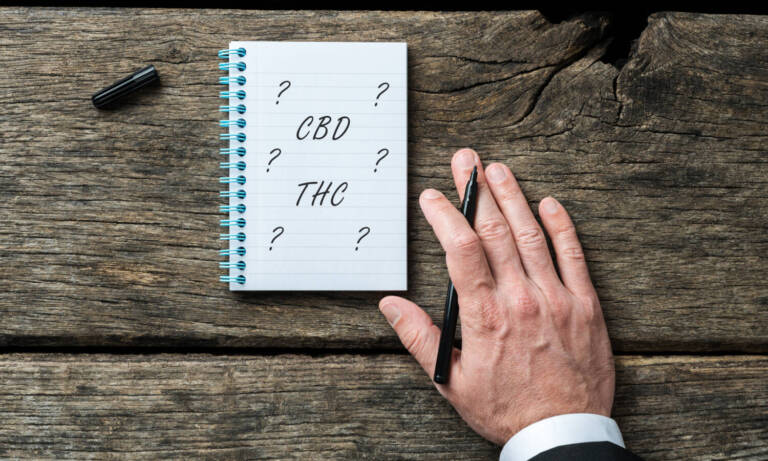
The good news is that it’s not rocket science. Both of them are cannabinoids — the compounds included in cannabis. And although marijuana contains over 100 different compounds, these two are the most common. In short, cannabidiol (CBD) is a non-psychoactive compound, while tetrahydrocannabinol (THC) is psychoactive.
But we are not here to make a brief presentation of these two compounds; we are here to discuss them in detail. So what’s the difference?
What’s the Difference Between CBD and THC and Why Is It Important?
Where can these two compounds be found? Everything is pretty simple: marijuana and hemp both contain them. The only really important difference is in the concentration of THC and CBD. Marijuana contains more tetrahydrocannabinol, while hemp contains more cannabidiol.
Atoms of THC and CBD are exactly the same; each has the same number of hydrogen, oxygen, and carbon atoms (30, 2, 21 atoms respectively.) However, all of these atoms are arranged differently. That is why our bodies are affected differently. Moreover, they are similar to endocannabinoids in the human body, and they interact with different receptors (we described this process in more detail below.)
How Are They Used?
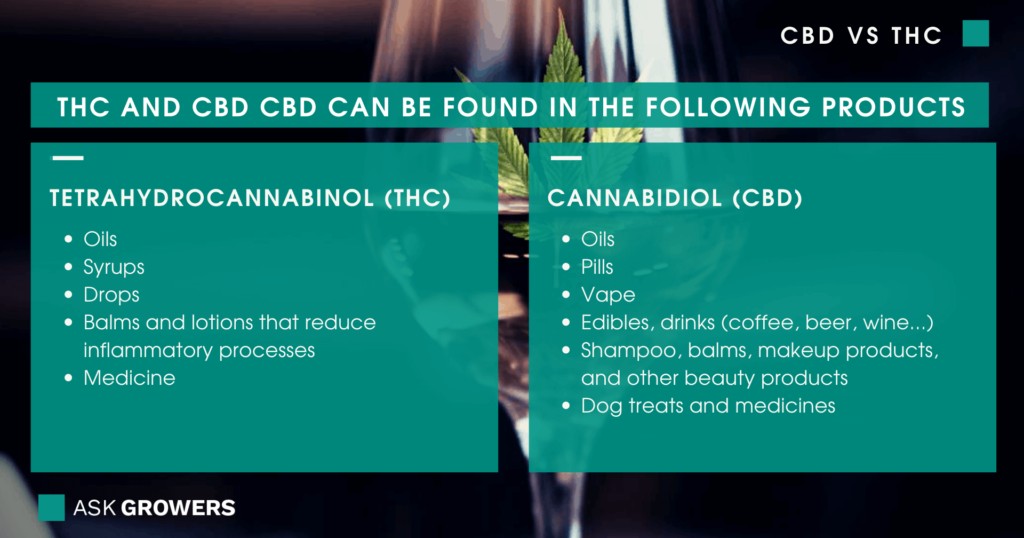
Before we start to talk about effects, let us discuss how these compounds are used. In fact, there are a lot of products that include such ingredients.
Edibles, drinks (coffee, beer, and so on and so forth)
Shampoo, balms, makeup products, and other beauty products
Dog treats and medicines
THC can be found in the following products:
Oils
Syrups
Drops
Balms and lotions that reduce inflammatory processes (topicals)
Medicine.
CBD vs. THC High
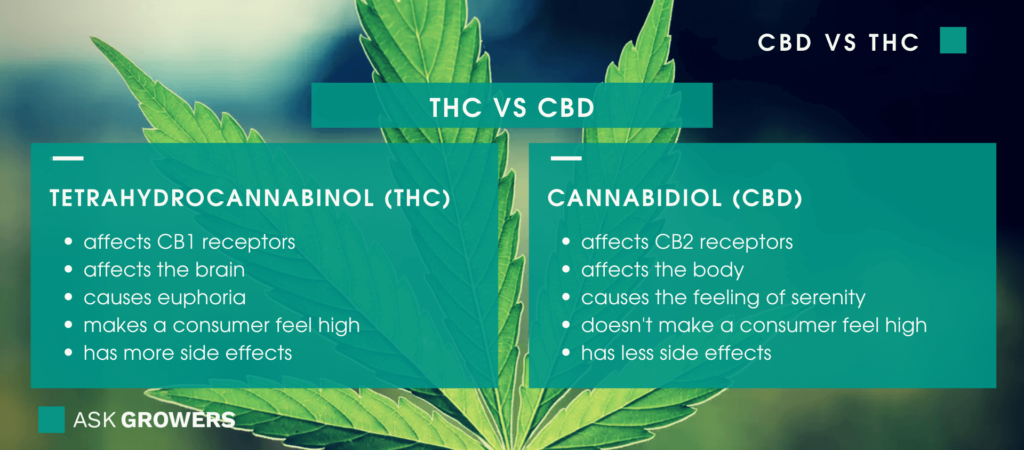
We all know that this aspect is important to a lot of people. Do both compounds get you high or not? In fact, this is one of the reasons why they are different. THC causes a feeling of euphoria, while CBD does not get you high. However, it does significantly reduce inflammatory processes.
High CBD Cannabis Strains
Let us discuss these effects in more detail. There are only two receptors in the body that are directly affected by the compounds of the cannabis plant. They are called CB1 and CB2 and also are the compounds of the so-called endocannabinoid system (yes, it is one of the systems of our bodies) that is responsible for hormone regulation. In other words, this system influences our mood and, of course, energy.
High THC Marijuana Strains
CB2s are mostly in PNS (peripheral nervous system) and CB1s are found more in CNS. CB1s affect the brain, while CB2s affect the whole body and reduce inflammatory processes without affecting the brain, and, therefore, without making you feel high.
So, THC affects CB1. However, it does not mean that a consumer will stop breathing or that his heart will stop. Tetrahydrocannabinol causes euphoria without affecting the brain stem.
Cannabidiol affects CB2. Consequently, it has no psychoactive effects; it only reduces the inflammatory process.
We should also emphasize that everything that all of the above proves — THC does not affect CB2 and vice versa. It only means that though THC may affect CB2, as well as CBD, may affect CB1, in most cases, they still react with their “regular partners.”
Medical Benefits of THC vs. CBD
Today we all know that cannabis, weed, and marijuana are not only about the high. It’s also about medicine. A lot of marijuana products are used to treat various medical conditions, including neuropathic pain, cancer, nausea, sclerosis, and so on and so forth. Not all of them are officially approved, but still, the medical benefit of cannabis is beyond question. A lot of top researchers work hard to identify the health benefits of this unique plant, and dozens of them have already been identified.
A lot of attention is paid to CBD which, as we have already noted, is non-psychoactive yet able to treat some symptoms and disorders. In particular, it helps to cope with such serious diseases as epilepsy and such symptoms as seizures.
Even though THC has fewer medical benefits, it is still used by many consumers to relieve pain, cope with anxiety, insomnia, etc. Some researchers even consider it helpful for treating Parkinson’s and Alzheimer’s.
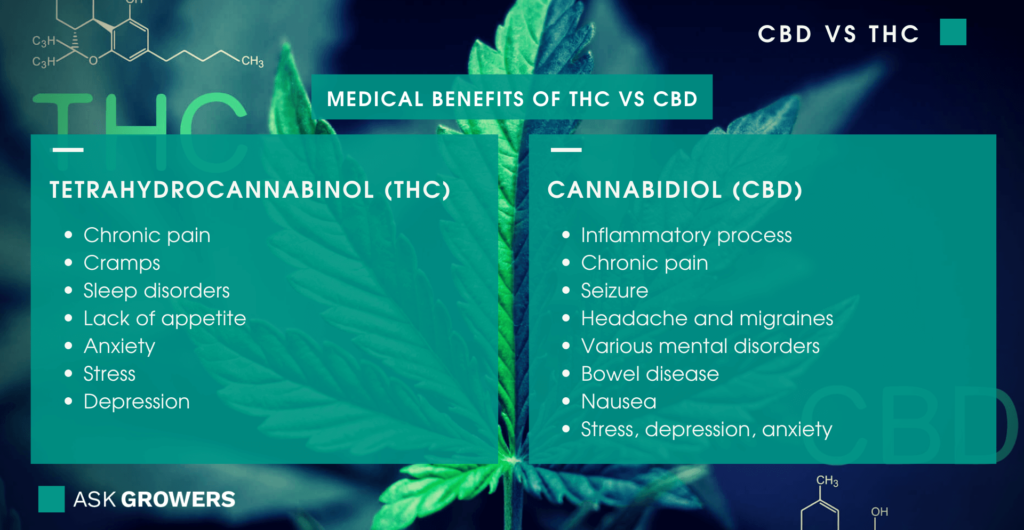
So, let us sum up the medical benefits of these two compounds.
Tetrahydrocannabinol is good for treating:
Chronic pain
Cramps
Sleep disorders
Lack of appetite
Anxiety
Stress
Depression
Cannabidiol helps with such symptoms, disorders, and diseases as:
Inflammatory process
Chronic pain
Seizure
Headache and migraines
Various mental disorders
Bowel disease
Nausea
Stress, depression, anxiety
Can They Cooperate?
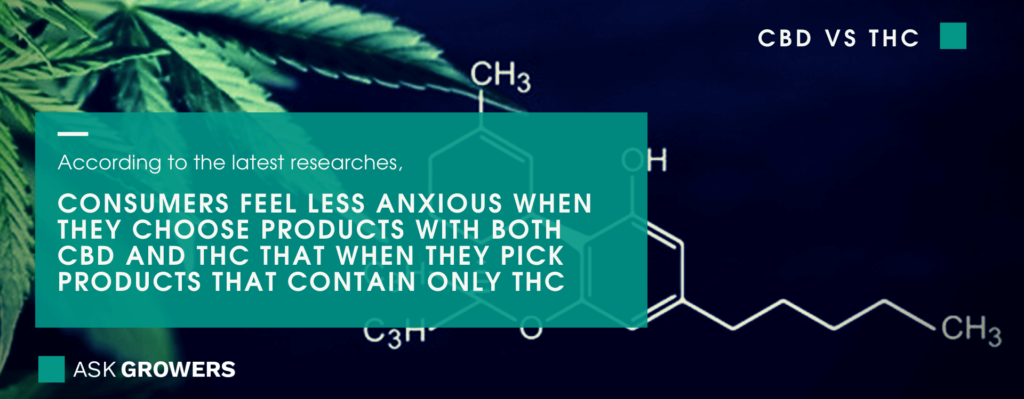
So here is the battle called “THC vs. CBD molecule.” They are similar and different at the same time, and people used to compare them. But can they work together, too? Of course, the effects of cannabis depend on a hybrid a consumer chooses, but according to the latest researches, consumers feel less anxious when they choose products with both of these compounds compared to products that contain only tetrahydrocannabinol.
Moreover, according to the results of empirical researches respondents who consumed CBD and then THC were less anxious than people who consumed only THC. Of course, there are cannabis products and hybrid that contain a big percentage of THC and do not make consumers feel anxious, but in most cases, CBD helps the body cope with some THC side effects.
In other words, the effects of CBD and THC when they are together are different from the effects of each of these compounds. However, consumers should also consider the fact that the presence of cannabidiol makes a consumer less high.
Nevertheless, experts note that they still do not know a lot about this unique plant. The effect of cannabis, its compounds, the way they affect various receptors (there are over 60 receptors that can interact with them!), all these things are left to explore.
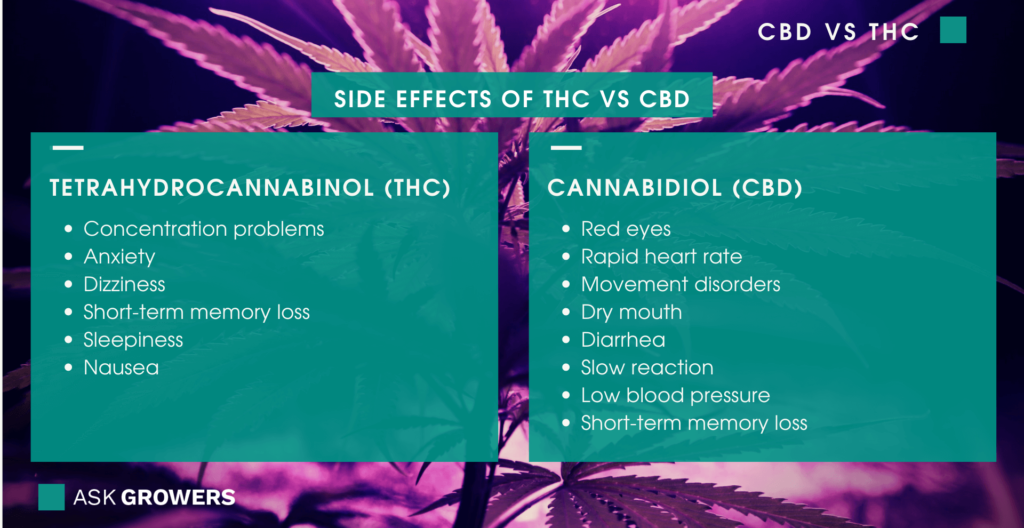
What About the Effects & Side Effects?
Another important thing to consider is the difference between these compounds’ effects, which are also different.
As we have already noted, cannabidiol does not cause euphoria, but this is not the only thing you need to know about it. CBD can make you feel more excited, bring you the feeling of serenity and perfection, of course, if a grower makes every effort to make the top-quality product. Only in this case, CBD will not have any intoxicating effects.
THC, in turn, can bring you the feeling of euphoria, make you feel more creative, happy, and relaxed, and that is why it is often consumed by people who are trying to cope with depression, pressure, stress, and anxiety.
But What About Side Effects?
Though cannabidiol is considered to be a “safer” cannabinoid just because people usually tolerate it even if they consume pretty large doses, it still has some side effects. However, these effects are usually the results of mixing the drugs (i.e., when someone consumes cannabis and another drug, medication at the same time).
So what problems a consumer can face when taking CBD products?
Red eyes
Rapid heart rate
Movement disorders
Dry mouth
Diarrhea
Slow reaction
Low blood pressure
Short-term memory loss
As you can see, though consuming products with cannabidiol may cause some side effects, not all of them are really dangerous. Nevertheless, you should not consume cannabis and other drugs at the same time — all bodies react to cannabis differently.
THC is considered to be a more “dangerous” cannabinoid. It can cause:
Concentration problems
Anxiety
Dizziness
Short-term memory loss
Sleepiness
Nausea
Please note that in most cases these effects are the results of overdose.
There is no secret that a lot of people have doubts about both these compounds and cannabis at large because of questions regarding their legality.
Two years ago, the DEA classified cannabis as a drug that has no accepted medical use. Moreover, the administration has noted that both of these compounds have a huge potential for possible abuse.
Nevertheless, despite the fact that experts have different views on this issue, most researchers claim that the compounds’, in particular CBD’s medical benefits, are a good reason to make it legal.
CBD hemp oil is supposed to be legal in America, but in fact, it depends on the state laws. Medical marijuana, however, is legal in over 30 states, but still, it is not so easy to buy something that contains good old THC.
In other words, you need to look through your state laws wherever you are. You cannot be too careful when it comes to state laws and good old cannabis, even this is just a medication.
Cannabidiol And THC – Who Wins?
Though we ask “Who wins?”, it is not a competition. THC and CBD are just two different compounds that are alike and, at the same time, completely different.
Firstly, we would like to emphasize that they affect different acceptors. As we have already noted, cannabidiol affects CB2s that, in turn, affect the body, while tetrahydrocannabinol affects CB1s or just brain, and that, in turn, causes euphoria. It means that CBD cannot make a consumer feel euphoric or become high, but it causes the feeling of serenity and helps treat various symptoms and diseases, from acne to schizophrenia.
THC, however, also has something to offer to a consumer. In particular, it makes a consumer feel high. Whatever skeptics say, this is not the only reason why people consume it. It also treats stress, anxiety, depression, insomnia. It has more side effects, but still – in some cases, it is really helpful.
It may seem that this makes them completely different, but it doesn’t. In particular, they can influence other compound’s “partner”, for example, THC may affect CB2 and vice versa. Moreover, they often cooperate — it is considered that cannabidiol may reduce the side effects of THC.
Insurance actuaries did not find any significant impacts of decriminalization on fatal car crashes or insurance claim frequency.
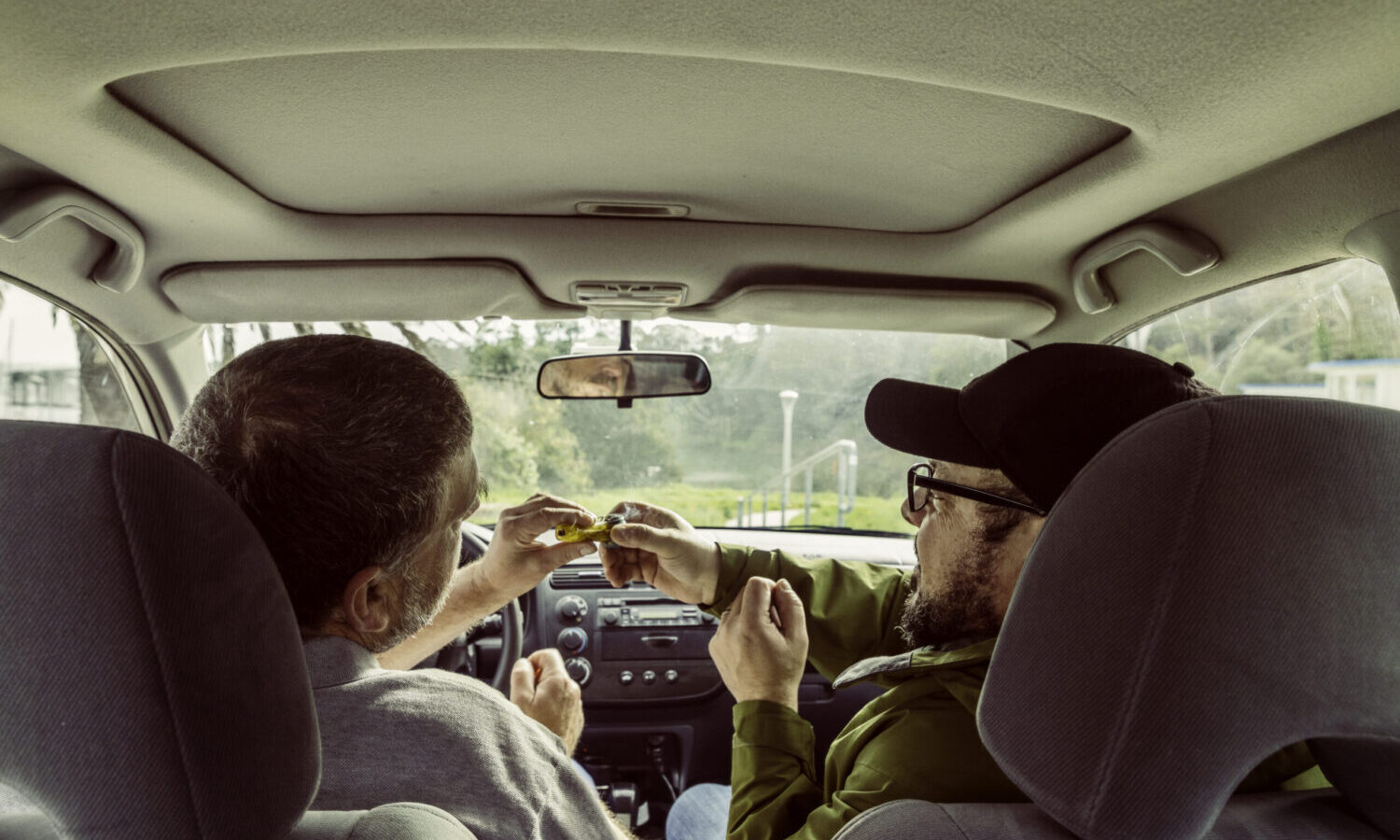
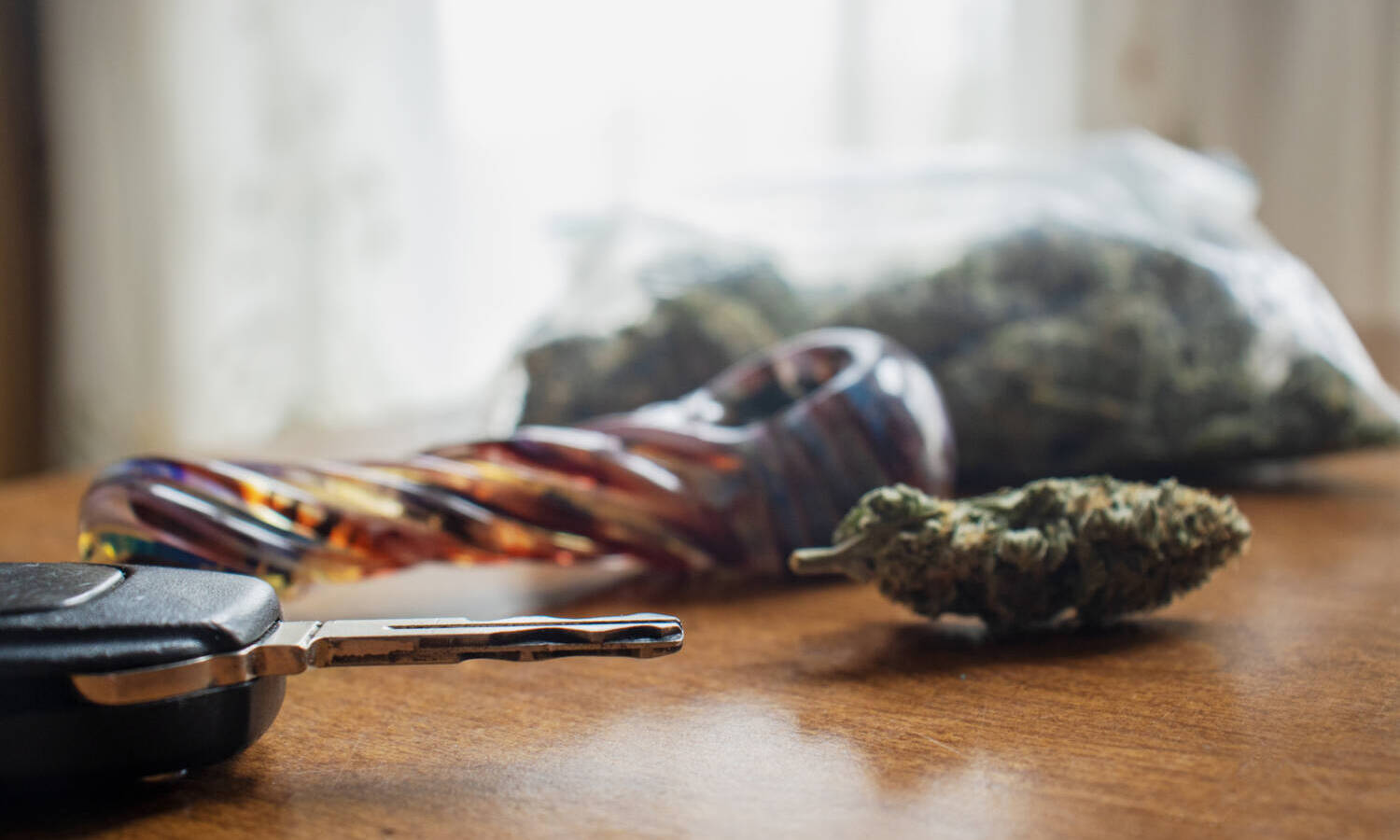
Marijuana intoxication and driving is one of the biggest issues that weed faces upon states going legal.. There’s no accurate way to quantify the moment when people are too high to drive and no accurate way of obtaining this data. But does marijuana legalization cause more car accidents?
A study conducted in Canada tried to get some answers, bringing in insurance actuaries to figure out whether or not marijuana reform results in more accidents.
Photo by JasonDoiy/Getty Images
The report was conducted by the Canadian Institute of Actuaries (CIA) and the Casualty Actuarial Society (CAS). They concluded that marijuana decriminalization wasn’t responsible for more traffic accidents.
The study conducted an overview of available data on marijuana and driving. And while the data showed that marijuana use did have an impact on the way people drove, this impact wasn’t always a bad thing, pointing out earlier data from 2016 and 2022 that showed that high drivers were more aware of themselves and tend to drive slower. The more experienced the marijuana user, the less likely it was for these people to get involved in an accident, showing how different the issue is when compared to driving under the influence of alcohol.
Still, the evidence is conflicting. Data that dates back to 1993-2003 shows that 5% of drivers between the ages of 20-50 who tested positive for marijuana were more likely to speed and fail to see road signs. Of course, these studies have their own caveats, with all of them limiting their scope to one statistic or focusing solely on one area.
The Canadian study had more modern data from both the US and Canada, compiled from 2016-2019, when people had a different, more positive relationship with cannabis.
“The methods used in this research include improved statistical models, machine learning, and other data science techniques. The models used high-resolution weather data to account for the effects of weather factors,” said the report’s author.
As usual, more research is necessary in order to have a more accurate picture of marijuana and its impact on driving. Still, it’s a complex topic and one that isn’t as simple as it’s often painted out to be.
It’s important to always take it slow when you are consuming edibles because the moment you eat too much, you’re in for a trip.
When it comes to consuming cannabis, it’s always a good idea to test your tolerance. However, if you are new to consuming, this might be a tad bit difficult to do. How do you know if you’re able to handle a full dose of an edible you bought at the store? How do you know how much cannabis to use in your butter before making your brownies?
If you’re struggling with these questions, you are in for a treat. Today, we’ll be walking you through the fundamentals of dosing, and how to properly test an edible you buy from a dispensary as well as what you should consider when you are infusing cannabis into your own edibles. If you are a seasoned cannabis user, some of this information might still be valuable for you.
Photo by iMattSmart via Unsplash
However, if you are completely new to the world of cannabis, this information might be just what you need to avoid greening out. If you’re not familiar with greening out, it is essentially experiencing an “overdose” of cannabis. Unlike other drugs, overdosing on cannabis is relatively safe. However, the experience could be scary — especially if you’re consuming edibles.
This is because edibles process the THC differently than when you smoke it. Instead of delta-9-THC — the byproduct of smoking cannabis — you get 11-hydroxy-THC. It’s estimated that 11-hydroxy-THC is 10 times more potent than delta-9.
This is why it’s important to always take it slow when you are consuming edibles because the moment you overdose, you’re in for a trip. Fortunately, the odds of you dying is slim to none. In most cases, finding a quiet place, drinking some coffee and going to sleep will get you through the Green Out.
Testing Your Dispensary Bought Edibles
The inspiration for this article came from a post I saw online which dived into the basics of dosing for first timers. In essence, the post explains that if it’s your first time, it’s best to buy a 1:1 ratio of THC to CBD. THC will get you high, but CBD counteracts this high.
Conversely, having a 2:1 ratio of THC to CBD would mean that the THC would be expressed more. Think of CBD as the break that would limit how far the THC can take you. Remove some of that, and the THC will take you further down the rabbit hole.
Next, let’s say you buy a packet marked with 50 mg of THC with 10 gummies in it. This means that each gummy is 5 mg. According to the post, here you’ll want to take one gummy and divide it further down into 4 pieces leaving you with 1.25 mg of THC per bit.
The post then suggests taking one portion of the gummy and to wait for 24 hours. Subsequently, you would increase the dose until you reach a pleasant high.
This is a very conservative way of doing it. The fact of the matter is that 1.25 mg of THC will hardly do anything to anyone. Your threshold is far higher.
You could do 1 bit of THC (1.25 mg) and then wait roughly 1 hour. If after 1 hour you don’t feel anything, take another one and wait another hour.
Photo by Moussa81/Getty Images
If you still feel nothing after the second hour, go ahead and consume 2.5 mg and wait again. If you still feel nothing after this, DO NOT EAT ANYMORE! Now you wait and reset for the next day, when you’ll start your dose with 2.5 mg and wait.
You will then follow the same protocol as day one until you feel a nice buzz. Once you have found your threshold, you know how much THC is required to get you going and this data can be applied to future edibles.
This is all good for dispensary bought products, but how much weed do you use in butter when making your own edibles?
Gauging Your Own Homemade Edibles
I could write about using X amount of weed per X amount of butter, but this would not be accurate, especially considering that strains have different percentages of weed. You’re not going to need the same amount of cannabis that contain 25% THC as cannabis that contains 15% THC.
Fortunately, I don’t have to explain these things to you since there are online tools available that allows you to calculate these things automatically.
The Cannabutter Dosage Calculator allows you to plug in your particular values and it will automatically work out how much you need.
Photo by Steve Cicero/Getty Images
Simply fill out the percentage of THC in your weed. The page has a sliding bar which you can set to your desired THC levels. Then, you’ll see a box where you’ll write out the cannabis used in grams. Finally, you’ll also be listing the number of servings you’ll be making with the blend.
Once you have filled this out, you’ll have a calculation on the dose per home made edible! As with the dispensary edible, you’ll want to test this out slowly and ramp your way up. If you already know your threshold dose, you can start there, but always be careful.
What Do I Do If I Overdose?
It could be that you overdose on weed when experimenting. As mentioned, drinking some coffee, finding a quiet place and laying down is key to coming out with flying colors.
The reason why most people go to the ER with a cannabis overdose is because they work themselves up. If you simply engage in slow breathing, relaxing, and knowing that whatever goes up must come down, you’ll be fine. However, if you follow the suggestions above, you should be safe from overdosing.