

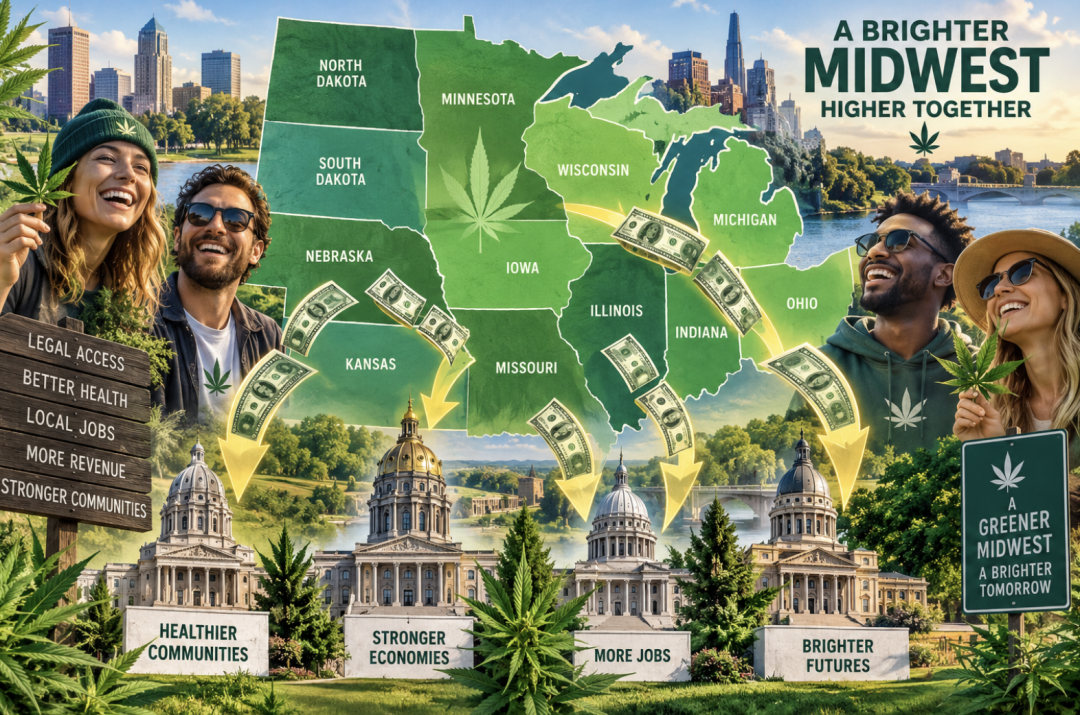
From Nebraska’s medical cannabis victory to Minnesota’s $250 million market, the Midwest is proving cannabis legalization can deliver jobs, tax revenue and regulated access
For years, the cannabis conversation in America has been dominated by the coasts. California, Colorado and New York tend to get the attention, while the the rest of the country is often portrayed as more cautious, conservative and slower to embrace legal marijuana. But here is how the midwest is becoming a surprising cannabis story. Data and actions are showing the mindset of the midwest as anti-marijuana is increasingly outdated.
Across the region, cannabis legalization is becoming less of a political experiment and more of an economic and public-policy reality. From Nebraska defending voter-approved medical cannabis laws to Minnesota surpassing $250 million in combined medical and adult-use cannabis sales, the region is quietly building some of the country’s most interesting cannabis markets.
Across the Midwest, cannabis legalization is becoming less of a political experiment and more of an economic and public-policy reality. From Nebraska defending voter-approved medical cannabis laws to Minnesota surpassing $250 million in combined medical and adult-use cannabis sales, the region is quietly building some of the country’s most interesting cannabis markets.
RELATED: Could Marijuana Rescheduling Help Reduce The Spiraling National Deficit
Nebraska provided a particularly important development this month. The Nebraska Supreme Court unanimously upheld the state’s voter-approved medical cannabis laws, rejecting a legal challenge sought to invalidate the petition process behind the 2024 ballot measures. In a 7-0 decision, the court determined the alleged problems with some signatures and notarizations were not sufficient to overturn the initiatives approved by voters.
The decision represents more than a victory for Nebraska’s medical cannabis patients. It also reinforces a larger trend across the Midwest: voters and state governments are increasingly treating cannabis as a legitimate part of healthcare and regulated commerce.

Minnesota offers perhaps the clearest example of the Midwest’s emerging cannabis economy.
One year after the state’s first non-tribal, state-licensed recreational cannabis dispensaries opened, Minnesota has recorded more than $250 million in cannabis sales. Approximately $150 million came from adult-use cannabis and another $100 million from medical cannabis. Those sales, combined with certain lower-potency hemp products, generated approximately $45.6 million in tax revenue between September 2025 and July 2026.
The economic impact goes beyond the sales receipts.
Minnesota’s Office of Cannabis Management says more than 300 new cannabis businesses have launched over the past year, creating jobs and opportunities throughout the supply chain. The state has also seen significant growth in licensed cultivation, with the number of licensed cultivators reporting inventory and the number of plants in the regulated system increasing dramatically.
Minnesota is also beginning to produce something potentially even more valuable: real-world data. A recent report from the state’s Office of Cannabis Management examining cancer patients found some patients reported improvements in symptoms including nausea, vomiting, appetite, anxiety, depression and pain after beginning medical cannabis. The findings don’t establish cannabis as a treatment for cancer itself, but they demonstrate how regulated state programs can contribute to research into cannabis and symptom management.
RELATED: Is CBD Next On The Fed’s Hit List
Minnesota isn’t alone.
Illinois continues to demonstrate the enormous scale a mature Midwestern cannabis market can reach. Through May 2026, Illinois recorded more than $566 million in adult-use cannabis sales, including more than $456 million from Illinois residents and over $109 million from non-residents.
The out-of-state component is particularly significant. Illinois sits at the center of a massive population corridor, giving its cannabis industry access to consumers from states where marijuana remains more restricted.
The broader Midwestern cannabis story is therefore not simply about legalization. It is about normalization.
States are creating licensing systems, testing requirements, medical programs, adult-use markets, cultivation businesses and tax structures. Consumers are moving from unregulated markets into legal ones, while entrepreneurs are building businesses around cultivation, retail, manufacturing, testing and ancillary services.
The Midwest may never have the cannabis culture associated with California. It doesn’t need to.
What the region is demonstrating is something arguably more important: cannabis legalization can become ordinary public policy.
