

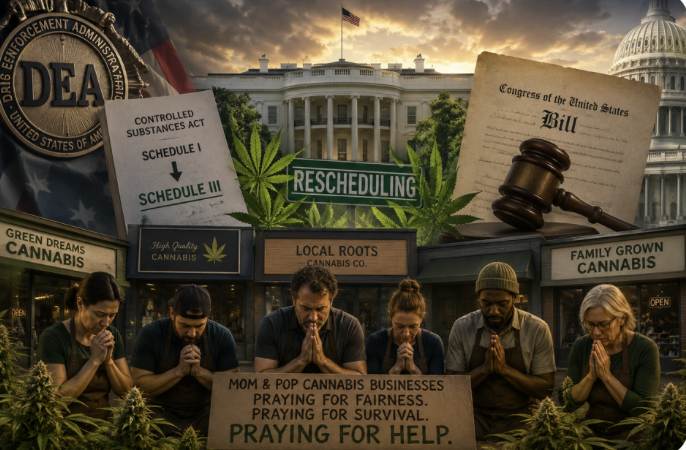
Cannabis Rescheduling Has Entered Its Waiting Game as the DEA Reviews the Record, Businesses Brace for Tax Changes and the CDC Asks Americans New Questions About Marijuana
The hearings are over. The final briefs have been filed. The official transcript is now being released.
Now the federal marijuana rescheduling process moves into its next phase. And the 88% of the country who believe it should be legal is wondering where things stand on marijuana rescheduling.
The Drug Enforcement Administration’s 11-day hearing on whether marijuana should be moved from Schedule I to Schedule III under the Controlled Substances Act ended July 15. The parties then had until Aug. 17 to submit post-hearing briefs and closing arguments. Those filings are now part of the record before Chief Administrative Law Judge Derek Julius.
The judge is expected to review the evidence and issue a recommended decision. The recommendation will then go to the DEA administrator, who will make the final agency decision.
There is no announced date for when the recommendation or final decision will come.
RELATED: New York and Texas Take Opposite Paths on Cannabis, CBD and Hemp
The DEA is arguing marijuana should be moved to Schedule III. Opponents of the proposal have argued the government has not met the legal and scientific requirements for rescheduling. The post-hearing briefs filed Aug. 17 give both sides a final opportunity to make their cases based on the evidence presented during the hearing.
For cannabis businesses, one of the most closely watched issues is not whether marijuana moves from Schedule I to Schedule III in the abstract. It is what the change could mean for federal taxes.
Section 280E of the federal tax code prevents businesses involved in trafficking Schedule I or Schedule II controlled substances from deducting many ordinary business expenses.
This has been a major issue for state-legal marijuana businesses, which can owe federal taxes while operating legally under state law.

A broader move to Schedule III could remove marijuana businesses from the scope of 280E. The move could significantly change the tax calculations for companies ranging from large multistate operators to independent dispensaries.
The federal government has already taken a narrower step in the direction.
In April, the Justice Department and DEA placed FDA-approved marijuana products and marijuana products covered by qualifying state medical-marijuana licenses into Schedule III. Treasury and the IRS said additional guidance would be needed to address the federal tax consequences of the change.
The broader rescheduling decision is still separate.
For businesses, this means tax planning is taking place while an important piece of the federal regulatory picture remains unresolved. Companies must evaluate what a potential Schedule III classification could mean for deductions, cash flow and future investments without knowing exactly when — or whether — the broader change will take effect.
Uncertainty extends across the industry.
Large cannabis companies are watching the potential effect on their financial statements and future expansion. Smaller, independent businesses face many of the same federal tax questions while operating with considerably less financial cushion.
At the same time, the federal government is taking a closer look at another part of the marijuana debate: how Americans actually use cannabis.
The Centers for Disease Control and Prevention has been evaluating changes to how marijuana use is measured in federal health surveys. CDC research on revised cannabis questions has found that some respondents interpret “marijuana” differently depending on whether they use cannabis for medical purposes or to get high.
The distinction is becoming increasingly important as medical and adult-use cannabis have expanded across the country.
RELATED: Cannabis Is Helping Seniors Have A Better Quality Of Life
