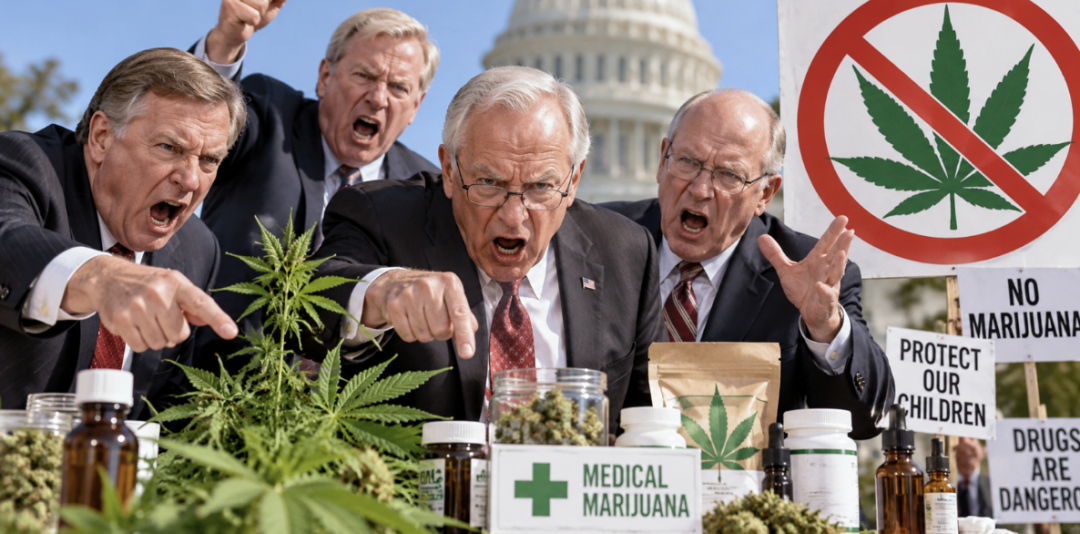
From Idaho’s resistance to medical marijuana to South Dakota’s legalization battles, longtime conservative leaders are keeping cannabis prohibition alive as public attitudes continue to shift.
Cannabis is having a moment. More Americans have tried it, more states have legalized it, and millions of people see it as an alternative to alcohol or a potential tool for managing certain medical conditions. But some older politicians still fighting marijuana hard – even medical.
Welcome to America’s latest cannabis culture clash, where a changing public meets a political establishment where, in some states, seems determined to keep the clock ticking backward.
In places such as Idaho and South Dakota, the battle over marijuana is far from over. And increasingly, the debate isn’t just about whether adults should be allowed to enjoy a recreational gummy or light up on a Saturday night. It’s about whether patients should have access to medical cannabis at all.
Many of the most visible opponents are longtime, socially conservative politicians who built their careers during the war on drugs. Their concerns about public health, addiction and public safety are real parts of the debate. But cannabis advocates wonder whether some lawmakers are still fighting yesterday’s battles while the rest of the country has moved on.
Age isn’t the whole story, of course. Plenty of older politicians support legalization, and younger lawmakers oppose it. Still, when familiar faces from an earlier era of drug policy lead the charge against reform, it’s fair to ask whether America’s cannabis laws are keeping pace with its changing attitudes.
RELATED: Is Sober October A Thing And Does Cannabis Count
South Dakota offers a particularly interesting case study in cannabis politics.
In 2020, voters approved recreational marijuana legalization and a separate measure establishing medical marijuana access. The recreational measure was later struck down by the state’s Supreme Court in 2021, following a legal challenge. The medical marijuana program, meanwhile, moved forward.
Then-Gov. Kristi Noem, a Republican and vocal opponent of recreational legalization, represented the state’s hard-line approach. Her administration raised concerns about the potential consequences of expanding marijuana access.
For cannabis supporters, the episode was frustrating: Voters had spoken, but the outcome wasn’t what legalization advocates had hoped for.
The story didn’t end with the court ruling, either. South Dakota has continued wrestling with how tightly to regulate its medical marijuana program, illustrating just how much political attention cannabis can attract even after a state establishes legal access.
The bigger question is whether a ballot-box victory ever really settles the cannabis debate — or whether advocates should expect another round of political pushback every time the rules change.

Idaho represents an even more restrictive approach. The state has maintained a prohibition-first policy despite the spread of medical marijuana programs across much of the country.
Idaho lawmakers have repeatedly resisted efforts to create a comprehensive medical cannabis system. The debate has left patients and advocates confronting a difficult question: Why should people in one state have access to cannabis-based treatments under state law while people across the border face a much narrower set of legal options?
Supporters of medical cannabis argue patients dealing with chronic pain, severe nausea and other debilitating symptoms deserve the opportunity to discuss cannabis with their health care providers. They also contend regulated access offers more oversight than forcing patients to navigate unregulated markets or travel to other states.
Opponents raise concerns about the quality of medical evidence for particular conditions, the potential for misuse, impaired driving and the difficulty of preventing products intended for adults from reaching children. Those are legitimate policy questions, but critics of prohibition say they should lead to carefully designed safeguards rather than blanket resistance to medical access.
Idaho’s position is especially notable because medical marijuana and recreational legalization are distinct policy questions. A state can prohibit adult-use cannabis while establishing a tightly regulated medical program with qualifying conditions, physician oversight and restrictions on who can obtain products. The debate over whether to allow such a system has become a central dividing line in the broader cannabis discussion.
RELATED: Pornhub Releases 2025 Data On What People Want
The debate is no longer limited to whether adults should be allowed to use marijuana recreationally. In some states, lawmakers are questioning the future of existing medical programs.
In South Dakota, the conflict intensified in 2025 when the state’s Medical Marijuana Oversight Committee considered a series of proposals to tighten regulations. The debate raised concerns among industry participants about whether restrictions could undermine a program voters had approved.
In 2026, South Dakota lawmakers introduced Senate Bill 181, which proposed repealing the state’s medical cannabis law following federal rescheduling of marijuana to Schedule III. The bill illustrates how federal policy changes can become a new battleground for state-level medical access.
The proposal raises a critical question: If federal officials recognize an accepted medical use for cannabis by changing its classification, should states respond by making patient access easier or by reconsidering their existing programs?
For patients and medical cannabis advocates, the possibility of losing a state-authorized program is particularly troubling. They argue people who rely on cannabis should not have their treatment options determined solely by political ideology.
RELATED: Cannabis Could Be Part of Your Next Solo Personal Retreat