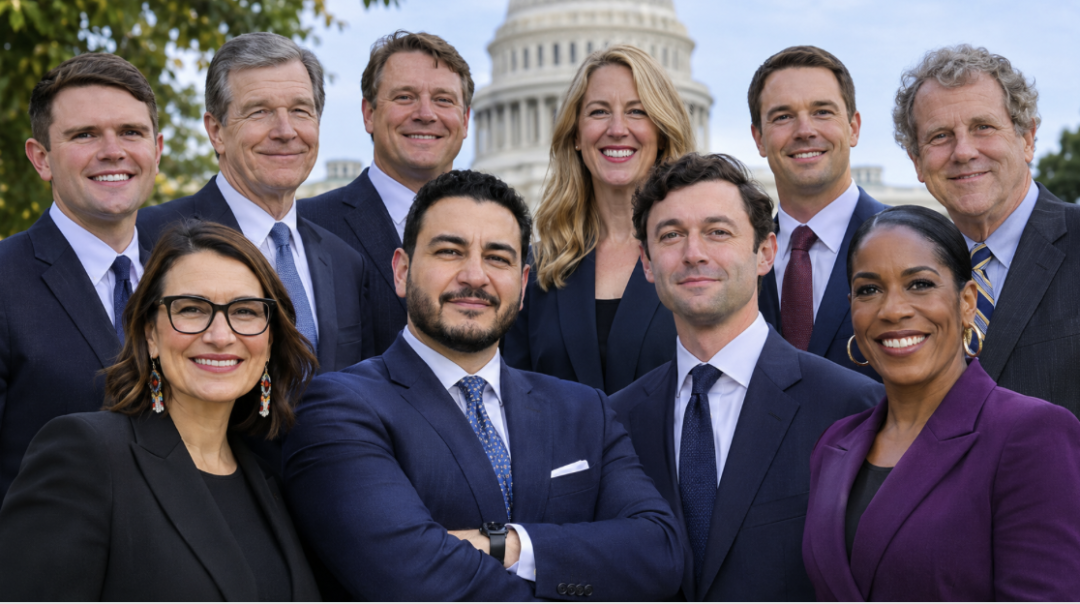
From James Talarico and Roy Cooper to a growing roster of House members and governors, a new generation of elected officials is ready to revisit America’s marijuana laws. Here’s who is pushing for change and what could happen next.
The news has been full of the blue tsunami, but is it also green wave? See the new class of electeds who support cannabis and hopefully will bring change. This new crop of lawmakers are considerably more comfortable talking about marijuana than many of the politicians they are replacing. And this time, cannabis reform has some company: Democrats have taken control of both chambers of Congress, while several states have elected governors who openly support changing their marijuana laws.
For an industry who has spent years watching federal legislation collect dust, the November elections could provide something it has struggled to get: more elected officials willing to put cannabis reform on the agenda. The interesting part isn’t simply how many Democrats won. It’s who they are, what they have said about marijuana and whether they are prepared to do something about it.
RELATED: Which Sports Fans Use the Most Marijuana
Several incoming senators have publicly supported meaningful changes to marijuana laws. They aren’t all promising the same thing, but their records offer plenty of reasons for advocates to pay attention.
James Talarico (Texas) may be one of the most interesting additions. He supports federally legalizing marijuana for adults, establishing regulated sales and expunging past convictions. He has even said he wants to work with Donald Trump on legalization.
Roy Cooper (North Carolina) brings a different background. As governor, he supported decriminalizing simple possession, pardoning low-level marijuana convictions and expanding medical cannabis access. His federal position on full legalization has not been clearly established, but his record makes him an important addition to the reform conversation.
Troy Jackson (Maine) supported adult-use legalization, decriminalization and medical cannabis access during his years in the state Legislature.
Abdul El-Sayed (Michigan) has expressed strong support for removing marijuana from the Controlled Substances Act, adult-use legalization, expungement and banking reform.
Peggy Flanagan (Minnesota) supported adult-use legalization and medical cannabis legislation as a state lawmaker and helped implement Minnesota’s legal cannabis program as lieutenant governor.
Annie Andrews (South Carolina) supports adult-use legalization and medical marijuana access, an especially notable position coming from a state where reform has faced considerable resistance.
Josh Turek (Iowa) has supported legalizing and regulating cannabis for adults, including legislation he cosponsored as a state lawmaker.
Sherrod Brown (Ohio) returns to the Senate with a record of supporting adult-use legalization and banking reform. As a former chairman of the Senate Banking Committee, he also helped bring cannabis banking legislation to a committee vote.
Juliana Stratton (Illinois) has explicitly supported federal legalization, pointing to Illinois’ regulated adult-use market as an example of how it can work.
These are not identical political positions. Cooper, for example, has a record of supporting narrower reforms rather than an explicit commitment to federal legalization. But all nine have publicly documented positions making them relevant to the cannabis debate.

The Senate gets the headlines, but the House of Representatives has an established group of lawmakers who have voted for legalization, supported banking reform or sponsored legislation to protect cannabis consumers and businesses.
Among the returning representatives with documented reform records are:
- Alabama: Terri Sewell.
- California: Jim Costa, Salud Carbajal, Raul Ruiz, Mark Takano, Linda Sánchez, Robert Garcia, Maxine Waters, Nanette Barragán, Mike Levin, Scott Peters, Sara Jacobs and Juan Vargas.
- Colorado: Joe Neguse, Jason Crow and Brittany Pettersen.
- Florida: Lois Frankel and Jared Moskowitz.
- Georgia: Sanford Bishop.
- Illinois: Delia Ramirez, Mike Quigley, Sean Casten, Brad Schneider, Bill Foster, Nikki Budzinski and Lauren Underwood.
- Maine: Chellie Pingree.
- Massachusetts: Richard Neal, Jim McGovern, Lori Trahan, Jake Auchincloss, Katherine Clark, Ayanna Pressley, Stephen Lynch and Bill Keating.
- Michigan: Rashida Tlaib, Hillary Scholten and Debbie Dingell.
- Minnesota: Betty McCollum and Ilhan Omar.
- Mississippi: Bennie Thompson.
- Nevada: Dina Titus, Susie Lee and Steven Horsford.
- New Mexico: Melanie Stansbury.
- New York: Paul Tonko, Joseph Morelle and Pat Ryan.
- North Carolina: Deborah Ross and Valerie Foushee.
- Ohio: Joyce Beatty, Greg Landsman and Emilia Sykes.
- Washington: Suzan DelBene, Rick Larsen, Pramila Jayapal, Adam Smith, Kim Schrier and Marilyn Strickland.
- Wisconsin: Gwen Moore.
- Louisiana: Troy Carter.
Their records vary. Some have supported comprehensive federal legalization, while others have focused on banking, medical research, veterans’ access, criminal justice reform and protecting state programs. They are not all interchangeable, but they represent a substantial group of lawmakers who have already engaged with cannabis reform rather than simply avoiding the subject.