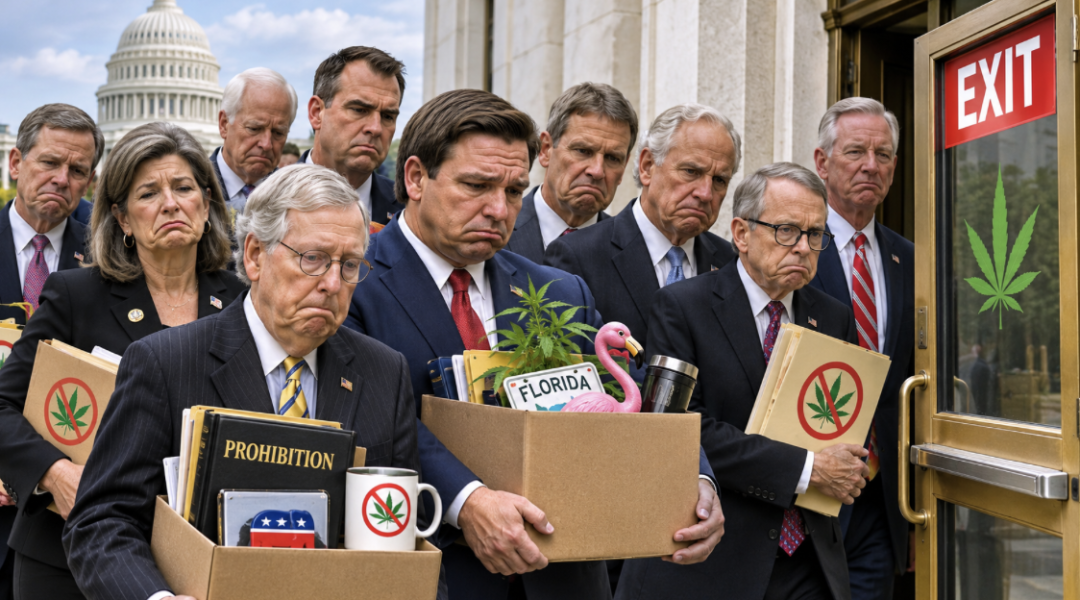
Every political movement has its champions. It also has the people who seem determined to make sure the movement never gets anywhere.
The war, affordability, voter’s rights, healthcare – all key issues leading to voter turnout in the midterms. The election upended politics in the White House, Congress, Governor’s mansion and state houses. After several administrations who blocked cannabis, the industry says farewell to the ardent enemies of cannabis reform.
Thousands of small mom and pop business are hoping 2027 is bringing a change of scenery. A number of governors and members of Congress who opposed marijuana legalization, resisted broader cannabis reforms or worked to keep prohibition in place are leaving their current offices in January.
No need to send flowers. But it is worth taking a look at who is going, what they did and whether their departure could change the conversation.
RELATED: Governors Could Be The Next Big Force In Cannabis Reform
Florida Governor Rons DeSantis made his opposition to recreational marijuana unmistakable during Florida’s 2024 Amendment 3 campaign. Ever the fan of a nanny state, he was worried the public would get what they voted for in an election. The measure would have legalized adult-use cannabis, but the governor campaigned against it, using public appearances and state-government paid messaging to argue against the proposal.
The amendment received nearly 56% support from voters, but Florida’s 60% constitutional-amendment threshold meant it failed.
DeSantis also questioned the ballot measure’s language and warned about the consequences of legalization. His administration’s opposition became a major part of the campaign, drawing criticism from supporters who said the governor was using the power of his office to fight a citizen-led initiative.
He leaves office in January after two terms. Florida will have a new governor, Byron Donalds, and a new opportunity to revisit the debate.

Oklahoma Gov. Kevin Stitt made his position clear when voters considered State Question 820 in 2023. The proposal would have legalized recreational marijuana for adults, but Stitt opposed it and publicly celebrated its defeat.
He said he believed the measure was not good for Oklahoma and promised to continue cracking down on illegal marijuana operations.
Oklahoma already had a substantial medical marijuana industry, but Stitt was not persuaded adult-use legalization was the next step. His administration’s approach favored tighter oversight and enforcement rather than expanding the legal market.
Stitt is term-limited and leaves the governor’s office in January. Oklahoma’s cannabis debate, however, is unlikely to disappear with him.
Tennessee Gov. Bill Lee has been unusually direct about his views. During his first campaign for governor, he said he did not believe Tennesseans should be able to possess and use marijuana. He also expressed skepticism about medical cannabis, saying he wanted more evidence before supporting it.
His administration did establish a study commission and later signed legislation regulating hemp-derived cannabinoid products. But Tennessee never moved toward a broad medical or adult-use marijuana program under his leadership.
Lee leaves office in January after two terms. His successor, Republican Marsha Blackburn, will inherit a state where cannabis policy remains considerably more restrictive than in many neighboring states.
RELATED: What If Workers’ Compensation Covered Medical Marijuana
Wyoming Gov. Mark Gordon has opposed recreational marijuana legalization and expressed skepticism about medical cannabis.
He has said he was not in favor of legalizing marijuana, while leaving a narrow opening for discussion about medical use. The opening has not translated into a push for a medical program or broader reform during his time in office.
Gordon is term-limited and leaves in January. Wyoming remains one of the states where advocates face a steep political climb, so his departure alone won’t change the law.
South Carolina Gov. Henry McMaster has been clear about opposing recreational marijuana. In 2021, he said he did not believe legal adult-use cannabis was a good idea.
Medical marijuana, he said, was a different question. But he stopped short of endorsing a medical program and said he would not sign legislation unless law enforcement was satisfied with its provisions.
The distinction matters: McMaster was not an across-the-board opponent of every possible medical use, but he did not become an advocate for bringing a legal medical program to South Carolina, either.
He leaves office in January after reaching the end of his term.
RELATED: Cannabis Becomes America’s New Daily Health Habit
Ohio Gov. Mike DeWine deserves a mention, although his record is more complicated than a simple anti-cannabis label.
He opposed adult-use legalization before Ohio voters approved it in 2023. After legalization passed, DeWine signed legislation changing the rules around the market. In 2025, he signed Senate Bill 56, which imposed new restrictions on the state’s cannabis and hemp markets, and used a line-item veto to limit sales of THC beverages.
So while Ohioans did get legal adult-use cannabis on his watch, the governor also pushed for tighter restrictions after voters approved the market.
DeWine is term-limited and leaves office in January. Ohio’s next governor, Amy Acton, will inherit a legal market already operating but still subject to political and regulatory fights.
State governors aren’t the only officials leaving their current jobs. The Senate is also losing several Republicans whose records have included opposition to major cannabis reforms.
Joni Ernst (Iowa) has described herself as adamantly opposed to marijuana legalization. Although she supported some limited hemp and cannabidiol measures, she did not support medical or adult-use legalization or ending federal prohibition. She is retiring from the Senate. <Cite refs={[“turn164028search1″,”turn305458view2”]}/>
Steve Daines (Montana) opposed legalizing marijuana personally and opposed federal legalization or descheduling without congressional action. He did support cannabis banking legislation, reflecting a more mixed record than some of his colleagues. He is retiring. <Cite refs={[“turn164028search3″,”turn305458view4”]}/>
Mitch McConnell (Kentucky) is a particularly interesting case. He was a major force behind the 2018 federal hemp legalization provision, which removed hemp from the Controlled Substances Act. This was a significant victory for the hemp industry. But McConnell did not become a supporter of legalizing marijuana. His legacy is a reminder hemp and marijuana have often been treated as two very different political issues in Washington. He is retiring from the Senate.
Roger Marshall (Kansas) opposed most cannabis policy reforms, voted against federal legalization and opposed a veterans cannabis research bill. He also signed a letter urging the Trump administration to oppose rescheduling. Voters elected Democrat Adam Hamilton to replace him.
John Cornyn (Texas) lost his Republican Senate primary to Ken Paxton. Cornyn argued more research was needed before changing federal marijuana policy and opposed moving ahead with cannabis banking without a federal regulatory framework. His departure from the Senate follows a primary loss, not a retirement.
RELATED: Meet The New Class Of Electeds Who Support Cannabis
This isn’t a claim every departing politician was responsible for every obstacle facing cannabis reform. Some supported limited medical access, banking changes or hemp legislation while opposing adult-use legalization. Those distinctions matter.
But the departures do mark a changing cast of characters. DeSantis leaves Florida after making opposition to a legalization ballot measure a highly visible part of his governorship. Stitt, Lee, Gordon and McMaster leave behind states where adult-use legalization remains off the table. And the Senate loses several members who opposed federal legalization or resisted broader changes.
The people taking their places won’t all agree on what cannabis policy should look like. Some will support legalization, others will favor narrower reforms, and some may want to keep the existing restrictions.