

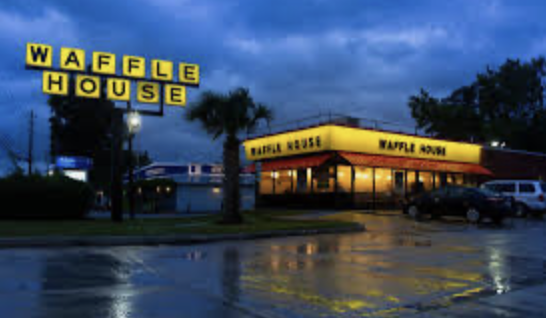
Smothered, Covered, and Government-Connected: Why Waffle House Keeps Showing Up in Federal Conversations.
Few American brands occupy the unusual intersection of culture, crisis response, and politics quite like Waffle House. Known for its round-the-clock service and no-frills menu, the Southern staple has become an unlikely but enduring touchpoint in government operations, political storytelling, and even viral controversy. But the Waffle House and the feds keep popping up together.
The latest example placing Waffle House back in the national spotlight involves Gregg Phillips, a senior leader connected to the Federal Emergency Management Agency. Phillips recently drew attention after remarks resurfaced in which he claimed he had been “teleported” to a Waffle House miles away from his original location. While the comments were made prior to his government role and dismissed by officials as personal, the story quickly spread across media and social platforms, raising questions about leadership credibility and further embedding Waffle House into the national conversation.
RELATED: The Crazy Stuff People Believe!!
But long before viral headlines, Waffle House had already secured a legitimate and respected place within government disaster planning through the widely cited “Waffle House Index.” The term was coined by Craig Fugate, who led FEMA under Barack Obama. Fugate observed the chain’s ability to remain open—or quickly reopen—after severe weather events made it a reliable, real-time indicator of community impact. A full menu signals minimal damage, a limited menu indicates strain, and a closure suggests severe disruption.
This informal index has become a powerful shorthand in emergency management, reflecting the chain’s remarkable operational resilience. The resilience is no accident. In fact, Waffle House’s internal disaster response system has become a model studied by government agencies.

The company maintains highly organized “jump teams” deployed ahead of storms, bringing supplies, staff, and mobile resources into vulnerable areas. These teams are trained to operate under extreme conditions, often restoring service faster than utilities or infrastructure providers. As a result, Waffle House has been referenced in emergency management circles as a benchmark for corporate disaster response done right.
Government agencies, including FEMA, have looked to Waffle House’s playbook for insights into supply chain continuity, rapid reopening strategies, and decentralized decision-making. In an era where public-private partnerships are increasingly critical during disasters, the chain represents a rare example of a private company influencing how government thinks about resilience and recovery.
The connection between Waffle House and government also extends into politics and personal narrative. Nancy Mace has frequently cited her experience working at the restaurant as foundational to her worldview. Her story—moving from service industry work to Congress—has been used to highlight themes of economic mobility and the value of hard work, reinforcing the brand’s symbolic role in American life.
RELATED: The Best Cocktails To Forget Politics
Beyond formal policy and politics, Waffle House also plays an informal role in public service culture. Its 24/7 operations make it a gathering place for law enforcement, first responders, and shift workers, further embedding it into the fabric of civic life.
Taken together, these threads reveal a uniquely American story. Waffle House is more than a restaurant—it is a cultural institution, a disaster response bellwether, a training model for resilience, and now, occasionally, a backdrop for political headlines.
Whether serving hash browns during a hurricane or appearing in viral government controversies, Waffle House continues to demonstrate even the most unassuming institutions can hold a significant place at the intersection of business and government.
