With recreational cannabis now legal and sales scheduled to launch in the coming months, the mayor said back in early June that he saw no need to crack down on sales in the interim.
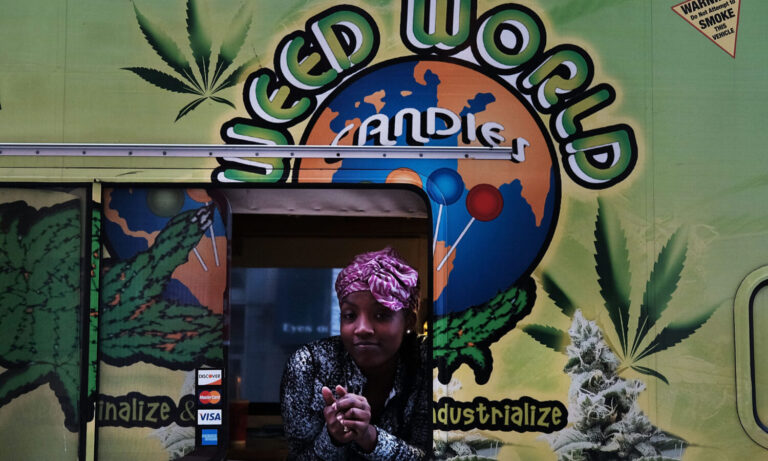
New York Mayor Eric Adams is not happy about the Big Apple’s prolific illicit cannabis sales taking place around town. He’s so hot under the collar that he vowed to put more cops on the street and increase enforcement. The NYPD started by towing 19 weed-vending trucks around Times Square and seizing the cannabis therein on just one day this week.
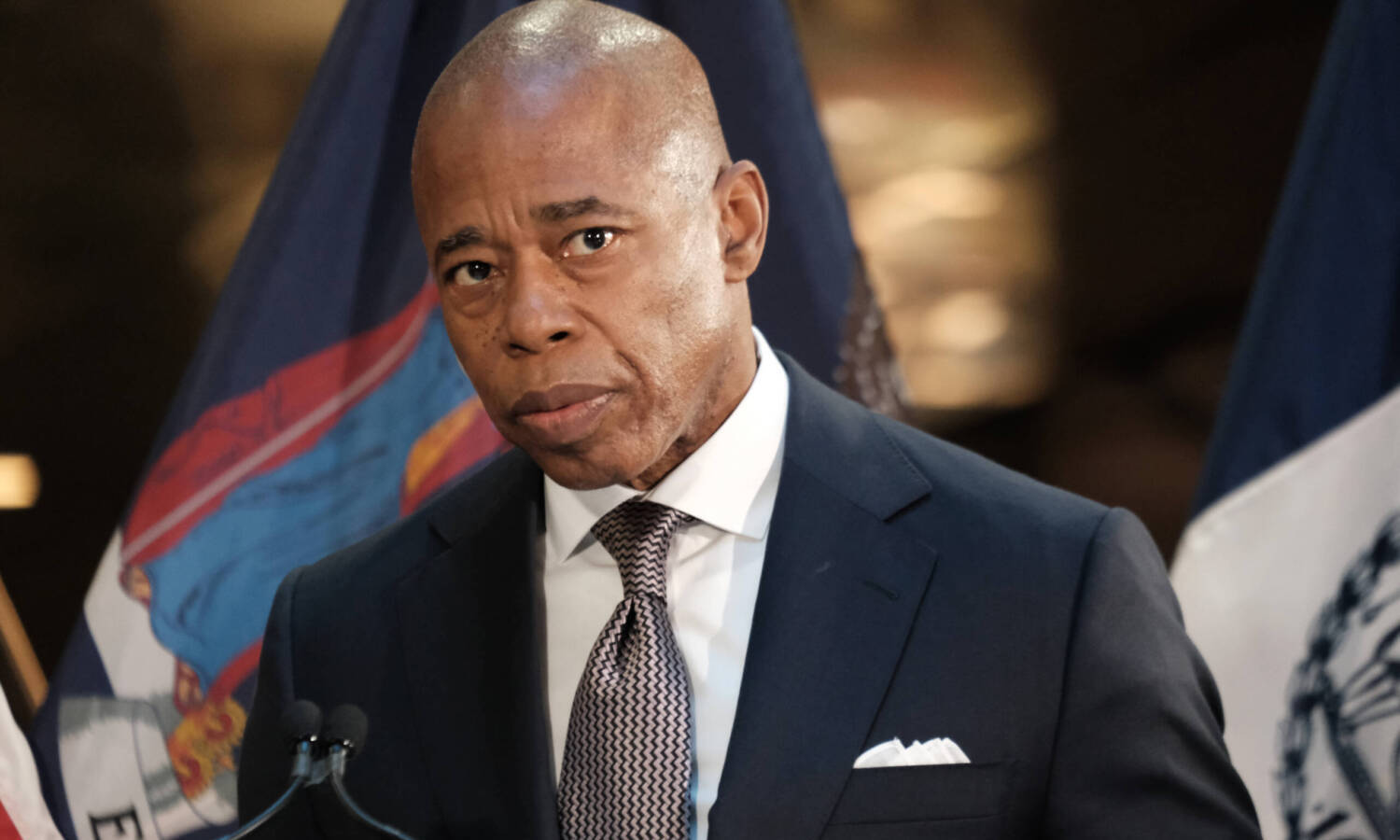
“Many people don’t read the complete law. All they read is, ‘Weed is legal,’ and they just kick into gear,” Adams said at an unrelated press conference in Manhattan on Thursday.
“This is not going to be a city where we openly snub our noses and break the law. That is not acceptable. We didn’t walk in with SWAT teams, we came in with tow trucks. You can’t sell weed on our streets,” the Mayor said.
Photo by Spencer Platt/Getty Images
Change Of Heart
Adams told NYC residents in early June that they should feel free to buy, sell and consume weed where ever they wish. He promised not to take a “heavy-handed” approach toward those illicitly selling marijuana in the city.
With recreational cannabis now legal and sales scheduled to launch in the coming months, the mayor said back then that he saw no need to crack down on sales in the interim.
“There needs to be a system of not heavy-handedness, but going in and explaining to that store that, ‘Listen, you can’t do this,’ give them a warning,” Adams told reporters at a cannabis industry expo in June in Manhattan.
But now, the weed trucks parked around the city, not just in Times Square, seem to irk the mayor. A similar crackdown occurred in mid-June to a dozen weed-vending trucks, two weeks after the Mayor’s comment about “not heavy-handedness.”
Up in smoke. 19 illegal vehicles and cannibis seized off the streets of NYC. While others follow the rules, these trucks and their vendors don’t have permits so we took action! pic.twitter.com/DzjAyEl3Xc
Meanwhile, the Cannabis Control Board (CCB) recently approved the first round of cannabis processor licenses as well as emergency lab testing regulations.
States that did not implement any policy change showed no meaningful change in arrests for White individuals and an increase for Black individuals, thereby increasing the arrest rate disparity over time.
The truth is, racism exists. Some of us don’t want this to be true, some refuse to see it, some don’t care and then there are racists who seem to work to keep it alive. It’s hard to believe that in the 21st century, we, as a population, haven’t spiritually evolved an inch.
A study published in the journal JAMA Health Forum sheds light on one of the examples of racial disparity across the US. The research revealed that those states that have not removed criminal penalties for cannabis possession increased arrest rate disparities over the last two decades.
Researchers used race-based arrest data from the Uniform Crime Reporting Program and Surveillance, Epidemiology and End Results county-level population data from January 2000 through December 2019 across 43 U.S. states. They examined how arrest rates compare before and after states decriminalized or legalized cannabis and also across those that made no policy changes.
Photo by Roman Budnyi/Getty Images
A team of researchers affiliated with Eastern Virginia Medical School in Norfolk and with Saint Louis University in Missouri revealed that both legalization and decriminalization policies were related to “large decreases” in the total number of adults arrested for cannabis violations. What’s more, it was discovered that legalization was associated with the biggest decrease in raw differences between Black and White arrests.
“States that did not implement any policy change showed no meaningful change in arrests for White individuals and an increase for Black individuals, thereby increasing the arrest rate disparity over time.”
The study authors concluded, “This study highlights the importance of statewide policies in reducing cannabis possession arrests. … While these results do not unambiguously favor decriminalization nor legalization, increases in arrest rate disparities in states without either policy highlight the need for targeted interventions to address racial injustice.”
NORML’s political director, Morgan Fox, commented on the results, “Even though removing criminal penalties for simple cannabis possession is not a surefire fix for the racially disparate application of the law, it does lead to a drastic reduction in the number of people of color that are disproportionately and unnecessarily caught up in the criminal justice system.”
He added: “It is appalling, though not particularly surprising, that we are seeing increases in racially disparate arrest rates in states that continue to cling to outdated prohibition policies. Regardless of intent, it is clear that the continued criminalization of cannabis perpetuates and exacerbates unequal enforcement under the law and the associated harms that come with it. This is not something that we can tolerate in the 21st century, and these findings should incentivize lawmakers to embrace sensible cannabis policy reforms.”
The homegrow market is likely to grow exponentially and legal retailers will need to have this in mind as they make their sales projections based on the estimated size of the consumer market.
New Frontier Data (NFD) has just released an extensive report an extensive report on the dynamics of cannabis homegrow in the US, including current state of affairs and future projections. The homegrow market is made up of those who cultivate cannabis plants at home for their own needs and/or the needs of consumers in their circle. Not much is known about this group in terms of who they are, what motivates them, how they do it, or their outcomes.
NFD conducted a survey involving 4,682 cannabis consumers and 1,250 non-cannabis consumers. This report which was titled “The U.S. Cannabis Homegrow Market: Motivations, Processes, and Outcomes” has made several revelations that can serve as pointers for the cannabis industry:
Photo by DaveLongMedia/Getty Images
Six percent of cannabis consumers grow their own cannabis, which translates to 3 million growers
By 2030, about 4.1 million Americans will be cultivating their own cannabis at home
While 7% of adult-use consumers are likely to cultivate their own cannabis, the figure goes slightly lower to 5% for medical consumers and 4% for those who purchase cannabis from the illicit market.
38% of homegrowers know someone working in the cannabis industry which is twice more compared to non-growers
Most homegrowers cultivate six plants or less each time and harvest up to three times a year
Here are 7 interesting findings that can be gleaned from the report:
What’s the anticipated growth trajectory of the homegrow spending on setting up the cultivation site and purchasing inputs?
Estimated spending for site set-up and cultivation inputs is expected to increase by 38% over the next decade: from $2.7 billion to over $3.7 billion. Consumers are expected to spend close to $30 billion on homegrow supplies during this period.
How much cannabis are homegrowers likely to produce in the next decade?
Conservatively, homegrowers are likely to produce about 11 million pounds of dried cannabis flower in 2022 and15 million pounds by 2030, annual production.
What will be the likely value in dollars of cannabis produced by homegrowers in 2022?
Placing the market value of a pound of dried cannabis at $1,250 U.S. homegrowers will generate cannabis worth $14 by the close of the year.
Why do homegrowers consume cannabis?
Homegrowers consume cannabis for reasons that are similar to those of the average consumer. However, a higher proportion consume for overall wellness.
Do homegrowers consume cannabis more frequently than non-growers?
Yes, while 66% of homegrowers consume cannabis daily, only 40% of non-growers consume it daily.
Most (49%) learned to grow cannabis from online sources and from their social circle (47%). Very few learned how to cultivate cannabis from agricultural or academic avenues.
Which are the common challenges that are experienced by homegrowers?
Pest, fungus, and disease
Producing quality flower
Creating the ideal grow environment
Proper plant maintenance pre-harvest
Proper preparation post-harvest
Odor challenges
Theft
Excessive costs
With prospects of federal reforms on the horizon, this information comes in very handy. The homegrow market is likely to grow exponentially and legal retailers will need to have this in mind as they make their sales projections based on the estimated size of the consumer market.
Current studies on marijuana for cancer are hopeful, and patients who want to explore using cannabis for cancer are recommended to talk to their doctors.
The big C has a tremendous impact on society and families around the world. According to the Centers for Disease Control and Prevention, there were over 1,750,000 new cancer cases in 2019 alone, and around a third of those patients died from cancer.
Unfortunately, there is still no known cancer cure, though the evolution of medical technology continues to save more lives. But cancer patients, along with their families, still have to face hardships: treatment with side effects, expensive and addictive medications for pain, poor quality of life, and emotional anguish. But perhaps cannabis can make things a little simpler.
Researchers from the Upstate University Hospital in Syracuse sought out to analyze how patients with advanced cancer responded to medical marijuana treatment.
Participants for the study were enrolled in New York’s MMJ registry. “The goals of this study were to review the characteristics of patients who received medical marijuana under our ambulatory palliative care program and to determine barriers to access and use of medical marijuana in this population,” says the study.
Photo by FatCamera / Getty Images
“Data from June 2017 to June 2020 were analyzed. Patients were included if they had a diagnosis of cancer, were certified by a qualified practitioner in the New York Medical Marijuana Program, and received care at Upstate Medical University,” it reads. “Patients were excluded if no marijuana certificate was found or if they transferred care.”
The researchers found that advanced cancer patients who used medical cannabis had positive effects. “Ninety-three patients (51.5%) received at least one prescription from a New York licensed marijuana dispensary while 72 (39.13%) were certified but never obtained any medical marijuana,” they wrote. “For patients who took at least one dose of medical marijuana, 48.14% experienced an improvement in pain, 44.95% used fewer opioids, and 85.11% had an improvement in at least one symptom. Adverse effects were low at 3.72%.,” says the study.
The research adds that “medical marijuana appears to have an important role in palliating symptoms of advanced cancers with few adverse effects.” The researchers also called on more studies to determine optimal dose and delivery for patients.
Cannabis For Cancer Treatment Is Promising
There’s still much that even experts are unsure of when it comes to understanding how cannabis can help with cancer. Several other aspects can make it slightly more complicated, such as the cannabinoids used and the kind of cancer.
In another recent study out of Israel, researchers assessed the cancer symptoms of several hundred patients over the course of 6 months. They found statistical improvements in symptoms and a significant decrease in their need for painkillers.
The researchers concluded that cannabis was associated with reduction in cancer symptoms, reduction of prescription drug consumption, and better quality of life. Almost half of the cancer patients who finished the trials no longer needed painkillers. “The main finding of the current study is that most cancer comorbid symptoms improved significantly during six months of MC [medical cannabis] treatment…. Additionally, we found that MC treatment in cancer patients was well tolerated and safe.”
There are also over 100 natural cannabinoids that we all need to learn about, which means that there is no one-size fits-all approach in using cannabis for cancer treatment.
The American Cancer Society acknowledges that THC and CBD have the ability to cause cancer cell death or slow the growth of cancer cells. They may also prevent cancer from spreading. They base it on early clinical trials in humans. “While the studies so far have shown that cannabinoids can be safe in treating cancer, they do not show that they help control or cure the disease,” they say. Certainly more research is needed to maximize the therapeutic ability of cannabis, though there have been many anecdotal cases of individuals saying that cannabis has helped treat their cancer.
Photo by fstop123/Getty Images
There are several studies that support the therapeutic properties of cannabinoids for cancer patients. In fact, cancer patients can benefit in several ways from using cannabis:
Managing the side effects of chemotherapy and radiation: Chemo and radiation are among the most common and successful conventional treatments for cancer. However, they can produce several uncomfortable side effects such as nausea, pain, and loss of appetite. Many patients also struggle to finish chemotherapy and radiation treatments due to the discomfort it causes.
Cannabis has been shown to be successful in helping cancer patients manage these conditions: it reduces nausea, improves appetite, mitigates pain, and helps improve sleep. All of these are critical for healing. In addition, several studies have shown that using cannabis together with chemotherapy greatly improves prognosis.
Cannabis can kill cancer cells without affecting healthy cells. Whereas chemotherapy also kills off healthy cells in the process, cannabis doesn’t. In one laboratory study, cancer researcher Dr. Matt Dun worked together with Australian Natural Therapeutics Group (ANTG) to come up with a marijuana variety with under 1% THC and high CBD. They found that this combination was effective for killing cancer cells.
“The CBD variety looks to have greater efficacy, low toxicity and fewer side-effects, which potentially makes it an ideal complementary therapy to combine with other anti-cancer compounds,” says Dr. Dun.
Conclusion
Current studies on marijuana for cancer are hopeful, and patients who want to explore using cannabis for cancer are recommended to talk to their doctors. They may be able to provide a dosage and consumption method that is best suited for your specific medical needs.
With the modification of the Swiss Narcotics Law, which changed the legal status of cannabis, patients can now obtain medical marijuana through a simple prescription from their doctor.
Starting September 15, Basel City will begin the first Swiss project on the legal sale of cannabis in pharmacies. The project will help evaluate the effects of new regulations on the recreational use of cannabis and combat black market distribution.
The Federal Office of Public Health approved the pilot in April. As a part of the project, the University of Basel, its psychiatric clinics and health department will participate.” Six cannabinoid products – four types of cannabis flowers and two types of hashish – will be sold in nine pharmacies selected by the authorities,” said Lukas Engelberger, health minister.
Cannabis users over 18 can now register to participate, with the number of participants limited to 370. In addition, pharmacies will charge prices around those set on the black market for products with THC content. A gram will therefore cost CHF8-CHF12 ($8.40-$12.60).
The Swiss parliament laid the legal basis for such small-scale initiatives in September 2020. After that, also other local authorities, including Zurich, Geneva and Bern, applied to roll out similar trials.
Legal Prohibition For Adult-Use Cannabis
In 2008 almost two-thirds of Swiss voters rejected an initiative to decriminalize cannabis consumption. Despite a legal ban, the health office estimates there are 220,000 regular consumers of cannabis in Switzerland.
However, since August 1, medical cannabis is legal in Switzerland. With the modification of the Swiss Narcotics Law, which changed the legal status of cannabis, patients can now obtain medical marijuana through a simple prescription from their doctor. Before medical cannabis was legalized patients had to apply to the Federal Office of Public Health.
As reported by Forbes, the new legislation enables the export of medical cannabis for commercial purposes. Companies should apply for authorization from Swissmedic, the Swiss surveillance authority for medicines and medical devices.
According to EU standards, available medical cannabis contains high levels of CBD and less than 1% THC.
A new YouGov poll showed that Americans are becoming more liberal in their drug policy stance. Of the 40% of respondents who admitted changing their minds on drug policy, nearly half (48%) said they’ve adopted a “more liberal” perspective on the issue, reported Marijuana Moment. Twenty-six percent of those asked touted a “more conservative” viewpoint, while the rest said their opinion has “changed in some other way.”
Among the top reasons why people change their minds about political issues are learning about “new facts or information” and acquiring insights about the world as they mature, followed by “events occurring in the world” that have nudged them to rethink their stance.
Other top issues why people are more likely to change their opinion during their lifetime are foreign policy, health care, the death penalty and immigration.
The survey was conducted online earlier this month and included 1,000 U.S. citizens aged 18 and over.
Meanwhile, a recent poll by Gallup revealed that half of Americans said marijuana has a negative impact on society. The new results surprised many, considering that 68.7% of Americans think cannabis should be legal, as per another Gallup poll.
Interestingly, adults who have tried cannabis believe cannabis’ impacts on consumers (70%) and society in general (66%) are positive, while on the contrary, the majority of those who have never tried it say they believe its effects are negative on both society (72%) and users (62%).
As you begin to purchase more expensive cannabis flowers, you may notice that the buds become stickier. This is because some of these plants were bred to contain a lot of trichomes, so they are highly potent.
Have you ever wondered why your weed is so sticky? With cannabis, many things can affect the overall experience. Some people prefer their weed to be really “sticky,” as that signals that the cannabis flower is high quality.
So, why is it that some cannabis is sticky-icky while other strains are dry and crumbly? This article will explore the science behind weed stickiness and teach you everything you need to know about sticky cannabis.
Why is weed sticky?
The secret lies in the trichomes, a subject the stickiest buds are well versed in. Trichomes, also called weed crystals, are small hair-like growths on a plant. Marijuana plants are full of them. But they do far more than just look good. Trichomes contain resin, which gives cannabis its power.
Often referred to as ‘essential oil,’ cannabis resin is a gooey, thick substance that may be translucent or have a red or orange color. Many plants and trees produce resin. However, cannabis resin contains cannabinoids, which makes it unique.
Photo by Christina Hempfling / EyeEm/Getty Images
As it turns out, trichomes on weed are resin glands. The sticky bud clearly indicates that many trichomes have formed on the flower. As trichomes increase, so does resin production. A higher resin content means more terpenes, THC, and cannabinoids. A resinous weed with crystals may have better medical potential, a stronger high, and a better smell and taste than if it has minimal resin (or is not sticky).
As you begin to purchase more expensive cannabis flowers, you may notice that the buds become stickier. This is because some of these plants were bred to contain a lot of trichomes, so they are highly potent.
Sticky marijuana resin is often compared to tree sap. You can imagine how similar the two are if you’ve ever felt sap in your hand. Just like cannabis, you can attribute the smell of sap to terpenes—the compounds in tree sap.
If you have ever heard of hash, hash is just cannabis resin. Hash is a concentrate formed by compressing the parts of the cannabis plant that contain resin. (Want to learn how to make hash at home?) Additionally, some people refer to the remnants of weed residue as resin, which may originate with the word residue. This article will restrict the term ‘resin’ to natural substances produced by plants.
Interestingly, the strain Pinkman Goo is considered to be one of the most resinous strains. The buds of this indica strain, a cross between Granddaddy Purple, Grape Ape, and Northern Lights #5, are densely covered in resin. According to laboratory tests, samples with the “goo glob” contain 4% additional THC than samples without the goo. This is evidence that a significant amount of THC is contained in resin. The resin contributes to the sweet flavor of the strain. Many people report that Pinkman Goo provides very relaxing effects.
Sticky weed vs. dry weed
It’s no mystery why sticky weed is prized by cannabis connoisseurs: it’s often more potent and flavorful. However, is dry bud less desirable because it’s not sticky? It turns out both have their benefits.
Dry weed has a bad reputation. However, it is often more affordable, and it is still effective, so many people prefer dry weed for this reason. Even though the cannabinoids and terpenes are not as abundant as in sticky weed, plenty are still available.
Photo by Cavan Images/Getty Images
Some weed is simply dry because it contains less resin and fewer trichomes. Consequently, the product is less potent. It may be that the plants were left to dry for a long time, thus losing some potency, or that strain may not contain as many trichomes as stickier varieties.
However, really dry weed indicates that the cannabis is past its prime. You can still use it, but it will have lots much of its flavor and some of its potency. As the plant gets older, it becomes drier. Still, it should remain sticky if stored properly. Nevertheless, you shouldn’t assume that you can stash sticky bud and pull it out a year later with its trichomes still intact.
Is sticky weed good?
Sticky-icky is a term you have probably heard, and it typically refers to good weed! When it’s cured properly, cannabis flower is moist and sticky to the touch. If the weed doesn’t have those specific characteristics, it’s likely not as high quality or flavorful. There are a lot of slang names for lower-quality weed, so low-quality cannabis is often called ’round-town brown’ or ‘reggie.’
Depending on your situation, you should choose your weed carefully. For example, you don’t need to use very sticky weed for edibles since you can achieve the same effects and save money by using dry weed. Even though sticky weed isn’t ideal for baking and can be expensive to share, it remains a preferred choice for many users.
Furthermore, if you’re gathering with friends, buying drier marijuana in larger quantities might be more economical. Sticky buds tend to be more expensive per gram. By choosing dried flowers, you will be able to get substantially more bang for your buck.
If you want an exceptional cannabis consumption experience and can afford it, sticky weed is the way to go. Due to the potency, many find that using less is more cost-effective than using drier variations.
If you want a strong and long-lasting high, go for the super sticky stuff. But if you’re trying to save money or don’t need such a powerful punch, dry weed will do the trick.
The US has ample reasons to choose from, but has yet to pick one singular cause strong enough to push the country into a post-prohibition era for marijuana.
Marijuana policy in the United States has been in the news a lot, but often it is the lack of action the country is making that is making headlines. Whether it is the MORE Act floating in limbo and failing, and a strongly worded letter urging a change in marijuana laws to the President from his strongest allies, America’s federal policy on marijuana is not “visionary” at the moment.
While the nation and many of its individual states have changed significantly in the last decade when it comes to opinions on marijuana, it can be argued that federal policy has fallen far behind the American psyche, and perhaps even the global consciousness. While America maintains its timid stance on marijuana, surrounding counties have taken concrete action.
What reasons have other countries have found reasons to legalize and decriminalize marijuana while the US remains unable to find its rationalization?
Photo by ChrisSteer/Getty Images
Mexico
If you ask our closest neighbor to the south why legalizing marijuana is a good idea, the response will likely involve hopes of decreasing violent crime. Mexico’s supreme court voted 8-3 last year to decriminalize marijuana, thus legalizing its medical use and cultivation. This decision came “after advocates pushed for decriminalization as a means to reduce drug-fueled cartel violence in the country,” according toCNN. While drug-fueled violence was not the only justification for this decision, it is one worth noting in that the justification for a change in marijuana policy can come from all sorts of places.
Thailand
While the US continues its debate on marijuana, Thailand made history as the first Asian country to legalize marijuana on a medical level. The country has made it clear that smoking joints in public is still very much punishable by law, but it has legalized marijuana as medicine. Even if it is medical marijuana that has gotten the green light, Thailand can still use this as a chance to boost tourism.
“Thailand mainly wants to make a splash in the market for medical marijuana,” according toNPR. With so few places with legalized cannabis nearby, it has a great opportunity on its hands. After all, “It already has a well developed medical tourism industry and its tropical climate is ideal for growing cannabis,” the article continued. Thailand is also releasing many inmates serving sentences for non-violent marijuana crimes, which is something many American lawmakers are pushing for (still unsuccessfully) with marijuana decriminalization bills.
Malta
Thailand was not the only country making international headlines for its marijuana legalization. Malta became the first European nation to legalize marijuana in late 2021. While it has not opened up cannabis lounges or dispensaries, it has legalized usage and cultivation of cannabis. Its reasons for this are fairly similar to Mexico’s.
“The government said that the new law was aimed at ending the criminalization of people for smoking the drug and at reducing criminal trafficking,” according to theNew York Times. Legalizing and thus regulating it, rather than fighting a criminal underground market seems to be a motivating factor in several countries that have legalized weed before the US.
Switzerland
Most recently, Switzerland lifted its ban on medical marijuana, and has thereby legalized medical cannabis as of August. The new move even allows for the export of medical cannabisallows for the export of medical cannabis. One of the main reasons for this shift, it seems, has to do with the growing popularity of medical cannabis and the increased level of administrative legwork that developed as a result of this popularity. “The Federal Council justified the legalization of medical cannabis in the country by stating that the demand for authorizations has increased in recent years. This entailed a considerable administrative burden and slowed down medical treatment,” according to Forbes. In 2019 alone, the health ministry issued 3,000 exceptional permissions.
There are a variety of reasons why countries are making major progress in cannabis legalization while the United States lags. From hope, to decreased crime, all the way to increasing medical tourism, the justifications are varied. The US has ample reasons to choose from, but has yet to pick one singular cause strong enough to push the country into a post-prohibition era for marijuana.
A letter published in the Le Monde explores several options for cannabis legalization in France. Through the launching of a consultation process, the European country seeks to culminate in proposing a new law to legalize recreational cannabis.
Among the 31 senators that co-signed the letter calling for the launch of the consultation process were Socialist, Ecologist and Republican groups, such as socialists Patrick Kanner, and David Assouline, senators from the North and from Paris respectively.
Decriminalization Is Not An Option
The senators rejected the notion of decriminalization, saying it is a demagogue option, which would perpetuate the existing ban. Days ago, Le Monde, which has called the current situation in France ‘unsustainable’, published the call to the senators, saying it is time to face reality head-on.
“Almost 18 million of our fellow citizens have used cannabis recreationally, according to a recent report by the National Assembly,” stated the senators’ report. “Although it is banned, 1.5 million consume it regularly.”
Indeed, Senators argue that legalization is a social issue that should be adopted by public authorities. According to them, the Government must respond to existing legitimate concerns.
“Decriminalization is a ‘cynical and populist’ option that is characterized by the maintenance of the prohibition with the elimination of the penalties incurred,” reads the letter. Moreover, senators continued saying that, “decriminalization merely buys social peace with a certain cynicism and they go on to categorically reject this demagogue and populist option.”
Photo by Florian Wehde via Unsplash
Legalization: A Solution To Protect Youth
According to the letter, this legal measure could be compared to existing public policies for tobacco and alcohol or even gambling. It also said that “legalization will provide the means to act more effectively to better protect citizens and especially young people.”
In addition, the senators concur that with legalization the state could obtain tax revenue, boosting the economy, especially in the areas of justice and law enforcement.
A new Gallup poll shows that Americans are divided on cannabis and how it affects users and society at large.
A new Gallup poll shows that Americans are confused when it comes to cannabis and its effect on society. Results show that 49% of Americans consider cannabis to be a positive influence, while half (50%) consider it negative. When discussing marijuana’s effect on consumers, more than half (53%) of those polled consider it positive while 45% of them consider it negative.
The results were shared this week and show that marijuana consumers are more likely to have positive opinions of the drug, and that young adults are increasing in consumption numbers.
Photo by Zummolo/Getty Images
A deeper look at the results shows that opinions are largely based on whether or not those polled are marijuana users themselves. Adults who said they’ve tried marijuana (50% of them) believe the drug to be positive on users and society at large. Adults who haven’t tried marijuana tend to be more conservative, thinking the drug has negative effects.
Despite people’s personal opinions on the drug and its effects, the majority of people believe cannabis should be legalized. And even if they don’t think the drug is a positive influence on society or on individuals, cannabis is seen in a more positive light than alcohol.
Other interesting facts include an expected increase in marijuana experimentation and larger numbers of regular consumers of the drug, which stand at 16% and is the highest record yet. Marijuana consumers tend to be marijuana smokers, with 57% of them claiming to also consume edibles.
When discussing specifics like gender and age, men are more likely to say they’ve experimented with marijuana but cannabis consumers are split evenly between men and women. The age group that consumes the most marijuana is those aged 18 to 34. In terms of education level, adults with a college degree are as likely to consume cannabis as those who don’t have a degree. In the case of political parties, Republicans are less likely to consume cannabis when compared to Democrats.
While marijuana’s acceptance in society has been steadily improving, the laws that regulate it move slowly and are out of step. The fact that marijuana is illegal on a federal level is something that surprises people who are young and who live in states that have legal programs in place.