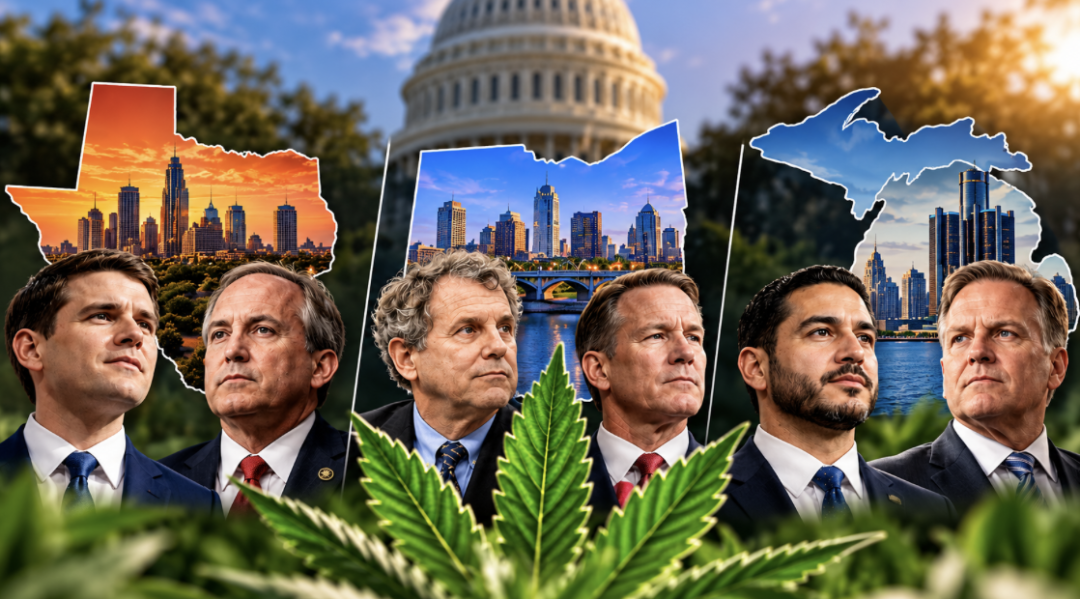
Where 2026 Senate Candidates Stand on Marijuana Legalization, Cannabis Reform and Federal Drug Policy in Three High-Stakes Midterm Battles
Cannabis may not be the first issue voters think about when they look at the 2026 Senate map. But marijuana could be a wild card in 3 key senate races – Texas, Ohio and Michigan. The candidates stance on policy offers a revealing test of where they stand on personal freedom, criminal justice, business regulation and the growing divide between public opinion and federal law or even the need for nanny states.
With control of the Senate at stake, the candidates’ positions matter beyond their home states. Congress could influence marijuana rescheduling, federal prohibition, banking access for cannabis businesses and the rules governing hemp-derived THC products.
And the contrasts are striking: one candidate may promise a legal, regulated market, while another favors maintaining restrictions or has yet to clearly explain a position.
Here is where the leading candidates stand in three races worth watching.
RELATED: President’s Support With Cannabis Consumers Crashes
Texas is shaping up as one of the country’s most consequential Senate contests, and marijuana is an unusually clear dividing line.
James Talarico (Democrat) has made his position unmistakable: he supports legalizing marijuana for adults, with regulated sales and taxes helping fund public safety and health programs. He argues prohibition has failed, pushing consumers toward the illegal market instead of licensed businesses.
Ken Paxton (Republican) represents the opposite approach. As Texas attorney general, Paxton sued cities who adopted local marijuana decriminalization policies, helping overturn those measures. A cannabis industry voter guide gives him a D grade, citing his opposition to broader medical access, reduced penalties and adult-use legalization.
The contrast is especially significant in Texas, where marijuana remains illegal for recreational use. Talarico wants to move toward a regulated legal market; Paxton’s record points toward continued restrictions.
The takeaway: Texas voters face a direct choice between legalization and a tougher enforcement approach, with implications for both consumers and the state’s cannabis-related businesses.

Ohio offers a different political test: Will voters who approved recreational marijuana in 2023 reward a candidate who backed legalization, or favor a Republican whose public position is less clearly documented?
Sherrod Brown (Democrat) has a documented record supporting federal marijuana legalization and decriminalization. He supported Ohio’s Issue 2, which legalized adult-use cannabis, and backed efforts to improve banking access for legal cannabis businesses. As chair of the Senate Banking Committee, he presided over a committee vote on the SAFER Banking Act in 2023.
Brown has also connected marijuana reform with criminal justice, arguing the consequences of the war on drugs deserve attention alongside the industry’s economic future.
Jon Husted (Republican) is the contrast, but with an important caveat: publicly available sources reviewed for this article do not establish a comparably clear, comprehensive position from Husted on federal marijuana legalization. His position should not be inferred simply from his party affiliation.
Ohio’s own cannabis debate remains relevant. State lawmakers have considered changes to the recreational marijuana framework voters approved, making federal policy only part of the story.
The takeaway: Brown has the clearer pro-reform record. Husted’s stance on the future of federal marijuana law is less defined in the available public record, leaving voters with an important question to press him on.
RELATED: Claude AI Plays Detective With A Cold Case
Michigan has already embraced recreational marijuana. The question in this Senate race is how far Washington should go in changing federal law.
Abdul El-Sayed (Democrat) supports marijuana legalization and has framed the issue around civil rights and medical research. He also supports expunging records for nonviolent marijuana possession offenses, an approach aimed at addressing the lasting consequences of past enforcement.
Mike Rogers (Republican) has a more restrictive historical record. During his time in the U.S. House, Rogers voted against an amendment designed to prevent the Justice Department from using federal funds to interfere with state medical marijuana programs. The vote offers a concrete indication of his past approach, although it does not establish his position on every modern cannabis proposal.The distinction matters in a state where recreational marijuana is legal. Federal restrictions can still affect research, banking, interstate commerce and the relationship between state-licensed businesses and federal law.
The takeaway: El-Sayed offers an explicit legalization and expungement agenda. Rogers’ congressional history points toward a more restrictive approach, though voters should seek his current position on specific federal reforms.
RELATED: Great Fall Whiskeys
the growing interest in marijuana and female intimacy reflects something larger than a new use for an old plant. Women are increasingly willing to talk openly about sexual satisfaction—and to question the idea desire should be effortless or pleasure is something they shouldn’t have to work toward.
Cannabis may become a useful part of the conversation, even if researchers have more work to do before they can say precisely who benefits and why.
The real story isn’t marijuana is a miracle bedroom enhancer. It’s women are looking for new ways to make intimacy more enjoyable, and cannabis has entered the conversation.
For some, this may be worth exploring. For everyone else, the more important development may be the conversation itself is finally becoming less taboo.
For cannabis consumers, business owners and criminal justice advocates, the stakes go beyond whether someone can legally buy marijuana at home. The next Senate could help determine whether federal prohibition changes, whether legitimate businesses gain access to banking services and whether people with past marijuana convictions receive relief.
The candidates are not interchangeable, and neither are their records. For voters who care about marijuana policy, the key question is not simply who supports cannabis in theory, but who is prepared to change federal law — and who would preserve the status quo.