

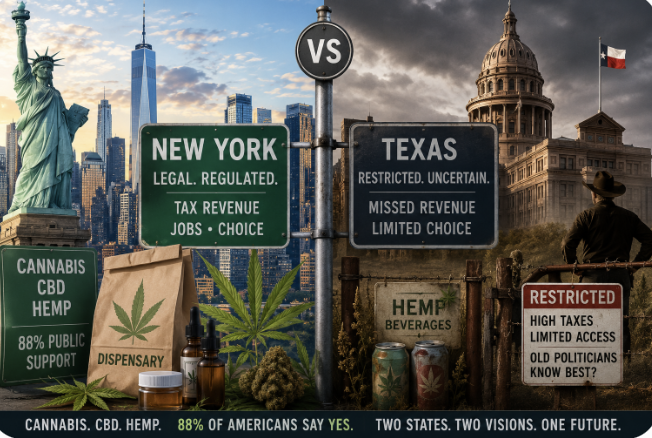
Cannabis, CBD and Hemp Laws: How New York and Texas Are Shaping Tax Revenue, Consumer Choice, Sleep Health and the Future of America’s Cannabis Industry
When it comes to cannabis, CBD and hemp, few comparisons are more striking than two of hte nation’s economic powerhouses. Both are home enthusiasts and millions of older adults who could benefit from expanded access to cannabis products. Yet despite growing public acceptance—roughly 88% of Americans support legal access to cannabis in some form, whether medical, adult-use, or hemp-derived products—New York and Texas take opposite paths on cannabis, CBD and hemp.
New York has embraced legalization. Adult-use cannabis is legal statewide for people 21 and older, a regulated retail market continues to expand, and hemp-derived products are allowed under state oversight. Texas, meanwhile, maintains one of the nation’s most restrictive medical cannabis programs and continues to debate how tightly to regulate—or even eliminate—much of the hemp industry which flourished after the 2018 Farm Bill.
The contrast reflects more than policy differences. It represents two fundamentally different philosophies of government.
RELATED: Gen Z Is Drinking Way Less Than Previous Generations
New York has largely chosen regulation, taxation and consumer choice. Texas has increasingly leaned toward a “government knows best” or nanny state approach, with many critics arguing longtime political leadership is attempting to restrict products a significant portion of the public already supports. Rather than expanding regulated access, lawmakers have repeatedly sought tighter controls on hemp-derived THC products, creating uncertainty for businesses and consumers alike.
The economic implications are significant.
New York’s legal cannabis market is already producing meaningful tax revenue. The state’s Office of Cannabis Management reports cannabis taxes, fees and fines have generated nearly $380 million since adult-use sales began, with revenues climbing as more licensed retailers open and the legal market matures. Forty percent of cannabis tax revenue is directed toward public education, while additional funds support community reinvestment and drug treatment programs.
Texas presents a very different picture.

Because recreational cannabis remains illegal, the state has largely forgone the billions of dollars in potential economic activity seen in other legal states. Independent economic analyses have estimated a fully regulated adult-use market could generate hundreds of millions—if not well over a billion dollars annually—in tax revenue while creating thousands of jobs across agriculture, manufacturing, retail and tourism. Instead, Texas has spent much of the past two years debating additional restrictions on hemp-derived products rather than building upon an industry it helped pioneer.
Ironically, Texas was once viewed as one of America’s most exciting hemp beverage markets.
Entrepreneurs quickly recognized consumer demand for low-dose THC beverages as an alternative to alcohol, creating innovative products which appeared on retail shelves across the state. The market attracted investment, created new businesses and positioned Texas as a potential national leader in hemp-derived beverages. Regulatory uncertainty, however, has slowed momentum considerably, leaving many businesses unsure of the industry’s future.
RELATED: Boomer And Gen Z Consume Marijuana For Similar Reasons
Demographics also make the policy divide especially noteworthy.
Both New York and Texas have rapidly growing populations of adults over age 50. Older consumers increasingly report using cannabis for wellness rather than recreation. Better sleep, pain management, anxiety reduction and improved quality of life consistently rank among the leading reasons for use. Surveys also show about one-third of cannabis consumers report using it to improve sleep, making it one of the most common wellness applications for cannabis today.
This raises an important question: should elected officials decide whether adults have access to regulated products, or should informed consumers make those choices for themselves?
The answer may ultimately shape not only public health, but economic competitiveness.
RELATED: The Numbers Show Americans Support Legal Cannabis
