

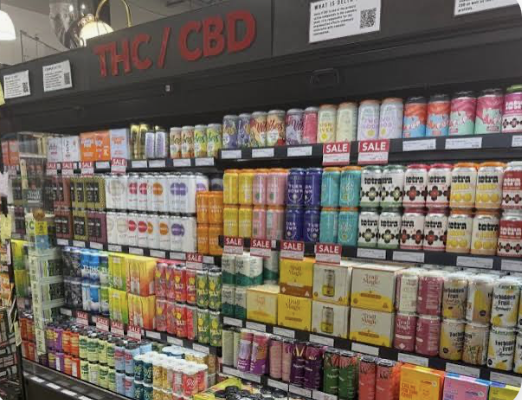
With younger Americans drinking less alcohol, companies are embracing THC beverages, cannabis investments and new drinking occasions as Washington gives the fast-growing hemp drink market more time
For years, cannabis was viewed as a potential threat to the alcohol industry. Now some of the biggest players in beer, wine and spirits seem increasingly interested in making room at the bar.
The latest sign came from Washington, the Senate gives hemp THC drinks a reprieve and alcohol retailers and wholesalers heartily the proposal temporarily delaying a looming federal crackdown on hemp-derived THC products, including the increasingly popular THC beverages showing up in liquor stores, restaurants and bars.
The Senate Appropriations Committee included language in a government funding measure postponing much of the new federal hemp restriction until December 11. The change is far from permanent, and the legislation still has to make it through Congress, but it gives the beverage industry additional time to push for regulation rather than prohibition.
RELATED: The Rise of the “Sober-ish” Guy
That matters because alcohol companies and retailers have a growing financial interest in cannabis staying on the menu.
The Wine & Spirits Wholesalers of America has endorsed legislation preserving legal hemp-derived THC products under a regulated system. Notably, the group supports putting cannabis beverages into a three-tier distribution framework similar to the one used for alcohol.
In other words, rather than simply fighting cannabis, portions of the alcohol industry appear ready to sell it.
The relationship isn’t new.
Constellation Brands, the company behind major beer and wine labels, made one of the industry’s biggest cannabis bets when it invested roughly $4 billion in Canada’s Canopy Growth in 2018. The investment did not perform as hoped, and Constellation later distanced itself from Canopy, but the deal demonstrated just how seriously major beverage companies were taking cannabis.
Molson Coors also entered cannabis beverages through its Truss partnership with HEXO, initially developing nonalcoholic cannabis-infused drinks in Canada and later exploring hemp-derived CBD beverages in Colorado.
Anheuser-Busch InBev similarly partnered with Tilray in 2018 to research nonalcoholic THC and CBD beverages in Canada.
The relationship has since started flowing the other direction. Cannabis giant Tilray has aggressively moved into traditional alcohol, buying eight beer and beverage brands from Anheuser-Busch in 2023 and four craft breweries from Molson Coors in 2024. Its portfolio now stretches across cannabis, THC beverages, beer, spirits and nonalcoholic drinks.
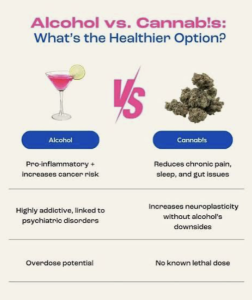
The crossover points toward a larger transformation: Companies may no longer be thinking strictly in terms of “alcohol versus cannabis.” Increasingly, they are competing for the broader adult beverage occasion.
The reason is sitting at the bar—or increasingly, not sitting there.
America’s relationship with alcohol is changing. Gallup reported just 54% of U.S. adults said they drank alcohol in 2025, down from 67% as recently as 2022 and the lowest level in its nearly nine decades of tracking. Among adults ages 21 to 34, 59% reported drinking.
Longer-term Gallup data also show drinking among adults 18 to 34 fell from 72% in 2001-2003 to 62% in 2021-2023. At the same time, marijuana use among younger adults increased substantially.
RELATED: Cannabis Can Help The Wellness Trend Nervous System Regulation
Many clinicians believe the greatest potential may come from combining CBD with very small amounts of THC. This approach, sometimes called the “entourage effect,” suggests the naturally occurring compounds in cannabis work better together than they do individually. Products higher in CBD and lower in THC are often recommended for older adults because they may provide symptom relief while minimizing psychoactive effects.
Scientists are also exploring whether cannabinoids could one day play a larger role in Alzheimer’s treatment itself. Laboratory studies have shown cannabinoids may reduce inflammation in the brain, protect nerve cells from oxidative stress and influence the buildup of amyloid plaques and tau proteins associated with Alzheimer’s disease. While those findings are encouraging, they have yet to be confirmed in large human clinical trials.
For now, experts caution cannabis should be viewed as a tool for symptom management—not as a treatment stopping or reverses Alzheimer’s disease or other forms of dementia.
RELATED: How TV Shows Are Redefining Marijuana in Modern Life
The change in drinking creates a fundamental business problem for alcohol companies. A generation drinking fewer beers, glasses of wine and cocktails doesn’t necessarily mean it has stopped socializing or seeking ways to relax. It may simply want different choices.
THC beverages can potentially fill some of the space while fitting comfortably into an infrastructure the alcohol industry already understands: cans, bottles, coolers, bars, restaurants, liquor stores and beverage distributors.
It explains why the Senate’s temporary reprieve is being greeted warmly by parts of an industry who once had reason to fear cannabis.
The future of hemp-derived THC drinks remains uncertain. Unless Washington changes course, federal rules scheduled to take effect this year would make most of today’s intoxicating hemp products illegal under the current definition.
But alcohol businesses are making their position increasingly clear: They would rather have THC beverages regulated, age-restricted, taxed and sold through established channels than eliminated.
Cannabis may be taking some consumers away from alcohol. The beverage industry appears to have decided the smarter business plan is to make sure it can still sell them something.
