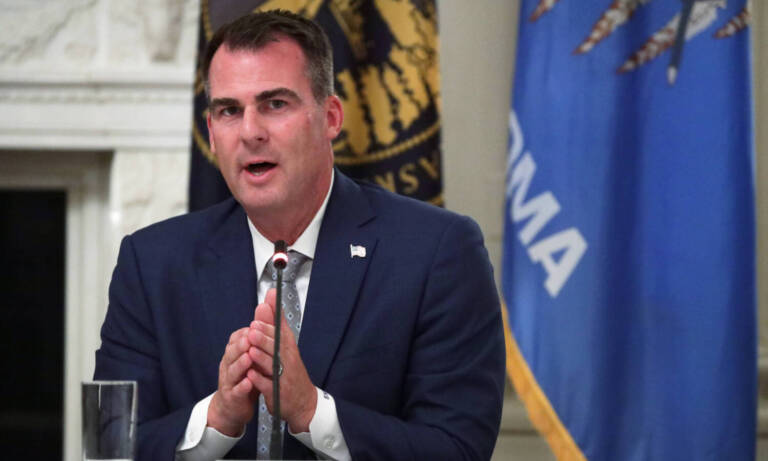
Oklahoma’s Republican Governor Kevin Stitt implied on Monday that voters didn’t quite understand the ballot initiative they overwhelmingly approved in 2018 to legalize medical marijuana. Or perhaps they were misled? The governor said he found the ballot to be “misleading, and it has tied our hands as we regulate the industry.”
The governor, reported Marijuana Moment, pointed to the relatively low cost of obtaining a cannabis business license, noting that without a cap on marijuana operators, the market has expanded at an unsustainable rate.
Photo by Melinda Podor / Getty Images
“Oklahoma charges just $2,500 for a commercial license,” Stitt said, noting that California charges far more, in fact up to 72 times more. “As a result, we have seven times the growers in California with just 10 percent of the people.”
Then the governor moved on to neighboring Arkansas. “Next door in Arkansas, they have eight growers. We have 8,300,” the governor said. “You know as well as I do that not all of that product is being sold legally. This is a perfect example of why we need to make sure initiative petitions represent Oklahomans and not out-of-state special interest groups.”
The governor advised that voters should be aware of all the details before changing voting to change the Constitution.
“While we can’t change the past, we can learn from it and improve our future. We’re getting the right leaders in place and untying their hands to enforce the laws.”
Stitt said he’s directed law enforcement to “crack down hard on the black market,” adding that “drug cartels, organized crime, foreign bad actors have no place in the state of Oklahoma.”
Meanwhile, Oklahoma legalization advocates filed another initiative recently in the hope of placing it before voters on the 2022 ballot.
A former NFL player now involved in the cannabis industry estimates more than 80% of players in the league use weed.
Cannabis use in professional sports is becoming more and more common. In a recent interview, a former pro athlete says he thinks that over 80% of professional football players are using cannabis.
Tavarres King, who was a professional NFL player for over seven years and played for the Georgia Bulldogs, is now involved in the cannabis industry. He told an Atlanta news station that, “I would probably say around 80 % of the guys in our league use cannabis,” and includes himself in that percentage “100 percent.”
“Playing with it, laser-sharp. I was laser-sharp, laser-focused,” King explained. Marijuana helped him deal with his anxiety and helped him focus when he needed it most. When asked about smoking before important games, alongside important players, King said that he still used cannabis to his advantage. “I did my job.”
King is the CEO of Suite 420 Access and Rowdy Wellness, two cannabis companies, the former facilitating the entry of minorities to the cannabis industry and the latter selling cannabis wellness products.
“My first love of football has directly guided me to my current career as an entrepreneur in the cannabis industry,” he recently told MG Magazine. “Playing in the NFL, with all of the daily challenges physically, mentally and emotionally, taught me a lifelong lesson that I can achieve anything if I put my mind to it.”
When discussing his interest in the cannabis industry, he said, “I absolutely love this industry—the opportunities it brings, the health and wellness aspects, the business and financial strategies, and especially that it’s still an emerging industry with more room for growth.”
Photo by Elsa Olofsson via Unsplash
King joins a growing cadre of pro athletes who believe in cannabis and what it can do for their bodies and performances. Players from the NBA, NFL, MLB, and more have all divulged their cannabis use during games and how the drug helped them achieve their goals and remain focused in moments of high stress.
From using marijuana as a painkiller to helping athletes stay focused, cannabis is becoming a topic that’s more and more openly discussed. Still, sports leagues remain cagey about its use, testing for it and creating controversy out of a drug that’s becoming increasingly accepted and legalized, and that, despite the many reservations that may be, is no performance enhancer.
Much of the worst environmental damage has been done on public lands, with illegal growers having leveled hilltops, bulldozed Joshua trees and dipped into the water table.
The California Department of Fish and Wildlife’s (CDFW) cannabis enforcement program recently released its year-end numbers for the 2021 calendar year, revealing that 2.6 million illegal weed plants were eradicated and 487,270 pounds were destroyed.
The CDFW, which investigates illegal cannabis grows as they pertain to environmental damage, said in its recent report that some of the most serious environmental issues involve unauthorized stream bed alterations with water diversions, habitat destruction, illegal use of pesticides and poaching.
Photo by CRYSTALWEED cannabis via Unsplash
“Illegal operators who are trying to bypass the legal system are a threat to California’s fish and wildlife resources, and a detriment to those legally cultivating cannabis,” said David Bess, deputy director of the CDFW.
Though recent statistics showed that illegal cultivation is moving away from public land to private property, this doesn’t mean that ambitiously large crops of weed have not been discovered by the CDFW’s 68 cannabis enforcement officers and other park rangers.
In the spring of 2021, park rangers in Death Valley National Park stumbled across a massive, illegal grow. The 40-acre weed farm was found in the remote and rarely visited Jail Canyon, an area near the border between California and Nevada.
A park spokesperson said at the time that rangers flew over the area to “photograph the extent and to (hopefully) encourage the growers to abandon the site.”
According to local media, the illegal grow was one of hundreds found and eradicated in Death Valley over the last decade. Like the CDFW, officials in the area stressed that marijuana grow sites can damage or cause irreparable destruction of the national park for similar reasons: pesticides, clearing of protected lands and diverting water resources.
Much of the worst environmental damage has been done on public lands, with illegal growers having leveled hilltops, bulldozed Joshua trees and dipped into the water table.
“The natural and cultural resources in these areas are irreplaceable and invaluable, damaging them for profit shows incredible disrespect to our homeland,” Barbara Durham, Traditional Historic Preservation Officer for the Timbisha Shoshone Tribe, said in a statement. The Timbisha Shoshone Tribe’s reservation is within Death Valley National Park.
Photo by Sharon Mccutcheon/EyeEm/Getty Images
Drug Cartels
Many of the grows are thought to be the work of highly organized drug cartels that take advantage of the forests’ thick canopy to help hide their operations. Some sites go undetected for years.
“The true crime here is the fact that they’re killing off basically America’s public lands, killing off the wildlife, killing off our water,” said Kevin Mayer, a U.S. Forest Service law enforcement assistant special agent. “This is stuff that, you know, it’s not gonna repair itself.”
Previously, Schumer said that he would like for the bill to reach President Biden’s desk before the unofficial cannabis holiday 4/20, though it is highly unlikely this will happen.
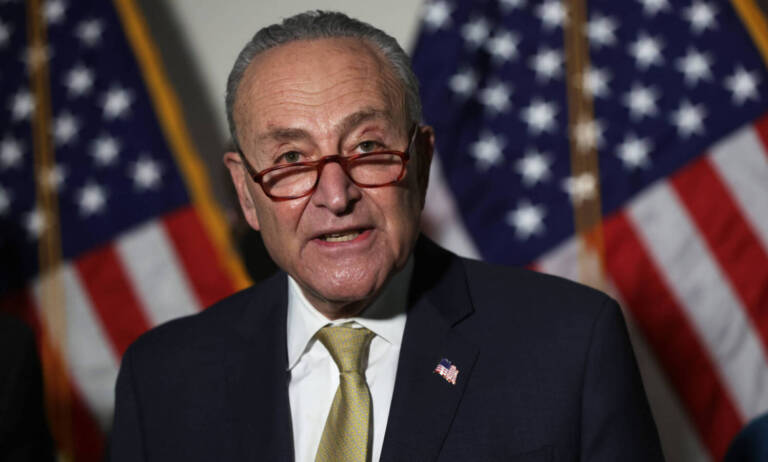
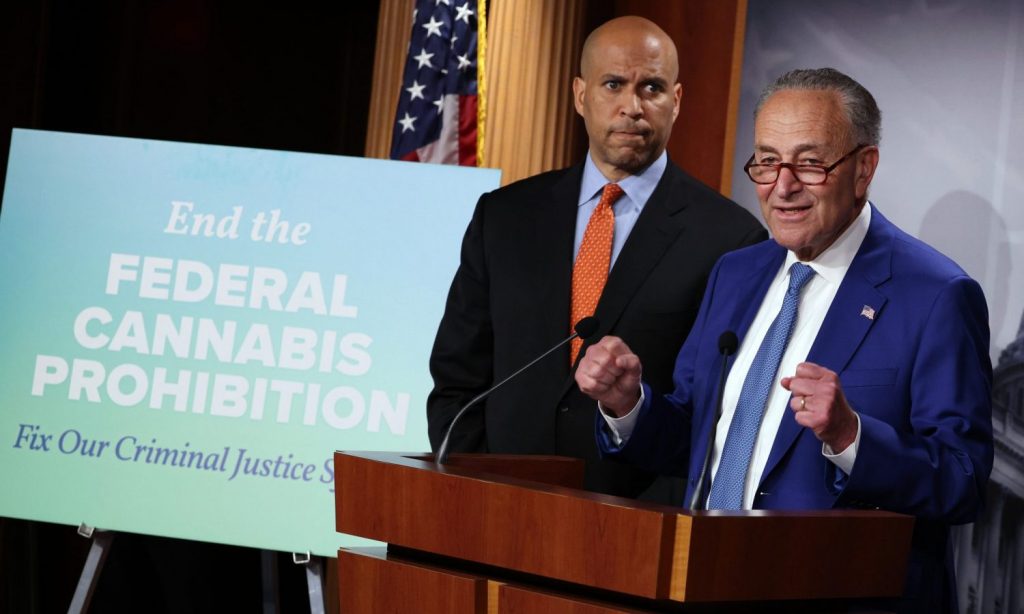
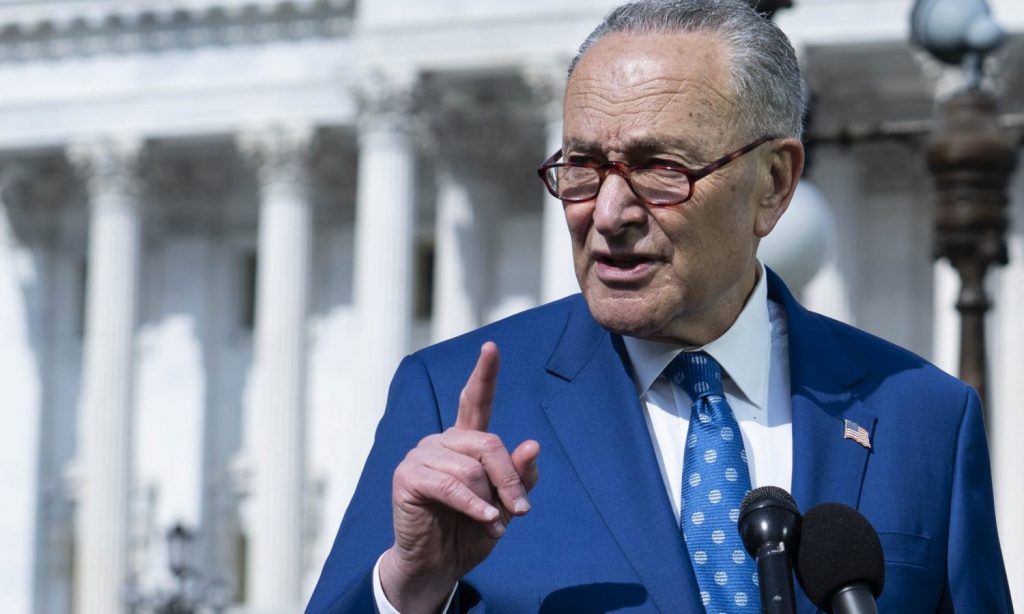
Senate Majority Leader Chuck Schumer (D-N.Y.) and fellow Sens. Cory Booker (D-N.J.) and Ron Wyden (D-Ore.) introduced the outline of the proposed Cannabis Administration & Opportunity Act in July last year. Then on Friday, Schumer told reporters that he plans to officially file the long-awaited bill to federally legalize cannabis this April reported Marijuana Moment.
At the same press conference in New York City, House Judiciary Committee chairman Jerrold Nadler (D-NY), talked about the advancements on his separate legalization measure. The event also included House Small Business Committee chairwoman Nydia Velazquez (D-NY), New York lawmakers and advocates with the Drug Policy Alliance and other organizations.
Photo by Kevin Dietsch / Getty Images
“In the coming weeks, we’re ramping up our outreach—and we expect to introduce final legislation. Our goal is to do it in April,” Schumer said. “Then we begin the nationwide push, spearheaded by New York, to get the federal law done. As majority leader, I can set priorities. This is a priority for me.”
It’s been around six months since Schumer unveiled details of the bill.
“Right now, we’re taking those comments [on the draft version] and reaching out to Democratic and Republican senators,” Schumer said, adding that “we have some Republican support.”
It was not clear if Schumer was referring to having GOP cosponsors of the legislation or if he was talking about general support from voters.
“If any senators have other ideas that they want to add to the bill, as long as it keeps social and economic justice as the spearhead, we’re happy and willing to listen,” he said.
Previously, Schumer said that he would like for the bill to reach President Biden’s desk before the unofficial cannabis holiday 4/20, though it is highly unlikely this will happen, seeing that the official filing is announced for April, and there has to be several committee hearings afterward.
Photo by Sarah Silbiger/Getty Images
New York As The Model To Look Imitate
“We want to renew the case for comprehensive marijuana reform that repairs the harm of the war on drugs at the federal level, using the great work that has been done here in New York as an example and way to lead,” Schumer said, “Just because we have a state law, the federal law still creates problems, and that’s why one of the many reasons we need to change it.”
In the meantime, Nadler talked about his Marijuana Opportunity, Reinvestment, and Expungement (MORE) Act.
“The war on drugs—and particularly the criminalization of marijuana—has been a failure that has unleashed untold suffering on millions of Americans, especially within minority communities,” Nadler said. “I am proud to stand here with Senator Schumer, and with the many other legislators and advocates with us today, who are leading the way in reforming our laws and bringing justice to those who have been harmed by these unfair and destructive policies.”
Mick Mulvaneywrote that a medical cannabis bill the state Senate was debating this month “does not fall neatly” into any pre-existing notion of Republican orthodoxy.
The ongoing medical cannabis debate resumed on Tuesday in the South Carolina Senate.
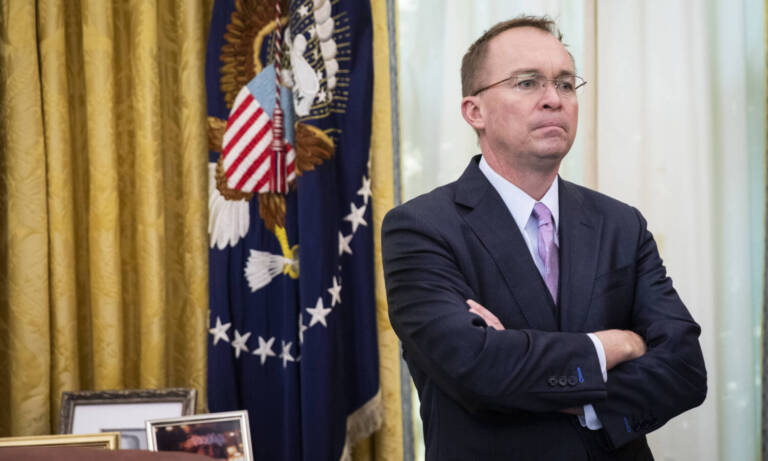
Mick Mulvaney, former President Trump’s White House chief of staff, is criticizing his own party for opposing a bill to legalize medical marijuana. He called local legislation “something that merits discussion and reasoned analysis,” even if it’s not a proposal that is conventionally considered a conservative priority, reported Marijuana Moment.
Photo by LPETTET/Getty Images
The South Carolina GOP (SCGOP) apparatus has also vocally opposed a congressional bill to end federal prohibition that was filed by a Republican congresswoman representing the state.
Described as a conservative approach to medical marijuana, the bill is titled the South Carolina Compassionate Care Act. However, leaders of the Palmetto State see the measure from a different angle. The SCGOP even paid to circulate a message from a sheriff attacking Davis’s bill.
Former Top Trump Aide Calls Out SCGOP
Triggered by his own state party, Mulvaney is now publicly criticizing SCGOP’s campaign against a bill to legalize medical marijuana.
In an op-ed for FITSNews that was published on Thursday, Mulvaneywrote that a medical cannabis bill the state Senate was debating this month “does not fall neatly” into any pre-existing notion of Republican orthodoxy.
“By allowing doctors the right to prescribe medical-quality cannabis (derived from marijuana) for certain severely-ill patients, the bill raises issues related to everything from law enforcement to allowing patients and doctors more control over health care decisions,” Mulvaney wrote. “It is then, the precise sort of proposal that screams out for reasoned debate.”
For him, suchdiscussion would have been “welcomed” if he was a legislator.
Mulvaney, who continuously voted to back marijuana reform amendments, also pointed to federal “Right To Try” legislation, enacted under the Trump administration.
“If that debate had taken place, the party might also have been made aware of the overwhelming public support for limited medical marijuana,” Mulvaney wrote.
There’s no better time of year than Black History Month to honor Black pioneers in the cannabis industry. Here are four outstanding trailblazers.
One of the undeniable realities of the War on Drugs is that it had a disproportionate impact on Black cannabis enthusiasts. Even so, there are numerous Black pioneers within the world of cannabis that have made an immeasurable impact.
This is the reality, even though there are a multitude of barriers that have restricted Black entrepreneurs from the legal marijuana industry. In fact, some of the ways these pioneers have affected the industry may come as a surprise. There’s no better time of year than Black History Month to honor these pioneers.
The Canna MDs
In 2014, Doctors Rachel and Jessica Knox, who are known as the Canna MDs, founded the American Cannabinoid Clinics in 2014. The purpose of the clinics is to deliver “precision cannabinoid medicine to every patient seeking a personalized approach to healing.”
They got the idea to start the clinic when their mother, Dr. Janice Knox learned about the diversity of medical marijuana patients, along with the benefits of it while her daughters were in college. Now, there are multiple clinics operating throughout the state of Oregon. Their impact when it comes to spreading the word about the therapeutic properties of cannabis has been tremendous.
Hope Wiseman
Becoming a dispensary owner comes with enough barriers for Black entrepreneurs as is. That’s why it’s so impressive that a Black Woman was able to do so at the young age of 25, making her the youngest Black dispensary owner in the nation. Wiseman graduated from Spelman College, an HBCU, and has a background as an investment banker.
Wiseman operates Mary and Main dispensary in Prince George’s County, Maryland, with the pillars of social activism, education and philanthropy at the core of their operations. Mary and Main provides a wide range of therapy treatments and products that help customers aid their discomfort that includes topicals, dry herb and extracts.
Wanda James
Wanda James founded Simply Pure Dispensary with her husband, Scott Durrah, in Denver, Colorado in 2010. When they opened the dispensary, they became the first Black dispensary owners in the nation. Since both Wanda and Scott are both veterans, they pride themselves on serving their fellow servicemen and women.
Given the fact that they opened Simply Pure at the dawn of cannabis legalization in Colorado, they’ve been able to adjust accordingly in order to provide one of the best dispensary experiences in Denver.
Brittany Moore & Alphonso T. Blunt Jr.
There aren’t very many equity-oriented dispensaries out there, and an Oakland couple recognized the need for one. That’s why Brittany Moore and Alphonso T. Blunt Jr. opened the first equity dispensary in Oakland, Blunts+Moore. They are among the earliest beneficiaries of an equity-program launched in 2017 meant to license Oakland residents with a local cannabis conviction, or who are residents of areas that experience a disproportionately higher number of cannabis-related arrests.
Blunts+Moore operate a 4,000 square foot dispensary that offers hundreds of products including edibles, concentrates and herbs. Since they’re demonstrating an ability to thrive as beneficiaries of the new Oakland equity program, the hope is that they’re providing a blueprint for other Black entrepreneurs to follow in the future.
Ski resorts are caught in the middle of murky legal issues surrounding state and federal cannabis policies.
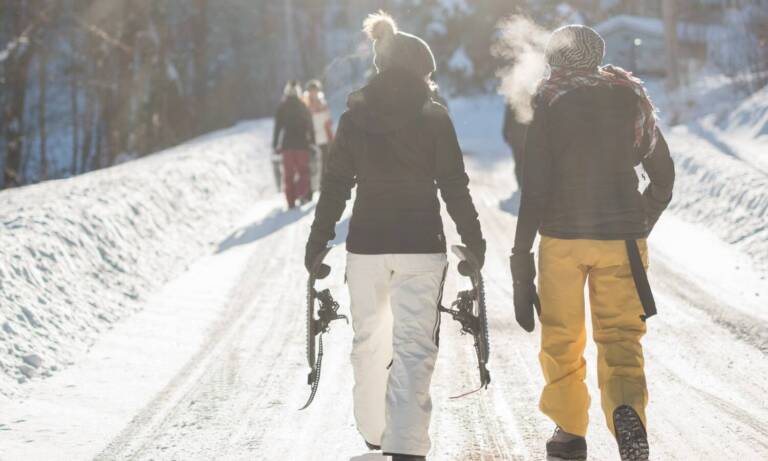
China Peak Mountain resorts have been forced to position some workers to enforce federal cannabis policies around their property. The recent happenings at this establishment make it a perfect example to describe the contrasting state and federal laws.
Photo by Harrison Moore via Unsplash
The Cannabis Policy at China Peak Mountain
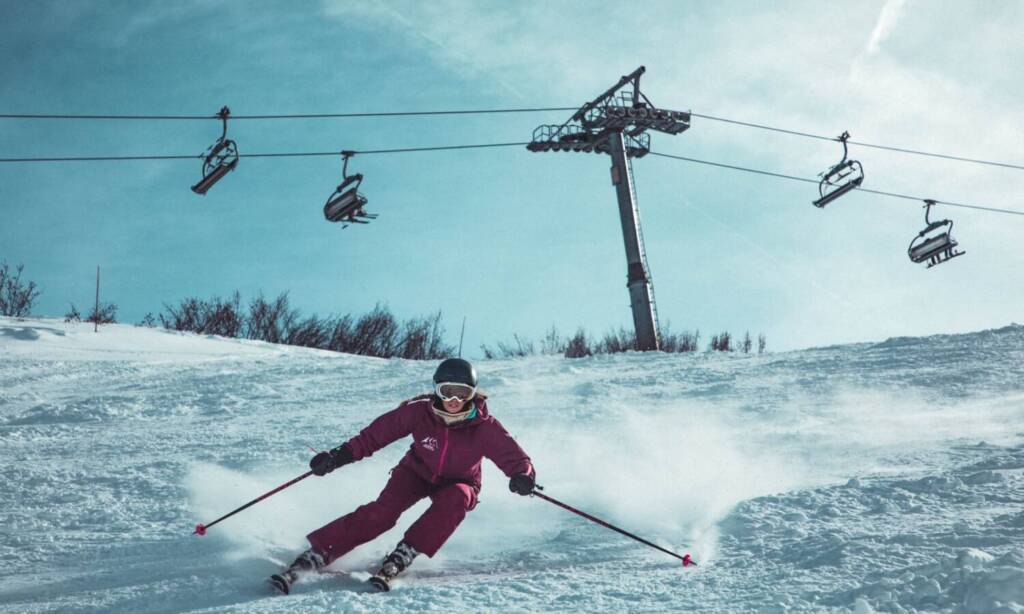
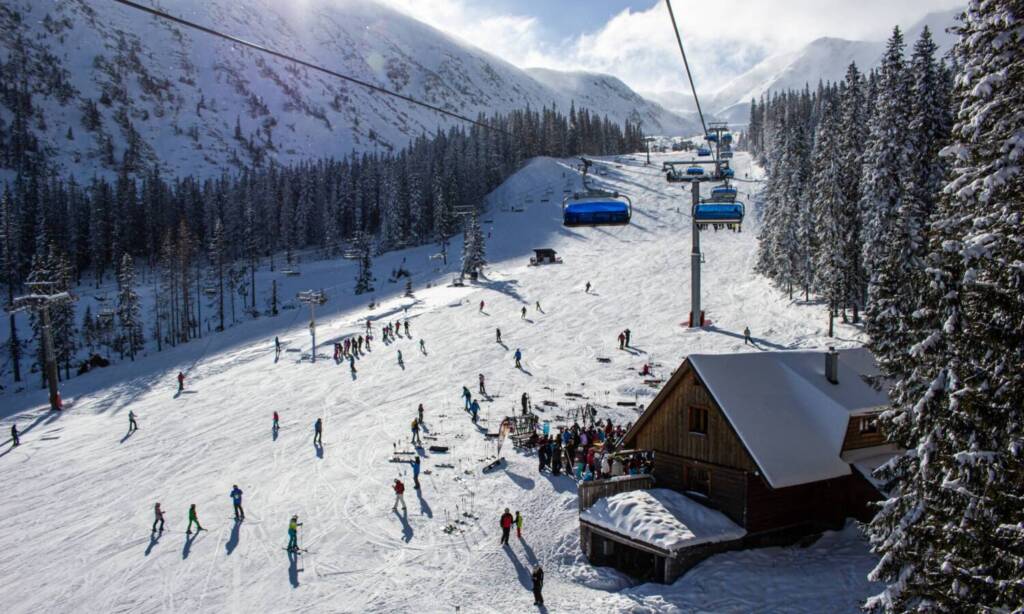
China Peak Mountain is a ski resort in California, located 110 kilometers northwest of Fresno. However, it operates primarily on federal lands. Therein lies the dilemma.
California cannabis legislation permits the recreational and medical use, sales, and cultivation of cannabis plants, but federal laws do not. Cannabis is a Schedule I substance according to the Controlled Substances Act. Other substances in this group include heroin, psychedelics, and cocaine.
This patchwork of cannabis policies has left ski resorts like China Peak Mountain in a confused state, unsure of which cannabis consumption laws to stick to. The Fresno-based resort currently adheres to federal laws and frowns against all forms of cannabis consumption on its grounds.
China Peak Is Cracking Down On Cannabis Use
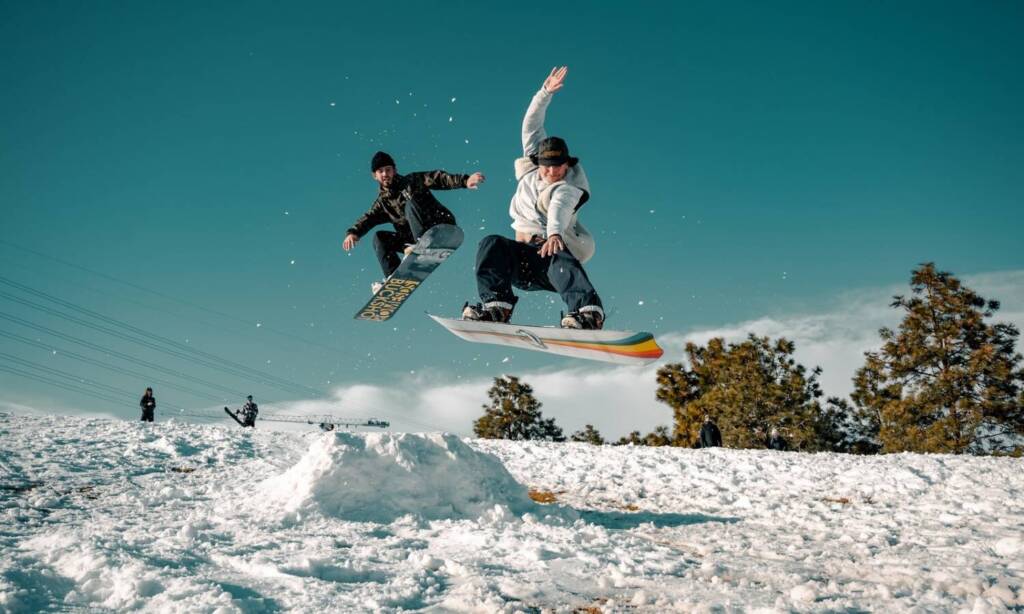
In December, the China Peak management posted an Instagram story detailing its stance against marijuana use on its grounds. The resort explained that California’s cannabis consumption laws are the opposite of the federal laws. Although the drugs are legal within the California borders, their consumption within the resort is an illegal act.
The resort’s location on United States Forest Service Federal Land means it must abide 100% by its federal laws.
This gentle reminder was accompanied by a series of punishments that could be meted out to visitors found using cannabis. The report stated that employees would be positioned at various locations around the resort grounds to crackdown on its customer base who are adamant about using marijuana around the ski areas.
In addition to this, the management also mentioned that it had received dozens of complaints from consumers who did not like the smell of cannabis. These complaints popped up throughout the last season and increased towards the end of the year. This reinforced the management’s decision to ensure all customers obeyed the federal rules. Staff are positioned in the parking lots, on lifts, and at several points on the ski grounds to prevent cannabis-consuming individuals from using the premises.
More Controversies
The Instagram post was received with mixed feelings. The post also received a lot of backlash from angry patrons who have promised to resist the resort’s stance.
Those found using cannabis in the resort will be removed immediately, according to the management. Customers who insist on resisting will have their passes voided for the remainder of the season, and they will be restricted from the resort’s grounds with no exceptions. Depending on the severity of the offense, the management says it would not allow some individuals to purchase the next season’s pass.
Photo by Colin Lloyd via Unsplash
The post’s conclusion, which begs patrons to stick to the new rules, also sparked outrage. Some patrons maintained that there should be a safe space for cannabis use on the grounds, despite the management’s wish to maintain its good standing with the USFS.
Softening Its Stance
Barely 48 hours after the post was put up, Tim Cohee, owner of China Peak Resorts, made another post on the company’s Facebook page. He wrote that he and his board were not happy to be in such an awkward position as this. He added that he was frustrated with the contradictory cannabis policies throttling the resort’s operations. While he and the resort’s management had expected the post to receive mixed views, they had not expected it to go as badly as it did.
Cohee further wrote that this stance was giving the resort extra running costs, as new employees had to be hired to ensure all points were monitored at all times. This is because the resort does not have the staff numbers or the time to enforce these rules. He emphasized that the resort does not want to act as an enforcement officer, but they have no choice.
He asked that marijuana users respect the rules and consider the wishes of other guests, their families, and friends who find the smell of cannabis offensive. He added that cannabis smokers could temporarily leave the resort premises to consume weed to prevent being removed from the property for the whole day or more.
Finding a Lasting Solution
Cohee expressed the frustration of many ski resort owners in the United States. To make matters worse, many of the country’s largest ski resorts are located in cannabis-legal states but on federally granted land. Many consumers are often perplexed about how these laws work out, and it’s not surprising because even the workers in the cannabis industry do not understand the constraint policies. Many owners have to find a compromise on this issue, and this confusion will linger until federal cannabis reform is finally approved.
Photo by Michal Knotek from Pexels
Enforcing federal laws has become a bother to privately-owned resorts and even national parks. Many park officials and personnel stated that some cannabis users might be perplexed about the state’s existing cannabis laws and why it is not permitted in these parks. Some come in with their medical marijuana cards issued by their home states in a bid to get around the federal laws being enforced. It’s high time Congress took cannabis reforms more seriously to clarify and resolve these challenges.
At least six cases were filed against people found with cannabis in national parks in Wyoming alone. Alex Freeburg, a criminal defense attorney, explained that these parks and ski resorts have to enforce the law as it is written, regardless of whether or not the guest has a medical marijuana card.
Bottom Line
China Peak’s cannabis situation is not unprecedented. In recent years, many resorts have lost potential customers due to these contrasts in federal and state cannabis consumption laws. The same goes for states with no cannabis reform.
Cannabis users have flooded into canna-legal states in droves to purchase and use the substance legally. This way, they get to enjoy cannabis without technically breaking their state’s laws.
There’s a good chance that none of the claims in this study can be replicated in a clinical setting, meaning that at this moment, you can simply ignore this research.
Did you hear about the latest study that claims using cannabis has negative impact on your ability to think and that it may continue after you stopped using? Yes, in essence, the study suggests that by using cannabis you will experience a detrimental effect on your cognition and that it may be permanent irrespective if you are young or old.
Of course, one would expect that with such outlandish claims that at the very minimal the researchers would provide substantial evidence, however, by their own admission, the “quality of evidence is low or moderate” despite them claiming that it was “of high quality”.
Photo by Dejan Marjanovic/Getty Images
Furthermore, none of the media publications that covered the research posted any data on the findings but simply regurgitate the same drivel as what the official study said in its PR release.
In today’s article, we’re going to be taking a closer look at some modern day Reefer Madness and how this anti-cannabis rhetoric becomes a part of the national conversation.
What the Actual Study Claims
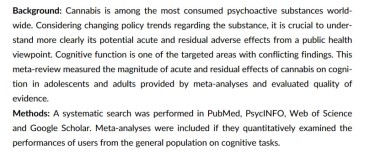
Let’s start with the Abstract of the research.
As you can see, that what the study did was utilize Meta-analyses on particular papers found on the databases of PubMed, PsycINFO, Web of Science and Google Scholar. They then took all of these studies and compiled them to compare all the data.
They then created categories to look for specific changes including;
Learning and Memory
Attention
Processing Speed
Perceptual Motor Function
Language
According to their findings, “verbal learning and memory” had the most impact when people were allegedly under the influence and that “persisted when the acute intoxication (aka the high) passed”.
For the rest of the categories, the researchers claim that “small to moderate” effects were experienced, and all with “lasting effects”.
Can We Trust the Data?
These are legitimate studies, but I’ve been covering cannabis for longer than these Researchers have and know a thing or two about the nature of the studies available in these databases. Firstly, it is a known fact that the vast majority of cannabis research is predominantly negative not because cannabis is a risky or dangerous plant, but because the vast majority of the funding went to studies to illustrate the negative impact of cannabis.
Photo by Charles Wollertz/Getty Images
Therefore any meta analyses would have a negative bias in the result as there is not enough evidence to counter the claims. There isn’t enough research into the benefits and even the quality of the evidence that was used by the researchers were “low to moderate”.
Furthermore, this analyzes takes both acute users and moderate users, old and young, and throws them all in one pile. Because as we all know, the physiological and cognitive health of a young person is exactly the same as an older person…because “SCIENCE!”
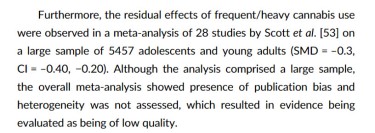
The screenshot above shows us one section of a Meta-Analysis it utilized within their critical analysis and as you can see, they included evidence of “low quality”.
The question then should be, “why are we still talking about “Low Quality” of evidence. Of course, researchers use these papers to ask for grants on more specific studies, but when a study is flawed from the get go, riddled with errors – it creates a disingenuous picture of what is really happening.
We Need Honest Cannabis Science
At this point in the article I’m going to stop reporting on the study since the vast majority of the studies they utilized are not replicable in a lab setting. In other words, these are once more “assumptions” based on a rhetoric of people who don’t fully understand the drug or may have had a bias against the substance.
However, as someone who has been reporting on cannabis for more than a decade, I don’t think that it’s bad to see whether cannabis has long lasting effects. It’s in the consumer’s best interest to have as much data as possible to make educated decisions about consumption.
Photo by RODNAE Productions from Pexels
However, in order to do this we need to have funding that not only looks into the potential negative effects of cannabis. In virtually all of the studies, “dose, previous use, tolerance,” all played a factor in the degree of “intoxication” and “impairment” as a result. This means that if someone smokes often, they begin to build up a resistance to these effects – yet according to the study, “it doesn’t matter”. Young, old, heavy user, moderate – their data shows that there’s residual effects in them all.
But that’s not true because there are millions of cannabis users that outperform their non-smoking counterparts in all of these levels of cognition. Cognition and intelligence, retention, and higher cerebral functions can be influenced by a myriad of things such as a lack of sleep, excess stress, poor diet.
This means that cannabis doesn’t necessarily have any causal relationship to the effects illustrated in the study, meaning that we don’t have an accurate picture of the whole truth. In fact, we now have a skewed version of the truth that is being published on multiple sites as “fact”.
Trust in the Institutions
C19 wrecked the trust people have in their institutions. Everyone saw the ineptitude not only of the government, but many of the scientific bodies. There is corruption within the scientific ranks and the pharmaceutical industry has long funded anti-cannabis scientists. When studies of this nature come to light, it doesn’t help to inspire more trust. Rather, it seems that there are researchers desperate to prove their biases by compiling data, playing with queries to create a narrative that fits their hypothesis.
There’s a good chance that none of the claims in this study can be replicated in a clinical setting, meaning that at this moment, you can simply ignore this research even though I’m certain you’re going to see rehashed versions of the findings published on media outlets around the world.
New York senator Michelle Hinchey filed legislation called “Cannabis Container Bill of Rights,” which pushes for recycling across the cannabis industry once retail sales officially begin, reported Marijuana Moment.
The measure asks marijuana shops to provide a $1 deposit for any cannabis product sold in single-use plastic containers and to reimburse customers when they return the container. The proposed legislation would also demand that all cannabis products use packaging made from 50% recycled materials, at a minimum.
Last year, Hinchey sponsored another measure that would give priority to hemp-based packaging over synthetic plastics for cannabis products.
The bill’s justification segment notes that New York’s recreational cannabis law has important packaging demands like childproof sealing, which have caused the industry to have an enormous plastics footprint.
“The legal cannabis industry in the United States produces about 150 million tons of waste each year. Even when marijuana packaging is recycled at home, it is often sorted out by recyclers and taken to landfills,” it says. “While no industry is blameless in the plastic pollution crisis, New York has a unique opportunity to prevent a new source of plastic pollution as we consider the legalization of recreational marijuana.”
This bill is the same as one filed by Assemblymember Patricia Fahy (D) last year, but this new Senate version had been presented to the Senate Environmental Conservation Committee.
New York Cannabis Program Overview
Among other policy changes and updates confirmed since New York State’s legalization took effect in March last year, one of the most significant was the employee cannabis testing policy update. In October, New York became the first state in the Union to prohibit employers from testing most employees for cannabis.
In addition, New York Senator Jeremy Cooney (D) proposed a bill that would allow transgender and non-binary people to qualify as social equity applicants under the state’s cannabis law.
The FDA has pushed for the fast approval of COVID-19 vaccines for kids under the age of 5. Here’s when these shots will be available.
COVID-19 vaccines for children under the age of 5 have been heavily debated. Despite Pfizer and Moderna pushing for their emergency approval, everyone involved is reticent to get it wrong. Still, if everything were to work accordingly and the FDA were to approve the shots, children between 6 months of age and 5 years old could start receiving them late this month or the next.
This past Tuesday, Pfizer and Moderna requested emergency authorization from the US Food and Drug Administration in order to get vaccines to kids under the age of 5. Clinical trial data and all of the pertinent information will be submitted soon, with the FDA meeting on February 15th to reach a conclusion.
“The confidence of the American public depends on that, that you’re recommending something that you would give to your own children,” said Dr. Paul Offit, director of the Vaccine Education Center at Children’s Hospital of Philadelphia, to CNN. “It all depends on the data. The data will tell us just how good these are. There should be a robust safety profile and a robust efficacy profile and immunogenicity profile. And if that’s true, speed doesn’t really matter, as long as they have those data.”
If the vaccine were to be approved, it would function like all of the Pfizer and Moderna vaccines, requiring two shots at separate times for the initial full inoculation. Still, pending more studies, kids under the age of 5 might work differently than older children and adults. Pfizer has some data dating back to December showing that two shots didn’t build up the expected immunity and that a third might be necessary.
According to health experts, the approval of the vaccine has been pushed forward in order to address the growing numbers of COVID-19 infections and hospitalizations seen in kids under the age of 5.
Following the vaccine’s approval, vaccinating kids under the age of 5 should be relatively easy with a few caveats. While doctors and health practitioners will likely be equipped with how to vaccinate these kids, some pharmacies might not have the personnel with the necessary training for vaccinating children these young.