

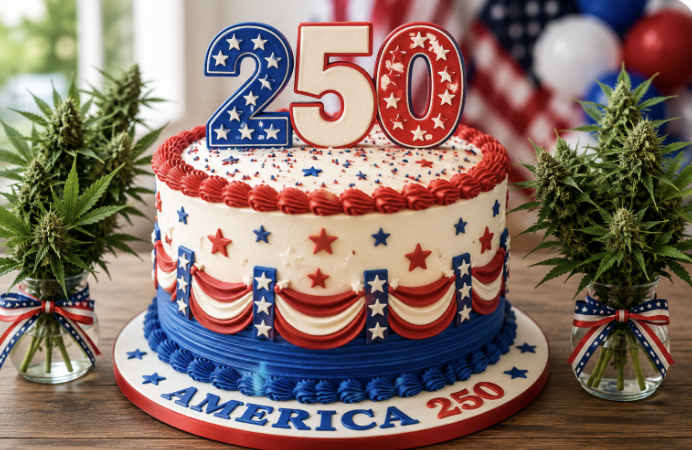
From colonial hemp farms to a multibillion-dollar cannabis industry, America’s 250th anniversary highlights the evolution of marijuana, CBD and hemp.
As the United States celebrates its 250th anniversary, Americans are reflecting on the people, industries, and ideas which helped shape the nation. Among the more surprising stories is the long and often complicated history of cannabis, hemp, and CBD—a journey mirroring many of the country’s broader themes of innovation, regulation, controversy, and reinvention.
But what about cannabis at America’s 250th birthday? Well long before cannabis became the subject of modern political debate, hemp was one of America’s most valuable agricultural crops. Here is the tale….
RELATED: Did You Know This About The 4th Of July
During the colonial era, hemp was grown throughout the American colonies to produce rope, sails, clothing, paper, and other essential materials. Because of its durability, hemp played a critical role in maritime commerce and military preparedness. Several of the Founding Fathers, including George Washington and Thomas Jefferson, cultivated hemp on their farms, although historians continue to debate precisely how extensively they used the crop.
In the nation’s earliest years, hemp was viewed simply as an important agricultural commodity. It helped support farmers, manufacturers, and the young country’s economy. Few could have imagined the plant would later become one of America’s most controversial policy issues.
The 20th century dramatically altered cannabis’ place in American society.
Beginning in the 1930s, marijuana became increasingly associated with criminal activity through aggressive anti-drug campaigns. The Marihuana Tax Act of 1937 severely restricted cannabis, and federal prohibition expanded in 1970 when marijuana was classified as a Schedule I controlled substance under the Controlled Substances Act. The designation placed cannabis alongside heroin and LSD, declaring it to have no accepted medical use and a high potential for abuse.
For decades, federal policy largely remained unchanged.
Yet public attitudes slowly evolved.
California became the first state to legalize medical marijuana in 1996, opening the door to a movement which would eventually spread across much of the country. Today, medical cannabis is legal in dozens of states, while many have also approved adult-use recreational marijuana. Millions of Americans now purchase cannabis products from licensed dispensaries operating under state regulations.
Alongside marijuana came the rise of CBD.
Interest in cannabidiol accelerated after families began reporting CBD-rich products appeared to help children suffering from certain forms of epilepsy. Scientific research expanded, and Congress passed the 2018 Farm Bill, which legalized hemp containing less than 0.3 percent delta-9 THC. The legislation transformed CBD into one of America’s fastest-growing wellness categories.
RELATED: The Best 4th Of July Cocktails
oday, CBD can be found in oils, creams, beverages, gummies, pet products, cosmetics, and nutritional supplements. Although the Food and Drug Administration continues evaluating many health claims, consumer demand has remained strong as researchers continue studying CBD’s potential therapeutic applications.
Hemp has also experienced its own renaissance.
Modern hemp is once again being used to manufacture textiles, biodegradable plastics, construction materials, paper products, insulation, animal bedding, automotive components, and even sustainable building materials such as hempcrete. Farmers across the country have embraced hemp as an alternative crop with growing commercial potential.

Meanwhile, the legal cannabis industry has become a significant economic force. Analysts estimate the industry supports hundreds of thousands of jobs while generating billions of dollars in annual sales and billions more in state tax revenue. Cannabis businesses now include cultivators, processors, laboratories, retailers, software companies, security firms, manufacturers, and research organizations.
RELATED: Marijuana May Become Part Of Your July 4th Tradition
Despite the growth, federal law has not fully caught up. Marijuana remains federally illegal even as many states regulate legal markets. The ongoing federal rescheduling process represents the latest chapter in a policy debate has evolved dramatically over the past several decades.
As America marks 250 years of independence, cannabis, CBD, and hemp offer a unique lens through which to view the nation’s history. A plant once valued by colonial farmers became prohibited, stigmatized, medically reconsidered, and economically revitalized. It has influenced agriculture, medicine, manufacturing, criminal justice, and public policy in ways few other crops can claim.
Much like the country itself, the story of cannabis in America has been one of constant change. And as the nation enters its next quarter millennium, the journey is far from over.
