

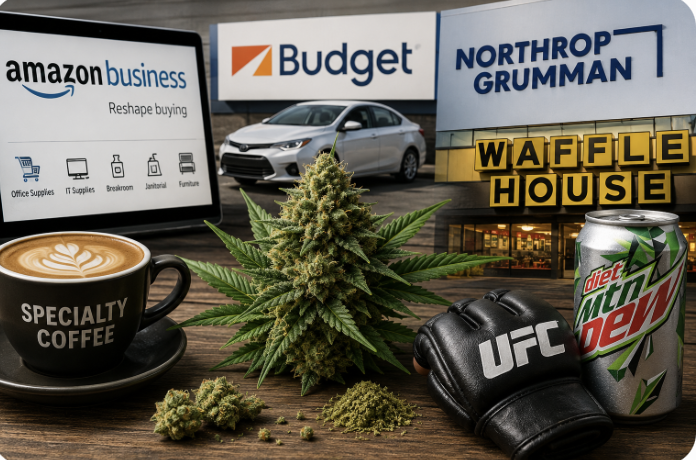
The legal cannabis industry now rivals billion-dollar sectors including specialty coffee, defense contractors, rental cars, and professional sports entertainment.
The legal cannabis industry has grown from a niche market into one of America’s largest consumer businesses. Depending on the report and whether medical and adult-use markets are combined, the U.S. legal cannabis industry now generates roughly $35 billion to $40 billion in annual sales. While those numbers are impressive on their own, who is the same size as the cannabis industry? Comparing cannabis to other well-known industries provides a clearer picture of just how significant the market has become.
One of the closest comparisons is specialty coffee. Americans spend tens of billions of dollars each year on premium coffee purchased through coffeehouses and specialty retailers. Like cannabis, specialty coffee has transformed from a luxury purchase into a mainstream lifestyle product with loyal consumers and premium branding.
RELATED: What New Research Says About Cannabis And Testosterone
Another surprisingly similar comparison is Amazon Business, the company’s business-to-business marketplace. Although Amazon’s overall revenue exceeds $600 billion annually, its Amazon Business division has grown into an operation generating tens of billions of dollars in annual sales, placing it in the same general neighborhood as the legal cannabis market.
The rental car industry also provides perspective. Major brands including Enterprise, Hertz, Avis, Budget, National, and Alamo collectively generate annual revenues comparable to the current size of the U.S. cannabis industry. Both industries depend heavily on consumer demand, tourism, and regional regulations.
Cannabis is also approaching the scale of some of America’s largest industrial employers. Defense contractors such as Northrop Grumman and General Dynamics each generate annual revenues in the $40 billion to $45 billion range. While these companies operate in entirely different sectors, their annual business volumes illustrate just how economically important cannabis has become.

Professional sports entertainment offers another point of reference. UFC has become one of the world’s premier mixed martial arts organizations, while WWE remains the global leader in professional wrestling. Individually, each company generates well over $1 billion annually in revenue. Even when combined, however, UFC and WWE remain far smaller than the legal cannabis industry, highlighting cannabis’ remarkable commercial growth.
Restaurant chains tell a similar story. Waffle House, one of America’s most recognizable dining brands and the Waffle House Hurricane Index, operates more than 2,000 locations across 25 states and generates an estimated $2 billion annually in sales. This represents only a fraction of annual legal cannabis revenue, despite Waffle House serving millions of customers every year.
Food products provide another fascinating comparison. Ranch dressing has become America’s favorite salad dressing, with annual retail sales exceeding $1 billion. Likewise, the U.S. soft drink market generates tens of billions of dollars each year through brands such as Coca-Cola, Pepsi, Dr Pepper, Sprite, and Mountain Dew. While soda remains substantially larger than cannabis, both industries rely heavily on consumer loyalty, product innovation, and strong retail distribution.
RELATED: How TV Shows Are Redefining Marijuana in Modern Life
What makes cannabis particularly remarkable is its growth trajectory. Unlike many mature industries, cannabis continues expanding as additional states legalize medical or adult-use marijuana, product innovation accelerates, and consumer acceptance grows. Analysts project continued expansion throughout the remainder of the decade, particularly if federal regulations become more favorable.
Cannabis has already evolved far beyond its image as a niche or emerging market. Today it competes economically with established industries spanning retail, hospitality, manufacturing, agriculture, entertainment, and consumer packaged goods. Whether compared with specialty coffee, billion-dollar defense contractors, rental cars, professional sports organizations, restaurant chains, or iconic food brands, one conclusion is clear: legal cannabis has become one of America’s largest and fastest-growing industries.
As legalization continues expanding and investment increases, the cannabis industry is expected to become an even more significant contributor to jobs, tax revenue, consumer spending, and the broader U.S. economy.
