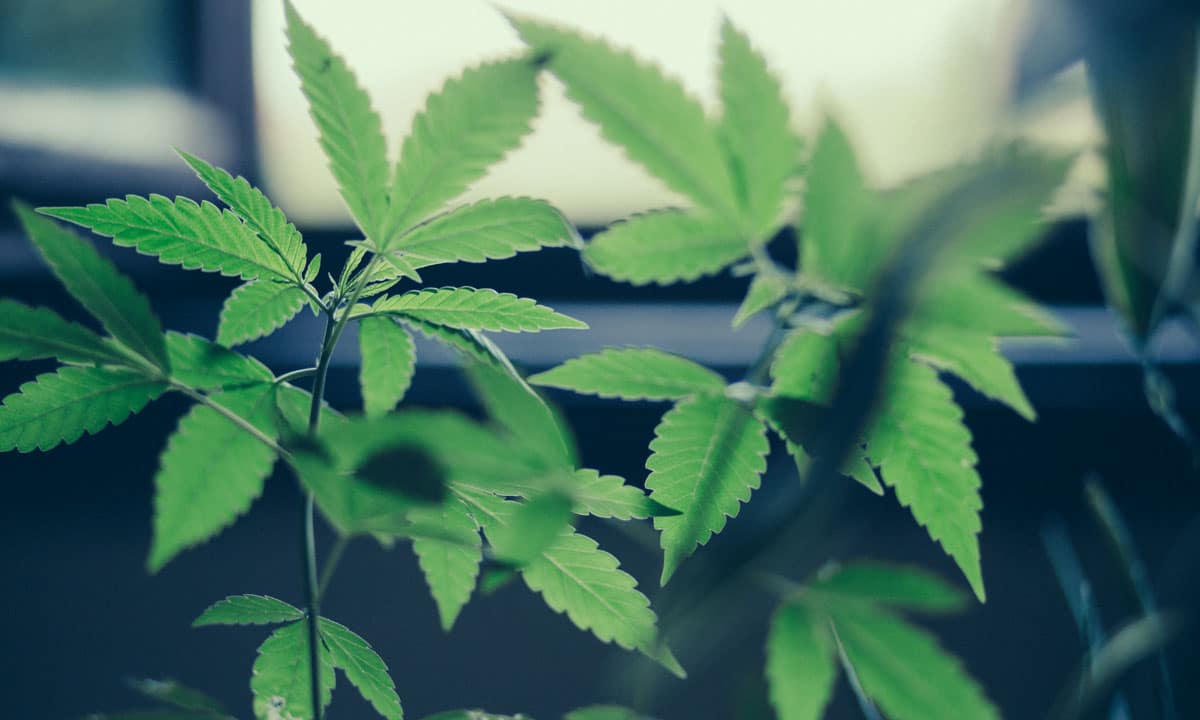
We know baby boomers have begun to embrace cannabis in recent years, thanks to legalization and awareness trends. According to the National Survey on Drug Use and Health, the 50-and-over crowd increased “significantly” from 2006 to 2013. However, the numbers started to drop with the 65-and-over crowd. However, that trend could change in the coming years thanks to further marijuana outreach campaigns within legalized communities. A chain of Seattle retirement homes recently took its residents on a Pot for Beginners tour to learn more about cannabis—and buy some, if the resident were so interested. The goal was provide information about the methods of consumption and the various applications marijuana can have in treating medical ailments.
“You can only play so many games of bingo,” Connie Schick told the Guardian. “My son thought it was hilarious that I was coming here, but I’m open-minded and want to stay informed. Cannabis has come so far from the days when you smoked a sly joint and got into trouble if they found out. We used to call it hemp then and didn’t know its strength. It just used to make me sleepy, so I didn’t see the point.”
Shick uses a wheelchair after suffering a stroke. So she was particularly interested in how marijuana can be used to treat pain.
“It’s so different now,” Schick said. “There are so many ways you can take it, and all these different types to help with aches and pains.”
According to a Gallup poll, more than 3% of the 65-and-older crowd smokes cannabis. This comes a time when individuals with two or more chronic conditions who used cannabis over the past year doubled. In addition, cannabis is being used to treat medical conditions that usually strike older crowds.
The Pot for Beginners tour came out of a desire from the residents. Baby boomers who once dabbled with the drug in their youth are now returning to cannabis for recreational and medicinal benefits. But first they had a few questions.
“They wanted to know where it was sold, how much money was made from it, where it was grown,” said Tracy Willis, who is resident home chain’s director of corporate development. “We’ve had a good reaction [to the tours] from nine out of 10 relatives, but some are horrified. One angry daughter said we were encouraging marijuana use. Her mother told her to butt out.”
The Pot for Beginners tour isn’t the only outreach program occurring across the country. As the New York Daily News reported earlier this year, one New York cannabis company was employing a similar strategy to help the state’s new medical marijuana program. Etain is one of the five companies licensed to grow and sell medical marijuana in the state. To help educate and provide their services to older folks, they’ve been contacting senior and long-term health care centers.
Under the arrangement being offered by Etain, the company would work with a nursing home and help its medical staff register with the state to certify patients for the drug. The company would then, under the state’s newly-authorized home delivery program, deliver the pot directly to patients or family members, who would administer the drug themselves.
There are promising signs regarding how marijuana can treat diseases like Alzheimer’s and Parkinson’s. We’ve also seen how cannabis can benefit patients with chronic pain diseases like Trigeminal Neuralgia. So if marijuana can help older folks, it’s no wonder why they’d want to learn more.
When you’re starving, it can feel like such a chore to cook for yourself, but waiting for the delivery or driving to the shop can take just as long as just begrudgingly whipping up a pantry cleaner. Trips to the Asian market leave me with bits and bobs of bulk purchases like noodles, sauces, and spices. Even when the only green in sight is a wilted scallion, this dish shines.
Japan, Korea, and Chinatowns in any city are going to have versions of cold noodles with iterations of the same theme: complex and refreshing. The only heat in sight is the spice, which like many a tropical culture has proven to be an internal temperature regulator. Dosed sesame oil is worth keeping around for these meals, whether hot and soupy or chilled and full of chilis, you can add that medicating hit to many dishes.
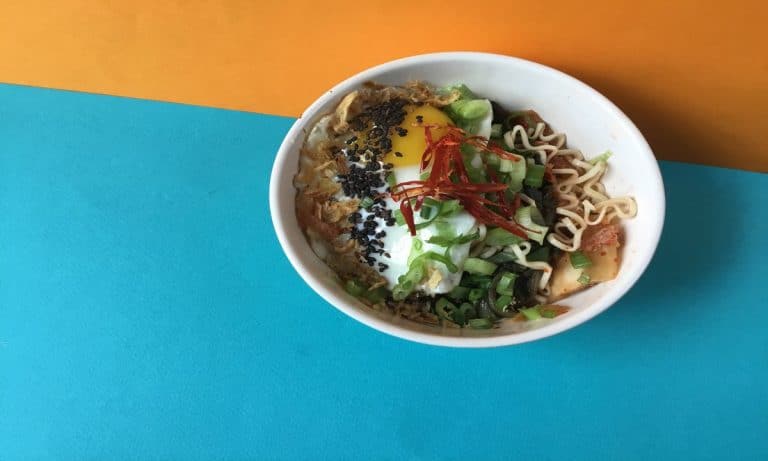
Photo by Danielle Guercio
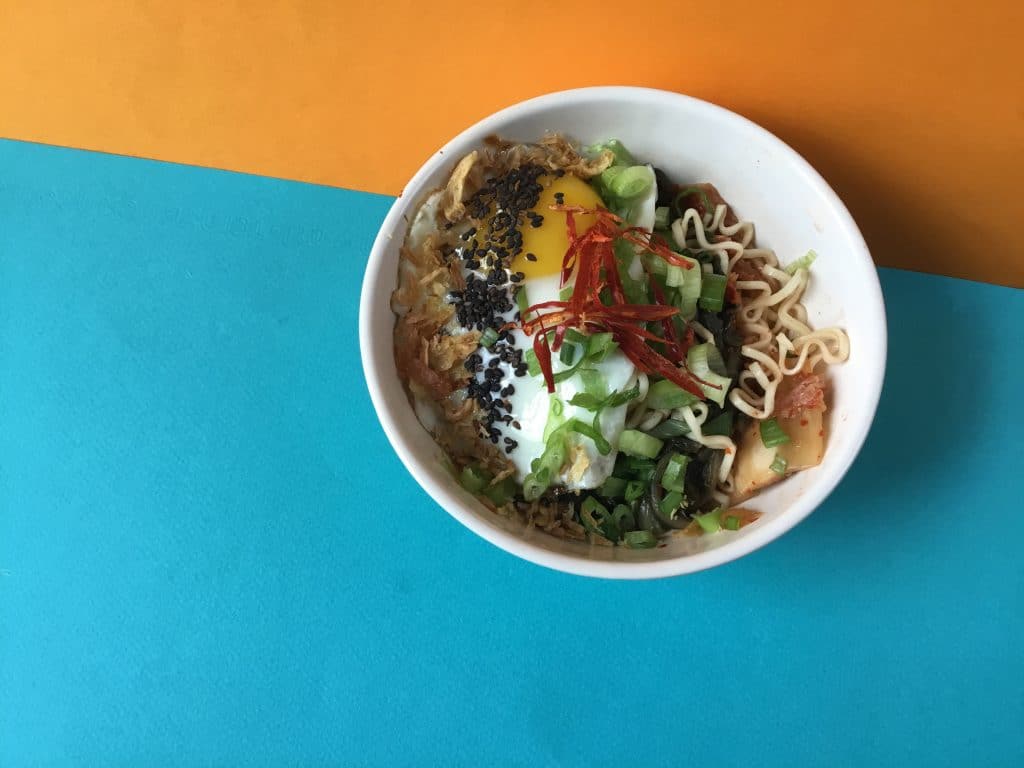
Cannabis Kimchi Cold Noodles
Danielle Guercio 2017 Makes 2 servings; 7mg THC per serving
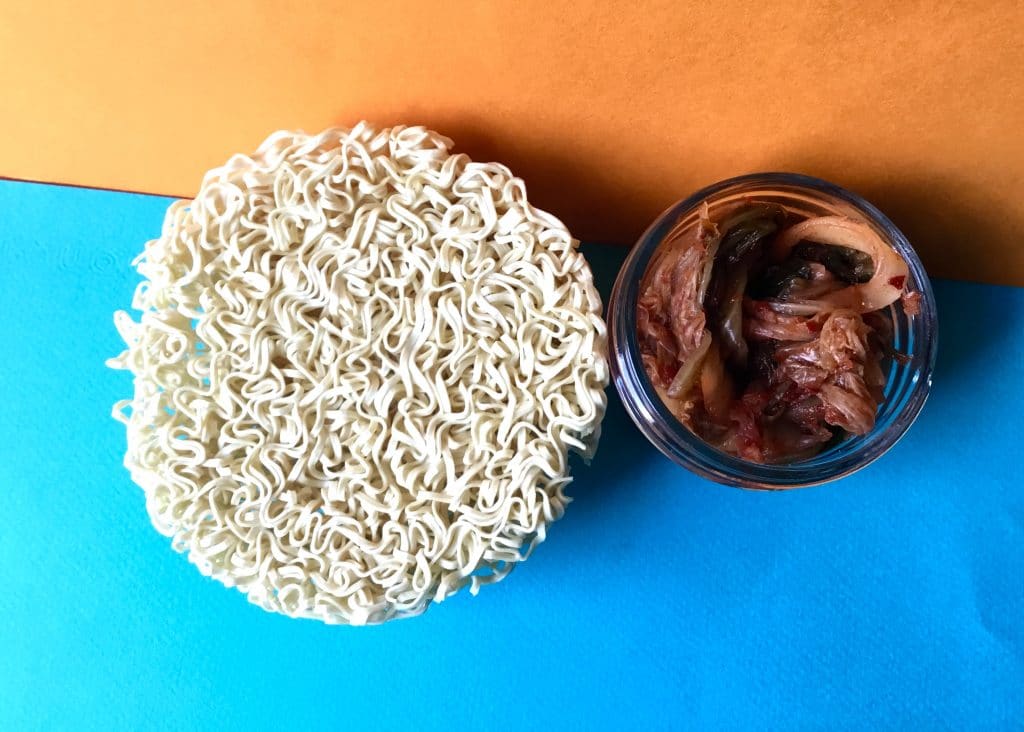
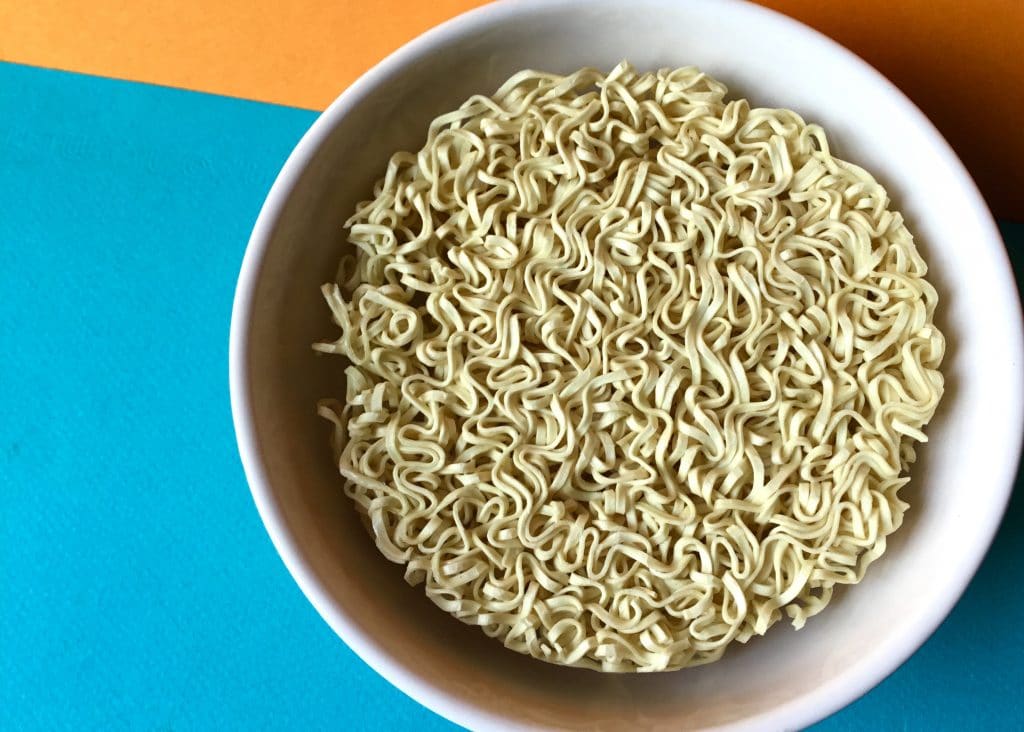
2 bricks instant wheat ramen noodles
4 c boiling water
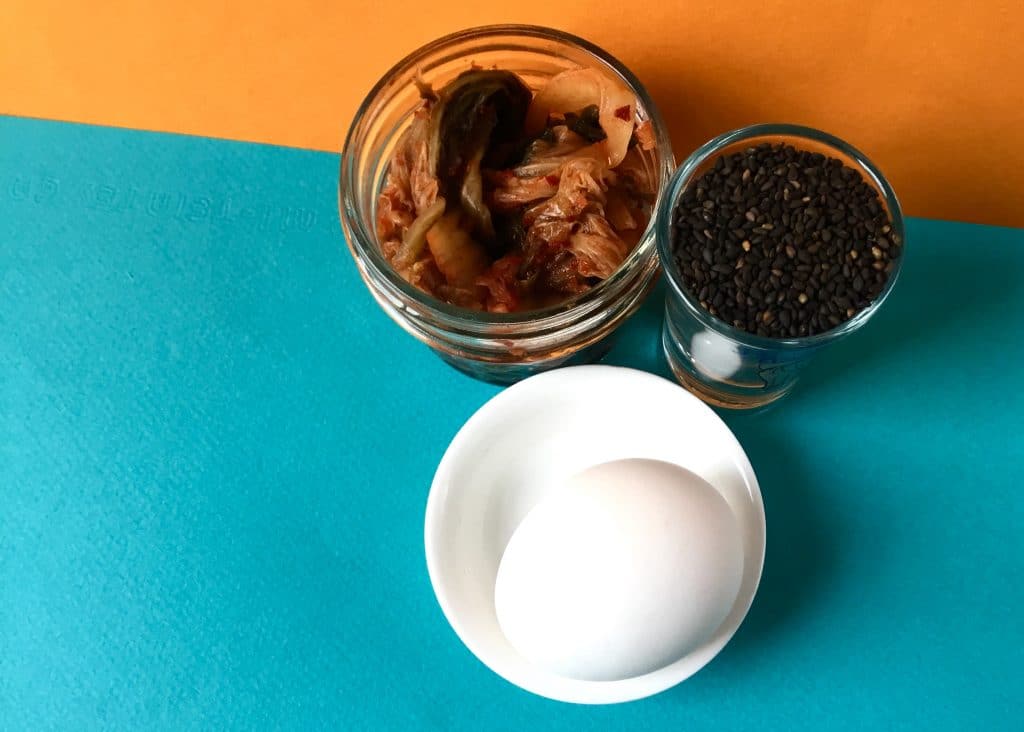
½ c kimchi, roughly chopped
1 Tbs rice wine vinegar
1 tsp cannabis infused sesame oil*
For the Garnish
Scallions
2 sunny side up eggs
Sesame seeds
Fried onions
Shredded chilis
Photo by Danielle Guercio
Put one noodle block into a bowl. Pour over boiling water and allow to sit for 4 minutes. You can cook these without a pan or a pot if you have a hot water kettle, if not just make in a regular pot on the stovetop.
Strain in a colander and rinse with cold water. Allow the noodles to drain for a minute while you whip up the sauce.
Photo by Danielle Guercio
Stir together the oil, kimchi, and vinegar in one of the bowls. Split between the second bowl, top each with noodles and toss. Add garnishes and dig in!
*Cannabis Infused Sesame Oil
Decarboxylate 7g of finely ground cannabis at 225 degrees for 20 minutes in a tightly sealed, oven safe container. Put in lidded mason jar or vacuum sealed bag with cannabis and four ounces of coconut oil. Heat in water bath just under boiling for at least 1 hour. Strain and add 1 oz infused oil to 2oz sesame oil. Stores in fridge for 4 weeks.
Photo by Danielle Guercio
If you remember to stop at one of these types of spots on the way home, great! Drizzle on your infused sesame oil if that’s the case.
If you are forgetful and rushing home to your weed, like I usually am, these ingredients keep in the fridge and pantry forever. This is why dosing dinner is an earned reward after a long and depleting day. Whether you have to work through the night or post up on the couchie for a Hulu sesh, you’ll be fed and won’t break up a sweat.
So imagine you’re a kid at the airport with your family, and while waiting to board your plane, you pass the time looking at magazine covers in a book store. Your mom says you can pick a book to read on the plane. Being a nerdy kid, obsessed with toys and cartoons, I gravitated towards the comic books, and that’s when I saw it. The comic book that would be my first: Amazing Spider-Man #1.
No, I wasn’t some kid in an airport in 1963, about to buy a comic book and a pack of smokes at eight years old. This took place sometime in the 90s when Marvel had reprinted some of their #1 issues. ≈
I remember seeing a similar looking copy of an X-Men issue, but only knowing the X-Men from the cartoon, I didn’t recognize any of the characters on the cover (the original X-Men). The Spidey cover, however, featured Spider-Man trapped in a glass tube, seemingly captured by the Fantastic Four. I tore it apart on the plane that day, absorbing every panel, teaching myself how to read and follow the speech bubbles and narrative captions. Later that comic was probably shredded underneath a mountain of Legos in my closet, but I can never forget my first.
I grew to love more heroes and books, and later I would look for specific artists and writers, but my heart has always held a special place for Spider-Man. The anticipation I felt getting ready to see his first movie in 2002 is equal to the giddiness and excitement I feel preparing to watch the sixth—Spider-Man: Homecoming. It doesn’t matter how many times they reboot the franchise, I just love seeing that guy swing from building to building on the big screen.
Rebooting the Spider-Man universe for the second time, Sony has teamed up with Marvel Studios. The comic book giant gets their flagship character back in the Marvel Cinematic Universe, which is how he appeared in 2016’s Captain America: Civil War.
Following the events of that film, Peter Parker (Tom Holland) returns to Queens and his regular life of attending high school by day, and fighting crime by night as the Amazing Spider-Man. After running afoul of the villainous Vulture, (Michael Keaton) Peter’s already hectic life is further disrupted.
This movie is just what the doctor ordered for both Sony and Marvel. A coming-of-age story that breaks up the current superhero model. He’s not like Iron Man or Thor; Spider-Man is a high school kid, who’s not just trying to understand his new amazing powers and abilities, but also how to navigate his regular life in the meantime. Also, we can all rejoice in the fact that it’s not an origin story. We’ve seen it twice now already and get the gist—great power, great responsibility, you know the rest.
They’re also introducing many new/never-before-seen characters (most notably villains) from the Spider-Man mythos, as well as completely new characters. Vulture might not have name-brand recognition with casual moviegoers, but it’s a sly decision on the studio’s part. Vulture was the second supervillain Spider-Man ever faced. He also appeared twice in the first 7 issues of The Amazing Spider-Man comic (Issues #2 & #7). And with Michael Keaton playing the role, we’re sure to see an amazing performance.
Although it hasn’t been officially stated, it seems like they’re borrowing a lot of elements from the Ultimate universe version of the character. Ultimate Spider-Man by Brian Michael Bendis, Bill Jemas and Mark Bagley was truly an incredible comic book and modern take on the character. Tom Holland himself has stated that he used this version for his own inspiration in portraying the character.
“The comics that sort of resonated with me most and I used for my performance was the Ultimate Spider-Man comics,” Holland told IGN. “They’re so modern and up-to-date with what’s happening in the world right now. For me, it was just a really, really strong thing to follow and I have so many screenshots on my phone from like lines that were written that I stole to use for the movie.”
From that first issue I read in the airport to this sixth movie entry, a connective web runs through every version of Spider-Man. That’s why Spider-Man: Homecoming can’t come soon enough. The movie opens in the U.S. on July 7.
The U.S. Drug Enforcement Administration (DEA) established a new code toward the end of 2016 confirming that, “marihuana extracts” are Schedule I drugs under the Controlled Substances Act.
Although the agency has said that anything derived from the cannabis plant is and always has been ranked among the most dangerous drugs in the world, the existence of a “new code number” sent the companies that market hemp products into a state of panic over concerns that it was just a greasy prelude to a shakedown.
But the truth of the matter is the legal status of these products did not change. The DEA did not make any scheduling adjustments, because it did not need to. DEA officials said last year that marijuana and hemp extracts “have been and will continue to be Schedule I controlled substances.”
However, attorneys for the hemp industry argue that the DEA’s action puts “lawful” hemp products in the same category with controlled substances. The situation has spawned a lawsuit that is now in the hands of the 9th U.S. Circuit Court of Appeals. The decision from this court could reportedly “chart a new course for the hemp industry,” reports the Cannabist.
The federal government considers “all parts of the plant Cannabis sativa L., whether growing or not; the seeds thereof; the resin extracted from any part of such plant; and every compound, manufacture, salt, derivative, mixture, or preparation of such plant, its seeds or resin” to be a controlled substance. Yet, by definition, “mature stalks and seed incapable of germination” are not included in the Schedule I classification.
The DEA said last year that the new code would not jam up common hemp products sold throughout the United States. But hemp industry leaders say the agency has already used it clarification on extracts to make busts in a number of jurisdictions. The lawsuit, which is being overseen by Denver’s Hoban Law Group, calls for a judicial review of the Controlled Substances Act and Agricultural Act of 2014, otherwise known as the Farm Bill.
Hoban’s lawsuit claims that the DEA’s extract code is the equivalent to scheduling action.
“The final rule creates this new drug code, indicative of being a controlled substance, for substances which are in fact not controlled pursuant to the (Controlled Substances Act),” according to the lawsuit. “Specifically, the final rule dictates that the mere presence of ‘cannabinoids,’ which are not controlled substances, is the determinative factor of whether a compound is a ‘marihuana extract.’
“Further, the final rule overbroadly defines ‘marihuana extract,’ without reflecting that certain portions and varieties of the genus Cannabis sativa L. are congressionally exempted from the CSA and/or are exempted from being treated as controlled substances altogether pursuant to the relevant laws, as enacted by Congress.”
Some other members of the hemp trade argue that there is no reason to challenge the DEA, since it is taking a mostly hands off approach. There are concerns that legal action will only increase enforcement.
Although the outcome of the lawsuit would only carry weight in 11 U.S. jurisdictions, it would provide some much needed clarity for the DEA’s new code.
Lindsay Lohan took to Twitter on Fourth of July to defend the Commander-in-Chief, writing, “THIS IS our president. Stop #bullying him & start trusting him. Thank you personally for supporting #THEUSA.”
The comment was a response to a Breitbart post shared by a Trump supporter with the caption, “For ALL YOU CRYBABIES At @CNN Whining About Trump Beating Up Your Logo Take A Look At What A REAL POTUS & Man Does.”
“@realDonaldTrump @IvankaTrump @FLOTUS @DonaldJTrumpJr are kind people,” Lohan wrote, referring to First Lady Melania Trump as well as Ivanka and Donald Trump Jr. “As An American, why speak poorly of anyone?”
Tupac Dumped Madonna Because She’s White, His Prison Letter Reveals
“Can u understand that? For you to be seen with a black man wouldn’t in any way jeopardize your career. If anything it would make you seem that much more open [and] exciting,” he explained. “But for me at least in my previous perception I felt due to my ‘image’ I would be letting down half of the people who made me what I thought I was. I never meant to hurt you.”
“I offer my friendship once again this time [I’m] stronger [and] focused. If you are still interested I would like to further discuss this with you but some of it couldn’t wait,” he wrote. “I felt compelled to tell you … just in case anything happened 2 me. Please be careful Madonna. Everyone is not as honorable as they seem there are those whose hearts bleed with envy & evil. They would not hesitate to do you harm! Let my 6 bullets be proof of that!”
The letter will be up for auction July 19-28 at Gotta Have Rock and Roll. The starting bid is listed at $100,000.
Love the fresh dirt we bring over daily from Naughty Gossip? Let us know in the comments!
It’s hard to make sense of cannabis regulation. Today we ask, are patents for marijuana possible? What can we expect in the future?
The Drug Enforcement Administration continues to categorize marijuana as a Schedule I drug. That means the government believes it has “no currently accepted medical use and a high potential for abuse,” putting it in the same league as LSD and heroin.
The Trump administration has expressly voiced skepticism of marijuana’s medical benefits, with Attorney General Jeff Sessions calling them “hyped.” Yet, legal pot has become a multi-billion-dollar industry that stuffs the coffers of eight states where voters have approved its legal recreational use. And nearly 30 states have legalized pot for medicinal purposes so far.
This burgeoning industry has also witnessed the issuance of dozens of patents related to cannabinoids and various strains of cannabis, including ones on marijuana-laced lozenges, plant-breeding techniques and methods for making pot-spiked beverages. Some of these products contain a significant amount of THC, the psychoactive ingredient in marijuana that makes people high.
As a professor who researches and teaches in the area of patent law, I have been monitoring how private companies are quietly securing these patents on cannabis-based products and methods of production, even though marijuana remains a Schedule 1 drug. An even richer irony is that the government itself has patented a method of “administering a therapeutically effective amount of a cannabinoids.”
This engagement with the patent system raises several interesting questions as the legal pot industry grows and medical research on cannabis advances.
Patenting Living Things
First of all, how can anyone or any entity obtain a patent on a living substance that grows in the wild and has been known for about 5,000 years?
In a landmark 1980 opinion, then-U.S. Supreme Court Chief Justice Warren Burger wrote that eligibility for patent protection does not depend on whether the substance is living or non-living. Rather, the key question is whether the inventor has altered nature’s handiwork to the extent the resulting invention can be deemed a non-naturally occurring substance.
Accordingly, sexually or asexually reproduced plants – whether geraniums, strawberries or roses – enjoy patent protection. The same goes for different versions, or strains, of the naturally occurring Cannabis sativa and Cannabis indica plants, both of which are better known as marijuana.
Moreover, two federal statutes expressly recognize patent protection on plant varieties, including the 1930 Plant Protection Act, which defined the constitutional term “inventor” as including not only someone who created something new but also someone who is “a discoverer, one who finds or finds out.”
No Judgment
And so why, you might ask, does the federal government issue (and own) patents on a substance it says cannot be possessed, sold or grown without breaking the law? And can the people, companies or other entities that hold those patents enforce their rights in a federal court if someone violates them?
Unlike European patent law, which prohibits patents on inventions considered “contrary to public order or morality,” U.S. patent law is amoral and nonjudgmental.
U.S. courts have ruled that the Patent and Trademark Office should treat the mundane – bicycles or can openers – and the controversial – such as birth-control devices, genetically altered mice and ammunition – the same way.
That is why all strains of flowering plants, be they tomatoes or cannabis, bud on the same even playing field.
However, the Patent and Trademark Office, part of the Commerce Department, and the DEA, a Justice Department agency, follow distinct rules and regulations regarding controlled substances.
Conflicting Laws
No surprise here, but sometimes these federal rules and regulations over weed conflict. Say the owner of a patent on a particular strain of cannabis sues a marijuana grower in Colorado – which legalized pot for recreational use – for patent infringement in a federal court.
Patent law is exclusively federal. Therefore, the grower cannot successfully argue that patent law doesn’t matter. Yet the grower can assert that the patent is unenforceable. Not because it fails to satisfy the patent laws, but because the patent covers an illegal substance.
The grower could argue that the patent owner can’t stop him from doing something that a state’s law permits, and that federal law forbids the patent owners from doing.
The patent owner may respond that federal law gives him the right to stop others from using (or growing) their patented invention.
Therefore, a patent on a particular strain of pot may be used to stop someone from growing or selling it, even in a state that has legalized weed.
In theory, patent owners may sue to stop anyone from growing specific kinds of patented pot plants in any state or territory – whether or not pot is legal there. To date, this hasn’t happened.
Prospecting For Pot Strains
Finally, why would anyone patent a cannabis strain knowing that their invention is an outlawed Schedule I substance?
A plausible answer is prospecting. Where there is money to be made now or in the future, entrepreneurs will take risks.
Growers are already (or soon will be) acting legally under state law in Alaska, California, Maine, Massachusetts, Nevada, Oregon and Washington – and with some limitations in the District of Columbia. Many cannabis patent applicants are positioning themselves today for what they expect to see within the foreseeable post-Trump future: marijuana being legal for recreational and medical use from coast to coast according to federal and state laws alike
Not everybody in the cannabis industry has such high hopes (sorry), however.
Smaller breeders, scientists who alter naturally occurring marijuana plants for medicinal purposes, fear that bioagricultural companies like Monsanto and Syngenta will arm themselves with cannabis-based patents and deploy their considerable economic power to position themselves as dominant forces in a promising market.
Full legalization – slated to happen next year in Canada – is probably years away on this side of the border, given the current political climate. Yet how this looming legal battle plays out will have significant consequences for innovation and the potential for cannabis-derived drugs.
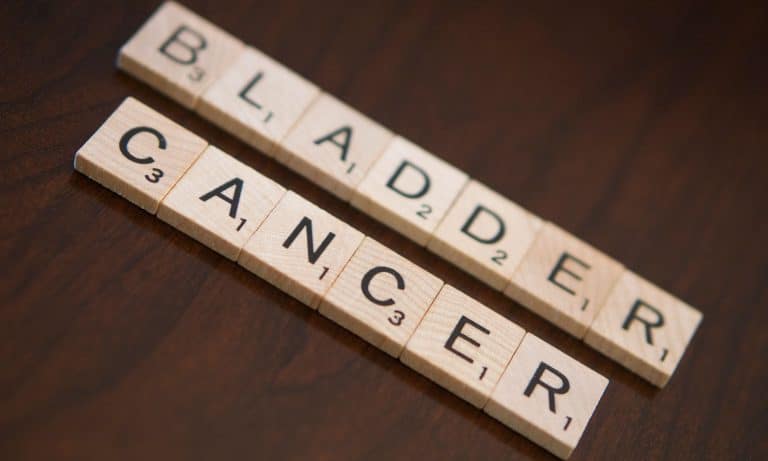
So you probably have a million questions, right? What is bladder cancer? Who gets it? Should I smoke cannabis so I don’t develop it?
First off, this cancer is a rare type of cancer that occurs when too many abnormal cells procreate in the bladder. These tumors push up against or even block neighboring structures, disrupting the body’s ability to work normally.
The most common symptoms include blood in the urine, frequency of urge and even pain when urinating. About 90 percent of the individuals who develop cancer of the bladder are over the age of 55, and it is more common among white men, although all ethnicities of men and women are not exempt.
A new study shows that whole-plant cannabis use can decrease the likelihood of developing bladder cancer.
The California Men’s Health Study gathered data from 84,170 men, ranging from 45-69 years old and of various ethnicities. Over an 11-year period researchers studied these men’s health records and found that 41 percent of participants reported cannabis use. After researchers controlled for age, race, ethnicity and body mass index they found that cannabis use was associated with a 45 percent decreased risk of developing bladder cancer. This decreased risk was significant in men aged 45-54.
Also the study noted that 29 percent of participants reported they didn’t smoke at all (whether it was cannabis or tobacco) and 57 percent reported they smoked tobacco. Researches found that men who smoked cannabis had a decreased likelihood of developing bladder cancer over than those who didn’t smoke at all.
We’ll say it again: Here’s our takeaway: If you smoke cigarettes—especially if you are, or plan on becoming, an old white guy—then you owe it to yourself to start smoking cannabis, too. Just like heads, two vices can be better than one.
Let’s all take a moment to collectively forget that it’s probably a terrible idea to drink coffee or tea on an airplane, because the water tank likely hasn’t been cleaned since that “three month reminder” sticker fell off in the ’80s.
Now, sketchy liquids aside, have you ever wondered what the swill du jour is on your morning flight? It’s never a great cuppa joe, but in case you wanted to know so you could order it a second time (or boycott the roasting company all together), Dripped Coffee has come up with a super cool infographic detailing which flights serve which brands of coffee.
The biggest take-away from this compilation is that airlines still have a long way to travel before nailing their coffee game. Seeing brands like Starbucks represented is a push in the right direction, but passengers are more or less still being served coffee that couldn’t win a fight against the drip from 7-11.
Next time you board a flight, make sure you have your own coffee in hand or skip the coffee all together. It will just keep you awake in all the wrong ways.
Country music has a closer relationship to cannabis than many realize. Many stars have waxed poetically about their experiences with weed—and we’re not just discussing Willie Nelson. Recently Toby Keith joined the fray.
Then again, if it weren’t for Nelson, we wouldn’t have the classic anthem of “Weed With Willie,” courtesy of Toby Keith. In the song he wrote with collaborator Scotty Emerick, Keith sings about ending up on Willie’s infamous tour bus after a show. “My party’s all over before its begins … I’ll never smoke weed with Willie again,” he sings.
Not so fast, it seems. The man who made red solo cups famous is back with another party anthem. This time Keith celebrates the green with his latest single “Wacky Tobacky.” In the music video, you’ll never guess who makes an appearance on a tour bus while everyone sings about smoking weed. That’s right: Uncle Willie Nelson.
“Willie Nelson’s in the video. He didn’t sing on it, but he’s in the video,” Keith told News OK. He also added that he’s in favor of legalizing marijuana because “if you drink liquor you ought to be able to smoke weed.”
The song is about all the simple joys of lighting up. As he makes clear, Keith is in strong favor of natural cannabis, and against synthetic marijuana. “Homegrown is healthy, synthetic can kill ya,” he sings.








 Full legalization – slated to happen