Fall is here which includes wet weather, holidays and a change to exercise routines – marijuana can help.
Spring and summer are the most active time of year and autumn starts the transition to more work and a little less healthy lifestyle. Why not use a smaller amount of time and try to boost workouts and take physical activity to the next level? Here are 5 ways marijuana can improve an active lifestyle. With cannabis being the enhancement plant that it is, it’s no wonder keeping active and using marijuana go hand in hand. For many, weed is part of a well rounded lifestyle includes nutrition, fitness and a balanced work life.
To begin, no matter how often you work out or eat healthily, an essential ingredient for good health is good rest. Cannabis, especially an indica or indica heavy hybrid, puts us in a state where we can more easily drift off to dreamland. Whether power napping before crunches class or getting a full night’s sleep before tackling a tough day, marijuana helps.
Many yoga studios and private teachers in legalized states are turning to cannabis, especially microdosing, to enhance their practices. Taking the smallest amount of marijuana and mixing it with hot yoga or even just good, deep stretches, will synergize the experience and help move it forward to the next level.
Get in the zone. Literally. Though we don’t recommend getting stoned before hitting the gym, having a puff and getting into the right frame of mind before a mild workout is the perfect way to work into the strain, while also getting into the music playing in your headphones to keep your body going with the flow.
Though cannabis has gotten a bad rap for being a demotivational drug, it can actually energize you for an active session. Here you’ll want to use a sativa dominant strain and again, not too much beforehand, don’t forget about the rewarding cool-down to come. Marijuana is a great motivator and vaping some and then hitting the floor running is the best way to utilize it. Just be sure to keep your head out of the clouds; focus is the goal here and you need to be clear headed to pay the best attention to your muscle groups.
Finally, after working out and getting workout high turned on, it’s time to cool down and soothe some sore muscles. Rub CBD or activated THC cream into those worked areas, use some tincture, vape a bit, however it hits you best. Cannabis is a known anti-inflammatory and it goes right to work on where it hurts, soothing aches and pains and readying you for the next round.
CBD provides benefits for people of all ages. When used by the 50+ set, it can improve their quality of life in key ways.
CBD is used by people of all ages, but as you age, the body changes and it could use a little extra help. Older adults can generally use CBD safely without experiencing any adverse effects when combined with their existing medications, which can be a benefit. By your 40s, your the wear and tear on your body start to increase and there are activities and self care to minimize the damage. Here are three ways CBD can help the 50+
Seniors traditionally struggle with chronic conditions, less restful sleep, more physical injuries, and the decline of their mental health. While CBD still lacks scientific support, some key studies and large amounts of anecdotal evidence show that CBD can improve people’s quality of life, especially when taken as a supplement.
Here are three ways in which CBD can help seniors:
Better sleep
Photo by Terry Vine/Getty Images
Insomnia occurs due to a wide variety of reasons, ranging from stress, to medications or bad habits. The condition is the same for people of all ages, but it affects seniors more often.
Seniors struggle with their sleep due to their age and the fact that their hormones are fluctuating. They no longer produce the growth hormone — one of compounds responsible for our sleep patters — in the same amounts. Seniors are likely to get less deep sleep than younger people, which influences their mood and health.
CBD’s effect on sleep hasn’t been studied in-depth, but CBD and its short term effects on stress, anxiety, and PTSD have been documented. These conditions are almost always connected with poor sleep.
Pain management
Photo by rawpixel.com
CBD oils and topicals can treat different kinds of pain, whether they’re occasional and obtained from an injury or recurring. These conditions can affect muscles and joints and can be very debilitating.
CBD has analgesic and most importantly anti-inflammatory properties, helping people find relief from their injuries while also speeding up the recovery process.
Source of alternative medicine
Photo by Caiaimage/Trevor Adeline/Getty Images
One of the best parts about CBD is its untapped potential. Since the compound can treat a wide variety of conditions, it’s one that a lot of researchers are interested in, especially since it can rid us of the negative side effects that are associated with medications.
Although more research is needed in order to understand the full capabilities of CBD, including its possible side effects, for the time being, nothing dangerous has been recorded. Studies have found that the compound can provide relief while also decreasing the amount of medications that seniors consume.
You’ll never guess what flavor dominates the cannabis edible and beverage marketplace. Data pinpoints a clear cut winner.
Everyone has a favorite flavor. Instinctually you know what that is whether it’s candy, soda, or popsicles. However, that may change with cannabis edibles and beverages, as sales data shows certain flavors rise above the rest for consumer wallets.
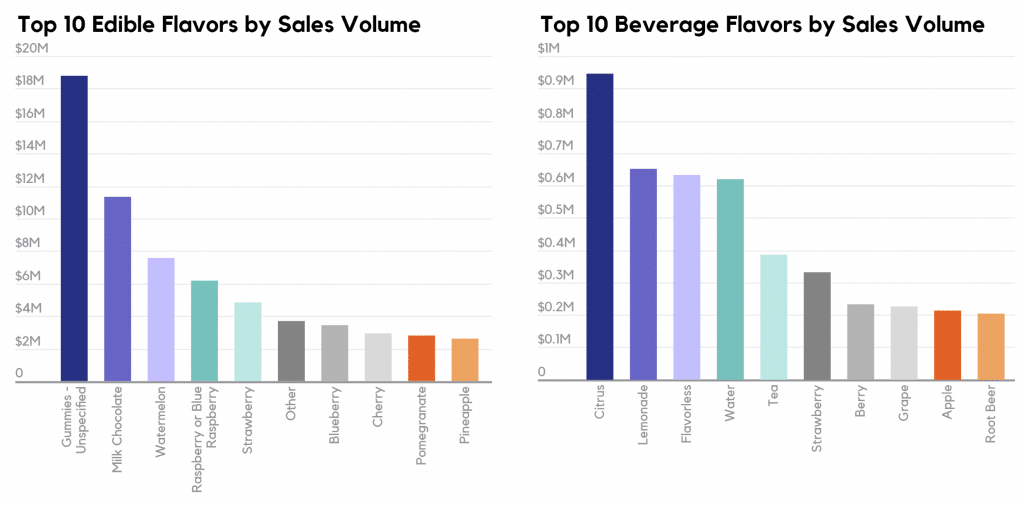
The company identified 73 different flavors currently sold on the market, which can range from hibiscus to red velvet. By a large margin, customers purchase citrus-flavored cannabis beverages and unspecified flavored gummy edibles more than any competing flavored product, according to Headset Analytics data.
Chart courtesy of Headset Analytics
Raspberry and watermelon are also popular with customers. But citrus and lemonade flavored beverages constituted approximately 24.2% of beverage sales over the past month for a reason.
“Citrus flavors are a great way to mask any residual flavor from the cannabis without making the product overwhelmingly sweet,” Liz Connors, Headset’s Director of Analytics, told The Fresh Toast. “Additionally, I think citrus likely just pairs better with the herbal taste from the THC than other flavors might.”
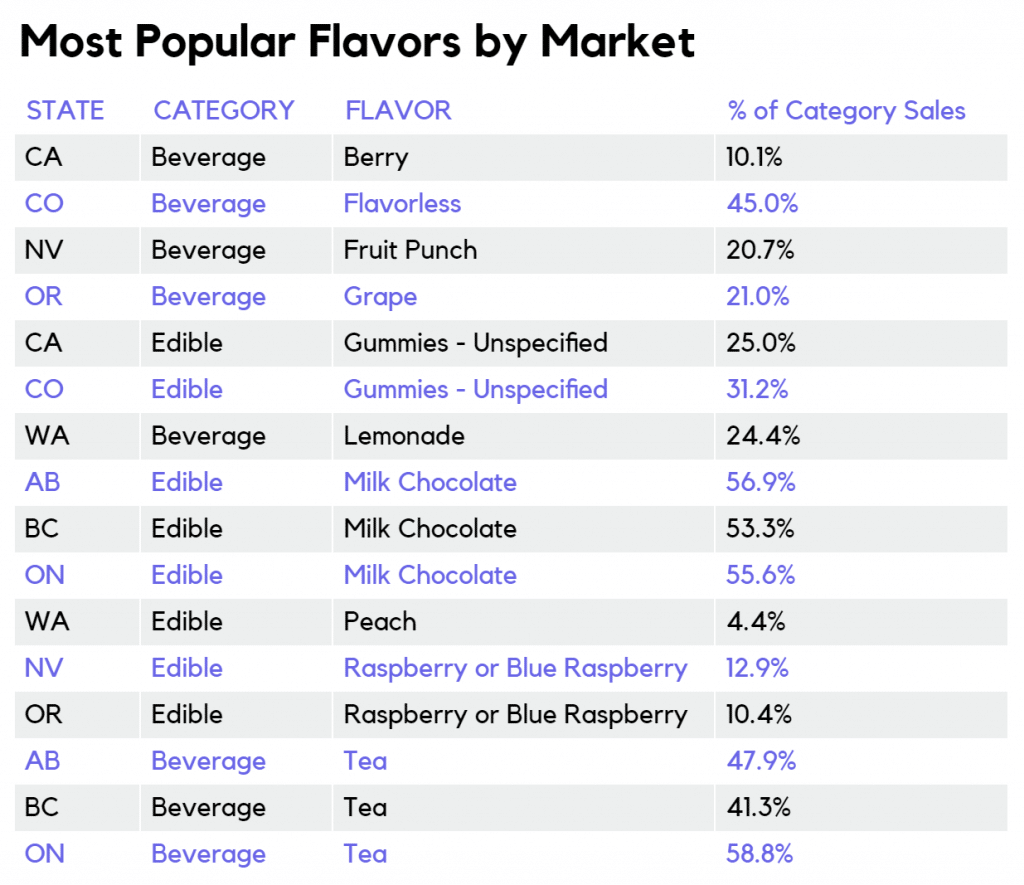
These flavor preferences change with the market, although for reasons that appear unclear. Canadian markets gravitate to milk chocolate edibles far more than American markets do. Milk chocolate commands more than 50% of all edible sales in British Columbia, Alberta, and Ontario provinces. But legal state markets mostly gravitate to cannabis gummies and candies, with different flavor preferences depending on the state.
Chart courtesy of Headset Analytics
Connors hopes retailers and producers use this data to find area of opportunity in the marketplace. “For example, if Berry flavors are common in Gummies but not in Candies this could be a space for a producer to innovate on flavors,” she said.
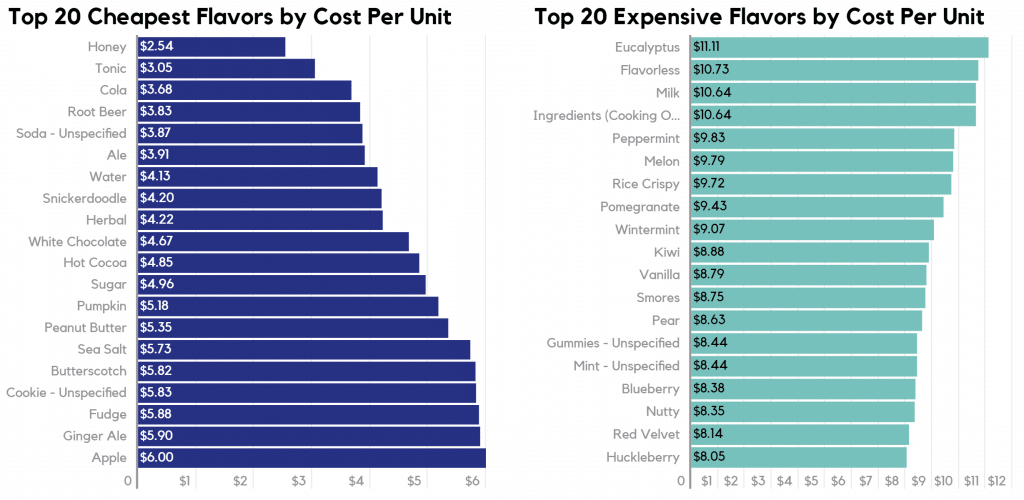
Fruity flavors like melon, pomegranate, and blueberry were generally more expensive than dessert flavors like chocolate, peanut butter, or snickerdoodle. But neither the cheapest flavor, honey, or the most expensive, eucalyptus, were top choices for consumers.
Chart courtesy of Headset Analytics
So what do customers care about more: price or flavor?
“I suspect that price is the primary driver over flavor,” Connors said. “This is mostly due to the fact that unlike a package of Haribo gummy bears you’re likely only eating one or two cannabis gummies. Even if it’s not your favorite flavor you won’t likely be consuming very many.”
According to a new poll, fans of America’s Big Four sports leagues — NFL, NBA, MLB, and NHL — were less cannabis friendly than fans of most other sports.
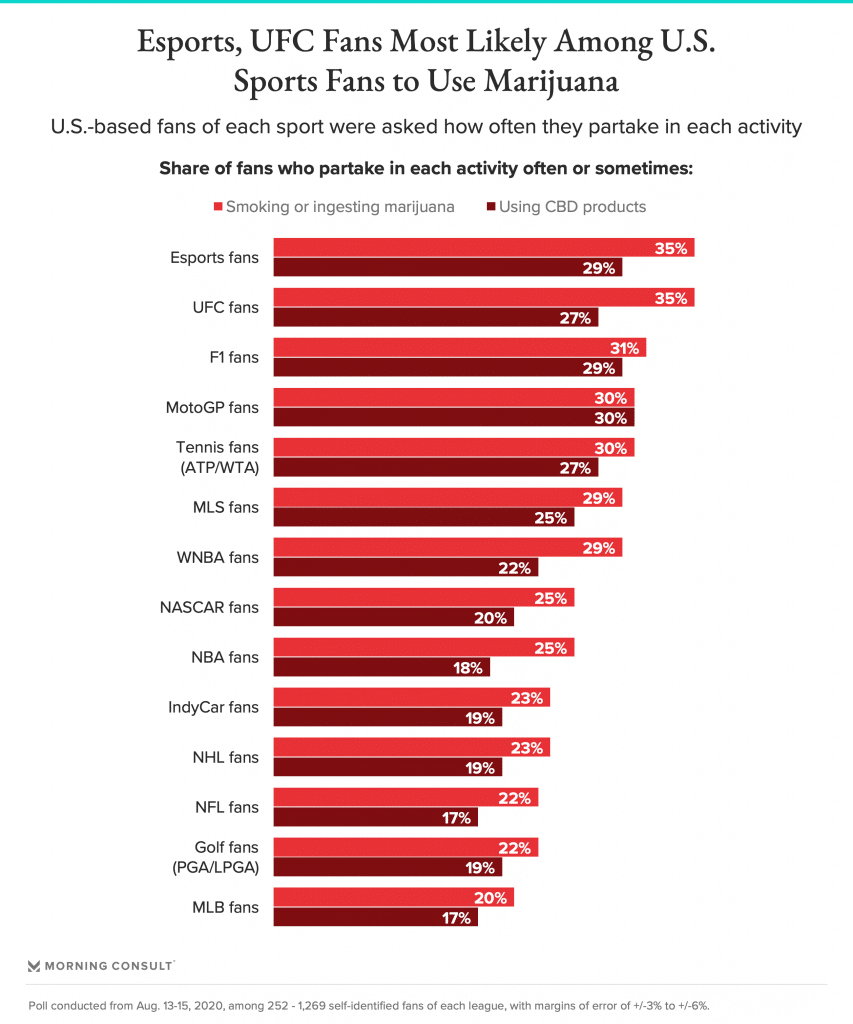
Although The Smiths frontman Johnny Marr once said America’s pastime was only worthwhile if cannabis was involved, many baseball fans don’t agree. According to a recent poll, baseball fans were the least likely to consume marijuana among all major sports. Fans of eSports, UFC, and Formula 1 Racing had a far friendlier relationship with cannabis.
A Morning Consult poll surveyed between 252 and 1,269 self-identified fans of multiple major sports and how often they consumed vices, such as tobacco and cannabis. Although multiple sports leagues prohibit cannabis use and promotion, the poll highlights a growing branding opportunity for professional athletes involving marijuana and CBD products.
About 35% of eSports and UFC fans regularly smoke or ingest marijuana. Racing fans also gravitated to cannabis: at least 30% of F1 and MotoGP fans were normal users. Fans of America’s Big Four sports leagues — NFL, NBA, MLB, and NHL — were less cannabis friendly than fans of most other sports.
Courtesy of Morning Consult
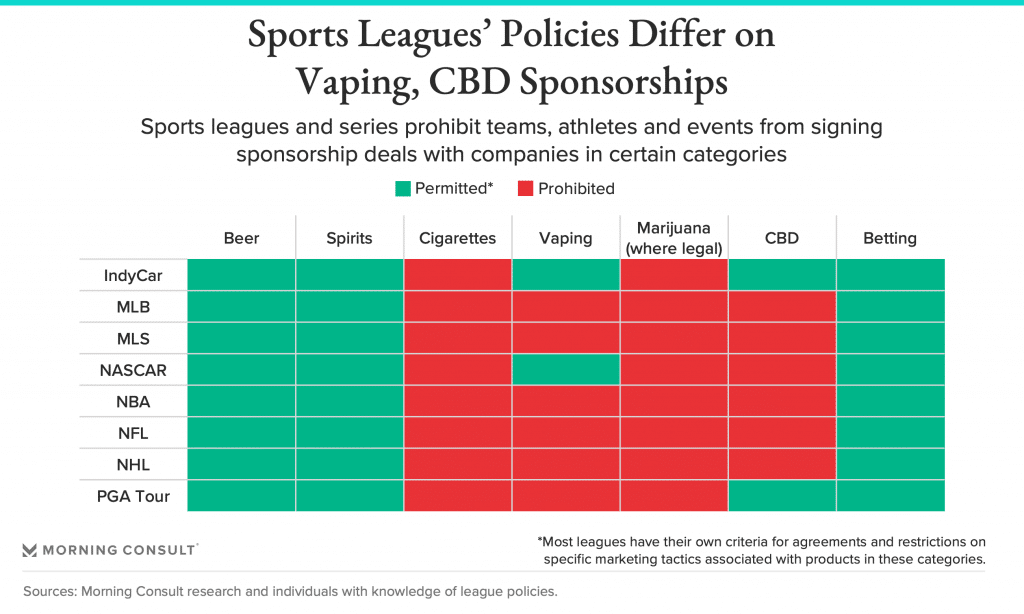
Sport organizations won’t allow players to sign sponsorship deals with marijuana companies, although professional athletes can freely do so with beer and spirit companies. But leagues have recently opened to the use and promotion of CBD among players. Big name golfers like Bubba Watson, Charley Hoffman, Scott Piercy, and Lucas Glover have signed CBD-related sponsorships without penalty.
It’s simple to understand what motivates players to sign such deals—the Untied States CBD marketplace generated $4.1 billion in sales last year, cannabis research firm Brighfield Group reports. Only racing athletes join professional golfers with permission to promote CBD products. However, Sports Business Journal reported in July the MLS could soon allow teams to sign CBD company sponsorships.
Courtesy of Morning Consult
A recent NFL analysis concluded that while “CBD is a promising compound […] the extent of its use in the United States outpaces the level of evidence.” That lack of evidence appears the main conflict traditional sports leagues have in associating with cannabis or CBD products. Added NBA Commissioner Adam Silver: “When we change our policy we have to be really careful because we’re clearly sending a message to young people.”
While a significant portion of most fanbases use cannabis, the leagues would rather leave that possible sponsorship money behind at the moment.
“As much as I would love to sell as many categories and allow our clubs to sell as many categories to monetize, you start getting into health and well-being,” a top sponsorship executive at a major U.S. sports league told Morning Consult. “There’s a whole other part of the organization, including doctors, that look into the effects of that product. And so at this point, we are looking into it, but there’s nothing imminent.”
Freddy Mercury music stays in our hearts and his life stays in the news. From the recent auction of his personal items to Patrick Wilson doing an amazing cover of him, new fans develop every day. But did you know his relations back story?
In the Freddie Mercury biopic, “Bohemian Rhapsody,” there’s a scene in which a family member scolds Mercury.
“So now the family name is not good enough for you?”
“I changed it legally,” Mercury responds. “No looking back.”
It might come as a surprise to some that Freddie Mercury was born Farrokh Bulsara. He came from a Parsi family that had roots in India and he was a Zoroastrian by faith.
In the world religion courses I teach at the University of Florida, we discuss Zoroastrianism.
Fleeing religious persecution from Muslims in Persia sometime between the seventh and 10th centuries, the Zoroastrians settled in India, where they came to be called “Parsis.”
Like Freddie Mercury, they worked to integrate into their new surroundings. Yet they also stayed true to the values, beliefs, and practices of their religion, which many scholars say had an influence on Christianity, Islam, and Judaism.
A precursor for Christianity?
The Zoroastrian faith is one of the world’s oldest religions, one that could date back as far as 1200 B.C.
Zoroaster, a prophet who lived in modern-day Iran, is viewed as the founder of Zoroastrianism.
We’re not sure when Zoroaster lived, though some say it was around 1200 B.C. He is thought to have composed the Gathas, the hymns that make up a significant portion of the Yasna, which are the liturgical texts of the Zoroastrians.
According to the Zoroastrian tradition, Ahura Mazda is the supreme lord and creator; he represents all that is good. In this aspect, the religion is one of the oldest examples of monotheism, or the belief in one god.
A glazed tile depiction of the Zoroastrian god Ahura Mazda in the town of Taft, Iran. A.Davey/flickr, CC BY
The main tenets of the faith center on the opposition between Ahura Mazda and the forces of evil which are embodied by Angra Mainyu, the spirit of destruction, malignancy and chaos. This evil spirit creates a serpent named Azi Dahaka, a symbol of the underworld, not unlike the Biblical serpents of Judeo-Christian traditions.
Within this cosmic battle we see the tension between “asha,” which roughly translates to “truth,” “righteousness,” “justice” or “good things,” and “druj,” or deceit.
Truth is represented by light, and Parsis will always turn to a source of light when they pray, with fire, the sun and the moon all symbolizing this spiritual light.
Indeed, scholars have noted the strong historical influence that Zoroastrianism has had on concepts seen in Judaism, Christianity and Islam, whether it’s monotheism, the duality of good and evil, or Satan
Today Zoroastrianism has a small but devout following, though it’s been shrinking.
In 2004, it was estimated that there were between 128,000 and 190,000 Zoroastrians living around the world, with 18,000 residing in the United States.
Like sugar in milk
The “Qissa e Sanjan,” which translates to “The Story of Sanjan,” was composed around the 17th century. It describes how the Zoroastrians, fleeing religious persecution from Muslim invasions in their Persian homeland many centuries earlier, head to Gujarat, in western India.
Once they arrive, they reach out to the local king, whom they call “Jadi Rana.” He agrees to give them land if they adopt local dress, language and some customs. However there is never any question about religious faith: They still practice their religion, and Jadi Rana is elated that these newcomers worship as they please.
In one, when the Zoroastrian refugees arrived in Gujarat, the king sends them a jar of milk filled to the top – his way of saying that his kingdom is full and there’s no room for any more people. In response, the newcomers stir in a spoonful of sugar and send it back to the king. In other words, not only do they promise to integrate with the local population, but that they’ll also enhance it with their presence.
In the other version, they drop a gold ring into the bowl to show they’ll retain their identity and culture, but they’ll nonetheless add immense value to the region.
These are both compelling narratives, though they make slightly different points. One extols the integration of immigrants, while the other highlights the value of different cultures living together but in harmony.
Parsis in India – and wherever they have gone – have done both. They’ve adopted some of the customs of the land they live in, while maintaining their distinctive culture, religious rituals, and beliefs.
They’ve also made more cultural contributions than the initial wave of refugees to Gujarat could have ever imagined.
Despite their small numbers, Parsis can count a number of famous musicians, scientists, scholars, artists and entrepreneurs among their ranks.
Beyond Freddie Mercury, there’s Zubin Mehta, the director of the Israel Philharmonic Orchestra; Jamshedji Tata, founder of the Tata Group, the largest business conglomerate in India; Dadabhai Naoroji, the first Indian elected to the British Parliament; Harvard professor Homi K. Bhabha; and nuclear physicist Homi J. Bhabha, to name a few.
Freddie Mercury’s family were migrants. Their first home was in India. Then they moved to Zanzibar, before finally settling in England.
Like his ancestors, Freddie Mercury integrated into a new culture. He changed his name, and became a Western pop icon.
Yet through it all, he remained immensely proud of his heritage.
“I think what his Zoroastrian faith gave him,” his sister Kashmira Cooke explained in 2014, “was to work hard, to persevere, and to follow your dreams.”
And now you know about Freddie Mercury And Zoroastrianism.
The ADA continues to push for more research on cannabis and oral health, but also recommends dentists talk about cannabis use while reviewing the health history of their patients.
A survey discovered that more than half of dentists (52%) confirmed that their patients are showing up for checkups while high on cannabis or some other drug. Following these results, the American Dental Association (ADA) advised patients to abstain from marijuana prior to dental appointments.
“When talking through health histories, more patients tell me they use marijuana regularly because it is now legal,” says ADA spokesperson Dr. Tricia Quartey, a dentist in New York. “Unfortunately, sometimes having marijuana in your system results in needing an additional visit.”
Photo by Cedric Fauntleroy via Pexels
Why Being High At The Dentist’s Is Not Advisable
The ADA noted that being under the influence of marijuana at the dentist’s can limit the care they’re delivering. The survey noted that 56% of dentists confirmed limiting treatments to patients who were stoned.
As many as 46% of surveyed dentists said they had to increase anesthesia to treat patients who had consumed cannabis due to how it and anesthesia impact our central nervous system.
These results were disclosed in two online surveys earlier this year – one of 557 dentists and a second nationally representative survey of 1,006 consumers.
“Marijuana can lead to increased anxiety, paranoia, and hyperactivity, which could make the visit more stressful. It can also increase heart rate and has unwanted respiratory side effects, which increases the risk of using local anesthetics for pain control,” Quartey said. “Plus, the best treatment options are always ones a dentist and patient decide on together. A clear head is essential for that.”
Marijuana & Oral Health
Previous studies confirmed that regular cannabis users have significantly more cavities than nonusers. Why?
Interestingly, but kind of to be expected, cannabis is not the direct cause of cavities, but rather an indirect one.
“The active ingredient in marijuana, THC, makes you hungry, and people don’t always make healthy food choices under its influence,” Quartey said. “Medically speaking, munchies are real.”
Photo by Caroline LM via Unsplash
Still, marijuana per se is not completely benign with regard to our oral health. “Smoking marijuana is associated with gum disease and dry mouth, which can lead to many oral health issues,” Quartey noted. “It also puts smokers at an increased risk of mouth and neck cancers.”
The ADA continues to push for more research on cannabis and oral health, but also recommends dentists talk about cannabis use while reviewing the health history of their patients.
And patients who love cannabis? Well, they can still preserve their oral health with a disciplined daily hygiene routine of brushing twice a day, flossing, visiting the dentist regularly and eating healthy. It’s that simple!
As autumn leaves begin to turn, it is also the Jewish high holy season. It is time for reflection, celebration, being thankful for blessing and to honor the history of the Jewish people. An ancient tradition upheld around the world and honored in the hearts and souls of millions. Rosh Hashanah is a burst of celebration for the New Year and peaks with Yom Kippur (the Day of Atonement). Fasting, family, prayers and more celebrate both holidays. During the high holiday days, the faithful chill, contemplate, and cast for true meaning. Which begs the question, what about the Jewish faith and marijuana.
Photo by Liubomyr Vorona/Getty Images
In the United States, the Jewish population is over-represented among the recreational cannabis using population. The reasons are thought to be the urban pattern of residence, the large association of Jewish residents in the academic milieu in metropolitan areas as well as the urban avant-garde movements. And Jewish families are thought to be less authoritarian and more tolerant toward “intellectual experimentation”.
In Canada, especially in Toronto, differences between Jews and Christians with regard to attitudes toward cannabis usage were detected in the high school population, in which surveys show that more than twice as many Jewish students have used cannabis as Catholic ones.
On of the largest marijuana product companies, Colorado based Wana Brands, have their edibles certified by Whole Kosher Services, a company based in Houston. They lead a long list of companies who have passed inspection. During fasting, you can not smoke as you would have to light a fire and edibles must be kosher to avoid impurities.
Ancient Israel archaeology, lexicography and paleobotany researchers generally believe in the Hebrew Bible cannabis is not documented or mentioned in early Judaism. The primary advocate of a religious use of cannabis plant in early Judaism was Sula Benet, who claimed the plant kaneh bosem קְנֵה-בֹשֶׂם mentioned five times in the Hebrew Bible, and used in the holy anointing oil of the Book of Exodus, was in fact cannabis. Many other scholars are more skeptical or just disagree.
In a 1973 opinion, Orthodox rabbi Moshe Feinstein stated that cannabis was not permitted under Jewish law, due to its harmful effects. In 2013, Orthodox rabbi Efraim Zalmanovich stated that medical, but not recreational, cannabis is permitted. The population, it seems doesn’t fully agree considering the use of cannabis.
There is no known, underlying medical cause for the symptoms of Chronic Fatigue, which include inexplicable exhaustion that doesn’t improve with increased rest and sleep.
For someone with Chronic Fatigue Syndrome, the tasks faced in everyday life feel insurmountable with a limited resource of energy to tap into. The frustrating nature of CFS, sometimes called Myalgic Encephalomyelitis, is that it is difficult to diagnose. There is no known, underlying medical cause for the symptoms of Chronic Fatigue, which include inexplicable exhaustion that doesn’t improve with increased rest and sleep.
Accompanying symptoms may include inflammation of lymph nodes, joint pain, muscle pain, and difficulty remembering things or focusing. Some individuals may also experience headaches and a sore throat.
In a Univeristy of New Mexico study, titled The Effects of Consuming Cannabis Flower for Treatment of Fatigue” published in the journal, Medical Cannabis and Cannabinoids, researchers showed using cannabis results in improvement for feelings of fatigue in the majority of users. This was the first large-scale study to show that, on average, people are likely to experience a 3.5 point improvement of feelings of fatigue on a 0-10 scale
Treating Chronic Fatigue Syndrome
There isn’t a standard treatment method for Chronic Fatigue Syndrome. While there are suspicions infection, hormonal imbalances, or issue with the immune system may have something to do with the condition, not knowing the cause of the CFS prohibits knowing how to cure or treat it.
For now, the standard approach is management, not treatment of the conditions. One such method is called pacing and involves managing exertion to avoid a flare-up of more severe symptoms. This requires a good understanding of what you are capable of carrying out without bringing yourself to a point of exhaustion. Additional management techniques focus on symptoms or co-occurring conditions, like depression and sleep problems.
Photo by Benjamin Combs via Unsplash
CBD and Chronic Fatigue Syndrome
From the start, it is important to be upfront that there is no existing formal research on the effects of CBD or marijuana on chronic fatigue syndrome. There are anecdotal reports, however, from individuals using CBD to manage their symptoms.
Many individuals who have CFS also experience joint paint. There are recent animal studies that have observed improvements in pain symptoms with the use of a topical CBD product, such as this study published in 2018.
There is evidence that chronic fatigue is connected to having a hypersensitive central nervous system. In 2017, the journal Expert Opinion on Therapeutic Targets listed cannabidiol as a way to decrease the activity of brain cells called glia, which triggers that hypersensitivity of the nervous system.
Marijuana and Chronic Fatigue Syndrome
With the UNM study, there may be solutions soon to help. Additional uses for marijuana for these individuals could include improving sleep, managing depression, and decreasing chronic pain. Patients struggling with chronic fatigue should find a doctor who are open to alternative therapies. Someone who has experience prescribing medical marijuana and cannabidiol can help guide you on dosing as you look for new ways to manage the worst symptoms for your conditions.
There remains no known association between heart disease and marijuana consumption, but patients should know the possible risks.
After smoking marijuana, users commonly describe the effects as sedative or relaxing. It places them in a calmer mood and allows the brain to turn off for a little while. But the same can’t be said for the heart. Though more than two million Americans with heart conditions admit to using marijuana, the cardiovascular risks related to cannabis use is not fully understood, a new research paper found.
Published in the Journal of the American College of Cardiology, the paper is a review of previous studies that explored the relationship between cannabis use and heart function. Due to research restrictions in the United States, few randomized control trials — considered the gold standard in scientific studies — exist. However, scientists understand one way marijuana affects common heart conditions, which might give cardiovascular patients pause.
Medications like statins and blood thinners could have reduced potency when combining with marijuana. Liver enzymes that break down those medications are also used to process marijuana in the body, the review reports.
According to a 2019 study, marijuana use could raise levels of the blood thinner warfarin, possibly resulting in excessive bleeding. In some cases, patients who combine marijuana and the medication might be forced to lower their dose up to 30%. The effectiveness of statins, meanwhile, could be boosted by marijuana, leading to potential drops in blood pressure.
Photo by rud0070 via Pixabay
Observational studies have caused some scientists to compare the cardiovascular risk of smoking cigarettes to that of smoking weed. While the dominant substance consumed in smoking is different between marijuana and tobacco, the two produce similar cardiotoxic chemicals. In addition, other studies have shown that marijuana users hold in smoke longer than those consuming cigarettes, which could deliver more cardiotoxic chemicals into the system.
Marijuana advocates might point to safer marijuana delivery methods, such as edibles, tinctures, and sublingual strips. Scientists involved with the review would agree, as smoking and vaping anything causes more problems. But the latest data from the Centers for Disease Control and Prevention (CDC)’s Behavioral Risk Factor Surveillance System show that just under 80% of adult marijuana users admit to smoking.
Edibles constitute their own risk, however. The lack of experience for many first-time users can cause them to take too high a dosage without realizing before it’s too late.
There remains no known association between heart disease and marijuana consumption. In 2017, the National Academies of Sciences, Engineering, and Medicine published a report investigating a possible connection, but said in their conclusion that the evidence was unclear. Until we know more, scientists cautioned heart patients to limit use when possible and talk to your doctor, so they can advise about how much you’re using and what delivery method you’re using.
Spending time alone is healthy you, whether you’re an introvert or an extrovert. Here are some things to make it more joyful.
Alone time is necessary although it can be difficult. People have different tolerance levels when it comes to how much “me” time they can handle, with some using it to replenish their energy and others needing to be around others in order to function properly. There’s nothing wrong with either; there are introverts and extroverts and people in between. Still, alone time provides benefits for everyone and can be used to nourish yourself and your inner world.
Introverts and extroverts are different. Despite the myths that surround them, introverts don’t need to be shy and anxious around others; they simply enjoy spending time alone, are likely conflict avoidant and make for great listeners. In contrast, extroverts tend to feel energized when interacting with others and likely find being alone draining.
Here are 5 things that can help you find joy in your alone time, whether you’re an introvert or an extrovert:
Talk about your feelings
Photo by Christin Hume via Unsplash
Whether you’re an introvert or an extrovert, it’s okay to feel comfortable or uncomfortable with being alone. Talk about your feelings with the people closest to you, letting them know if you want space or if you want to create boundaries that way you can create a space for yourself without the intrusion of others.
Use alone time for self care
Photo by Brian Lundquist via Unplash
Some activities work better when practiced alone, and can be more beneficial if you create boundaries that allow for alone time. Turn off social media notifications and create the space for doing activities like exercise, meditation and sleep. Don’t view this as punishment, simply view it as a way as growing more resilient and comfortable with yourself.
Animals are great companions. They’re silent but their presence can be felt and it contributes to a less lonely environment. Hanging out with cats or dogs is nourishing and can help you get in touch with your feelings, while also taking responsibility for an animal that depends on you for care.
Spending time alone can be very productive. It can be a time for introspection and reflection, used to develop a better relationship with yourself and with loneliness, which isn’t easy to cope with.
Get creative
Photo by VIKTOR HANACEK via picjumbo.com
While alone time can be spent doing nourishing things like eating out, reading or watching a TV show, you can also try out something creative like painting or drawing. Use your alone time to dive into a new creative project and try to enjoy yourself as best as you can.