While many expect that Ohio Gov. Mike DeWine will oppose the bill, many more are optimistic based on the fact that a vast majority of Ohio voters support marijuana legalization.
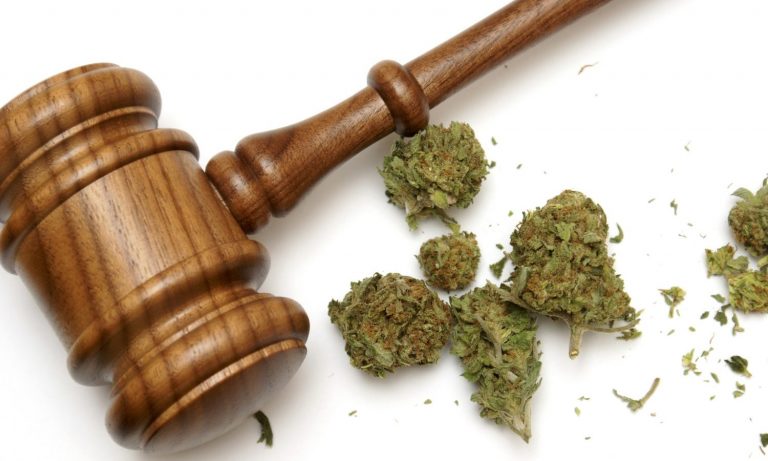
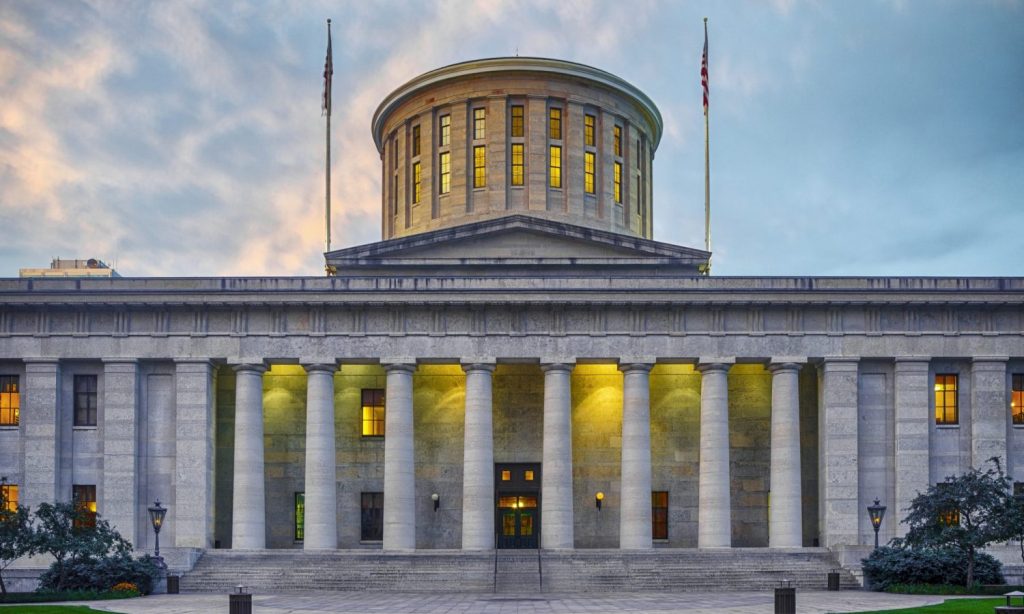
A bill to legalize cannabis possession, production and sales was officially filed for the first time in the state of Ohio on Friday. The legislation was submitted by state Reps. Casey Weinstein (D) and Terrence Upchurch (D), after weeks of trying to gather more support for the proposal, reported Marijuana Moment.
“It’s time to lead Ohio forward,” Weinstein stated. “This is a big step for criminal justice reform, for our veterans, for economic opportunity, and for our individual liberties.”
Photo by traveler1116 / Getty Images
The 180-page measure proposes legalizing the possession of up to five ounces of cannabis for adults 21 and older and the cultivation of up to 12 plants for personal use. Some of the provisions seek to expunge prior convictions for possession and cultivations of small amounts of cannabis.
‘More Than Legalization’
“This bill is much needed in Ohio, and it’s time for Ohio to become a national leader in marijuana decriminalization and legalization,” Upchurch stated. “This bill is more than just about legalization, it’s about economic and workforce development, it’s about decriminalization, and it’s about healthcare! The time is now, and I look forward to getting this done in a bipartisan fashion.”
While many expect that Ohio Gov. Mike DeWine (R) will oppose the bill, many more are optimistic based on the fact that efforts undertaken over the past several years have shown that a vast majority of Ohio voters support marijuana legalization.
The Ohio Department of Commerce would be in charge of managing legal cannabis program and issuing business licenses. The proposal highlighted that Ohio’s current medical marijuana program would not be affected by the recreational market.
A 10% excise tax would be imposed on marijuana sales, with revenue first going toward the cost of implementation and then being divided among municipalities with at least one cannabis shop (15%), counties with at least one shop (15%), K-12 education (35%) and infrastructure (35%).
Forget about that stinky cheese you love. Is mold a health hazard when it comes to your weed?
Mold is easy to spot, at least when it comes to food. But how about when it comes to weed? When you find an old joint under the couch, should you toss it out? Are there risks to smoking moldy weed?
Sadly, mold is never a good thing to inhale, no matter how much you want that weed. While it likely won’t kill you, inhaling mold could pose some health hazards to your lungs, increasing your odds for coughing and then develop a lung infection.
For people who are allergic to mold, smoking could result in inflamed sinuses and lungs. These conditions could result in symptoms like sinus pain, wheezing, and congestion. In rare instances, people who are sensitive to mold could experience a fungal infection in their lungs or throats, which could be deadly, particularly if the person afflicted is immunocompromised.
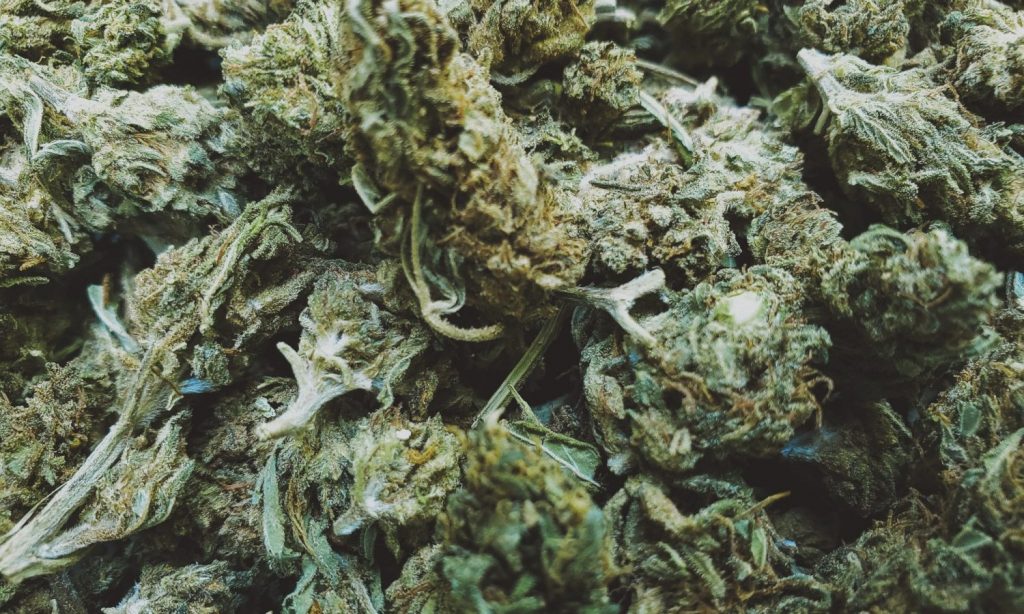
Recognizing mold in weed isn’t as easy as recognizing it in food. In marijuana, mold usually looks like a greyish or white coating, which can be easily confused with trichomes. Upon closer look, mold can look like fuzz, spots, or even slime.
Photo by Flickr user Thomas Bresson
For all users, the easiest way to tell if your weed is moldy is to smell it. Mold has a distinctive smell, one that will cloud marijuana’s natural aroma. It’ll smell musty and unpleasant, unlike skunky marijuana that hasn’t yet expired.
The best way to avoid moldy weed is to buy your products from a certified dispensary and to always check the expiration date if there is one. The closer the weed is to this date, the more likely it is for it to be contaminated by mold. To prevent mold, storage is key. Keep your cannabis in a cool and dark place, sealed in an airtight container.
Whether they’re breaching the stratosphere or lobbying for weed, America’s billionaires want to take their businesses to the next level.
The same day Amazon CEO Jeff Bezos and his fellow passengers flew into space in the New Shepard rocket, his company took action to start lobbying in favor of cannabis reform legislation. Bills such as the Marijuana Opportunity Reinvestment and Expungement (MORE) Act, in the event it passes, “removes marijuana from the list of scheduled substances under the Controlled Substances Act and eliminates criminal penalties for an individual who manufactures, distributes, or possesses marijuana.”
The retail behemoth and one of the country’s largest employers made $21.3 billion in net income in 2020, while legal cannabis sales across the United States topped $17.5 billion. Bills like the MORE Act have passed in the House but are consistently left to languish in the Senate, and many cannabis activists, like the leaders of the Marijuana Policy Project and the Drug Policy Alliance, believe Amazon’s support could tip the legislative scales in their favor.
Photo by Christian Wiediger via Unsplash
“I think that if Amazon were able to lend its political support to federal reform and fund state level efforts, that would be a net positive for the cannabis reform movement in this country, Matthew Schweich, deputy director of the Marijuana Policy Project, told Politico.
This is far from the first time Amazon has expressed an interest, either financial or political, in cannabis. In February, the company announced the launch of a pilot program for sellers of CBD-infused products for the UK branch, though thousands of unregulated CBD products are searchable for sale on the American site.
On June 1, the company declared changes to its drug-testing policy, and would cease disqualifying candidates and employees who tested positive for marijuana. In the same memo, as part of their “Earth’s Best Employer and Earth’s Safest Place to Work” initiative, Amazon expressed its support for the MORE Act, and encouraged others to get involved.
Other billionaires seem to have the same idea. Tesla and SpaceX Elon Musk has publicly smoked cannabis with Joe Rogan, and expressed in a tweet last year, which has since garnered over 680K likes, that “selling weed literally went from major felony to essential business (open during pandemic) in much of America & yet many are still in prison. Doesn’t make sense, isn’t right.”
Whether they’re breaching the stratosphere or lobbying for weed, America’s billionaires want to take their businesses to the next level. It’s only a matter of time until we see what their actions mean for the rest of us.
“I can tell you that marijuana, undoubtedly, is connected to violent crimes that we’re seeing in our community,” said Robert Contee.
Disclaimer:The views expressed in this article solely belong to the author and do not necessarily represent those of The Fresh Toast.
During a press conference July 23, Washington D. C. Police Chief Robert Contee said that: “I can tell you that marijuana, undoubtedly, is connected to violent crimes that we’re seeing in our community… When you have something where people get high reward—they can make a lot of money by selling illegal marijuana—and the risk is low, the risk for accountability is very low, that creates a very, very, very, very, very bad situation because those individuals get robbed, those individuals that shot at, those individuals get involved in disputes all across our city.”
“Marijuana undoubtedly is connected to violent crimes that we’re seeing in our communities.”@DCPoliceDept Chief Contee addressed the recent string of violent crime in the District.
Of course, most major American cities are dealing with increasing violence, probably pandemic related. However, the Drug War is continuing and “more people were arrested for cannabis last year than for all violent crimes put together,” according to FBI data
Could that number explain the real relationship between marijuana and violence?
Chief Contee is African American, but he still seems to ignore the fact that, as Forbes reports, “In addition to those dwelling in the northeast, those in the black community may also be at particular risk of being arrested for cannabis crimes. A recent report from the ACLU looked at data from 2018, and found that black people were 3.6 times more likely to be arrested for cannabis possession than white people. This is despite the fact that both groups use cannabis at similar rates.
Photo by Matthew Karila via Unsplash
Even in western states with recreational cannabis laws, black people were 1.5-1.8% more likely to be arrested for having cannabis. In states with the worst racial disparity in arrests, like Montana and Kentucky, black people were 9.4-9.6% more likely to be arrested. In some counties, disparities were so high, black people were 50 times more likely to be arrested. Contee, who is 48, is a D.C. native, and, as noted, is African American (as is roughly half of the D.C. population) and has been on the D.C. police force all of his adult life. Consequently, he would seem to be an excellent choice for his job, despite his muddled statement.
Ironically, he complained, “This is the same movie when I was a boy growing up here.” Yep. It was called the Drug War, and marijuana prohibition is still a major part of it, despite the city trying to legalize it and despite the opposition of the federal government, which ultimately controls D.C.
“This is the same movie when I was a boy growing up here. When are we going to do something different? And what different looks like and what does not happen here is accountability.”
Chief Contee voices frustrations over the recent D.C. shootings.
In 1972, a couple of years before Contee was born, I visited D.C. and wandered around and found myself at RFK Stadium, where there was about to be a concert by a rock group called “The Rolling Stones”, or something like that. A scalper sold me his last ticket, and — as best I remember — there was some skinny guy dancing around the stage complaining that he couldn’t get no satisfaction. Terrible grammar!
I’m a little hazy on the rest of it, but I am certain there was no violence despite there being 50 thousand people there smoking marijuana. I have lived in Amsterdam, where I have never seen any marijuana related violence. I have lived in Nevada and in California, where I have never seen any marijuana related violence. Ditto, Austin, Texas. Ditto, Vancouver. Ditto, ditto, ditto!
Photo via Pixabay
Contee is complaining about the violence associated with black markets for anything. I’m sure that the African American leaders in Congress who are working on legalization will help him issue a “clarification”. Badly needed.
For many people, the task seems daunting and I’m not going to sugar coat it. The first time you attempt it by yourself you’ll be questioning your actions every step of the way.
When you decarboxylate cannabis, you’re essentially applying heat to activate the cannabinoids and convert them from their acid form into their psychoactive state. For example, turning THCa into THC. Here is how to decarb cannabis.
If you were to skip the step of decarboxylating your cannabis, your infusion would lack in potency and would in most cases not live up to your expectations. But what’s the right time, method, and heat settings to get the perfect decarbed weed?
That’s what we’re about to find out in this article right now. Not only are we going to be talking about the right temperature and time, but also providing you with different methods of decarbing your weed. This should provide you with everything you need to know to start experimenting with cannabis infusions. Let’s get ready to bake!
Photo by Margo Amala via Unsplash
Decarboxylating Your Weed the Right Way
Depending on the sources you find on the internet, there’s many ways to decarb your weed. The most common method is using the oven and some oven-ready trays.
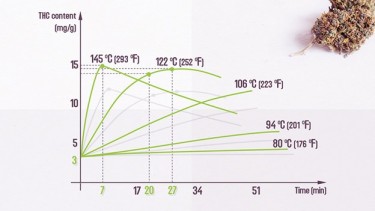
Conventional wisdom says to put it in a preheated oven at about 250º F (122ºC) for about 30-minutes and this is entirely a correct assessment.
However, you can also do faster decarbs if you raise the temperature or slower decarbs if you lower it. There’s actually a chart which I found on Green Camp that is very useful if you wish to play around with the temperature.
But why would you play around with temperature in the first place? Wouldn’t following the “rule of thumb” be enough to get consistent decarboxylations on the cannabis?
Of course it would!
The reason you want to play around with time and temperature settings is because some terpenes and flavonoids are sensitive to the heat.
We’ll talk more about preserving your terps during the decarboxylation process a bit later on.
Depending on the purpose of your decarb-ed weed, by following the chart you should have a more precision with your process.
The Process of Decarbing
Oven Method
Let’s first go over the most common method — using the oven.
This is pretty straight forward.
You’ll preheat the oven at the desired temperature. We’ll say 250ºF for this example. While the oven is heating up, you’ll begin to break up the cannabis into small chunks. Don’t grind it; simply break it up finely, but not too much either. Small chunks should do.
Lay these chunks on some baking paper, evenly. Then, place it in the oven and let it cook for about 25-30 mins.
The weed should turn from green to a light brown. Once this has been achieved, you’ll carefully remove the tray and let it cool for a bit.
The weed will now be breaking and crumbling rather easily. So be careful!
Your weed is now ready to be infused.
Double Boil Method
The other method is to use a double boiler.
You’re essentially following the same basic principles, except the cannabis would be in a jar with a lid, that will allow it to trap in a lot of the terpenes
A double boiler is essentially a stovetop method for decarbing. You’ll have a pot with some water in it; roughly a quarter of the pot should be filled.
Then, you’ll place another pot on top of it, creating a sort of seal between the two pots. The steam from the water below will evaporate and will heat the pot above it.
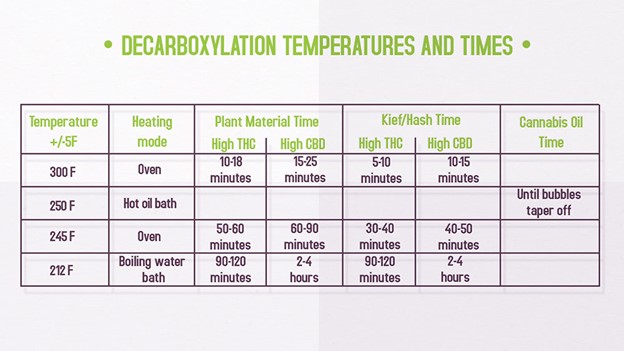
This gives you a controlled heat of about 212 degrees F or 100 degrees C. Based on the chart below — also from Green Camp — shows you that at that temperature you’ll be cooking it for about 90-120 minutes.
By placing a lid on the top boiler — perhaps with a little opening — you’ll be able to trap in a lot of the other gases that get rereleased when heat is applied. These are terpenes, flavonoids, etc.
Once the THC is activated, and the vapor settles in the second boiler, the terps and flavonoids will recombine with the weed, increasing the taste profile of the decarb.
This comes in especially useful when you find aromatic buds. Take a blueberry strain or some lemon haze and infuse that with your favorite desert. You’ll absolute love it.
Your edibles can take on a whole new life if you understand the subtle chemistry behind all of this. The best teacher however, will always be experience.
If you’ve got some weed, it’s time to start experimenting!
Can I Store Decarbed Weed?
Sure, but it will only continue to degrade over time. It’s probably best to use it as soon as it is ready to be used.
If you’re thinking of storing weed, rather store it as fresh herb. The decarboxylation process continues with time. In fact, leave it for long enough the weed will completely decarboxylate on its own.
It may take months in some cases! Who’s got time for that!
It’s not recommended to store already decarbed weed simply because it will continue to degrade until it becomes non-viable.
Photo by Yarygin/Getty Images
The Sticky Bottom Line
Making infusions is a science that many people enjoy! It’s just as addictive as growing weed, and when you begin to process your weed according to your own desire, cannabis takes on a whole new level of awesome!
For many people, the task seems daunting and I’m not going to sugar coat it. The first time you attempt it by yourself you’ll be questioning your actions every step of the way.
I’ve left weed in the oven until it was blackened and smoky. It happens to all of us at some point.
But that’s okay!
All you got to do is get out there, experiment, make your own infusions, and learn the craft of bringing depth to your cannabis activities.
I hope this article inspired some confidence in your interest to start making your own infusions. Trust me, it’s worth the learning curve!
This past year has taken a toll on our mental and physical health. Here’s what you can do to feel a little more safe if you’re rejoining the gym.
Just when we started to recover from the past year, COVID-19 cases started to rise again. And while we should kind of know how this works by now, this situation still feels new and scary, especially since states and businesses are doing things their own way. Gyms are some of the businesses most affected by the pandemic and a big source of anxiety for people.
While working out can be done anywhere, some people prefer to go to a place where they can be a part of a community, where they’re encouraged by other people’s progress. That’s totally fair and something that should be done if it ends up making you feel better and happier in the long run.
In order to do what you want to do and continue to feel safe, it’s important to do the stuff that you know works. Getting vaccinated is first, providing thorough protection from the virus and protecting your community as well. After that, you should learn your state, county and gym guidelines. While so many rules can be overwhelming, knowing them can help ease your anxiety and give you some control over the situation. Wear your mask and keep a distance from people, especially if they’re unvaccinated. Wipe down the equipment you use and keep washing your hands.
Do what feels comfortable to you
Photo by Victor Freitas via Unsplash
If joining a socially distanced gym class feels comfortable to you, go ahead. If working out in a machine alone makes you feel safer, do that. There’s no right or wrong way to act, and if you’ve been battling COVID-19 anxiety and are in a gym then you’re already making progress by trying your best to go back to your normal life.
The previous year has been a weird one, to say the least. While it may seem that other people are thriving and rejoining the normal world, many are still struggling with anxiety, weight gained over the pandemic, and more. Try your best to be kind to yourself and to celebrate your small wins, whether that’s getting back to the gym or meeting up with friends in a space that feels safe and comfortable to you.
As billionaires like Elon Musk,Jeff Bezos and Richard Branson race for space, who will be the leaders in the nascent cannabis industry as it vaults to astronomical heights?
Operators in various parts of the cannabis industry offered Benzinga their takes. Providing various responses, most focused less on the people and more so the brands and companies that could be headed to the moon, of sorts.
Photo by rawpixel.com
Predicting The Shape Of The Cannabis Space Race In Its Early Stages
The cannabis space race is in its earliest days, providing no clear answers at this time. The uncertainty leaves room for ample speculation and hypothesizing.
Olivia Alexander, CEO of online global CBD boutique Kush Queen, compared the industry to the dot com bubble.
“At this stage, the industry is so young with so much room for innovation and expansion it is very hard to say how many players are going to remain once the market begins to mature and fully develop on a federal level,” Alexander stated.
Marco Eadie, managing director at consulting firm O’Keefe, said that well-capitalized companies would have an advantage over smaller players. “Larger companies will be much more strategic in deploying their capital,” he said. Eadie added that market variables, such as state-by-state licensing and capital access, will hinder companies.
Alexander believes that the number of players in the space will hinge on which companies can successfully navigate the tumultuous space, forming a reliable consumer base in the process.
Major MSOs could have to pivot if vertical integration doesn’t become part of federal legislation. Trevor Fencott, CEO of Fire & Flower Holdings Corporation (OTC:FFLWF), believes that vertical integration won’t last, thus separating the industry into product and distribution companies.
“Vertical integration is uncommon in most other industries and we believe this will be true of cannabis,” Fencott said.
If true, both sides of the market will see “inevitable” consolidation. Like other industries, he expects significant consolidation to lead to three to five global players in each market segment, reflecting many other industries.
Photo by Kevork Djansezian/Staff/Getty Images
Seth Worby, co-founder and managing partner of the Cannabis Creative Group, believes that legalization will eventually lead to the downsizing of current players as major companies swoop in to get in on the action.
“They will find cannabis businesses with impressive revenue potential, brand equity, and operational standards – and they’ll snatch them up at a premium too,” Worby said.
Non-Cannabis Brands Largely Predicted To Become Eventual Market Leaders
Both major cannabis brands of today and leading non-cannabis companies could become the eventual leaders of the industry’s space race.
Worby predicted market leaders will ultimately be determined by scale. “Major corporations such as Pfizer Inc. (NYSE:PFE), Johnson & Johnson (NYSE:JNJ), Procter & Gamble Co (NYSE:PG), et cetera, that have existing distribution and plants in similar markets will quickly emerge at the forefront of this race as soon as federal legalization comes about.”
He added that companies experienced in recreational-focused marketing, like Anheuser Busch Inbev SA (NYSE:BUD) and Molson Coors Beverage Co Class B (NYSE:TAP), will also enter and innovate the space post-federal legalization.
“These types of conglomerates have stayed away from the industry because of the federal status and restrictions, but that doesn’t mean they are not preparing for a shift,” Worby added.
Photo by VictoriaBee/Getty Images
Roger Bloss, CEO of cannabis holding companyMJ Holdings, Inc. (OTC:MJNE), believes Jeff Bezos will be in the race as well, with Amazon.com, Inc. (NASDAQ:AMZN) likely becoming a distribution dominator. Aside from Amazon, he sees brands that are able to excel at both medical and recreational becoming eventual leaders.
Leading cannabis brands weren’t excluded from the conversation entirely. Eadie noted increased market caps and double-digit growth from Curaleaf Hldgs Inc. (OTC:CURLF) and Canopy Growth Corp (NASDAQ:CGC) as signs of their strength. He also liked private companies, including Gage Cannabis and its continued focus on growth.
“Each rising star will need to differentiate themselves in this competitive market as groups like Harvest Health & Recreation Inc. (OTC:HRVSF) and Verano Holdings Corp. (OTC:VRNOF) continues to acquire unique cannabis-related companies to strengthen their portfolios,” Bloss noted.
Getting in ahead of the wall of capital that will follow federal banking reform should also prove almost as historic as the broader cannabis legalization movement.
By Tim Seymour and Brady J. Cobb, Esq.
After Democrats swept control of the White House, the House of Representatives and the US Senate in January of 2021, cannabis stocks soared into the new year on the hopes of major legislative policy reform advances including the prospect of federal legalization. While waiting for this legislation cannabis markets have consequently fallen from their January 2021 highs, despite plenty of commentary by Democrats their cannabis agenda was coming fast.
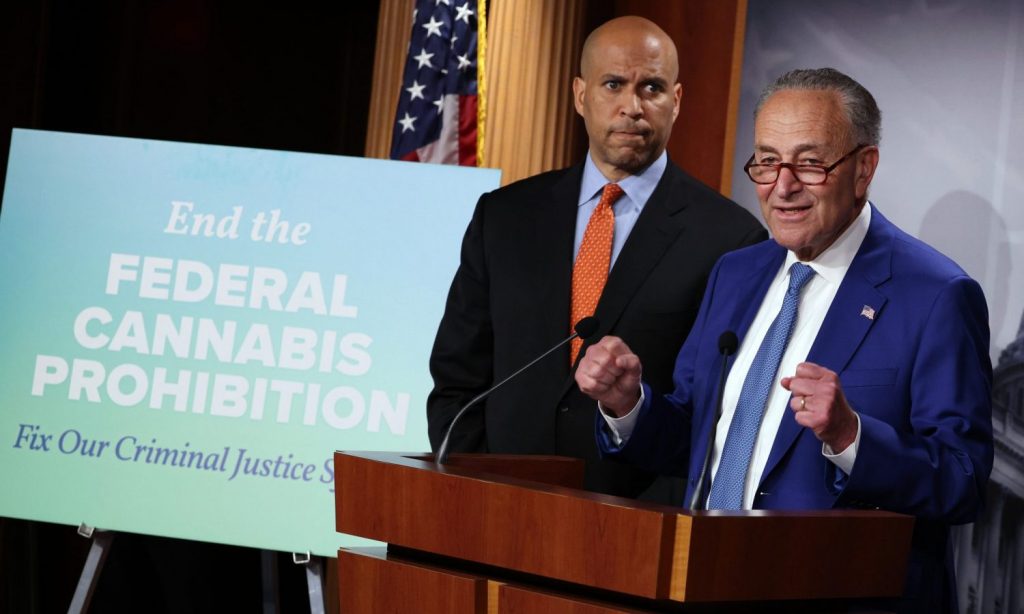
On July 14, after rumored releases each of the last two months, Majority Leader Schumer unveiled the much-anticipated discussion draft of the comprehensive cannabis reform bill that he and Senator Wyden and Senator Booker have been working on since January. While the proposed bill contains sweeping reforms that are long overdue, the prospects of the bill garnering the support of 10 Republicans in the Senate is slim, and based upon previous statements from some Democrat Senators obtaining all 50 votes from that caucus may be a bridge too far as well. Schumer and his colleagues have presented a wish list of legislation for the industry that while important over the course of time for the growth of the sector and the social restitution that should accompany it, is not realistic or necessary at this time.
Photo by Kevin Dietsch / Getty Images
The Bill contains sweeping reforms including:
a) Descheduling cannabis from schedule 1
b) Offering expungements for those with cannabis convictions
c) Funding social equity programs via cannabis excise taxes
d) Ceding regulatory control of cannabis to the FDA, ATF and TTB from the DEA, and
e) Maintaining state based regulatory frameworks (which seemingly contradicts item (d) above), among other initiatives. The Bill does not expressly tackle needed banking and financial reforms, tax and 280e reforms, and/or how to harmonize state and federal regulation of cannabis, which will be key items to watch for as comments pour in from stakeholders and negotiations begin.
Clearly, Democrats are well positioned to deliver the first step towards historic and long overdue cannabis policy reform, yet to date it’s been more conversation and less action in the halls of Congress. Schumer’s Bill doesn’t leave Republican lawmakers a lot of room for compromise that they can get comfortable with.
We take the view that Schumer has the ability to cut right to important issues that and take a pragmatic approach to passing legislation now that can be passed, and that this legislation will be a stepping stone to more broader, sweeping reform he has proposed. Even Supreme Court Justice Clarence Thomas, who is regarded as one of the most conservative Justices on the Court, recently threw his hat into the ring on cannabis reform when he opined in a recent opinion that “the Federal Governments current approach is a half in, half out regime that simultaneously tolerates and forbids local use of marijuana. This contradictory and unstable state of affairs strains basic principles of federalism and conceals traps for the unwary.”
Photo by Sarah Silbiger/Getty Images
Now, it’s time for Congress and more specifically the Senate to address banking and taxation issues that can allow the industry to be built on a more solid foundation and afford minority/social equity applicants access to affordable capital while we tackle the bigger federal issues and social issues over the longer term.
Although the SAFE Banking Act passed through Congress last month (with over 100 Republicans voting in favor of allowing cannabis companies access to the federal banking system), Senate Majority Leader Chuck Schumer expressed reservations about the legislation and how it could undermine his own proposed cannabis bill that will seek broader reforms including long overdue social justice measures. While we agree that SAFE does not go far enough in remediating our country’s ill fated “war on drugs,” it would be the first major win for cannabis reform in Congress, and winning begets winning.
Social justice must be a critical component of the broader reform legislation, but the reality of policy making in Washington D.C. is that its a game of incrementalism, and in some cases pragmatism that is best summarized by the motto of the late Jim Valvano during the miracle run by N.C. State Wolfpack in the NCAA tournament, namely “survive and advance.”
If we truly want to empower minorities and those that have been negatively affected by this misguided war on drugs, the industry needs to first have proper access to capital and real banking services. If the leading U.S. cannabis companies cannot access traditional commercial and investment banking, while also facing punitive tax code, minority small business owners will no chance to succeed
How About Putting Some Points on the Board?
The SAFE Banking Act is a rare piece of bipartisan legislation supported by Republicans, Democrats, and the cannabis industry at-large. In last month’s House vote, 15 more Republicans voted in favor of the bill than in 2019 (when the SAFE Act was first introduced only to be derailed by the coronavirus pandemic). The significant increase in Republican support coincides with the growing trend of legalization of medicinal and adult-use cannabis products at the state level over the last two years.
Photo by Bloomberg Creative Photos/Getty Images
Since the SAFE Act was first passed, seven states have legalized adult-use cannabis. A bi-partisan group of 34 U.S. Senators have signed on to sponsor or co-sponsor the SAFE Act, and the bill has the public support of the American Bankers Association and a bipartisan group of Governors and State Attorney Generals.
Passage of the SAFE Banking legislation would mark the first time that Congress passed cannabis reform legislation, while simultaneously serving as a springboard for the members of both chambers to collaboratively tackle reasonable and workable social justice, social equity and legalization policies. Immediate benefits of this legislation would include allowing the government the ability to accurately assess the size of this market and the tax dollars to flow from it (even the head of the IRS has stated he wants the money in banks for regulatory purposes).
Taxation at the federal level would unofficially transition the federal government’s treatment on cannabis from legal enforcement to revenue generation, and the potential tax revenue that could be generated from the cannabis sector could be used to assist in the funding of other key Democratic initiatives such as the infrastructure bill that is currently being finalized.
Thankfully, Majority Leader Schumer has made cannabis a priority and the release of his comprehensive proposal is an exciting day for the industry and investors alike. But to get it over the finish line, Democrats need a two-step approach: Pass the SAFE Banking Act first and take the historic first win, while simultaneously crafting and building bi-partisan support for a broader reform bill. The former is what will make the latter, including the Senate Majority Leader’s more involved bill, a reality.
Meanwhile, cannabis investors no longer are pricing in near term federal banking access and cannabis stocks have pulled back 20-30% from the mid-February highs. While investors are right to focus on the long term growth fundamentals, getting in ahead of the wall of capital that will follow federal banking reform should also prove almost as historic as the broader cannabis legalization movement.
Tim Seymour is thePortfolio Manager of the Amplify Seymour Cannabis ETF (NYSE:CNBS).
Brady J. Cobb, Esq, is the founder and former CEO of Bluma Wellness/One Plant Florida. He’s also a board member of Captor Capital and a longtime cannabis advocate.
More than 100 million U.S. residents already live in a recreational state and 95% of residents live in a state with legal medical weed — so the consumer population is present and growing.
By Michael Sassano
Multi-State Operators (MSOs) in the United States are primed for the next big stock amp-up, which could see at minimum a 50% move starting as early as late August even without federal legislative movement. As volumes start to pick up this July, U.S. stocks don’t need a special event to bounce off this latest correction.
Cannabis is a Consistent Performer
Cannabis is rapidly closing the revenue gap outpacing such landmark institutions as the National Football League — and there is still an estimated $66 billion U.S. legacy market still to replace. Even more compelling is the emergence of profitability that is coming after the massive infrastructure spending that started in 2018 and 2019. While summers have always presented lower volumes of movement for small caps, the trading indexes are showing favorable valuations through the end of the season, despite the to-be-expected typical federal legislative gridlock on the horizon.
Photo by p_saranya/Getty Images
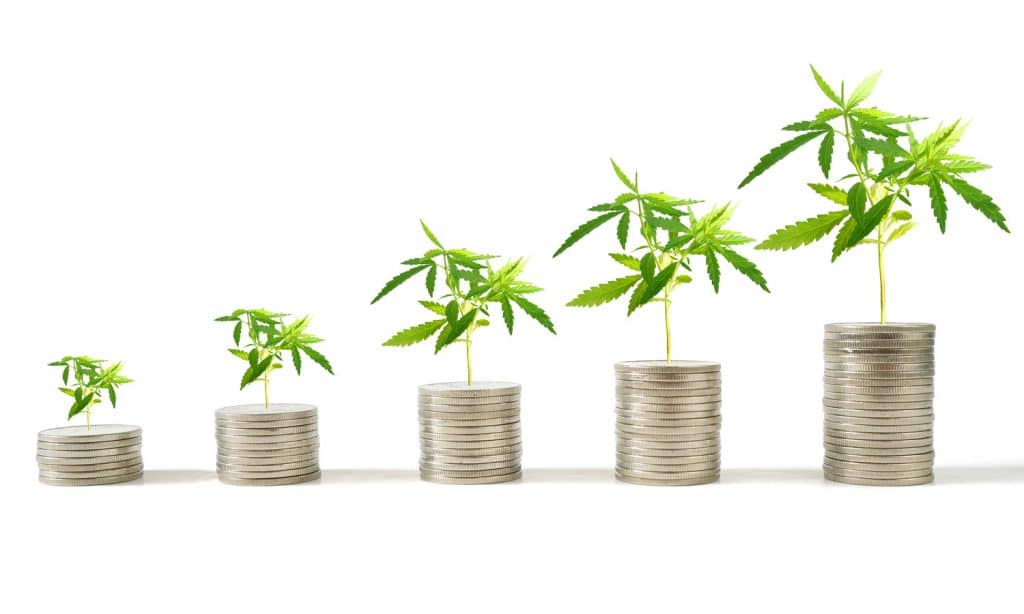
Even without federal rule enactment of legislation like the SAFE Banking Act, U.S. cannabis revenues increased astronomically from $1.9 billion in 2014 to $17.5 billion in 2020, beating expectations yet again. Forbes recently predicted that by 2025 the U.S. market will reach $43 billion — which only a few months ago was predicted to reach $29 billion. A flurry of newly legalized states (and more to come) all but ensure we will most likely see another stellar year in 2021, and an even larger increase in 2022. And with more demographics like seniors opening up to cannabis therapies, the industry is growing more robust with legalization sweeping through the remaining hold-out states.
Cannabis is Creeping up the U.S. Marijuana Index
Compare the above mentioned revenue growth and increased growth predictions to the U.S. Marijuana Index and you will see a typical over-optimistic yearly run. The index started in January 2015 and was trading at 115 which is above where we are trading today, around 110. By February 2016 that index dropped to 23 which is exactly where the second-biggest drop bottomed in March of 2020. In that period from February 2016 to March 2020, we saw two peaks of 101 in late October 2016 and another peak of 134 in April 2019 followed by a record high in February 2021 of 145. The next run will crack the 145 ceiling established this year and surpass it.
The quality of companies operating now — plus the solid fundamental of a guaranteed, permanent U.S. cannabis market — is dramatically different from the landscape back in 2015. Profitability has emerged as a recurring theme in larger, more well-developed MSOs, while smaller companies have learned to be profitable by starving MSOs of capital markets. Of course, if the SAFE Banking Act or other measures occur to stimulate cannabis companies, that will turbocharge the financial environment, but it’s not vital for hitting a new high in cannabis stocks this year. Cannabis sales will keep increasing, companies will continue posting record numbers and profits, and new states will legalize until federal rules catch up to consumer preference.
Legislative Stagnation Can’t & Won’t Impede the Growth of the Cannabis Market
Mergers and Acquisitions (M&A) and infrastructure building are reaching the highest levels ever seen. And despite Canada’s woes, the U.S. and global capital markets are responding by beefing up their services for cannabis. The U.S. is receiving the largest benefit of private equity funding due to the massive revenue stream that is gaining momentum, but also the increased fundamentals of the companies. People are shunning the build and forget about the profitability model Canada’s federal legalization brought and realize cannabis is here to stay and best to invest in profitable operators. However, money and M&A are going to all companies big and small in the U.S. Even the Canadians are trying to buy into the U.S. market and picking up the scraps that U.S. MSOs are passing on. Expect M&A and infrastructure investment to only increase over the year.
Photo by stockstudioX/Getty Images
Ideally, positive legislation will be taken on Capitol Hill to work toward building out the cannabis industry, but regardless of this term’s action, cannabis will continue making major gains. The political hubbub becomes mere background noise to the daily reality of a regular U.S. cannabis consumer. 100.9 million U.S. residents already live in a recreational state and 95% of residents live in a state with approved medical cannabis — so the consumer population is present and growing.
Moving into the fall, we will see disrupted supply chains return to full volume production in the market, and should be prepared for the next stock run somewhere around late August. Already cannabis brokerage houses are telling brokers to take time off now and be prepared for heavy activity in late August. The valuations you see today won’t be around again, and any surprise positive news from Washington DC will send stocks doubling where they are today.
Author Bio: Michael Sassano, the CEO of Somai Pharmaceuticals, a European company centered in pharmaceutical extraction, manufacturing and formulation of pharma-grade GMP-certified cannabinoid products throughout the European Union.
COVID-19 safety measures are fluctuating and it can get confusing. Here’s what the CDC is recommending you do if you’re vaccinated and exposed to the virus.
While the slow rise of COVID-19 cases can make it feel like we’re going back in time, there’s one big difference. Vaccines are readily available to any adult who wants to get their shot. Still, getting the call or message that you’ve been exposed to COVID-19 is terrifying, no matter your vaccination status.
What should you do if you’re vaccinated and have been exposed to someone who tested positive for the virus? It’s very unlikely for people who have been vaccinated to spread the virus or to get the disease symptomatically. Still, there is a margin of error, and breakthrough COVID-19 is a possibility.
There are a few steps you can take for some peace of mind:
Monitor your symptoms
Photo by cottonbro via Pexels
Per the Centers for Disease Control and Prevention (CDC), vaccinated people who’ve been exposed to someone with COVID-19 should monitor themselves for symptoms for 14 days. These include fever, cough, breathing difficulties, loss of smell and taste, and fatigue. These symptoms are often confused with those of a common cold and it’s important to remain vigilant.
If experiencing these symptoms, people should stay isolated and get a test for the virus. There should be an immediate test administered and another one 5 days later to make sure the results were correct. If you test positive for COVID-19, you should remain isolated for at least 10 days since your last COVID-19 test.
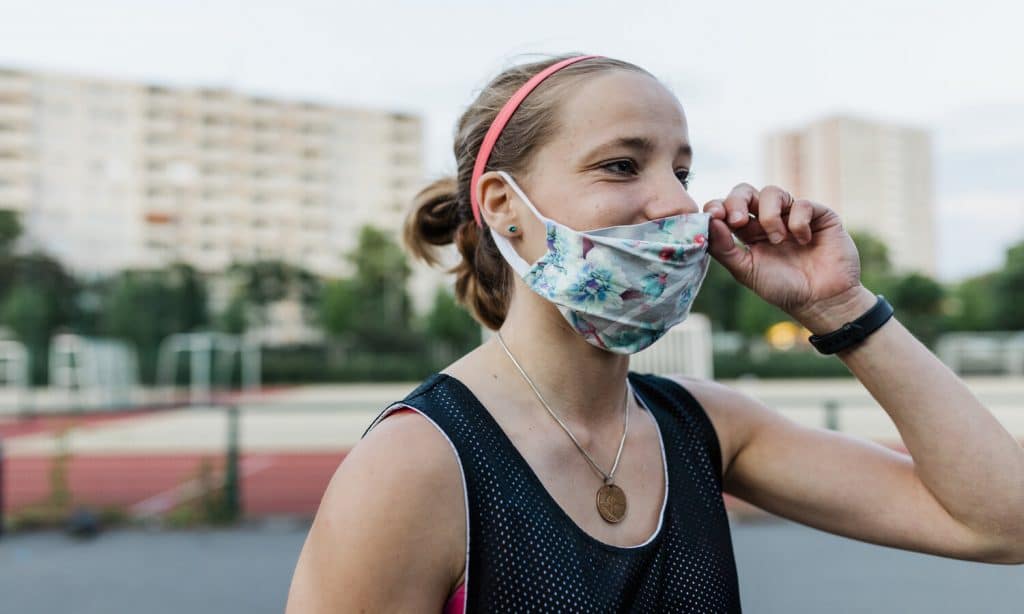
Lastly, mask mandates are fluctuating now that COVID-19 cases are on the rise. It’s always best to err on the side of caution, even if you’re vaccinated, masking up when located in indoor settings and crowded spaces. Even if the vaccine is highly effective against the virus, it’s still not a foolproof solution. By wearing a mask you’ll be protecting yourself and other people in your community, slowing down the person-to-person spread of the virus.