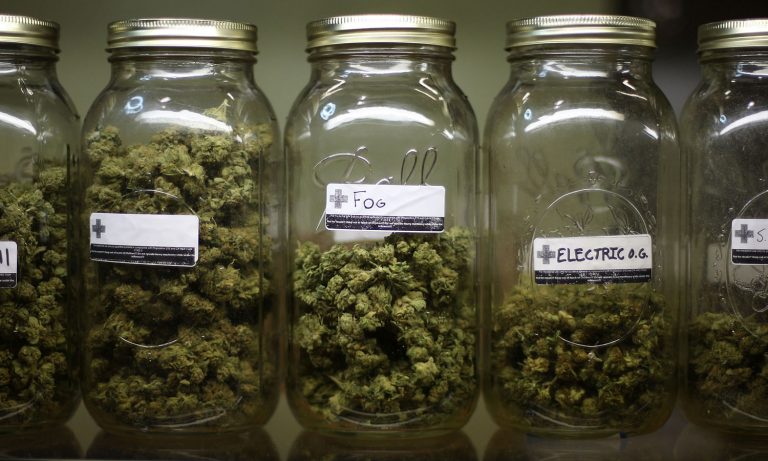
Summer love is so real. The reason summer songs never get repetitive, just like the foods we eat and the drinks we drink, is because it’s a mostly fleeting time. American BBQs aren’t the same without ketchup, and real American values of freedom call for the addition of cannabis.
Responsible parties can indulge in this sweet classic flavor with anything coming off the grill. Keeping the cannabinoids away from the heat and cooking is the move when you want strength, as infused foods that have been cooked will lose some naturally. Having a squirt bottle handy with special ketchup will make any fireworks watching or poolside lounging that much better.
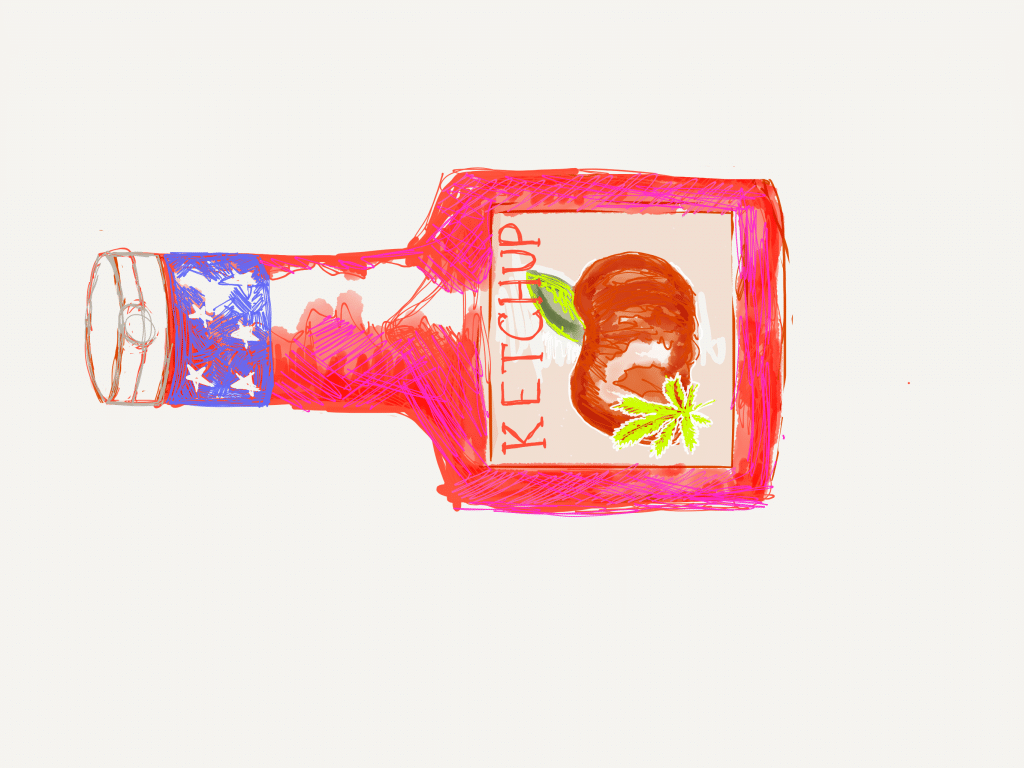
Illustration by Danielle Guercio
Quick Cannabis Ketchup
Makes 10oz; 4 mg. THC per tbs.
8 oz of your favorite ketchup
½ oz cannabis glycerin tincture
1 ½ oz tomato paste (optional)
Spices (optional)
You can gather as much that simply adding a nice pour of glycerin tincture to your ketchup and mixing well is enough to get the party started. It really can be that easy, however if you don’t add a pinch more tomato paste to balance it out, you may end up with slightly over-sweet sauce.
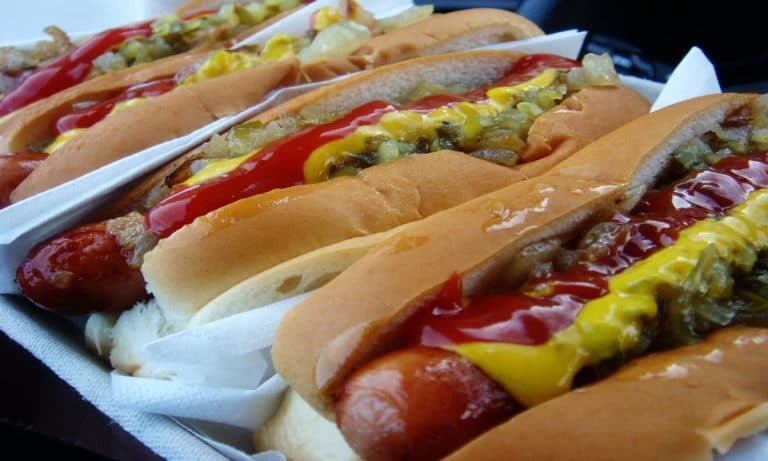
Squirt onto hot dogs, veggie burgers, fries and more all summer long, since it should last a few months if you keep it tightly sealed in the fridge.
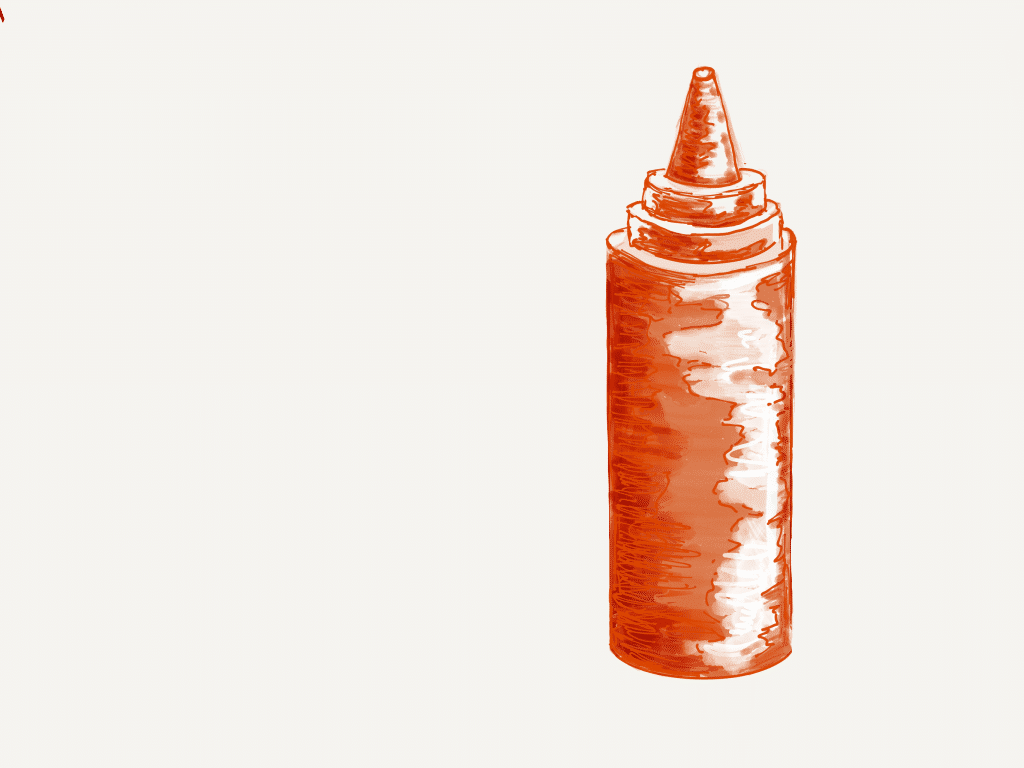
Illustration by Danielle Guercio
Don’t stop there if you are into unique condiments. You’ll have that little hit of weed taste, but you can go even further with other unique additions. Try some siracha for a spicy twist, about an ounce would be perfect to let that really come through. They don’t have to be liquids either, there’s a whole world of ground spices that can go in fun directions. Sazon powder, ground garlic, and turmeric are all yummy choices for that type of addition.
Ketchup doesn’t have to be basic, and it doesn’t have to be virgin either. It’s so widely used that you may want to label it clearly at your party, so no unsuspecting people have any. It’s not polite to dose guests without their knowledge, you never know who has to get home or get a drug test done, regardless of your state’s rules. Party safe and don’t ketchup and drive!
In the eyes of many Americans, the Fourth of July is a day for parades, barbecues and, of course, fireworks.
The tradition got its start at the beginning of our nation’s history after the Founding Fathers met in Philadelphia to write and sign the Declaration of Independence. A day after the Continental Congress adopted the declaration on July 4, 1776, John Adams – soon the second U.S. president – penned a letter to his wife Abigail, declaring that Independence Day
“ought to be solemnized with pomp and parade, with shews, games, sports, guns, bells, bonfires and illuminations from one end of this continent to the other from this time forward forever more.”
One year later, Philadelphia celebrated the anniversary with fireworks – or “illuminations,” to Adams – plus a parade commemorating Independence Day.
So with that in mind, here are four fascinating sets of facts about fireworks.
And this figure has grown rapidly in recent years, from half a pound per adult in 2000. In 1976, the United States’ bicentennial, the figure was just one-sixth of a pound annually.
A reason for the big increase is the steady reduction in state prohibitions against individuals using fireworks. Today only Massachusetts completely prohibits individuals from owning and using any type of fireworks. The other states all allow usage in some form.
The most recent states to allow fireworks are New Jersey, Delaware and Iowa, whose new law legalizes fireworks around the 4th of July and New Year’s Eve only.
Fireworks are also illegal in many urban areas, like New York City.
Because states are now permitting individuals to purchase and possess fireworks, there has been a large shift from professional to amateur use. Back in 2000, roughly one-third of all fireworks were set off during professional displays, the kind that light the skies of cities around the world on holidays like New Year’s Eve and national celebrations. By 2017, professional displays comprised less than 10 percent.
Sparklers cause a large share of fireworks-related injuries. Maria Symchych/Shutterstock.com
Firework prices have fallen
Just because more regular Americans have been shooting off fireworks doesn’t mean prices have surged. The vast majority of the fireworks shot off in the United States are manufactured overseas, mainly in China.
Each shipment of fireworks brought into the U.S. includes a detailed invoice that shows the price the importer paid. These invoices show fireworks prices, after adjusting for inflation, are cheaper today than in the mid-1990s.
In 1996 it cost about $1.37 in today’s terms to import 1 pound of fireworks. By 2017 the price had fallen to just $1.13 a pound. That means pound-for-pound fireworks are less than half the price of the hot dogs many people are grilling this 4th.
Accidents and injuries
Fireworks are dangerous – hence the reason so many states had banned them previously.
Back in 1986, fireworks injured about 6.6 out of every 100,000 people. Since 1986, injuries have steadily fallen as government regulations made them safer. In 2008, the rate was down to 2.3 people.
But as states have relaxed restrictions, the injuries have started increasing again. The latest figures for 2017 show a rate of 4 people per 100,000.
In addition, there’s also a big gender divide in who suffers the most injuries. Men experienced about 70 percent of fireworks-related injuries for the one-month period from June 18 to July 18, 2017.
Beyond such statistics, however low, every year there are horrible stories of both children and adults being maimed and killed. So it’s always important to exercise caution when lighting what amounts to a low-yield missile.
Today, it is working to lower injury rates again by requiring manufacturers to adhere to higher standards. In February 2017, for instance, the commission passed several of what I believe are common sense regulations for firework manufacturers to make their products safer.
For example, faulty fuses have caused many injuries, such as when some burned rapidly and ignite a rocket too quickly, preventing the holder from moving away in time. Other fuses actually take too long to ignite, leading people to investigate whether it needs to be relit just as the firework explodes in their face. So the commission now requires all fuses to ignite fireworks three to nine seconds after being lit.
The commission also now requires fireworks to have bases that are wider and support more weight so they do not tip over after being ignited. This prevents fireworks from firing off horizontally, becoming missiles that bounce along the ground and potentially hit spectators.
As more states loosen restrictions on fireworks this Fourth of July, millions more people will follow the exhortations of John Adams and celebrate by shooting off “illuminations.”
But if you do plan to shoot off a few rockets or more advance fireworks, use some common sense, especially if children are around.
Whether you are lighting fireworks, watching them explode above you or just hiding from the noise, try to have a fun and safe Independence Day.
We’re all aware of the effects and dangers of consuming alcohol. The fact that drinking is related to weight gain, sleep loss, and anxiety (to name just a few ailments) hasn’t stopped it from being one of the most popular activities in the world. Associated with fun, winding down at the end of the week and facilitating social interactions, alcohol has been a mainstay in our culture for decades, something that’s unlikely to change any time soon. They don’t call it social lubricant for nothing. So, here are some tips for drinking alcohol without getting wrecked.
It’s never a good idea to drink on an empty stomach. This practice makes it more likely for you to get drunk while also irritating your digestive system and facilitating even worse hangovers. You should consume a balanced meal that contains proteins, healthy fats and carbs, around the same time you’ll be consuming alcohol.
Aim to have a balanced meal close to the time you’ll be consuming alcohol, said Wendy Lopez, a registered dietitian in Port Chester, New York, and the in-house dietitian for Vita Coco.
“Drinking alcohol on an empty stomach can irritate your digestive system. It can also result in faster absorption of alcohol,” Lopez said.
While we all appreciate a bartender who over-pours, large portions contain more than one serving of alcohol and make it easier for you to get drunk rapidly. Plus, your liver has a hard time keeping up!
While it’s always important to pair alcohol with food, it’s just as important to consume water as you’re drinking to keep you hydrated and help you stay sober. Since alcohol depletes your body of electrolytes, the more dehydrated you are the next day, the stronger your hangover will be. “Drink a glass of water between every glass of alcohol,” recommends personal trainer Mike Clancy.
Sodas, juices and all sorts of sugary drinks pair deliciously with alcohol, but they come with an extra serving of throwaway calories that you probably don’t need. Alcohol is already caloric enough, so try to learn how to enjoy and appreciate the flavor of it by pairing it with seltzer or some other mixer that is low in sugar and calories.
Try to keep some sort of control even on the nights where you really want to drink with your friends. Learn your drink limit and always pace yourself with water. While getting drunk is still likely to catch you off guard from time to time, if you eat, drink water and pace yourself, you’ll feel better the next day and avoid some of the damage to your liver and body.
There’s no better pick-me-up than the one you get when you see a clip of an animal acting silly, which is why we’ve compiled this weekly column. These short videos feature all sorts of animals, providing you with that much needed rush of endorphins.
This week’s column features a lot of adorable animals, including a smiley puppy, a donkey who is not enjoying the fact that it’s Wednesday, a screaming cat, two bunnies and a strangely large amount of turtles. Check them out!
According to the post’s description, this puppy is excited to be adopted. While a lot of comments suggest that her demeanor suggests that she is more stressed than excited, it’s still a positive post because a puppy was adopted into a loving home. There’s also that smile, which is adorable.
A sleepy donkey
https://www.instagram.com/p/BzOO6x7gOd-/
Donkeys are a rare animal on Instagram but they’re very cute, especially when they’re as tired and sleepy as this guy, who does not want to get up and face the day.
A screaming cat
https://www.instagram.com/p/BzaUOt8HNv8/
Although the sounds this cat is making aren’t normally associated with cats, there are other videos of it making the same particular sounds. We don’t know if it’s happy, stressed out or upset, we just know that it’s cute.
A hole in the ground wouldn’t normally make for such comforting and adorable viewing, but these don’t normally feature cute bunnies who also happen to be cuddling and making the cutest faces you can imagine.
A lot of turtles
https://www.instagram.com/p/BzK9SJ_jbh9/
Turtles are cute but they aren’t as beloved as they should be, at least on social media. This video makes up for this, giving us an overwhelming stream of them, all rapidly waking towards their caretaker. There’s probably a lettuce or some vegetable involved.
Two major talking points among Democratic presidential candidates ahead of the 2020 Election has been universal health care and marijuana reform. But those two issues could have more in common than you think. According to one cannabis CEO, opening medicare for all could “dramatically” boost medical marijuana access.
“I think it would eliminate the financial subsidy for people to use products like opioids,” Columbia Care CEO Nicholas Vita told Yahoo Finance. A system that doesn’t overly rely upon opioids could “actually open the door for [patients] to use products that are potentially much less harmful and more efficacious like medical cannabis.”
The opioid epidemic places a serious economic burden on the country. Health care and court expenses, as well as wasted productivity, caused by the opioid crisis cost about $78.5 billion annually, according to The Centers for Disease Control and Prevention. A report from the National Institutes of Health estimates that nearly 130 people die every day from an opioid overdose.
Medicare is once again a hot button political issue, in part because Sen. Bernie Sanders introduced his Medicare For All Act. While Medicare usually only covers those ages 65 or older, Sanders’ plan would provide health care for all Americans. If that happens, companies like Vita’s need to be prepared for how medical marijuana will fit into the system.
“Because of the way cannabis is handled, there’s no access to credit, which is the most common form of transactions for consumers. We thought that alleviating one of the most important bottlenecks, we can actually increase access in a significant way.”
Kylie Jenner’s 1-year-old daughter Stormi Webster can now call herself a cover girl.
Stormi graced the cover of Harper’s Bazaar Arabia alongside her mom and grandmother Kris Jenner for the magazine’s July/August issue. The cover marks the young girl’s first and also marks the first time that Kylie and Stormi have been photographed together for an international fashion magazine, according to Harper’s Bazaar Arabia.
https://www.instagram.com/p/BzYe5IbpNRx
Both Kris and Kylie took to their respective Instagram accounts to share the cover image.
“Thank you so much @harpersbazaararabia! Such an honor to be on the cover of the July/August issue… three generations,” Kris, 63, captioned hers, in part.
According to a report from The Daily Beast, Meghan McCain may leave The View, where she is reportedly paid about $1 million per year. Why? Because she feels like a “caged animal,” according to a friend. That’s certainly an interesting turn of phrase!
The Daily Beast spoke with several people who claim to be close to McCain, all of whom shared that she is “emotionally drained, angry, and isolated.” She feels “exhausted and defeated,” one said. Another added, “It’s getting to the point where it’s not worth the emotional toll every week.”
According to one source, it’s not only due to the blowback she receives whenever she spouts her questionable opinions on everything from anti-Semitism to the treatment of people at border detention centers. She “feels different in every way a person can feel different [at The View]—everything from politically to just socially to where she’s from,” they said, pointing to the fact that McCain, unlike her fellow co-hosts who enjoy traipsing off to the Hamptons, prefers to spend weekends “hanging out in the creek and doing Jell-O shots and shooting guns.”
Perhaps no other former NBA player has further ingratiated themselves into the cannabis industry than Al Harrington. After launching Viola Extracts Inc. following his retirement, he wanted to show the sports world—and the world writ large—that cannabis “isn’t just about rolling a joint” through a line of wax, resin, and CBD wellness products. He also convinced former NBA commissioner David Stern, who was notoriously anti-marijuana during his tenure, to agree cannabis should be removed from the controlled substances list for basketball players.
But Harrington wasn’t always such a proponent or advocate for cannabis. When he first joined the NBA, in fact, Harrington considered marijuana a gateway drug to more potent substances. But when he saw that other players on his team were using cannabis and still successful, he reconsidered whether the lazy stoner stereotype or marijuana-as-gateway-drug myth that was commonly believed at the time were fact or fiction.
“When I got to the NBA, it was the first time that I realized that athletes can use cannabis and still be very productive,” Harrington told Bloomberg.
“Some of the best players on my teams were self-medicating all the time, so that’s when I first realized that the stigma wasn’t true.”
He understands, though, the league has to handle any embrace of marijuana delicately. Current NBA Commissioner Adam Silver previously explained that marijuana is a “complicated issue” for the league. Silver worries how it could impact the mental wellness of players as well as what message they’d send to younger fans.
Harrington thinks it could also become a low-hanging fruit for critics and opposing fans.
“If cannabis goes legal and the NBA says players can consume, if Steph Curry missed 10 threes, everybody’s going to say he’s high,” Harrington said.
Still it encourages Harrington that various sports leagues have reconsidered their previously prohibitionist rhetoric. This year both the NHL and NFL have announced plans to research cannabinoids as a pain management tool for players and whether marijuana could work as a neuroprotectant against traumatic brain injuries.
“I think CBD’s kind of a gateway into sports,” he said. “If the teams in these organizations know what’s best for their players, they should take a deeper dive into the cannabis plant because there’s something there.”
Summer is great. It used to be even better during school when we got a months-long break that actually allowed us to travel. But who says that you need to go on holiday in order to see things you’ve never seen before? Here are 4 ways to vacation without leaving you house.
While nothing can compare to the feeling of being in a different place, technology is sure trying hard to recreate that! Does it work out smoothly? Probably not. Still, it’s worth a shot if you really feel like traveling and aren’t able to do it. Here are 5 ways you can take a mini vacation without leaving your house.
There’s a whole subset of YouTube videos dedicated to bringing the theme park experience right into your home. For starters there’s Defunctland, which is a YouTube channel that focuses on the history of extincted theme parks. It’s an extremely interesting and popular channel that has branched out into a podcast, and even VR, which transform the whole rollercoaster experience into something even more immersive. If you just want to experience a cool ride, YouTube’s got you covered as well.
Look at some zoo animal live-feeds
Zoos tend to remind us of vacation activities, right? Why not watch some live streams of your favorite animals as a way of relaxing and forgetting that you’re still at home and that you have work tomorrow?
There are feeds for all sorts of animals, ranging from elephants to penguins to pandas. While it’s not the most active of viewing experiences, since these are live streams and are not edited clips, it makes it very special and rewarding when something does happen.
A lot of great museums are now offering ways of viewing their content from the comfort of your home, giving you the chance to appreciate some of their art without feeling like you’re surrounded by people smarter than you.
While most of the artwork won’t be available on most museum virtual tours, you can still catch a glimpse of some of the classics. Here’s a list with some of the best tours.
Instagram?
https://www.instagram.com/p/BzbjWXkBibn/
Alas, when you’ve exhausted all options there’s always the Instagram travel tag, which can depress you as much as it can transport you. There’s all sorts of influencers out there who live off of traveling. You can find daredevil accounts, fashion, foodies or more. Scroll with care.
It’s no secret that Prince William and Meghan Markle don’t have a close relationship. Not only is there tension between Will and her husband, Harry, but it’s been rumored that the future King wasn’t sold on her marrying his brother. But now, it turns out that the name “Meghan” never had a good standing with William. Is this why Prince William never warmed up to Meghan Markle? A new book claims that back at university, the Duke of Cambridge was turned down by an American with the same name.
In her new book Kate: The Future Queen, royal biographer Katie Nicholl writes that during his time at St. Andrews, Prince William had a huge thing for this girl named Meghann Gunderman. And she was not having it.
“One of the first girls he spotted was the Texan heiress Meghann Gunderman, known as Gundy,” writes Nicholl. “When William asked her out-something he did not do lightly-it came as somewhat of a shock when she declined his advances. This seemed to make him want her more.”
According to Marie Claire, Meghann, who is the founder and executive director of The Foundation For Tomorrow, went on to marry former NFL star Jason Sehorn in 2017. Her birthday, by the way, is May 18 — the day before Meghan Markle and Harry’s anniversary.
https://www.instagram.com/p/BxnTnrIhveS/
https://www.instagram.com/p/BtR1liQB_HV/
The Foundation for Tomorrow is a global impact organization. The Foundation For Tomorrow’s programs are impactful, personalized programs that focus on the value and promise of each student, each teacher, and each community we work with. Providing a previously out-of-reach education to some of Tanzania’s most vulnerable children is the heart of our work. To ensure the success of this educational opportunity, TFFT provides Whole Child life skills, a Teachers Training Program, and will soon build a community-enriching Learning Centre.
A report released last month from a House of Commons committee in Canada called for the country to decriminalize all drugs. It was part of an effort to treat addiction as a public health issue, following rising rates of methamphetamine addiction. The Standing Committee on Health advised the government to “undertake an evaluation of Portugal’s approach to the decriminalization of simple possession of illicit substances and examine how it could be positively applied to Canada.”
Now, one Canadian lawmaker is taking the proposal one step further. Liberal MP Nathaniel Erskine-Smith recently introduced legislation that would repeal parts of federal laws that concern controlled substances in Canada, as Marijuana Moment first reported. The bill would effectively decriminalize possession of all illicit drugs.
“It does not mean removing the criminal sanction for producing or trafficking, but for personal use by the very people we want to help, it means treating patients as patients and not as criminals,” Erskine-Smith said when introducing the legislation. “That is exactly what this bill seeks to do by removing the criminal sanction for low-level possession. It is a necessary next step in following the evidence to save lives.”
Erskine-Smith has long advocated for decriminalization as a solution to the country’s opioid crisis. In Erskine-Smith’s estimation, possible criminal charges for drug possession persuade Canadians suffering with addiction from receiving the help they need. While federally legalizing marijuana was “about treating Canadians like responsible adults,” decriminalization is “about saving lives.”
The opioid and meth crises continue to kill thousands of Canadians. We need to treat drug use as a health issue, remove the criminal sanction for small drug possession, and follow the evidence to save lives. https://t.co/8HPEAHEqXw
“When you have such a serious issue and a clear policy response that every expert has embraced, we really need to follow the evidence,” Erskine-Smith told CBC. “Fundamentally, we should treat drug use as a health issue.”
The current probability of Erskine-Smith’s bill passing is low. Canada’s Parliament is currently shut down for a summer break before the country’s October election. Once that date passes, any lingering legislation that hasn’t received any action will expire. However, Erskine-Smith promises that if he is re-elected, his decriminalization bill will be the first one he re-introduces.