Olivia Jade Giannulli was reportedly aware of her parents’ bribes to get her accepted into USC, as per a new report from Us Weekly.
The celebrity gossip magazine revealed the 19-year-old was well aware of what her mom, Lori Loughlin, and dad, Mossimo Giannulli, did in order to get her accepted into the university. “Olivia fully knew what her parents did to get her into USC, but didn’t think there was anything wrong with it,” an insider told the magazine of the YouTube influencer. “She didn’t get into any other California schools.”
As you know, Loughlin and Mossimo were arrested for their involvement in the scandal, which exposed a number of parents for bribing officials for nationwide college admissions. Since the debacle took off in March, the couple pleaded not guilty to two charges of money laundering and conspiracy to commit mail and wire fraud, during a court appearance. They face up to 40 years in prison for the charges. To be specific, the couple allegedly paid $500,000 in bribes to get their daughter, as well as their eldest child, Isabella, labeled as crew members for sports teams they never played and the tactic worked.
Even though the student accounts for Olivia Jade and her sister, Isabella, have been put on hold by USC, the former apparently wants to return to the institute. “She knows they won’t let her in, so she’s hoping this info gets out,” one insider told Us Weekly last week. “She wants to come out looking like she’s changed, learned life lessons and is growing as a person, so she for sure wants people to think she is interested in her education.”
Moby has canceled his book tour dates in the U.K., just days after he apologized to actress Natalie Portman for the way he wrote about her in his new memoir, “Then It Fell Apart.”
The 53-year-old singer had been scheduled to speak at a series of events in the U.K. and Ireland in early June to promote the book, but according to his website, those dates and all other upcoming appearances have been canceled.
“Moby is canceling all upcoming public appearances for the foreseeable future,” a statement on his website said. “We apologise [sic] for any inconvenience this may cause. All tickets will be refunded at the point of purchase, and Moby is happy to provide signed bookplates to everyone who bought tickets to these events.”
The singer also posted on Instagram Tuesday to say he is “going away for awhile.”
In his memoir, Moby went into detail about his alleged relationship with the Oscar Award winner and how he met her backstage at one of his concerts.
He said that she was “flirting” with him in his dressing room and that, afterward, he tried to pursue dating her in the early 2000s.
However, Portman shut down the dating claims and said she found him “creepy” back then.
“I was surprised to hear that he characterized the very short time that I knew him as dating because my recollection is a much older man being creepy with me when I just had graduated high school,” the mother of two said in an interview with Harper’s Bazaar UK.
“That he used this story to sell his book was very disturbing to me,” she said, in part. “It wasn’t the case. There are many factual errors and inventions. I would have liked him or his publisher to reach out to fact check.”
At first, Moby declared she was lying in her statement but then backtracked and wrote an apology which he posted on social media.
Burnout, or the intense version of the Sunday Scaries, is now a recognized medical condition in the eyes of the International Classification of Diseases, or ICD-11, which is the handbook from the World Health Organization. So, it’s legit.
Burn-out is a syndrome conceptualized as resulting from chronic workplace stress that has not been successfully managed. It is characterized by three dimensions: 1) feelings of energy depletion or exhaustion; 2) increased mental distance from one’s job, or feelings of negativism or cynicism related to one’s job; and 3) reduced professional efficacy. Burn-out refers specifically to phenomena in the occupational context and should not be applied to describe experiences in other areas of life.
While we all joke about the fact that we work like dogs and how it’s a drag to get up every morning because we have to do it all over again, the WHO’s recognition of this illness is step forward. A US survey reports that 67% of employees experience work related stress, proving that this condition has been increasing as the years go by.
The WHO’s recognition will hopefully open the door for change and for the existence of treatments. You might even get a few paid days off from work, like with the flu.
Burnout has been studied for decades, with the term first introduced to our language in 1974. Even though it is one of the most discussed conditions of the modern era, its progress and study has been plagued by vague studies and correlations that made it confusing and hard to catalogue.
Last year, after filming his new comedy special “Silent But Deadly”, Kevin Smith suffered a major heart attack. He stayed calm and cool under the circumstance because he was…well, Kevin Smith was high. As Smith relayed on “The Late Show”, doctors told him that marijuana potentially saved his life.
At the time, most of us laughed it off as another charming anecdote from a late-night guest. But a new study from doctors at the University of Colorado demonstrate there may be some scientific truth to that assumption. Researchers pored over 1,273,897 hospital records of heart-related emergencies, or Acute Myocardial Infarctions (AMI). Among those records included 3,854 patients that were cannabis consumers.
While scientists assumed those cannabis users would have more negative reactions following hospitalization, the opposite was true. Cannabis users had decreased risk of death, shock, and having to insert a balloon into a blocked artery.
“Perhaps the most striking finding of our study is that marijuana use prior to AMI was associated with decreased in-hospital mortality post AMI,” the study’s authors wrote.
The researchers didn’t have exactly clear answers as to why this was, but did offer some suggestions. One theory is “marijuana use may have provided a cardioprotective effect to users,” thanks to activation of CB2 receptors in the endocannabinoid system. The study’s authors pointed to different cannabis research, which found that cannabis use could increase blood flow, which resulted in lowering the risk of strokes.
But the researchers’ other theory isn’t as up-lifting. Cannabis consumers could be more at risk for “smaller, non-fatal” heart attacks. According to the data, the marijuana users who suffered a heart attack were on average 10 years younger than non-cannabis users.
Neither suggestion is conclusive, which is why researchers called for more work to be done related AMIs and cannabis consumers. Overall though, they concluded that “marijuana use reported during hospitalization for AMI was associated with a significantly decreased risk of in-hospital mortality.” I can imagine Kevin Smith would agree with that sentiment.
We often discuss how any legislative action ripples outward with unintended consequences— some desired, some not. This is also true with cannabis legalization and regulation in the adult-use market. A positive outcome is the proliferation of previously ancillary cannabis products like tinctures, topicals, and edibles.
Most newcomers struggle with edibles, because it’s tricky to comprehend proper dosages and wait times when learning to digest cannabis instead of smoke it. (Hence why “8 Things You Need To Know About Eating Marijuana Edibles” is one of our most popular stories ever.) Though one Colorado doctor believes humans shouldn’t have recreational access to edibles due to our misunderstanding their potency, the creature most struggling with edibles are dogs. Yes, dogs a.k.a. man’s best friend.
The ASPCA Poison Control Center has experienced a 765% increase of weed-related calls for dogs over the past 10 years. Part of this is because people have left their edibles and other weed products in the open and dogs keep vacuuming them up.
But another and definitely stinkier problem involves dogs eating human feces tainted with marijuana, according to a report from Bay Area public radio station KQED. Due in part to San Francisco’s rising homeless population, there’s poop available on the streets for our canine friends to gobble up. Considering dogs love sniffing each other’s butts, the idea they might eat human crap isn’t so much an idea out of left field.
“Dogs will get into anything and everything,” said Dr. Dorrie Black, a San Francisco-based veterinarian, told KQED.
Common causes of dogs accidentally consuming cannabis products include “eating the remainder of a joint, or getting into someone’s edible marijuana, either at home, on the street or in parks,” says Dr. Black.
“Dogs love that scent, to them it’s perfume,” she added.
In previously writing about dogs eating edibles, I begged people to lock up their marijuana treats in a place where Fido can’t find them. Now I’ll make a similar plea—please don’t let Fido eat human crap. I never thought I’d have to tell someone that, but here we are in a world where dogs eating someone’s dung will result in them getting a nasty contact high. Dare to dream, kids. Dare to dream.
Cannabis weddings and events are sleeker than ever, with celebrities putting an extra spotlight on CBD parties: Kim Kardashian’s baby shower featured customized CBD body lotions and oils, and Kate Hudson had a full blown canna-birthday party. And millennials are keeping the weed wedding trend alive by hiring professional budtenders, dabaristas, creating CBD-infused cocktail stations, infused foods, gourmet desserts, and personalized vape pen party favors.
“The trend is towards microdosing, taking a very low dose so nobody needs to feel an unwanted response,” says Julie Roth Novack, CEO of PartySlate, a party planning inspiration and digital marketing platform. Presenting this kind of alternative to the alcoholic bar is seen by some as a social revelation. There is a different mindset around cannabis,” says Novack. “It is now an acceptable luxury.”
The cannabis flower is celebrated, too, just as wedding bouquets are. At a vintage Americana farmhouse wedding by Le Festin Events in Central California, native floral arrangements and bouquets were woven with cannabis leaves, the wedding cake featured a carefully chosen cannabis strain as a topper, and the bride wore a hemp and silk wedding dress with a cannabis braided floral crown.
“It has to be the right crowd, but things are no longer hush hush in the backroom of a party,” says Novack. She notes mixologists serving cannabis infused sparkling water with a mixer and 1.5mg of THC per drink, an edibles station with 1.5–2mg CBD and THC infused flatbreads, pasta and soup shooters, cannabis tokens for guests 21+, where a guest receives 3–4 tokens which they can redeem for a low-dose edible or cocktail. She is careful to note that everything should be clearly labeled and separate from the rest of the food. “There is going to be someone at that party that it turns off,” says Novack. So the host needs to decide first, if they care, and if there is a way to present it in a tasteful way so that people can opt in to participate.”
Back before the Duchess of Sussex got engaged to Prince Harry, she was just your typical single gal, blogging, Instagramming and eating food from a box.
When EyeSwoon interviewed Meghan Markle in 2017, they asked her if she had something she “embarrassingly and secretly still loves to eat.” Markle replied that she loves French fries, but that’s not exactly a revelation.
“But you know what I do really happen to lovvvvve,” she continued, “is that boxed macaroni and cheese. I now buy the Annie’s organic one if I’m craving it, but I throw some frozen peas into it and have this gooey simple childlike meal. I used to cook it for the kids I would babysit and I always enjoyed feeling like a kid and eating it with them. I’m also not averse to eating tater tots. With ketchup and sriracha.”
There’s something about that visual that is hard to swallow, no? What would the Queen say!!??
When Marie Claire interviewed Markle back in 2013, she talked about her foodie status and said that the creators of “Suits” made her character, Rachel Zane, a foodie because they knew she was a foodie IRL.
“I’m always on the quest to find amazing new restaurants and new recipes,” she told the mag. “I’m a California girl, right? I grew up with that farm-to-table dining before it was sweeping the nation. I do think there’s some value to really throwing yourself into food and embracing where it comes from.”
Just when we start to picture Meghan sitting in fancy dining quarters, feeding her newborn with a sterling silver Tiffany’s spoon in between sips of expensive Champagne, we get gifted this mac and cheese truth bomb.
There’s no better pick-me-up than the one you get when you see a clip of an animal acting silly, which is why we’ve compiled this weekly column. These short videos feature all sorts of animals, providing you with that much needed rush of endorphins.
This week’s column features a kitten smaller than a human foot, some playful pug puppies, the perfect sized goldendoodle, a bus filled with huskies and a dachshund wrapped up as a Christmas present. Check them out!
This super short video is pretty simple. Nothing happens, only a kitten comfortably perched atop a guy’s foot while some silly music plays in the background. Someone give them an award.
Tiny pugs
https://www.instagram.com/p/Bx0w9hVg05e/
There’s one baby pug and then there’s two. Then there’s another one pulling on a shirt. Another one looking up at the person recording the video. And another one, trying to learn what a camera is. There’s six pug puppies in total. You won’t find a better video.
A labradoodle who thinks it’s small
https://www.instagram.com/p/Bx4G20FB5Bp/
Big dogs are adorable, especially when they’re unable to make peace with the fact that they are very big and hard to carry around.
I don’t understand what’s happening here and I don’t want to know. Having no context makes this video feel all the more special. In short, there’s a bus filled with huskies and some wolf-like dogs. There’s also one poodle over there in the back who looks very excited.
The perfect present
https://www.instagram.com/p/ByCxRd4A3fK/
Although it’s far from Christmas, I’m not complaining. This video shows you an effective way of gift wrapping a dog (in case you ever need it) and a very obedient and trusting dachshund who’s happy with all of the attention.
You don’t need me to tell you CBD is everywhere these days. Various stores sell it, people incorporate it into their lifestyles, and doctors recommend it as medication to various ailments. But as CBD explodes across the country, cops have struggled to keep up in their ability to accurately test whether a CBD product is derived from hemp or marijuana, as well as how much THC that product contains.
According to NBC Washington’s News4 I-Team, this has resulted in struggles for consumers detained by law enforcement. Just this month, cops arrested a Grandma at Disneyworld for admitting she had CBD oil on her. Those cops alleged the oil contained THC, hence the arrest.
But therein lies the problem. Testing if a product has THC isn’t enough to qualify if someone is worthy of arrest. Because while marijuana typically contains high-level amounts of THC, CBD products still contain trace amounts of THC, regardless if it’s derived from hemp or marijuana.
The testing technology “is woefully behind the where it needs to be,” James Moody, an attorney specializing in cannabis law, told NBC Washington. “I don’t think anyone anticipated the rise in the use of CBD.”
“Judges are being told that [a] product is being field tested and is coming back positive for THC, and that’s factually incorrect,” Moody added. “They very well could be possessing nothing other than CBD, which is completely legal.”
Most state laws allow for hemp-derived CBD products, thanks to the 2018 Farm Bill loophole. So long as the CBD products contain less than 0.3% of THC, it’s legal. But, as NBC Washington reports, it’s “unclear whether major law enforcement supply manufacturers are working to develop a test that can distinguish between CBD and marijuana.”
This can result in various false positive testing, which can land consumers in jail who are otherwise obeying the law. And while some forensic labs can do a qualitative testing to determine whether a product like cannabis oil contains more CBD than THC, or vice versa, the field test cops perform cannot. So while CBD may be everywhere, it doesn’t mean that it’s safe to bring everyone. Maybe it’s best to leave your products at home for now, if you don’t want to risk being on the receiving end of a false positive test.
CBD, or cannabidiol, is everywhere, with word on the street saying that it can cure everything from a bad mood to cancer. However, most of these claims are not based on scientific evidence. Animal studies suggest that CBD might be beneficial for some health indications, such as pain, inflammation, arthritis and anxiety.
However, until recently, the only medical indication that CBD has been proven to treat in humans is seizures associated with pediatric epilepsy. Now, however, a recent study suggested that CBD curbed cravings in people with opioid dependence. This is one of the first double-blind controlled trials, the gold standard for drug research, to show benefit of using CBD outside epilepsy treatment. Thus, researchers can say with greater confidence that CBD may be helpful in fighting the war against opioid addiction.
While this study is very exciting, as scientists who study drugs and addiction, we want to stress that this study was very narrow and used specific, standardized amounts of CBD. Thus, the results do not suggest that buying a bottle or jar of over-the-counter CBD is going to help with opioid cravings – or any other medical conditions.
Addiction is a brain disease
In order to understand why CBD might be useful to treat opioid addiction, it is helpful to take a closer look at how addiction alters normal behavior. Addiction is broadly defined by the American Psychiatric Association as “a complex condition, a brain disease that is manifested by compulsive substance use despite harmful consequence.” Addiction is classified as a disease because addiction hijacks and alters the way how the brain processes information.
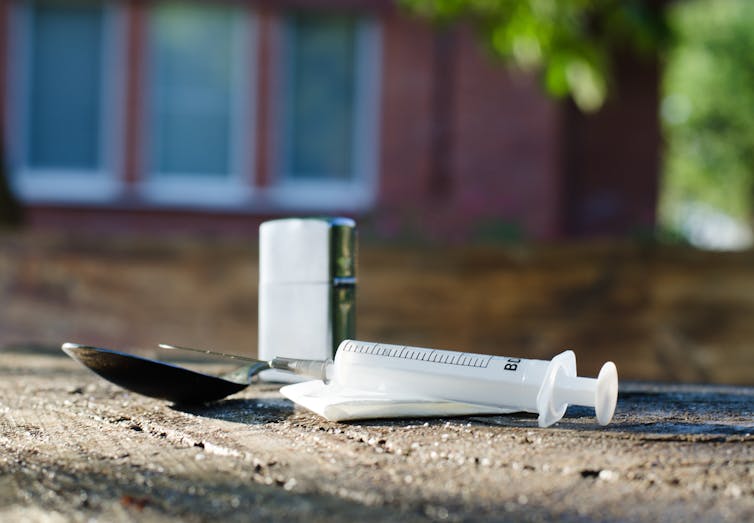
People with opioid addiction issues can often be triggered by seeing drug paraphernalia, which can trigger a relapse. Oleg Mikhaylov/Shutterstock.com
Specifically, areas of the brain critical in controlling the perception of daily and pleasurable activities are susceptible to the influence of addictive drugs. Due to the rewiring of the brain under addiction, the individual often perceives the world in context to their drug of choice. The brain learns to associate drug paraphernalia or the physical location of drug partaking in the context of receiving a drug. These cues become integral reminders and reinforcers of drug use.
Addiction is often thought of in terms of the pursuit of the “high” associated with the use of a drug. However, most addicts continue to use, or relapse when trying to quit using their respective addictive drug. This difficulty, despite the desire and often pressure by friends, family and co-workers to quit, is often due to the negative effects of drug withdrawal.
Depending on the drug, the symptoms of drug withdrawal can vary and range from mild to severe intensity. In the case of opioid withdrawal, symptoms often include anxiety, nausea, vomiting, diarrhea, abdominal cramps and rapid heartbeat. An individual going through opioid withdrawal experiencing extreme conditions of anxiety is likely to take opioids to alleviate that anxiety. This sort of behavior can be repetitive, leading to a what is called a feed-forward loop of dependence on an abused drug.
A person is often referred to as “dependent” on a drug when the drug must be present for the individual to function normally. Importantly, anxiety and depression are correlated with opioid dependence.
For dependent individuals, ongoing use of a drug is not perceived as a conscious choice, but rather an evil necessity. Medication-assisted treatment with drugs like methadone or buprenorphine, allows for an individual to undergo recovery from an opioid use disorder. The use of medication assisted treatment significantly decreases the likelihood of an individual to relapse and fatally overdose due to withdrawal or dependence symptoms.
CBD and Epidiolex
CBD was tested in several clinical trials and was shown to work and to be safe in treating a rare form of epilepsy. A pharmaceutical grade CBD, Epidiolex, gained FDA approval in June 2018 for this specific usage.
CBD is currently only prescribed as the drug Epidiolex. That is because, up until now, CBD has only been shown to be safe and effective in the treatment of intractable pediatric epilepsy.
Importantly, CBD binds to different receptors than those that lead to opioid addiction.
CBD and opioid addiction
In experiments reported in 2009, rats were trained to press a lever to receive heroin. CBD did not decrease the amount of heroin that the rats self-administered, or the drug seeking behavior displayed by the rat while taking heroin. However, when rats were taken off heroin and given CBD, there was a decrease in drug-seeking behavior when the animals were exposed to a heroin-associated cue.
Initial studies of CBD in humans verified that CBD, when co-administered with fentanyl, is safe and well tolerated in healthy, non-opioid dependent individuals. A 2015 report of a small double-blind study conducted in opioid-dependent individuals found that a single administration of CBD, in comparison to a placebo, decreased cue-induced craving of opioids and feelings of anxiety. A double-blind, placebo-controlled study means that doctors and patients in the study do not know who is getting a real drug and who is getting a placebo. That is to guard against what is known as the placebo effect.
A double-blind placebo-controlled study published on May 21, 2019 adds to these findings by demonstrating that the Food and Drug Administration-approved Epidiolex can reduce cue-induced craving in individuals that had been former heroin users. Furthermore, in these individuals, Epidiolex reduced reports of anxiety, and blood levels of cortisol, a hormone known to increase under conditions of stress and anxiety.
Although further studies are needed, these studies strongly suggest that Epidiolex or CBD may hold promise as a critical weapon in fighting the opioid epidemic.
This could be a big deal.
A bottle of CBD oil may contain unpredictable amounts of CBD, and it also could contain THC. WIRACHAI/Shutterstock.com
Practical considerations
Before rushing out to purchase over-the-counter CBD to treat any medical condition, there are several practical considerations that should be considered.
Only Epidiolex is FDA-approved for a medical condition – pediatric seizures. All other forms of CBD aren’t regulated. There have been numerous consumer reports that show that the actual amount of CBD in over-the-counter products is significantly less than what is reported on the label. Also, some of these over-the-counter products contain enough THC to show up on drug tests.
Although Epidiolex was found to be safe in clinical trials, it can interact with other drugs prescribed for migraines and bipolar disorder. This could mean that taking CBD with certain drugs could diminish or enhance the effects of prescriptions, leading to problems controlling particular medical conditions that were once well-managed, or increase side effects of the other medications. For this reason, it is incredibly important to talk to your doctor or pharmacist about potential drug interactions before using CBD.
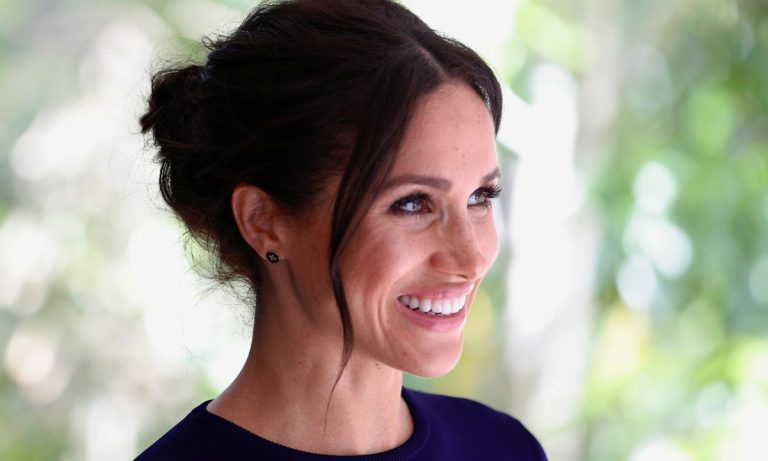
We already know that Meghan Markle is the poster child for understated beauty. Her simple style, hairdo, and makeup almost make you forget she’s a royal. She’s just Rachel from “Suits.” Living in a palace. Married to a prince.
Part of the reason we can still see her through her makeup is that she wears very little. And contrary to popular belief, she doesn’t have a royal attendant making her look gorgeous everyday, now that she’s a Duchess.
“She’s gotten more comfortable doing her own makeup. She loves makeup and she’s good at it!” Meghan’s friend and wedding makeup artist, Daniel Martin, told PEOPLE.
“She’s been doing her makeup herself. She’s not fussy — she’s just trying to get it on and get out the door.”
Martin, who is a longtime friend of Markle’s, as well as the Dior Beauty brand ambassador, helped her achieve her wedding day look. But he said she’s always pretty much had the same beauty routine.
“She likes a stronger eye, her brow is a lot more defined now. But it’s still her. If anything, she’s going to experiment with different tones, and now that she’s more tan she’ll use warmer colors. But she doesn’t stray too far from her technique, she’s very formulaic with her routine.”
And that includes wearing nude lip colors in lieu of bold ones, like red. Said Martin:
“The one time she did a red lip, she just didn’t feel comfortable in it. She likes to talk and she’s not a fussy person, so she doesn’t want to have to worry about anything.”
Martin said Markle will continue to do her own makeup even while she’s abroad on royal assignments.
“They have so many engagements, you have to stick with what you know and feel comfortable and confident and just own it,” he says, adding that Markle’s wedding makeup started a “less is more” beauty trend; people loved that you could still see her freckles and that they weren’t covered up with heavy foundation.
“It’s about owning your own beauty,” he said. “We’ve been inundated on social media with contouring and highlighting and it’s created this narrative that you need so much makeup to be beautiful, and I think that day when they saw her, it was just her looking beautiful with not a lot on. They embraced her rather than her face first, and that was the intention.”