Kerryman Don O’Neill is the first Irish designer to dress Meghan Markle. Speaking about the excitement at dressing the stylish Duchess, Don revealed: ‘I am humbled and sooo excited to dress The Duchess of Sussex. It has been an exciting whirlwind collaboration.’
‘When her stylist reached out to inquire if I could make a dress for her Australian press tour, I stopped everything we were doing (my bridal show was just a week away) and immediately went to work on Her Royal Highness’s gown.
‘We completed the gown in 2 days, shipped it out and received confirmation that The Duchess LOVED it, but with one caveat. We needed to remake it with extra seam allowance.’
He added: ‘We knew immediately why this extra allowance was required, but Mum’s the word, and with less than one week to my bridal show, all hands were on deck once more, we re-made the gown and I literally had to run down Broadway that Friday night to catch the UPS truck making it with just 2 minutes to spare!’
After a much hyped announcement last week, insiders say her much hyped upcoming residency is off to a rough start. Ticket sales for the shows got off to a VERY SLOW start, with most of the shows not even half sold out.
This is NOT the situation with Aerosmith and Lady GaGa who have sold out weeks worth of shows ahead of their residencies at the same venue .
As industrialization spread across the globe, society really bungled up the way we eat, drink, and relax. It’s clear from Ancient Chinese burials and Mediterranean archeological dives that people have been all about intoxication since before we knew what gravity was. Compared to today’s selection, wine used to be a very different affair altogether. Its preparation in the days of amphorae and togas was not the pesticide laden and maxed out experience that we are used to. Wine was one of the chief sources of ancient alcohol, so it was cherished and carried out by skilled farmers and fermenters.
Now there is a revival of prewar — some would say even ancient — winemaking practices, and it’s coming up right alongside the downfall of cannabis prohibition. To understand the basics of “natty wine” is not a single-afternoon-at-a-vineyard affair, and similarly to cannabis connoisseurship, it takes time, reading, and taste testing.
Natural wine is a term that can be confusing to the uninitiated, it can seem to mean simply organic, but that’s just one tiny part of the puzzle. Like organically produced cannabis, it not only requires no chemicals in the cultivation, but careful hand harvesting and expert knowledge of suitable nature-derived sources of pest, fungus and virus control.
The wines are best described as “nothing added or taken away” in the bottle, and mimic techniques practiced throughout much of Europe pre added sulfates and mass production. Like the difference between a full flower cannabis live resin and a flavorless CBD isolate, these classifications can help you know exactly which products to choose.
Photo by Maria Penaloza
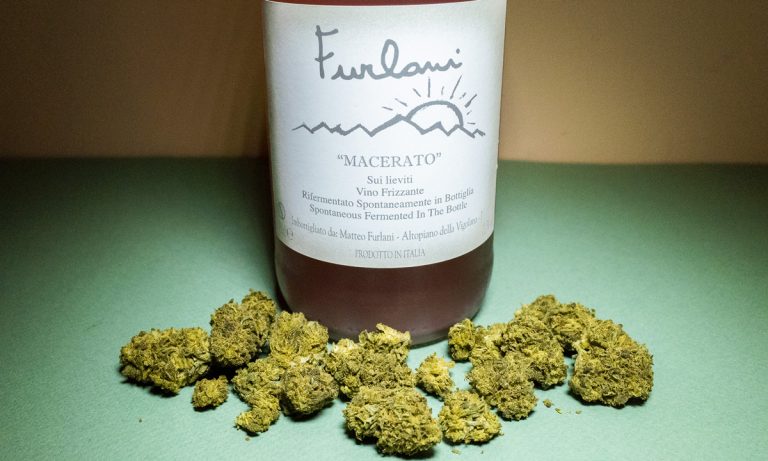
Furlani Macerato Rosato and Romulan strain
Skin Contact High
Many of the most popular natural wines are downright Instagrammable, from their niche labels to a fascinating spectrum of colors, the trend is definitely driven in part by the drive to seek out colorful and unique things to drink to impress your friends and followers. But beyond that, these wines are often referred to as “glou-glou”, French for “drinkable” and an apt description of the tasty notes you’ll encounter. With cannabis’ recent and intense quality drive and sudden reach, people seek out limited drops, popular recommendations, and star ingredients just like with these special wines.
This is why orange, pink, and deep purplish red natty selections are sought after by followers of this winemaking movement, full of new discoveries in what had become a pretty droll category, especially for those not able to spend more than $30 on any given wine bottle. There’s a lot less of the inaccessible stuff that makes luxury bottles not any fun to an explorer. Once you’ve had Veuve or Moet, you know what it’s going to taste like when you buy it again. Oftentimes that doesn’t happen with natural wines, so much can change inside the bottle before it reaches your glass.
Prestigious cannabis is almost exactly the same, rare colors, uncommon terpenes, and super potency often drive what makes a particular harvest from individual cultivators so desirable. Like waiting around for the new Sherbinski’s flavor, grabbing one of the last bottles of Le Coste vineyards Le Primeur Pour les Filles is a special moment that wholly depends on how committed your local shop is to getting these types of products.
Photo by Maria Penaloza
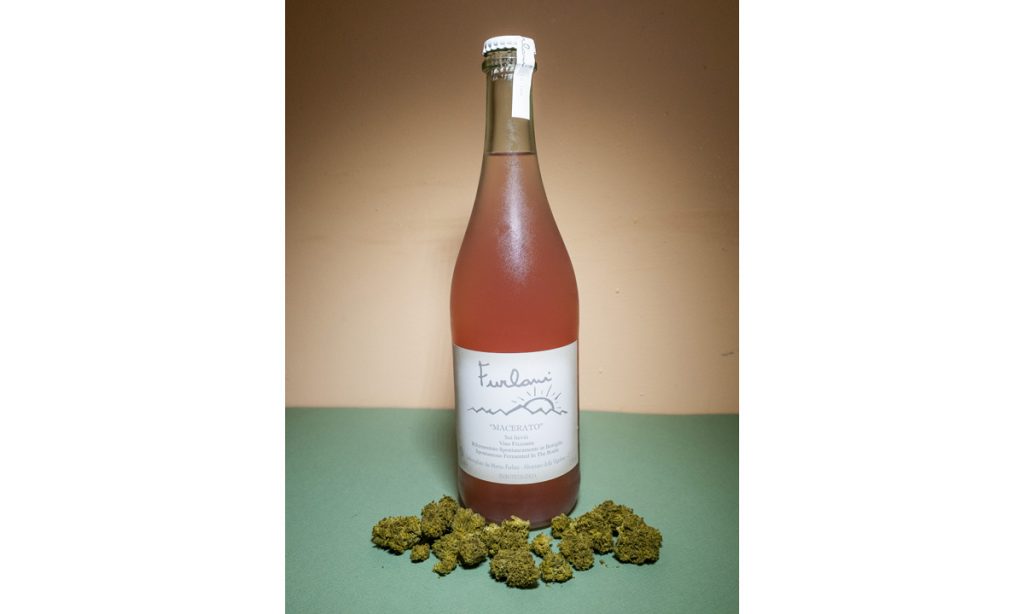
Furlani Macerato Rosado and Romulan
Flavors
Natural wines can be on the sweeter side or even get into super dry depths you thought were reserved for vermouth. Learning how they work with your meal, joint, or both will help you choose optimally. Restaurants are a better place for tasting– if you aren’t into the glass you don’t have 80 percent of a bottle to get through after, and many do tasting flights, a perfect crash course that can hone your skills.
Beginners will like how macerated Italian rosato will play with an herbaceous and piney indica like Northern Lights, the bubbliness is countered with heavier indica effects. Going with a fruit forward glou-glou French offering? Then avoid also picking an overly fruity cultivar or you’ll be forced to choose which you like more. Churchy orange wines, with their sharper tannins and complexity are a good grab for a cheesy or rich meal– the prevalence of Alsatian and Austrian orange wines does well with rich Raclette and citrusy sativas like Orange Cookies.
Reds that are bold and dry first would be the best time to roll out a berry heavy jack hybrid, they’ll play off each other especially if you are having a creamy vanilla dessert beforehand. On the white wine side, things can get really really funky, like bat guano fertilized Zwei NaturKinder, when its zippiness is paired with a punchy Cinex, it’s happy hour dynamite.
As you get ready to queue up some of your favorite horror flicks , you might be interested to know that the movie most Americans watch on Halloween isn’t even scary. Like, at all. In fact, it’s super campy.
It stars Bette Midler, Kathy Najimy and Sarah Jessica Parker. And as terrifying as the Sex and the City movies were, it’s none of those.
According to streaming service FandangoNow (by way of Business Insider), which surveyed more than a thousand people about the movies they’re most likely to watch on Wednesday, they found that the 25-year-old movie Hocus Pocus was the top choice, garnering 96 percent of the votes. That’s almost everyone. How is this possible when newer flicks like The Haunting of Hill House, Veronica, and Hush are all the rage on Netflix?
Before you stamp a big “COWARD” on the foreheads of humanity, here are the 4 other films those surveyed gravitate towards on Halloween.
Sexual fantasies are deeply personal, things and thoughts that we tend to keep to ourselves or only share with trusted sexual partners. Since they’re not openly discussed, they’re often thought of as fetishes and things that have no reason for existing. But a new book studying the matter proves that fantasies are intricately related to our personality traits. And this personality type has the wildest fantasies.
The book Tell Me What You Want was written by sex counselor and expert Justin J. Lehmiller, who studied over 4,000 people of different ages, ethnicities, sexual orientations, and genders. By analyzing the subjects’ Big Five personality traits and asking them to describe their sexual fantasies in detail, Lehmiller saw patterns and noticed that sexual fantasies tend to reflect peoples’ personality traits and characteristics.
The Big Five personality traits include extroversion, openness to new experiences, conscientiousness, agreeableness, and neuroticism. Lehmiller explained to the Huffington Post the importance of sexual fantasies, what they say about the different genders, and more. “Our fantasies seem to tell us something important about who we are and where we are in our lives at any given moment,” he said.
Check out what Lehmiller had to say regarding peoples’ personality traits and how they relate to their sexual fantasies:
The book found that people who considered themselves as extroverts had fantasies about orgies, threesomes, swinging, and other forms of group sex activities, which makes sense. On the other hand, introverts’ answers were much kinkier and taboo. “This may be because introverts have a harder time establishing the types of sexual relationships they want and that increases their propensity for developing taboo and uncommon sexual interests,” Lehmiller explained.
People who are open to trying out new life experiences are also the ones who report the most varied types of fantasies out of all the personality groups. They can have fantasies of taboo and very specific topics or conventional fantasies about traditional sex acts.
People who label themselves as neurotics tend to have a propensity towards depression and anxiety. These people have more stress in their personal relationships, and a large percentage of them fantasized about having calm and loving sex. Neurotics are less likely to fantasize about adventurous sex activities because this demands them to step out of their comfort zone.
This trait refers to how compassionate and cooperative people are, and people who considered themselves agreeable tend to fantasize about mutual pleasure. They really want to see their partners enjoying themselves and be absolutely sure that everything is safe and consensual,” Lehmiller says.
Conscientious people are those who like to plan ahead. These people tend to be organized and reliable, and fantasize about sex that’s scheduled and not too deviant. Conscientious people spend a lot of their imagination on picturing elaborate fantasies where there’s a perfect setting and ambiance.
The broader stock market took a tumble this week and brought the cannabis stocks down as well. However, considering how high they had gotten, a little reversal seems healthy.
MedMen (MMNFF) reported fourth-quarter sales of $20.6 million and annual revenue of $39.8 million. Both increases over 1000%. Unfortunately, that came at a cost. The net loss was $66 million. But no worries, MedMen is sitting on almost $80 million in cash and will have numerous stores coming online in the near future through the many acquisitions the company has made. MedMen also uplisted to the OTCQX Best Market from the Venture market.
Scythian Biosciences had a big week. The company flipped its Florida property 3 Boys Farms to Verano and in exchange will get the multi-state properties from Verano’s portfolio. The exchange is valued at $100 million.
Namaste Technologies (NXTTF) closed on its previously announced bought deal including the over-allotment option for gross proceeds of $51 million.
Lots of housekeeping notes on stocks this week.
Aurora Cannabis began trading at the New York Stock Exchange this week using the symbol ACB. The company moved over from the OTC markets.
CannaRoyalty changed its name to Origin House and it will begin using the symbol OH in trading.
Marapharm Ventures changed its name to Liht Cannabis and will use a new symbol LIHT.
Canaccord initiated coverage on The Green Organic Dutchman (TGOD) with a Speculative Buy rating and a C$7 target price. The Canadian stock was lately trading at C$3.83. “While TGOD’s current focus is on increasing production capacity in Ontario and Quebec, we expect the company to be free cash flow positive in 2020 as it plans to build a portfolio of organic cannabis brands that will serve legal recreational and medical markets around the world.”
Bloomberg reported that Pax Labs was valued at $5 billion.
And 4Front holdings raised $31 million and putting itself solidly on the road to going public. 4Front will use the proceeds of the offering to fund its ongoing investment in top-tier talent, the build out in multiple states of its Mission-branded dispensaries and cultivation facilities, as well as for M&A opportunities
Attention Deficit Hyperactivity Disorder affects over 3 million U.S. citizens per year. Though more common in males than females, it is relatively prevalent in both, and mounting anecdotal evidence is suggesting that cannabis may be the answer for many.
Pharmaceutical drugs used to treat ADHD have side effects that include sleep problems, a decreased appetite, delayed growth in children, headaches, stomach aches and horrible cases of moodiness. Aside from its potential to relieve the symptoms of ADHD, cannabis is known to treat all of the aforementioned side effects as well.
Before weaning off medication, however, it is extremely important that you consult your physician, preferably a doctor that is familiar with the endocannabinoid system.
The thing is, for many people, including those living with ADHD, the stimulant type drugs that are prescribed make it even more difficult to concentrate and keep things in recent memory. The mind literally reels and, though the meds have proven somewhat effective for countless patients, the side effects are severe, especially for children.
Cannabis is a potentially safe alternative. Recently, Joseph Lazarus told Tonic that, “I felt like someone turned on a light switch in my head,” regarding his first time smoking weed. The immediate effects were astounding, “I heard the birds chirping for [what seemed like] the first time,” he said. He also stated that the leaves looked greener and that he felt the wind tickle his skin. “I was one with the forest, a wooded forest. I was so calm.” Lazarus was only 13 years old when he discovered cannabis medicine.
Diagnosed with ADHD at the age of 6, Lazarus had not felt “normal” up to that fateful toke. Now 33 years old, he hasn’t stopped using cannabis to combat the disorder and sees it as an essential part of his daily routine. Now into vaping, cannabis has been his “drug of choice” since the incident in the woods – even if its illegality did land him in an institute for troubled teens early in life.
With anecdotal evidence like this, we can only hope that more research will be done in this area and that others experiencing the ADHD ride might be able to benefit from no-side-effect bearing cannabis rather than a handful of questionably effective pills.
Scary movies are an acquired taste, very much like wine or CrossFit. For the uninitiated, it’s a seemingly awful activity, one that makes them wonder why someone would submit themselves to the discomfort. But a lot of people enjoy it, so there must be something that they’re missing out on, right?
Despite the fact that watching scary movies is weird, because you’re actively looking to get freaked out, these types of films produce a really cool feeling that’s tough to explain and that a lot of people love. These stories make you feel scared in a safe way, resulting in a rush that’s incredibly fun.
If you’re one of those people who doesn’t understand why scary movies are a thing, check out these 5 tips that’ll help you ease your way into the genre:
You can’t start off with The Exorcist just because you’re feeling brave. Despite the dated production value and those awful special effects, it’s a disturbing movie for someone who has little experience with the genre. GQ recommends kicking things off with basic spooky movies, like The Addams Family, Beetlejuice, or Hocus Pocus. There are witches and dismembered things, but these movies are more about creating a spooky mood than giving out real scares. There are also several kids movies that are a little creepy but still PG, like Paranorman, Coraline, and Monster House.
Once you’ve graduated to actual scary movies, be sure to take advantage of the daylight and of the comfort of your TV. Watching scary movies in the theater is awesome, but the dark room and the screaming crowd might be too intense for a horror movie virgin. By watching the movie at home you’ll be allowed to pause it, take a breath, prepare yourself and proceed on.
Scary movies are a great collective experience, but friends who scare you may make things worse. Watch these movies with friends who are relaxed and mellow, capable of holding your hand and not willing to run off in the middle of the movie just so they can scare you on your way to the bathroom.
After watching a particularly scary movie you can always put on a TV show or movie that never fails to make you happy. Comedies are always a good option but movies that remind you of your childhood or a particular time in your life are safe bets, because they’ll bring you out of that funky mood in no time.
Know yourself
https://giphy.com/gifs/jfM7rT6YOxpx6
It’s important to know your limits. For example, some people can handle slasher/home invasion movies pretty decently, but are kept up at night by spirits and demons. If you’re not into insomnia (who is?) just stay away from the genre until you build up some tolerance.
It’s “that” time of year whether you’re in California or Chicago. “That” being cooler temps everywhere. Winter’s holidays bring germs and viruses no matter your local climate, and sometimes you’re the unfortunate beneficiary of a gift you never opened. In addition to taking your vitamins, resting and eating well to undo all the revelrous raucity, boosting your immune system by incorporating turmeric into your everyday has more benefits than meets the eye. One excellent spot to park it: Hot Cocoa!
In India’s Ayurvedic medical culture, turmeric powder or juice is given to people with many gripes, particularly for pain and inflammation. Somewhere in the internet, golden milk was touted as an ‘ancient Indian secret’ and though it’s often added to milk in India, this concept seems to be an interpretation rather than an authentic classic. Interpretation being the specialty of any chef looking to stash the power of cannabis, a desire to take hot cocoa to the next level spawned this awesome take on two favorites.
What you end up with is quite delicious and is the perfect vehicle to get maximum benefit from turmeric. Combining it with hot cocoa is utterly divine, adding the devils lettuce, makes it not only literally intoxicating, it’s ingredients push through both the THC and turmeric’s curcumin faster and better than most consumables. Black pepper and cardamom, both enhance your stone and help the turmeric work its magic, and since everything is fat soluble, it will play nicely together.
In a mug, add cocoa and sugar put aside. If you are using a milk frother, lightly crack spices except turmeric and add to mug with cocoa. Without a milk frother, use a dry saucepan to lightly toast the cardamom and pepper before heating milk, do not boil, do not pour milk over flame.
While milk is heating, boil water separately and pour over cocoa, stirring thoroughly. Remove milk from heat and stir in infused oil and turmeric. Let stand for a few seconds, then slowly pour over cocoa.
Put ¼ cup coconut oil in a clean mason jar with decarboxylated starting material (20 min at 225 in a sealed container for raw cannabis, 10 for hash and wax). Seal the Mason jar and placed in a warm water bath for 1 hour. Cool the Mason jar to room temperature and place in a freezer overnight. The next day, defrost and place in a water bath once more, just to heat through. Strain if using raw cannabis. If using a concentrate or hash you won’t have to strain the material.
If you want to get really weird, you can use some boozy rum cream with the milk, and it will be mildly alcoholic, but incredibly tasty. Drink up when you’re feeling under the weather in any way–inflammation doesn’t just mean injuries and sore muscles, it counts for sinuses and PMS too.
A scroll through /r/shittyfoodporn and you will find a crossroads between absolutely disgusting and truly inspiring. Ramen, it turns out, goes with everything, including canned chili and tuna salad. Anything resting on a piece of processed white bread — even a whole mackerel — is by definition a full meal. It is a lawless land of 3 a.m. munchies and inventive minds using limited means to an end. Which end? Can’t say.
We chose 10 of this community’s most noble and noteworthy examples of culinary achievement for your viewing displeasure.
This Week’s Music is a weekly column that discusses the weeks’ best, worst, and most interesting songs. We try to select songs of different artists and genres to keep things interesting and to please a variety of music fans.
This week, music fans of all types of genres saw the return of some of their favorite artists. Jessica Pratt released the headlining song of her latest album, pop star Zara Larsson put out an interesting and unique single that’s bound to become one of these year’s earworms, and Mariah Carey released an R&B ballad with the help of Skrillex and Ty Dolla $ign. Wait, what?
Indie
Jessica Pratt – This Time Around
“This Time Around” is the first song of Jessica Pratt’s new album, Quiet Signs. The record marks the musician’s return to the spotlight, being her first album in four years. It consists of nine songs that’ll be released on February 8th 2019.
Pratt is a beloved performer of the folk and indie genre, someone who’s capable of evoking melancholic moods and tones with a couple of precise lyrics and simple arrangements of instruments. “This Time Around” is a song that doesn’t focus on building up to a chorus or a catchy beat; it’s more concerned with the big picture, resulting in a compilation of sounds and feelings that coexist perfectly together.
Zara Larsson is 20 years old and has been involved in the music business since she was 10, where she won the Swedish version of the TV show America’s Got Talent. She’s released eight singles that have made it onto the U.K.’s top 15, with several of these placing high on US music charts. Larsson is an interesting pop star, with a heavy electronic influence and a distinct voice that doesn’t allow her to blend into the background of anything. With “Ruin My Life”, the singer has created a song that has a glossy and bright surface and that offers something different than some of her pop contemporaries.
R&B
Mariah Carey – The Distance (Ft. Skrillex And Ty Dolla $ign)
Since it’s 2018 and the world is a strange place, Mariah Carey has teamed up with Skrillex and Ty Dolla $ign for her latest single. “The Distance” features a muted Mariah yet one that’s still indistinguishably herself, with her fast and smooth diction and those deep beats that show up in some of her best hits. Ty Dolla $ign makes a small appearance, making some sounds in the background and singing a brief couple of verses that don’t do much for the song. Skrillex’ presence, or lack thereof, is one of the most surprising parts of the song, resulting in a beat that’s tamed and kept under wraps, very far from some of his crazier outings.