When we’re hungry, we are apt to think that grabbing some quick food will ease our low blood-sugar and turn our hangry appetite into a satisfied one. But there is a nasty side-effect to your drive-through urge.
Business Insidertook a spin through a forthcoming book called The Happiness Diet and, according to author and mental health advocate Rachel Kelly, our gut produces about 90% of our serotonin, the chemical responsible for making us feel good. And, in a nutshell, fast-food hampers its production. According to Kelly, fast-food, salty snacks and margarine are just some of the foods to avoid for the sake of everyone around you.
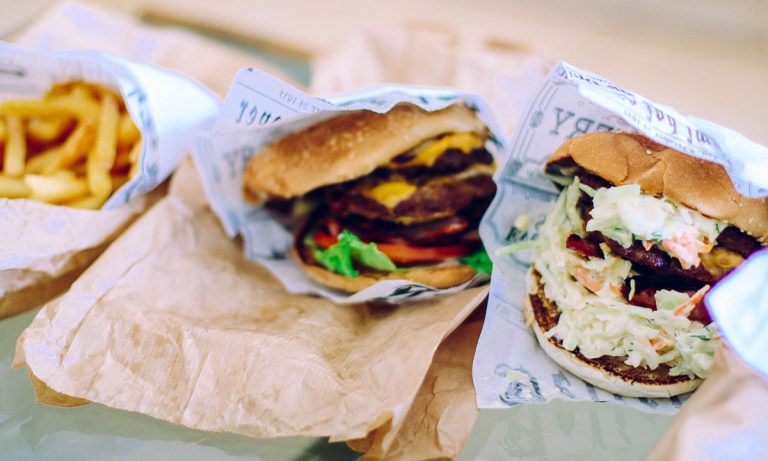
If you didn’t already know, french fries are drenched in trans fats, which not only increases the risk of heart disease, it creates and imbalance of healthy omega-3 fat. And that, in turn, creates feelings of sadness, pessimism and aggression.
In a study of 106 healthy volunteers, researchers found that participants who had lower blood levels of omega-3 polyunsaturated fatty acids were more likely to report mild or moderate symptoms of depression, a more negative outlook and be more impulsive. Conversely, those with higher blood levels of omega-3s were found to be more agreeable.
“A number of previous studies have linked low levels of omega-3 to clinically significant conditions such as major depressive disorder, bipolar disorder, schizophrenia, substance abuse and attention deficit disorder,” said Sarah Conklin, Ph.D., a postdoctoral scholar with the Cardiovascular Behavioral Medicine Program at the University of Pittsburgh School of Medicine. “However, few studies have shown that these relationships also occur in healthy adults.”
Soft drinks, which often accompany a burger and fries, is no better — even the diet variety. The artificial sweetener found in diet cola (aspartame) contains something called phenylalanine, which, according to the National Institutes of Health, has the power to mess up our levels of serotonin (a neurotransmitter that influences mood, among other things), which means you should probably opt for something more natural to drink.
Kelly says cereal and snack bars are also not a great choice, especially the ones with high sugar content. So when you’re in the grocery aisle, make sure to chose labels that have 8 grams of sugar or less. As we all know, sugar highs are followed by sugar lows. And when that happens, we get stressed and moody.
As the date of the royal wedding fast approaches, so does rapid speculation of who received an invitation to Meghan Markle and Prince Harry’s nuptials. Various sources have reported the guest list includes some 600 possible attendees and everyone’s wondering if their fave made the cut.
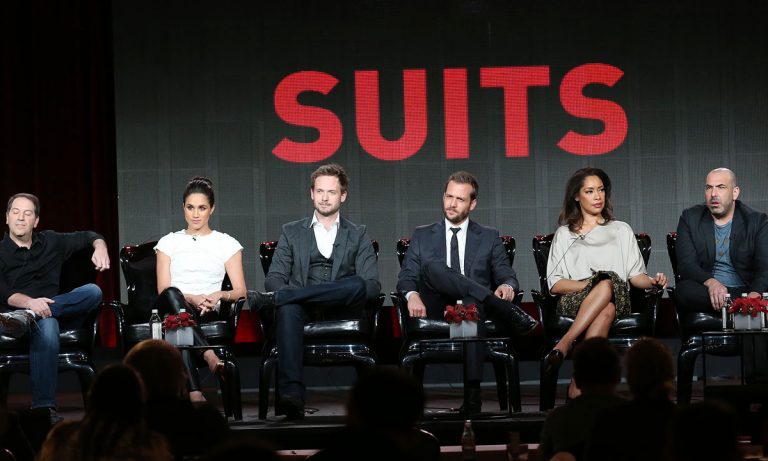
But what about Markle’s former “Suits” co-stars? Every bride- and groom-to-be makes tough decision (apologies in advance to that B-level college buddy who didn’t quite qualify) though in Markle’s case, she hasn’t forgotten her work friends.
According to sources, “The cast has been contacted in regards to invites from Kensington Palace.” What’s more, it appears “the cast and key executives from the hit U.S. show are on the invite list for the royal wedding.”
If you care about these types of things, you’re probably wondering just who did and didn’t receive invitations. And though we can’t definitively answer such an important question, social media does give us a clue because—*cue dramatic music*—some “Suits” castmates have been dropping heavy hints with nearby travel pics.
Last week, Patrick Adams was low-key flexing with some “totally spontaneous” motorcycle pics. His location? Morocco, which is a mere 32 hour drive away from the U.K.. Adams, in case you forgot, played Mike Ross, Markle’s husband on the show.
Also we have Sarah Rafferty just “casually” posting some Instagrams with her daughter in Paris. Proud mom sharing an intimate moment with her child on a social media platform or a bat-signal suggesting she’s nearby for the royal wedding? You decide.
Then there’s perhaps the most blatant clue of all. That would be Jacinda Barrett. She’s married to “Suits” actor Gabriel Macht and you won’t believe where she’s posting Instagrams from. That’s right. Buckingham Palace, a.k.a. the home of the Royal Family.
It’s estimated that every day 37 trillion cells in your body will have trillions of new mutations. If you’re doing something out of the ordinary, like sunbathing or having a drink, then science says you’ll be “mutating” even more. Which is creepy, because that’s a scary word unless you’re watching X-Men.
A million things could go wrong in each of these processes but somehow, most of us are fine and go about our days without even knowing something’s up.
The Atlantic reports that our human genome can be compared to a finely tuned car, and that many of our everyday mutations are as simple as changing the tint of our car window. For example, humans are constantly shedding their stomach lining, which means that those cells are dividing themselves frequently to replace others. You won’t grow an extra arm out of it or get cancer, because these mutations are not a big deal.
Other mutations, however, are more complex. For example, smokers’ lung cells come in frequent contact with tobacco smoke, causing more mutations than normal. The same happens with your skin, which gets frequently exposed to sunlight.
According to experts, the older people are, the likelier they are to have cancer because it gives them more time to accumulate the wrong set of mutations. Which is so strange and not reassuring at all. At least human history proves that our bodies kind of know what they’re doing; after thousands of years, we’re still here.
“Overdosing” happens because of lack of understanding regarding how to calculate how much THC is in a serving, and how the THC affects your body.
For how popular edibles are, there’s a surprisingly little information out there about the process of making them. We’ve all heard that story from a friend about how easy it is to “overdose” on edibles, even for the most seasoned of marijuana enthusiasts. This is all due to a lack of understanding regarding how to calculate how much THC is in a serving, and how the THC present in edibles affects your body.
Here’s a simple set of guidelines to follow when it comes to prepping and consuming your own edibles, because there’s no such thing as having too much information:
Identify How Much THC Is In The Strain You’re Cooking With
On average, most strains have about 10 percent THC. Strains with 15 – 20 percent are above average and the ones with over 30 percent are often medicinal. Be sure to look up your strain online or ask your provider about how much THC the strain contains.
How Much Should You Start With
If your strain has 10 percent THC, then a gram of cannabis contains 100mg of THC. This simple math problem will allow you to know, or to give an educated guess, on how much THC you have per serving. This will grant you some power over your high and prepare you for your edible.
A good starting point for beginners would be 5 milligrams per serving. 3 grams of ground marijuana equals 300 milligrams of THC. If you make 60 cookies, each one will have 5 milligrams of THC and you’ll be the best cannabis cook there ever was.
Tips For The Best Cooking Experience Ever
Prep your kitchen! Wash your utensils so that you avoid contamination and be sure to prop open a window or two because it will get aromatic.
Eating cannabis with protein rich and fatty foods will elongate the effects of marijuana on the body. Eating cannabis in an alcohol base will produce effects with a shorter duration. Keep this in mind when consuming.
Patience is also key when consuming an edible. If it’s been two hours since you consumed the edible and you’re still not feeling high, eat something that’s rich in proteins which will kickstart the effect of marijuana. On the other hand, if you’re feeling a little too high, try raising your blood sugar with some OJ or something that’ll get your spirits up. Ingest wisely!
For college students across the country, commencement formally marks the transition from student to graduate. Per tradition, most schools feature speakers, give out awards, organize departmental dinners – and, of course, designate caps and gowns for students to wear when they receive their diploma.
But in the midst of the official pomp and circumstance, more and more graduates are adding a personal touch: They’ll decorate their graduation caps, also known as mortarboards.
As a folklorist, I pay close attention to the creative ways in which people choose to express themselves, which can tell us a lot about their beliefs, perspectives and aspirations.
When I attended my first University of Nevada, Las Vegas, commencement ceremony as a faculty member in 2011, it struck me how widespread the practice of decorating mortarboards had become. I wanted to learn more about how graduates were decorating their caps, what messages individuals wanted to convey and what these messages revealed, more broadly, about their college experiences.
So I began gathering data on the caps from photographs, surveys and interviews. Much of it will eventually be digitally archived by the Center for Folklore Studies at The Ohio State University. While the project is still ongoing, I’ve begun to identify a few key trends.
Celebrating The Accomplishment
The practice of embellishing mortarboards is by no means new. In the 1960s, some graduates would affix peace signs to the top of their caps to protest the Vietnam War. When I completed my B.A. at University of California, Berkeley, in 2003, it was not uncommon to see decorated caps atop the heads of graduates.
Today, however, it seems to have become much more popular – which can probably be attributed, at least in part, to social media. As one person I interviewed put it, these caps are very “Instagrammable”: visually appealing, easy to photograph and sure to garner likes and comments.
It makes sense that people would want to announce the accomplishment of graduation, and a photo of a personalized cap posted on social media is one way to do so. Sharing images of customized caps inspires others to do the same, and so the practice spreads.
Not surprisingly, many of the messages on decorated caps reaffirm the value of higher education and look optimistically to the future (“The Best is Yet to Come,” “Time to Spread Your Wings”). Others reflect school pride by including a university logo or mascot or identifying the graduate’s major or academic accomplishments.
One student is already looking ahead to med school. Sheila Bock, Author provided
Identity often influences what appears on the caps. You’ll see students reference their family, their veteran status, their hometown, religious beliefs and personal obstacles they’ve overcome.
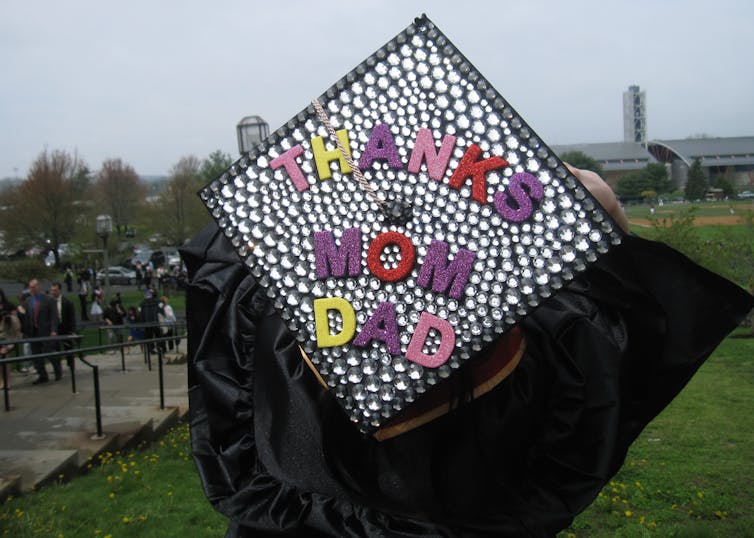
A University of Massachusetts at Amherst student thanks her parents on her mortarboard. AP Photo/Beth J. Harpaz
Was It All Worth It?
Humor is also common. Sometimes it’s deployed to highlight the graduate’s personality or mock the formality of the occasion, with phrases like “Thanks Mom, Dad and Alcohol.” One cap had a 3-D model of a beer pong table – little cups included – affixed to it.
But graduates will also use humor to engage with more serious issues. One 2017 UNLV graduate’s cap, for example, featured a homemade version of the “I Have Three Dollars” meme, which features Patrick Star from the animated children’s television show “SpongeBob SquarePants.”
The degree is taken care of – but what about the debt? Sheila Bock, Author provided
While making a humorous pop culture reference, the student was really calling attention to her experience of being a poor college student – and the fact that she’ll be carrying significant student loan debt well into the future.
It’s just one of many examples that show how graduates can creatively use the space on their mortarboards to resist the celebratory mood of commencement, questioning whether the time and money spent on a degree was really worth it (“My $35K Hat,” “Was the BS Worth the BS?”).
Taking A Stand
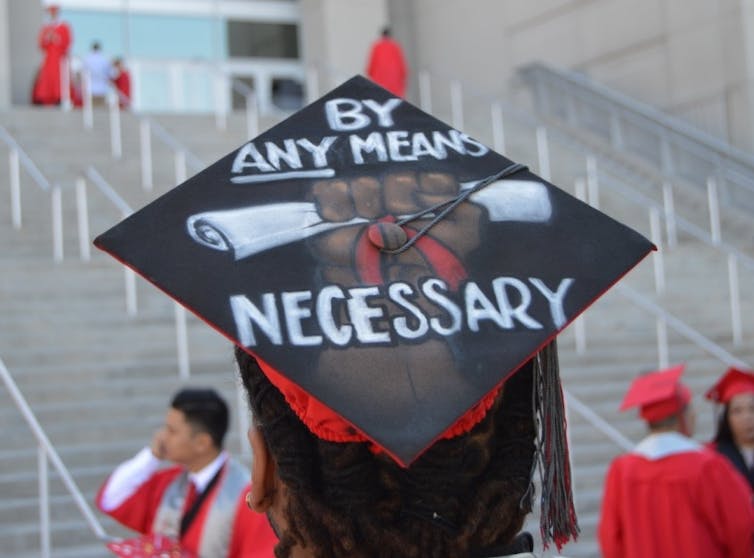
Like the graduates protesting the Vietnam War in the 1960s, today’s graduates are also making political statements. Slogans like “Black Lives Matter” or images of raised, clenched fists will appear on caps.
The mortarboard has become a space to make political statements. Sheila Bock, Author provided
The University of Nevada, Las Vegas, where I have collected the majority of my data so far, is among the most diverse campuses in the nation. In observing and tracking mortarboard cap decorations over the last couple of years, I have seen a marked increase in the number of caps that highlight the wearer’s racial and ethnic identities (“Black Girl Magic,” “This Xicana from El Chuco. ¡Si Pudo!”).
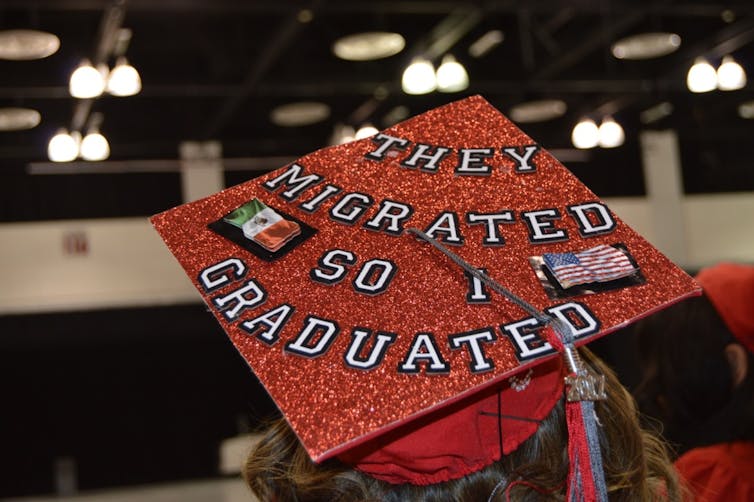
Then there are the mortarboards that point to the immigrant status of graduates or their families: “They Migrated So I Graduated,” “Product of Immigration,” “A Product of 2 Refugees Now with 2 Degrees.”
For the children of immigrants, receiving a college degree can be a huge milestone in their larger family story. Sheila Bock, Author provided
To these graduates, it’s important to show that the procurement of a college degree is part of an ongoing family immigration story characterized by hard work and perseverance. Images of butterflies – a symbol of the immigrant rights movement – also dot many caps. A good number reference the DREAM Act and the hostile political climate immigrants and their families find themselves in.
Everyone experiences college differently. For every student who spreads their wings socially or falls in love with their major, there are those who struggle to stay on top of tuition bills and keep up their grades.
While all of these students end up in the same place on graduation day, a critical look at these mortarboards gives us both a glimpse into the varied paths students take to graduation and the different futures that await them.
Thomas Markle collaborated with LA photographer Jeff Reyner to stage photos of himself reading British books and magazines in preparation for the royal wedding. According to different sources, these photos were sold for thousands of dollars. Weird? Maybe. Bad enough to ditch your daughter’s wedding? Probably not.
The Daily Mail claims that witnesses saw the photographer and Markle arriving together at different locations, taking the images, and then leaving together.
The pair took a few pictures at a cafe, and then went to a tailor shop to photograph Markle getting fitted for a suit. Since the store was closed, Markle and Reyner asked for the help of an employee from a neighboring shop, who was paid to pose as a tailor. “I just went along with it. I was telling him the measurements, but he didn’t write them down or anything,” said the employee, David Flores. “It was really strange.”
According to Vanity Fair, Samantha Markle, Meghan Markle’s half-sister, took full responsibility for the staged photographs. “The bad press over my father doing staged photos is my fault,” she tweeted. “The media was unfairly making him look bad so I suggested he do positive photos for his benefit and the benefit of the royal family. We had no idea he would be taken advantage of. It was not for money.”
Kensington Palace released a statement saying that this was a “Deeply personal moment for Ms. Markle in the days before her wedding. She and Prince Harry ask again for understanding and respect to be extended to Mr. Markle in this difficult situation.”
While Jeff Reyner declined to comment, TMZ claims that Thomas Markle will not attend the royal wedding since he’ll be undergoing emergency heart surgery.
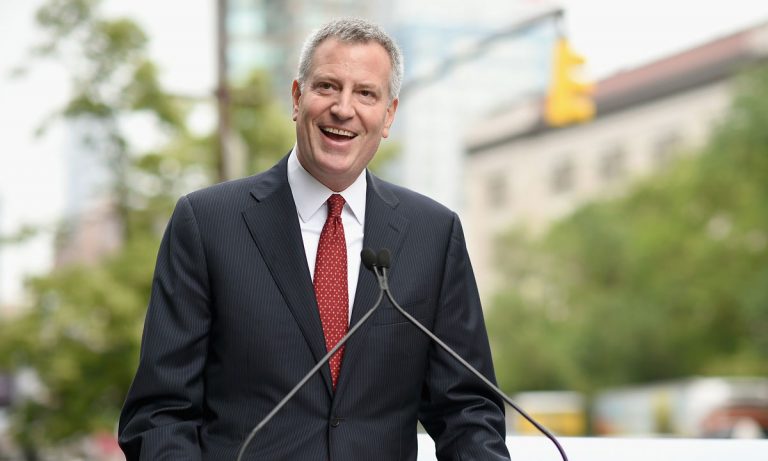
Will New York’s onerous stop-and-frisk method of law enforcement be coming to an end? On Tuesday, Mayor Bill de Blasio announced that the New York Police Department will unveil a plan within 30 days to drastically reduce arrests for marijuana possession.
“The N.Y.P.D. will overhaul and reform its policies related to marijuana enforcement in the next 30 days,” Mr. de Blasio said. “We must and we will end unnecessary arrests and end disparity in enforcement.” The mayor was not specific on details of the plan. Also not addressed was how law enforcement officials will handle any new directive from the mayor.
According to a story published on Sunday by the New York Times, black people were arrested on low-level marijuana charges in the city at eight times the rate of white people over the last three years, despite nearly identical usage rates.
Mayor de Blasio was vague as to what specific infractions would no longer warrant an arrest, but eliminating arrests for people with a clean record could reduce the number of arrests by an estimated 35 percent. But it’s not just putting citizens behind bars that de Blasio hopes to reduce. Those arrested on possession charges become a cog in the criminal justice system. And because people of color have been the primary targets in the city for decades, they are also more likely to have been arrested before on marijuana or other minor charges and have a criminal record in the first place.
The Brooklyn district attorney’s office, which in 2014 decided to stop prosecuting many low-level marijuana cases, is considering expanding its policy so that more people currently subject to arrest on marijuana charges, including those who smoke outside without creating a public nuisance, would not be prosecuted, one official familiar with the discussions said.
The Manhattan district attorney’s office, which last year decided to lighten penalties for some marijuana offenders, would decline to prosecute all but several hundred low-level marijuana cases annually under the plan, with some exceptions for people with serious criminal histories, a second official said.
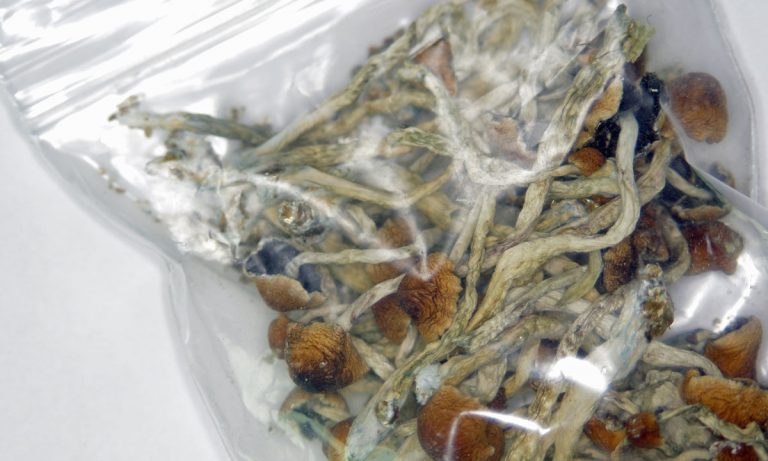
It’s already legal to use marijuana for recreational purposes in Oregon and Denver. But now, there is another push — this time, for “magic mushrooms.”
Activists in both locations are working to decriminalize the psychedelics, which contain an active ingredient called psilocybin, which can cause hallucinations, among other things. Their main talking point is that this compound could perhaps be helpful in combating depression and/or anxiety.
Speaking toKaiser Health News, Kevin Matthews, the campaign director for the group working to legalize the mushrooms in Denver, said, “We don’t want individuals to lose their freedom over something that’s natural and has health benefits.”
Oregon backers will likely have a tough time with their cause, as they’ll likely need to hire signature gatherers, just like other statewide initiatives. That’s according to William Lunch, a political analyst for Oregon Public Broadcasting, who spoke to KHN.
Paul Hutson, professor of pharmacy at the University of Wisconsin, who has specifically researched psilocybin, says he’s skeptical of decriminalizing magic mushrooms because their powerful active ingredient isn’t safe for everyone. He told KHN that he rejects the idea that “this is a natural progression from medical marijuana,” adding that mushrooms “are very, very potent medicines that are affecting your mind. In the proper setting, they’re safe, but in an uncontrolled fashion, I have grave concerns.”
These efforts to legitimize hallucinogenic mushrooms come at a time of renewed interest in the potential mental health benefits of psychedelics, including mushrooms, LSD and MDMA (known as ecstasy). Two small studiespublished in 2016 by researchers from Johns Hopkins University and New York University found that a single large dose of psilocybin, combined with psychotherapy, helped relieve depression and anxiety in cancer patients.
Matthews tells KHN that Denver would be a good testing ground for this initiative nationwide and that just getting it on the ballot would be a “huge victory.”
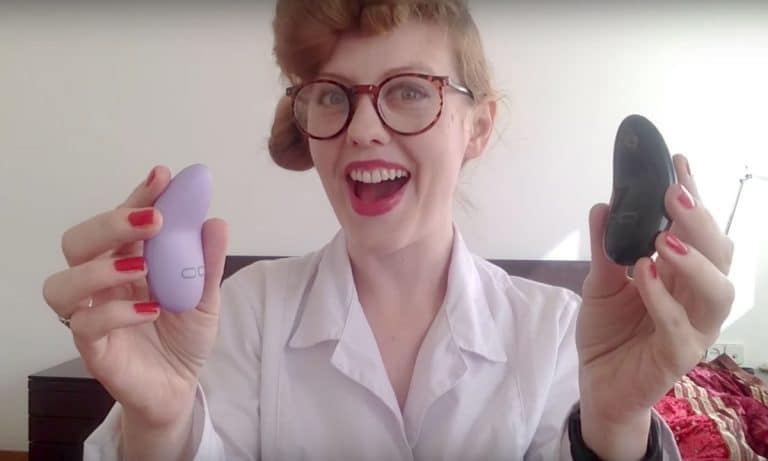
Q: It seems a ton of people are using person toys as a way to enjoy themselves. Curious on how to care for your personal toy so they last as long as possible? I know a lot come with a year warranty, but I’d rather it not break for even longer.
A: Thanks for the question! I’m glad you’re digging your new vibrator, and I have to say, I absolutely love this question, because it gave me a chance to investigate the answers for myself. I reached out to Stuart Nugent, Brand Communications Manager for LELO, to find out how to best take care of your luxury vibrator — and make it last. Granted, these suggestions are for the toy and brand you mentioned in your question, but I think many of the tips should prove useful for any high-end vibrator. Here are four questions you might have about caring for your vibrator, answered.
What’s the ideal amount of time to charge a luxury toy?
As you might expect, the answer varies from product to product.
“A useful rule of thumb is to charge the product for the same amount of time as you intend to use it: LELO products charge fast. There are exceptions. Two hours of charging LILY 2 should offer four hours of use, but it’s the other way around with our most powerful pleasure products, like the Smart Wand,” Stuart says.
He adds that the products all feature clearly blinking LED lights to tell you when the toy is still charging, so you’ll want to unplug it when those lights stop blinking. And, just like with your phone, allowing the battery to drain fully every now and then is actually good for its longterm battery life.
Does lube matter?
It sure does! “The majority of LELO pleasure products have some silicone in their design, which means, for a variety of fascinating but longwinded reasons, you can’t use silicone-based lubricants with them,” Stuart says. So make sure you check the material of your new luxury vibe, and only use lube with it that’s compatible. (Of course, LELO’s Personal Moisturizer will work with all their toys, but any non-silicone-based lube should be safe.)
If Your Vibrator Gets Weaker After A Year Of Consistent Use, Is That Normal?
If you’re noticing that your vibrator seems to be losing steam, does that just mean you’re having a lot of sex, that you’re overcharging it, or is that just normal?
“Common sense suggests you could expect a couple of horsepowers to drop off through use over the course of a year,” Nugent tells The Fresh Toast. But it’s possible that if that’s you’ve been leaving your toy on to charge for extended periods, you might cause a dip in battery capacity.
“That’s the boring answer. The fun answer is that maybe you have too much sex. The corporate answer is that all LELO products have a one year warranty and a ten year pleasure guarantee, so if you think you might have sexed it to death then we’ll happily help you out,” Stuart says.
It’s also possible that some lube could work itself into the motor and slow vibrations, though since most luxury toys like LELO’s are watertight, it’s unlikely.
How should you clean and store toys?
“This is the least fun – and most important – aspect of responsible sex toy ownership,” Stuart says. LELO recommends cleaning toys by hand (not in the dishwasher, for example), using an anti-bacterial gel and hot water. “Don’t use an alcohol-based cleaner, that can damage the surface of the product, and don’t rely on hand soap, as that isn’t always anti-bacterial,” Stuart says. I’d add to be careful about any soap that’s fragranced, since that can irritate if it leaves any sort of residue. LELO also has a toy cleaning spray that I’ve been using the past year and which seems to help keep things clean. (Fun fact: Stuart says it’s apparently also really good for cleaning glasses and computer screens.)
Once you’ve cleaned the toy, dry it with a lint-free cloth and store it in the bag the toy comes with, or in another hygienic container, until your next use. Keep toys at room temperature and out of sunlight.
So there you have it! If you don’t overcharge that new toy, keep it clean, and store it safely, you should have years of orgasms from your new investment coming! Pun very much intended.
It has been said that 2018 will be one of the best years for marijuana reform since Colorado became the first state in the nation to legalize the leaf for recreational use. President Trump has called off the dogs with respect to the possibility of a federal marijuana crackdown and more Congressional figures — those who opposed legalization early on — have changed positions.
There is no disputing the progress that has been made over the past year, but there are still some major roadblocks on Capitol Hill preventing the decline of marijuana prohibition at the national level. One of them is Senate Majority Leader Mitch McConnell.
Earlier this year, cannabis advocates nearly wet themselves when McConnell began pushing a bill intended to legalize industrial hemp. The consensus was that maybe the old coot had finally changed his tune on the issue of marijuana. And without this Republican nightmare standing in the way, there was solid possibility that any number of legislative offerings aimed at bringing the plant out of the underground could end up getting some much-needed attention in the Senate at some point this year.
But the situation was blown out of proportion. It turns out that McConnell, the long arm of the Senate, has no intention of so much as discussing cannabis reform anytime soon.
He said last week that he does not “have any plans to endorse the legalization of marijuana,” because hemp and pot are “two entirely separate plants.”
Hemp is known for its versatility. The plant, which only has trace amounts of THC, can be used to manufacture everything from paper to composite materials strong enough to build homes. In fact, Henry Ford, the man behind the Ford Motor Company, once constructed an automobile back in 1941 that was made almost entirely of hemp and ran on hemp-based fuel.
The United States imports over $6 million in hemp-related products every year, but the product is illegal to cultivate on U.S. soil. McConnell’s Hemp Farming Bill of 2018 is designed to change that.
But supporting industrial hemp and the legalization of marijuana are two completely different beasts, according to McConnell. The difference, at least in his eyes, is that one can get Americans stoned and the other cannot.
“It is a different plant. It has an illicit cousin which I choose not to embrace,” he said.
This anti-marijuana opinion did not set well with Senate Minority Leader Chuck Schumer, who intends to introduce a federal marijuana legalization bill in the near future.
“Aw come on, Mitch,” Schumer said. “I think this is something that is long overdue. I would hope to see it happen. I would hope the feds would take the heavy hand off and let each state decide to do what it wants to do.”
No matter how many pieces of pot legislation are introduced this year in the Senate, the chances of any of them being given the appropriate consideration are little to none. McConnell, who has been called the “Swamp Captain,” will likely prevent the marijuana issue from progressing beyond the headlines. Some political analysts predict the issue will pick up the necessary momentum once the Democrats gain control of Congress later this year.





 While all of these students end up in the same place on graduation day, a critical look at these mortarboards gives us both a glimpse into the varied paths students take to graduation and the different futures that await them.