Wednesday, May 13, 2026
Home Blog Page 984

Are Prince Harry And Meghan Markle Gearing Up To Start A Family?

Prince Harry and Meghan Markle are getting married soon and, according to their close friends, are getting ready to start a family sooner rather than later.

According to the Daily News, Markle has gotten Harry to quit cigarettes and to cut back on his alcohol intake; she’s also been pushing to have kids soon. An insider says, “It’s no secret among friends that they want to start a family immediately.”

Harry has lost around 10 pounds since the couple announced their engagement in November, signing up with a personal trainer and nutritionist at KX Gyms, where memberships cost up to $1,000 a month. The Daily News also claims that the reason behind why Harry quit smoking is because the habit can affect men’s sperm count. Katie Nicholl, author of Harry: Life, Loss and Love, claims that the prince is also very excited to start a family.

Markle has always kept herself in great shape, and she enjoys cooking healthy meals for herself and Harry, which they eat as they watch episodes of “The Crown” in their home at Kensington Palace.

Rumors regarding the royal couple and kids have been swirling around since they announced their engagement, with some claiming that pregnancy is the reason why they decided to get married in the first place. It’s not, though.

The Latest In The Fight For Recreational Marijuana In Connecticut

As surrounding New England states legalize recreational marijuana, Connecticut lawmakers have been under pressure to explore legalization. Some members of the General Assembly of Connecticut worry the state could be missing out on potential opportunities that legal marijuana presents, particularly in the form of tax revenue.

The current bill before the judiciary committee would create regulation for legal marijuana sales and a network of marijuana lounges, while also promoting diversity and small business development through a new state Liquor and Marijuana Control Commission.

Senate President Pro Tem Martin Looney stands behind the legislation and says the bill would require the Department of Consumer Protection to boost applications from communities that “have been disproportionately harmed by marijuana prohibition.”

“It is time we take the rational, commonsense approach to marijuana, as we did with alcohol: regulating and taxing it,” Looney wrote, according to the Hartford Courant. “We need to ensure that Connecticut is not left behind as our neighbors move forward with commonsense marijuana policy.”

One of those neighbors looming over Connecticut lawmakers is Massachusetts, which is set to have legal marijuana shops open by July of this year. Connecticut Coalition to Regulate Marijuana is advocating lawmakers to legalize retail sales of marijuana, so they don’t lose out on potential tax revenue.

“Massachusetts, Maine and now Vermont have moved forward with this policy and are regulating marijuana like alcohol,” the Coalition’s Sam Tracey told Rhode Island Public Radio. “Very soon people are going to be able to drive over the Massachusetts border and purchase marijuana legally if they are over 21. So Connecticut, if we stay with our current course of inaction, we are losing all of the tax revenue to Massachusetts.”

But in the first vote by state lawmakers in recent years, an important legislative committee rejected legalization by an 11 to 6 vote Tuesday, according to the Courant. This isn’t a striking blow to Connecticut legalization, as the general law committee only focused on specific aspects of the bill, like how many plants an individual could grow.

“There’s still a lot of issues that are on the legislators minds, so I didn’t expect it to pass,” said Sen. Carlo Leone, who voted in favor of legalization. “I think the bill, as was mentioned, still has a long way to go but this gives us the opportunity to think for when that time comes, whether it’s now, or some time in the future or far off in the future. At some point, we need to have a framework.”

According to the Courant, state legislative committees have never voted in favor of legalization. In the past two years the initiative has failed without any formal votes being cast.

Utah Will Allow Terminally Ill Patients To Use Medical Marijuana

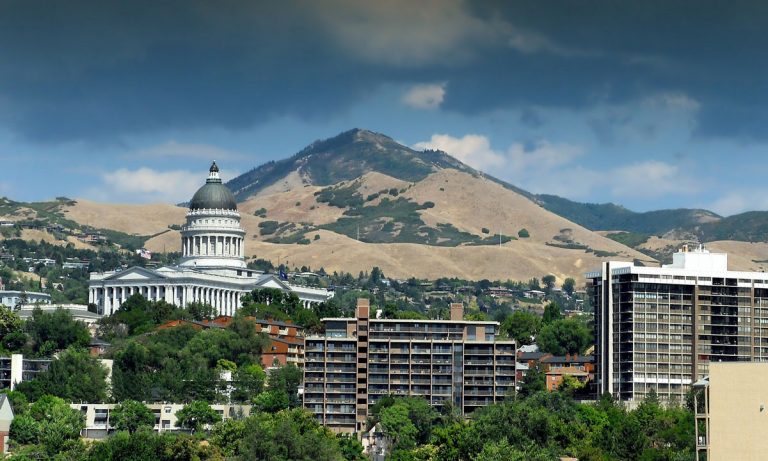
As medical marijuana programs continue to spread throughout the US, Utah took baby steps this week. Gov. Gary Hebert signed a bill that allows terminally ill patients access to medical cannabis.

It’s not an overwhelming victory for patients, but it’s a start. “This is … a very small toe in the water,” said Rep. Brad Daw, the Orem Republican who sponsored HB195. “Other states have gone vastly further down the road than we have,” Daw added.

Indeed, many legalization supporters said the legislation does not do enough to help patients. According to a report in the Deseret News:

Advocates from Together for Responsible Use and Cannabis Education opposed the bill, saying it was too restrictive in the forms of marijuana it approved, that it was unwise to limit the number of terminally ill patients a doctor can make recommendations for, and was a distraction from efforts at legalization for a much broader group of patients via a ballot initiative.

However, Daw characterized the bill as measured legislation designed to give relief to patients who have “exhausted all other methods of treatment” and are interested in trying the drug for their pain.

The law will allow a physician to recommend — not prescribe — limited forms of cannabis to any patient diagnosed as having “an incurable and irreversible disease” with six months or less to live. The law also restricts the cannabis to be in the form of a tablet, capsule, concentrated oil or patch.

Doctors are not allowed to recommend medical marijuana to more than 25 patients at a time and the patient is allowed a one-month supply at a time.

The bill sailed through the Senate on a 19-3 vote and the House on a 40-26 vote.

Girl Power: Women Are Way More Likely To Orgasm When They Do This

0

Men, come closer to the screen. Closer. Now, get comfy and pay attention. If you’re looking to give your lady an orgasm, look no further than other women. A new study shows that when it comes to satisfying women in bed, it’s not men who have the answers, it’s women who have sex with other women.

Researchers surveyed more than 2,000 women aged 18 to 65 and found that women were more likely to achieve orgasm with another woman. While straight couples were found to have more sex (around 16 times a month) compared to lesbians (around 10 times per month), women were 32 percent more likely to have an orgasm with another woman, some reporting up to 55 in a single month.

https://giphy.com/gifs/amen-M4oGeOtvCl7nW

Let’s compare that to straight women, who reported experiencing just 7 orgasms during that same time period.

Why is this? It could be that men are too focused on their own satisfaction.

Dr Kristen Jozkowski, from the University of Arkansas tells The Sun:

Sex that includes more varied sexual behavior results in women experiencing more orgasms.

Rebecca Dakin, author of 101 Sex Tips, says that “Men get over-excited and go for penetration far too soon. A woman needs at least 45 minutes of foreplay before intercourse.”

As The Daily Mail points out, the Indiana University School of Public Health-Bloomington released a study last fall that investigated the link between orgasm, sexual pleasure, genital touch, and stimulation. The survey was conducted on more than 1,000 women ages 18-94.

Researchers found that a woman’s sexual pleasure was based on several factors “with diverse preferences for genital touch, location, pressure, shape, and pattern.”

The results? Only 18 percent said they could orgasm from vaginal penetration alone, with the remaining 72 percent revealing that clitoral stimulation was either necessary to or boosted their orgasms.

It’s worth noting that a third study focusing on the “orgasm gap” found that nearly all men—95 percent— always orgasm during sex…

https://giphy.com/gifs/amen-zKsfeEYZI4Ku4

…compared to less than two thirds of women. It’s time we all took control of our own pleasure by reminding ourselves that not all sex moves work on everyone.

Weed Fight! Professor Challenges Police Chief Over Cannabis Report

0

If this were a professional wrestling event, it would be billed as The Battle of The Professor vs. The Cop. But it’s not a sporting event; it’s real life. A professor at the Colorado State University-Pueblo has challenged the Pueblo police chief to a debate over the findings of a study that found no link between legal marijuana and homelessness in the Colorado city.

According to a news report from the Pueblo Chieftain, CSU-Pueblo sociology professor Tim McGettigan has had it up to his eyeballs with Police Chief Troy Davenport over a 187-page study’s conclusion. Twenty-nine health professionals from the university worked on the report, but the city’s top cop called it “junk science.”

McGettigan, who led the study, fired back:

“The authors of the impact study stand by their research. Science is a force for good because good scientists pursue the truth wherever it leads — even (or especially!) when doing so debunks lies propagated by the powerful.

Throughout history, scientists have often been attacked by narrow-minded egotists who prefer ignorance over enlightenment. The authors of the Social Impact of Cannabis Study encourage those who are interested in this subject to read the impact study and draw their own conclusions.”

McGettigan also challenged Davenport and other unenlightened officials who take issue with the findings to a debate.

“Anyone who would like to debate the strengths and weaknesses of the Social Impact of Cannabis Study is welcome to do so at the fast-approaching Institute of Cannabis Research Conference from April 26-28, 2018 at CSU-Pueblo,” McGettigan said. “See you in April.”

The study suggests that the homelessness problem in Pueblo is not because of cannabis legalization, but due to Black Hills Energy, a major employer in the area.

“When you have a utility kicking thousands of families out of their homes in a community where there are no more than 35,000 family homes in one year, that’s 20 percent of the homes with utilities cut off. And pushing those families out into the streets, you are definitely going to see an increase in homelessness,” McGettigan wrote in the study.

How Marijuana Slang Evolved Across States And Generations

Back in 2017, the Drug Enforcement Agency needed to make sure law enforcement officials were keeping up with the evolving nature of drug slang. When someone referred to “lucy,” “ganja,” “Yayo,” “flake,” or “School Bus,” they wanted to be sure of what type of drug was being described.

The report was extensive, listing every known variation of slang for a specific drug. Here’s just the list for marijuana slang starting with the letter K— “Kaff; Kali; Kaya; KB; Kentucky Blue; KGB; Khalifa; Kiff; Killa; Kilter; King Louie; Kona Gold; Kumba; Kush.”

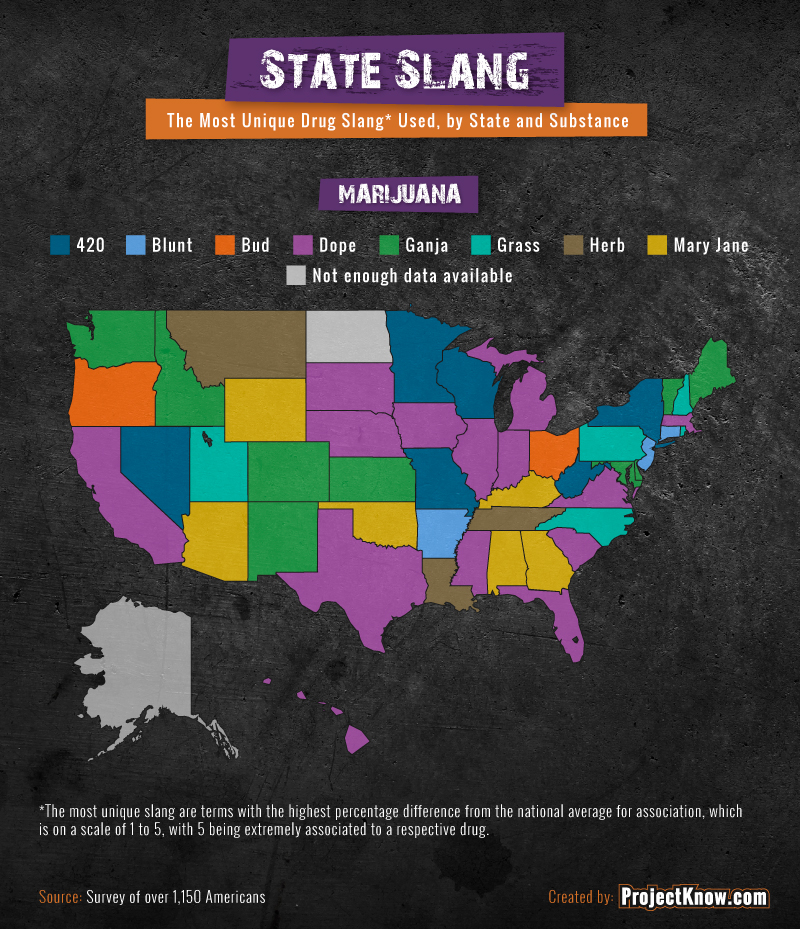
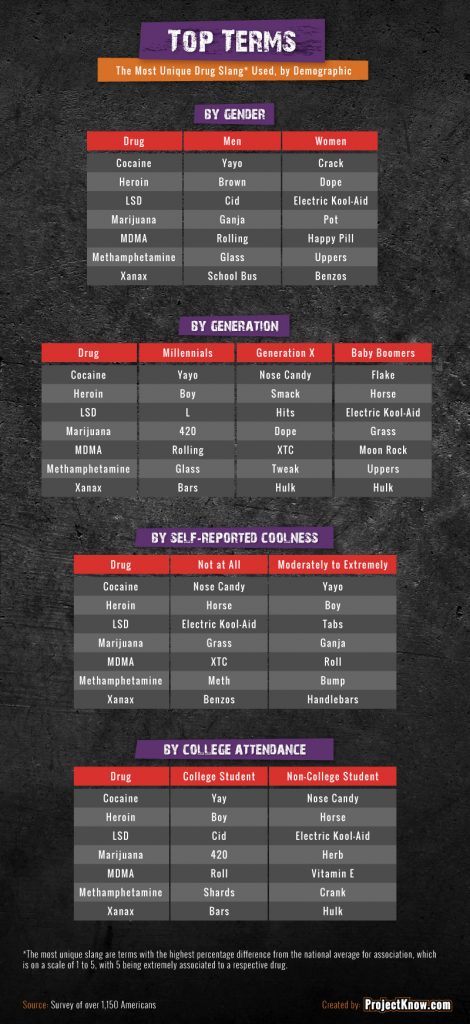
While it does document the slang itself, it doesn’t actually pinpoint who is saying what and where. To understand how the evolving vernacular being birthed in various communities, Project Know surveyed more than 1,150 men and women regarding the changing drug terminology and what terms they could identify as which drug.

The study also raised an interesting question: with growing legalization efforts, would marijuana slang change all that much?

Infographic courtesy of ProjectKnow

It turns out, not really. Most terms popularized in various states are known slang to describe cannabis. In 14 states including California, Texas, and Florida, “dope” was the most unique term to label marijuana. Which isn’t that unknown term at all.

While terms like “‘grass,’ ‘Mary Jane,’ and ‘ganja’ [persist] in various parts of the country, the legalization and popularity of marijuana may have reduced the need for such abstract terminology,” theorizes the study.

Also of note is how slang changes across genders and generations. While baby boomers are most likely to call marijuana “grass,” most people consider the term outdated and doesn’t make someone appear cool for knowing the term. What’s an example of a cool term to know for marijuana? “Ganja,” according to the study.

Infographic courtesy of ProjectKnow 

Conservative States Are Embracing CBD For Medicinal Use

The biggest victories in marijuana legal reform have been in states considered more progressive than average: California, Washington, Massachusetts and the like. But you may be surprised by the number of predominately conservative states taking a good look at the landscape.

You can thank CBD-based medicine for that.

“Progress is being made in places you’d never have thought possible,” said Keith Stroup, founder of NORML, told the Marijuana Business Daily.

According to a comprehensive report from Kristen Nichols, the demand for CBD-infused products are changing the way so-called Red states view the issue.  

Nichols report shows that states from Virginia to Iowa to Utah are studying how to allow some forms of cannabis:

  • Virginia’s governor recently signed an expansion of the state’s low-THC medical marijuana registry, removing any list of qualifying conditions for the drug and allowing it for any ailment for which a physician recommends cannabis.
  • Iowa is reviewing 21 applications for proposed dispensaries selling low-THC marijuana, with five stores slated to be approved next month.
  • Indiana lawmakers have passed a bill to expand CBD access from patients with certain kinds of epilepsy to all adults. The measure awaits the governor’s signature.
  • Louisiana is expected to start issuing cannabis licenses this spring, with the first cannabis pharmacy aiming for a Sept. 1 opening.
  • In Alabama, patients may possess CBD for any condition for which the drug offers “therapeutic or palliative relief,” and the state no longer requires physicians to have a UAB affiliation to recommend cannabidiol.
  • In Utah, a House committee ihas approved a bill to allow pharmacies to sell CBD products produced under state supervision. The bill has the backing of the Utah Medical Association and the state’s Department of Agriculture.

Why this push from conservative states? Because CBD is medicine. Plain and simple. Cannabidiol — or CBD — is a non-intoxicating component of cannabis with great therapeutic potential.

CBD doesn’t make people feel high like THC does. Medical marijuana patients are using CBD-rich products to treat a wide range of conditions: chronic pain, cancer, Crohn’s, diabetes, rheumatoid arthritis, PTSD, cardiovascular disease, anxiety, antibiotic-resistant infections, multiple sclerosis, schizophrenia, and more.

Take A Peek At Meghan Markle And Prince Harry’s Wedding Invitations

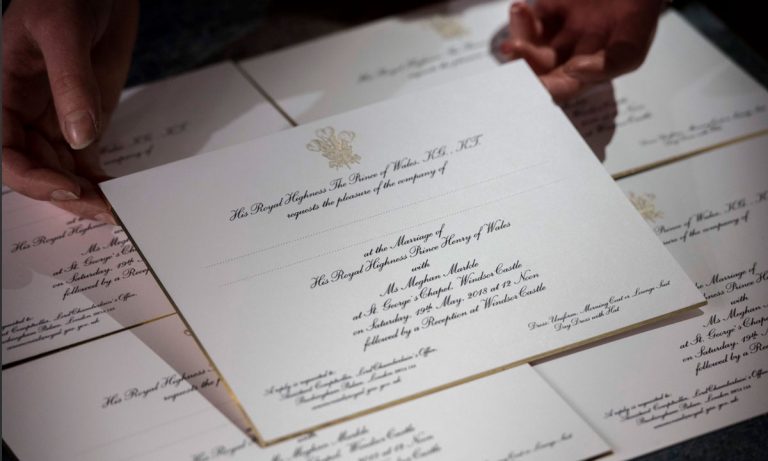
If you haven’t received an invite to Meghan and Harry’s wedding on May 19, time to pop open that bottle of vino and drown your sorrows because you haven’t been invited. Invitations went out today. Kensington Palace Tweeted out the official first look.

In addition to the wedding, the Palace also Tweeted that 200 guests are being invited to the post-wedding reception at Frogmore House given by The Prince of Wales. Guests have also been invited to the service at St George’s Chapel and to the lunchtime reception at St George’s Hall, which is being given by Her Majesty The Queen.

The invitations were made by London-based printers Barnard Westwood, who, according to Kensington Palace, have been making Royal invitations since 1985. They feature the Three-Feathered Badge of the Prince of Wales (Prince Charles) printed in gold ink. Harry and Meghan’s engagement announcement were also issued in Charles’ name, which is customary.

They were made with American black and gold ink on English card and are printed in gold and black, then burnished to bring out the shine, and gilded around the edge.

Lottie Small, who recently completed her apprenticeship at Barnard Westwood, printed all of the invitations in a process known as “die stamping” on a machine from the 1930s that she affectionately nicknamed Maude.

Here’s a video showing how they were made.

Young People Believe Alcohol Will Kill You Faster Than Marijuana

In our age of wellness and enrichment, people still like to have fun, but they want to monitor what they put into their bodies. A new Oregon study found that young people believe alcohol does more harm to their bodies that marijuana.

The study, led by researchers at RTI International, asked more than 1,900 Oregon adults prior to recreational marijuana legalization. Researchers found that more than half (52.5 percent) of participants believe alcohol is more potentially damaging to a person’s health than marijuana. Meanwhile only 7.5 percent consider cannabis the more harmful substance to a person’s health.

The shifting tides, as we’ve seen in similar previous studies, is occurring in younger demographics. Of those aged 18-34, a stunning 70.5 percent of them said alcohol was more harmful than marijuana. For people who have tried both marijuana and alcohol, 67.7 percent said alcohol was worse for your health.

“This study is the first to measure perceptions of the relative harmfulness of marijuana and alcohol,” said Jane Allen, the study’s author and RTI’s public health search analyst. “The findings surprised me somewhat, because there is widespread acceptance of alcohol for adult recreational use, and in contrast, marijuana is classified at the federal level as a Schedule I drug. There seems to be a disconnect between the social and legal status of the substances and people’s perceptions of harmfulness.”

Via RTI:

The RTI study notes that legalizing recreational marijuana will likely affect use of other substances, such as opioids and alcohol, and that perceptions of harmfulness may play a role. For example, research suggests that greater availability of marijuana may reduce reliance on opioids and other pain medications. The relationship between marijuana and alcohol appears to be more complex; marijuana functions as a substitute for alcohol in some contexts and as a complement in others. For this reason, it is unclear whether legalization of marijuana for recreational use will increase or decrease the significant social costs associated with alcohol.

For the past 40 years RTI has studied cannabinoids and the potentially positive and negative impacts the drug can have. You can learn more about RTI’s cannabis research here.

JK: Why Sarcasm Is So Difficult To Detect In Texts And Emails

This sentence begins the best article you will ever read.

Chances are you thought that last statement might be sarcasm. Sarcasm, as linguist Robert Gibbs noted, includes “words used to express something other than and especially the opposite of the literal meaning of a sentence.” A form of irony, it also tends to be directed toward a specific individual.

However, it’s not always easy to figure out if a writer is being sarcastic – particularly as we march ahead in a digital age that has transformed the way we communicate, with texting, emailing and online commentary replacing face-to-face chats or phone conversations.

In writing, the signal of sarcasm can be muddied. For example, say you’re texting with a friend about meeting at the movies:

Friend: I’m waiting at the front. Movie starts in 5.

You: I’m on my way now. Should be there in 10.

Friend: I’m glad you were watching the clock today.

https://giphy.com/gifs/fox-foxtv-newgirl-zN3IyVQag8smY

Was the friend being sarcastic or sincere? The later you are, the more upset they’ll likely be, and the higher the probability their response is a sarcastic jab. But if your friend knows you’re usually much later, they could be sincere.

So there’s one thing to look for: How well does the attitude the writer is conveying agree with the situation and the person?

Nonetheless, the struggle to interpret written sarcasm is real.

Studies have shown that people realize that they have a tough time interpreting sarcasm in writing. Studying the use of email, researchers found writers who think they’re being obviously sarcastic still confuse readers.

Sarcasm thrives in ambiguous situations – and that’s the main issue.

When delivered in person, sarcasm tends to assume a cutting, bitter tone. But written messages don’t always get that attitude across or give you much else to go on. We still need more information.

Signals That Go Missing In Texts

Studies have examined the use of sarcasm in a variety of everyday situations, whether it’s at work to give criticism or praise, or in situations where social norms get violated. (Be on time to movies, people!)

The problem is that a lot of previous studies of sarcasm have been done on spoken sarcasm, which tends to give listeners cues.

When you have a conversation with someone face-to-face (or FaceTime-to-FaceTime) and they say something sarcastic, you’ll see their facial expression, and they may look slightly bemused or tense. Equally or more helpful, the tone of their voice will likely change, too – they may sound more intense or draw out certain phrases.

You’ll also be firmly grounded in the real-time context of the situation, so when they say, “Man, nice job ironing your clothes,” you can look down – and see your wrinkled shirt.

All of these cues have been researched, and we know enough about them that we have the ability to artificially make a sincerely spoken statement sound sarcastic.

And yet when we text, a lot of that information goes missing.

https://giphy.com/gifs/ifc-sketch-comedy-baroness-von-3ohhwrB5qGefXxfYBy

There are no facial cues, no vocal tones and maybe even a delayed response if a person can’t text you back immediately. And if you don’t know the person all that well, there goes your last potential cue: history.

Emojis To The Rescue?

So after what you thought was an unexceptional first date – exactly how do you interpret the following flurry of texts?

Date: I had a great time. (12:03 a.m.)

Date: That was the most fun I’ve had in years. (12:05 a.m.)

Date: Really, it could not have gone better. (12:30 a.m.)

Was the date really that good? Did they really seem like they had that much fun? Or are they just a jerk lamenting the wasted time? All valid questions. And the recipient could come to a lot of conclusions.

Fear not. The digital age has developed some ways to mitigate some of the tortuous ambiguity. You can probably include an emoji to make it clearer to a reader something was meant sarcastically.

Date: I had a great time. (12:03 a.m.)

Date: That was the most fun I’ve had in years. ? (12:05 a.m.)

Date: It really, could not have gone better. ? (12:30 a.m.)

Ambiguity reduced, and facial expression taken care of. Probably not headed for date #2.

If we’re talking about email, we also have modifications that that can be made to text. We can italicize or bold words to change the way that a reader interprets the message.

Lastly, social media platforms like Twitter have given writers even more tools to allow people to communicate their intent. A study that included sarcastic tweets found that tweeters who include the hashtag #sarcasm tend to use more interjections (wow!) and positive wording for negative situations in their sarcastic tweets.

Algorithms have actually been built to determine the presence of sarcasm and rudeness in tweets, user reviews and online conversations. The formulas were able to identify language that’s outright rude pretty easily. But in order to correctly detect sarcasm, researchers found that algorithms need both linguistic (language) and semantic (meaning) information built in.

In other words, sarcasm’s subtlety means that the algorithms require more specification in their coding – unless you #sarcasm, of course.

The ConversationWith so many options to choose from, it’s time to make sure that text you send at 2:30 a.m. really gets your point across ?.

Sara Peters, Assistant Professor of Psychology, Newberry College

This article was originally published on The Conversation. 

Don't Miss Your Weekly Dose of The Fresh Toast.

Stay informed with exclusive news briefs delivered directly to your inbox every Friday.

We respect your privacy. Unsubscribe anytime.