

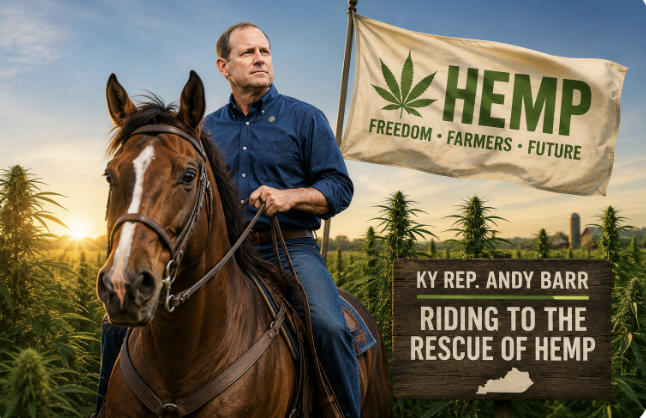
Rep. Andy Barr leads a bipartisan push to protect hemp farmers, preserve the 2018 Farm Bill, and prevent new federal restrictions.
For Kentucky, hemp is more than just another crop—it’s part of the state’s agricultural identity and an increasingly important economic engine. Now, one of the state’s senior lawmakers is stepping up to protect the industry. Yes, a Kentucky congressman rides to the rescue of hemp as Congress prepares to debate the next Farm Bill and potential changes to federal hemp policy.
Rep. Andy Barr (R-KY) is leading an effort to ensure hemp continues to receive fair treatment under federal law while opposing proposals industry leaders say could severely restrict the crop and many hemp-derived products. His efforts have been welcomed by farmers, processors, retailers, and manufacturers who have spent years building businesses around the hemp provisions included in the 2018 Farm Bill.
RELATED: Cannabis Dispensary Tackles Cost of Living With Free Gas Cards
The landmark legislation legalized hemp nationwide by defining it as cannabis containing no more than 0.3% delta-9 THC. Since then, the industry has expanded rapidly, producing everything from fiber and textiles to CBD products, building materials, animal feed research, wellness products, and industrial applications.
However, as the hemp marketplace has evolved, so have concerns in Washington. Some lawmakers have proposed tighter regulations on intoxicating hemp-derived cannabinoids, arguing additional oversight is needed to protect consumers and prevent products from reaching minors. Industry representatives, meanwhile, caution against broad restrictions could unintentionally harm legitimate hemp businesses operating within existing federal law.
Barr also appears to have support from the current administration’s broader approach to agricultural development and domestic manufacturing. While federal agencies continue evaluating hemp-derived cannabinoid regulations, there has been growing recognition hemp represents an important American agricultural commodity with significant economic potential. Industry groups believe policymakers increasingly understand the value of supporting legitimate hemp production while addressing safety concerns through targeted regulations rather than blanket prohibitions.
For Kentucky, the issue carries particular importance. The state has emerged as one of America’s hemp leaders, with farmers cultivating thousands of acres and companies investing in processing facilities, research, and manufacturing. Hemp has become an attractive alternative crop for many producers seeking to diversify beyond traditional tobacco production.
Supporters argue the industry supports rural jobs, attracts private investment, and creates opportunities for innovation across multiple sectors, including construction materials, biodegradable plastics, nutritional supplements, and sustainable textiles. They contend regulatory certainty is essential if businesses are to continue expanding and hiring.
RELATED: Can Medical Marijuana Improve Workplace Productivity
The debate over hemp also reflects a broader conversation about cannabis policy in America. While marijuana legalization remains politically divided, hemp has generally enjoyed bipartisan support because of its agricultural and industrial uses. Barr’s efforts seek to preserve consensus by ensuring hemp producers are not caught in the crossfire of debates over intoxicating cannabis products.
As Congress moves closer to Farm Bill negotiations, hemp businesses will be watching closely. If Barr’s proposals gain traction, they could provide much-needed stability for an industry which has experienced rapid growth but also significant regulatory uncertainty. For Kentucky farmers and the broader hemp economy, the coming months could prove critical in determining whether one of America’s fastest-growing agricultural sectors continues to flourish.
