Saturday, May 9, 2026
Home Blog Page 1076

California Issuing Cannabis Business Licenses Online

In a momentous step, California has begun issuing licenses to cannabis businesses that will go into effect on January 1. After several months of false starts, the online system has launched to procure state licenses for testing labs, retailers and distributors. These licenses will be required to open up shop in California.

“Now that applications are coming in, we can officially move one step closer to issuing California’s first state licenses for commercial cannabis activity,” Lori Ajax said in a statement. She heads the state Bureau of Cannabis Control.

When the online system first went up, officials said that it was functioning properly and that it seemed like people were familiarizing themselves with it. They expect completed applications to start really coming in sooner than later.

“People are creating accounts and checking out the site. Some people have started an application but may be putting in some information and finishing the rest later,” bureau spokesman Alex Traverso said in an email to Insurance Journal.

The licenses are temporary and will not go into effect until the January 1 opening day, plus, local permits will be a requirement before going for the state issued licenses.

All business owners must be disclosed, along with diagrams of the location, the location itself and an outline describing how business will be conducted at the site.

Rules and regulations are being brought to the table as fast as they can to standardize this fast-approaching $7 billion industry. From home cultivation rules to possession to cannabis business locations, it all must be sorted out.

Another issue being sorted is buffer zones around schools and playgrounds. There are some areas that simply won’t be able to have cannabis businesses because of where they’re built.

California pot laws are known to be born of the wild west mentality, so it will be interesting to see how many businesses sign up for licenses. The state projects $1 billion in tax revenue within the first couple years.

Let’s Talk About Cannabis Use In Traditional Therapy

In the last couple of years, there has been an abundance of media coverage concerning the use of medical marijuana in treating psychological disorders such as depression, anxiety, and PTSD. Moreover, in US states with strict medical cannabis programs, such as Minnesota and New Jersey, there have been heated debates concerning the treatment of mental illness with the plant. However, there has been very little research, as well as news coverage, concerning the relationship of medical marijuana to traditional forms of psychotherapy.

For many people who suffer from psychological disorders, regularly visiting a therapist can prove quite beneficial. Not only can these mental health professionals help individuals diagnose their particular disorders, they can often times treat them without the use of prescription drugs. Nonetheless, depending on the severity of the psychological disorder in question, therapists often times prescribe or recommend the use of mood altering drugs in order to aid in therapeutic processes.

These notions raise the question: what sort of benefits, or drawbacks, are there to using medical marijuana in conjunction with traditional therapy for the treatment of mental illness?

In an article written for Psychology Today, Dr. Joe Magliano highlights how, on a molecular level, cannabis can play a role in therapy for psychological disorders. Magliano’s research draws some fascinating parallels between the chemical composition of the human brain and “danger and safety” learning through both medical marijuana use and psychotherapy.

Cannabinoids are molecules produced by the human brain which act as neurotransmitters; they regulate neural activity within essential brain functions. For Magliano, this notion is particularly important regarding the area of the brain known as the hippocampus, which researchers believe dictates emotive arenas of PTSD, anxiety, and depression. This is because, marijuana consumption stimulates cannabinoid function in the human brain, including within the hippocampus, by introducing more cannabinoids into the nervous system.

Psychotherapists sometimes utilize “safety learning” as a therapy technique which helps individuals overcome irrational worries and distress. Safety learning functions by forcing subjects to face irrational stressors in a controlled setting—this process also directly reacts with the hippocampus region of the human brain.

The congruencies between marijuana consumption and safety learning are apparent within the chemical, neural reactivity of the hippocampus. Migliano speculates that “under some conditions, cannabis might promote learning processes related to safety and danger” as seen in safety learning practices of psychotherapists. Point being, on a molecular level, and within carefully controlled circumstances, cannabis consumption may make mentally ill people more receptive to therapy practices such as safety learning.

It is should be noted, however, that any theories positing a direct correlation between medical marijuana consumption and successful therapy practices are pure conjecture. In fact, on a mainstream level, mental health professionals generally opt to steer clear of the medical marijuana topic in general. This is largely because, there is a general lack of legitimate research into the potential applications of marijuana as a medicine—for both physical and mental ailments.

A majority of accepted medical literature that touches on the relationships of cannabis, mental illness, and therapy describes the psychological pitfalls of marijuana consumption. These medical publications often times delve into the potentially addictive nature of marijuana as well as its theoretical tendency to retard cognitive development.

Opposing viewpoints aside, novel scientific theories concerning cannabinoid function in the human brain certainly warrant more research into the potential applications of cannabis as an aide to traditionally therapy. However, the choice to medicate with marijuana, whether for mental or physical conditions, should not be taken lightly and should be discussed with a professional.

Kent Gruetzmacher M.F.A. is a Colorado based freelance writer and the Director of Business Development at Mac & Fulton Talent Partners (www.mandfconsultants.com), a recruiting firm dedicated to the indoor gardening and cannabis space. He is interested in utilizing his M.A. in the Humanities to critically explore the many cultural and business facets of this youthful, emergent industry by way of his entrepreneurial projects.


Science Says Marijuana Can Protect The Brain From The Effects Of HIV

Cannabis has been used by HIV/AIDS patients to treat a wide variety of symptoms associated with the virus and the side effects of antiretroviral medications. One study reports that more than 60 percent of patients with the virus identify as “medical cannabis users,” citing that the leaf combats anxiety, loss of appetite, nausea and vomiting.

Another study shows that patients who use cannabis as a form of therapeutic relief are 3.3 times more likely to follow their antiretroviral regimens, as compared to non-cannabis users.

Now, research shows that cannabis is not only effective in treating adverse side effects, but it has the power to protect one of the most powerful organs in the body: the brain.

Researchers from the Division of Experimental Medicine at Harvard Medical School say that about 40 percent of HIV infections lead to some sort of brain impairment. HIV-1 associated cognitive impairment and dementia, commonly referred to as HAND, which occurs when HIV enters the nervous system. When this happens attention, memory, communication and other cognitive abilities are severely impaired.

The research team, led by Dr. Hava Avraham, found that cannabinoids can offer protection from a harmful protein called Gp120 protein, which is the product of the HIV virus. Dr. Avraham explains that when this protein crosses the “blood-brain barrier” it has a “very toxic effect on the brain.” Specifically, the protein attacks the neuronal cells that are crucial to the functionality of the brain.

The Harvard team used a cannabinoid called AM2421 that acts on the brain’s cannabinoid receptor, CB2. The AM2421 protected the progenitor and neural stem cells from damaging doses of Gp120.

Aside from AM2421, further research shows that another cannabis chemical called cannabichromene (CBC) can actually aid in neurogenesis (the growth and development of nervous tissue). CBC appeared to increase the viability of developing brain cells.

All of this research proves cannabis is a promising option for not only increasing brain activity, but protecting the brain against a virus that afflicts over one million people per year.

Watch: This Japanese Sex Doll Dispenses Cocktails Too

The sex doll is not  a new idea, but this very realistic looking Japanese one is the latest innovation in terms of sex toys, and the priciest commodity for bachelor parties.

Developed by Orient Industries, this sex doll (apart from its implicit use) works as a drink dispenser, which you can buy it for the price of $5,000. If you’re smart, you can try to get your money back by charging people for squeezing her boobs and getting their drinks ?.

The video above demonstrates how the doll works, showing several people giggling as they squeeze the doll’s breast, making it pour them all types of different colored drinks. The red wine coming out of the fake boob is a highlight, as it looks particularly striking.

It’s not necessary to erotically massage the doll’s breast to get it to pour a drink but, you know, to each his own.

Meowijuana Launches Catnip Product Line For ‘Cats Who Need the Weed’

Meowijuana, a catnip company, has launched a new product line that is creatively branded and plays on the euphoric “high” some cats have from catnip. The company sells 100 percent organic catnip that is available for shipping both domestically and internationally. Meowijuana’s legendary catnip is grown in Southern California and Washington State.

Although the company uses the trademarked tag line, “For cats who need the weed”, there is no actual marijuana in the product. It is perfectly safe and legal for both cats, and even people, to consume. Catnip, which is from the mint family, contains the chemical nepetalactone, which triggers a sense of euphoria in susceptible cats. But not all cats react to catnip. Pet MD has noted that sensitivity to catnip is an inherited trait effecting 50 to 75 percent of cats. Catnip produces a different response depending on how it’s consumed. Sniffing catnip produces a stimulant effect while eating it can cause sedation in cats.

The company also sells the product similarly to the way marijuana dispensaries do in Colorado and other states where it is legal. Meowijuana’s Purple Passion Jars offer the product in clear re-sealable jars. The catnip buds were harvested during peak oil product providing cats the next-level catnip experience. For the most dedicated catnip connoisseurs, Meowijuana offers the Grand Daddy Purr Cigar Box. The humidity-regulated cigar boxes are filled with the finest 100 percent organic Grand Daddy Purr Catnip buds. The company even offers their customers, a Medical Meowijuana ID card, which includes the cat’s pictures, name, sex and date of birth.

“We offer the highest-quality, pet-safe, organic catnip you will find on the market today all packaged in a unique branding concept that our customers love,” says Chris Glissman, CEO of Meowijuana, LLC. “Our team has a great time marketing our product, which is a great gift for your cat. Plus our customers enjoy the shopping experience.”

For more cannabis business coverage, visit the MJ News Network.

Watch: Virtual Cocktail Smells, Tastes And Looks Real

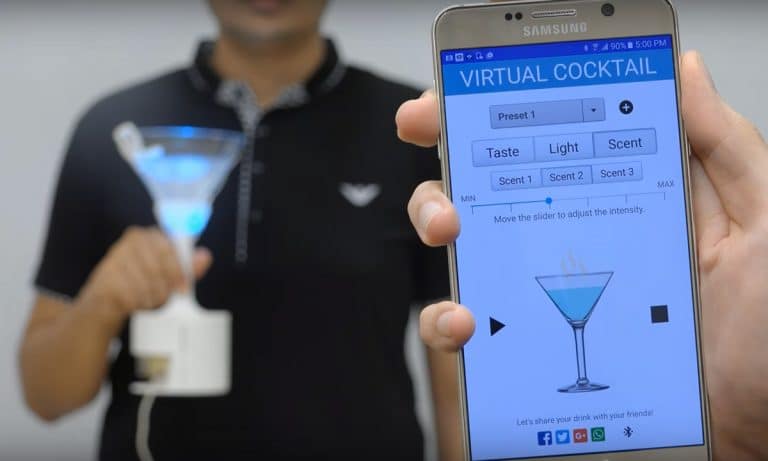
Has virtual reality jumped the shark or is this a genius idea? There’s a new interactive cocktail on the market called a ‘Vocktail’ and, according to those who’ve tried it, it smells, tastes and looks just like the real thing.

“You could walk into a bar and order a mojito and using the mobile application, customize it to your preference with, say, a chocolate aroma and a hint of banana or mango,” says research fellow Nimesha Ranasinghe, speaking to World Economic Forum. “Or you could customize water to taste like your preferred flavored beverage and save the money.”

Here’s how it work. The cocktail glass has three tiny air pumps that are connected to three scent cartridges that mimic a cocktail aroma while you sip your drink.

And when it comes to the flavor, according to WEF, there are two silver electrodes on the rim of the glass responsible for the salty, bitter and sour notes of your VR drink.

LED lights complete the trifecta by projecting a color preference onto the glass.

What’s the point of drinking a cocktail if you can’t get drunk? Says Ranasinghe:

Using this technology, salt can be delivered in a virtual manner without the health drawbacks. Likewise, for diabetic patients, sugar consumption can be reduced dramatically without loss of sensory pleasure.

As many mobile apps do these days, the Vocktail would allow creators to save and share their customized creations through social media.

The Vocktail is still in the testing phase. According to WEF, the team is currently working on things like texture. They’re also in talks to mass produce their idea that is basically a high-maintenance mocktail.

WATCH: Endless Chocolate And Peanut Butter On Tap Exists In Australia

We now live in a world where Willy Wonka is becoming more of a reality every day. C9 Chocolate & Gelato in Australia (Sydney and Newton) has a bottomless chocolate faucet that allows you to drown just about any dessert you can imagine in a warm chocolate blanket. Cookies? Check. Chocolate lava cake? Check. Croissants? Check. Doughnuts? Check. Gelato sandwiched between two doughnuts? Check. Chocolate soufflé already injected with chocolate? Check. Your gaping mouth hole? Not likely.

Taking a straight shot of the sweet stuff is allowed, however.

https://www.instagram.com/p/BEXyMF1RQhj

The dessert shop started in 2014 and now boasts more than 200 unique flavors of gelato (which you can douse in chocolate), like smashed avocado and bacon.

Here’s the chocolate tap in all its glory:

There’s also another dessert shop in Sydney called The Peanut Butter Bar that has unlimited PB on tap. (Oddly enough, the two dessert shops are not related.)

https://www.instagram.com/p/BcVRYqcj_Ct

And according to owner Christine Elbakht, it’s also an attempt to shift the Nutella obsession to peanut butter. She tells Broadsheet, “Over the last few years we’ve seen the use and abuse of Nutella on everything. It’s not sustainable [because] there’s only so much you can consume.”

Along with her husband Nagib Elbakht, the couple offer peanut butters made without sugar, preservatives or hydrogenated fat. Healthy peanut butter on tap. It’s almost too much, isn’t it?


Alaska Airlines Is Offering Early Boarding For Passengers Wearing This

Alaska Airlines will be celebrating National Ugly Holiday Sweater Day on December 15, allowing passengers in festive seasonal sweaters to board early that day.

The one-day promotion will be honored across the airline’s 115-city network including all Alaska, Virgin America and Horizon Air flights. There will also be “festive boarding music” all month long to keep those holiday vibes going.

“Travel during the holidays can be stressful for guests, especially those who do not travel often,” says Natalie Bowman, managing director of marketing and advertising at Alaska Airlines. “This fun promotion not only allows guests to board early on that day, but gives people another opportunity to dust off that ugly holiday sweater hanging in the back of their closet.”

Alaska is using this stunt in hopes that it will go viral. They’ve already set-up hashtags in anticipation and is urging guests to “join in the merriment of the holiday season and share their memories on Twitter” by tagging their photos and videos using #UglySweaterDay and #MostWestCoast.

Science Tells Us How Marijuana Makes Us Feel Happy

After you enjoy a marijuana session, do you sometimes get an uncontrollable smile on your face? Or experience a bout of unrestrainable giggling? Welcome to the club of happy.

That feeling of bliss you’re feeling is rooted in science. But before we begin with endocannabinoid science, let’s have a quick lesson in etymology.

Just Another Word For Bliss

Anandamide is the reason you get that unmistakable feeling of happiness from consuming cannabis. Anandamide was discovered in 1992 by Dr. Raphael Mechoulam — who, coincidentally also was the researcher who first isolated THC in 1964.

Mechoulam selected the word anandamide from the Sanskrit word ananda, which means “joy, bliss, delight.”

RELATED: People Who Use Weed Also Do More Of Another Fun Thing

So now we know that the word means bliss, let’s get back to the science. Why does marijuana make us happy?

Your brain contains anandamide and other cannabis-like chemicals that control happiness and euphoria. It acts as an an anti-anxiety and antidepressant agent.

It’s Like A ‘Runner’s High’ …. Without Breaking A Sweat

Have you ever experienced a “runner’s high” after a jog? Or have you enjoyed a chocolate truffle a little too much? That’s anandamide doing its job in your brain.

In the book Your Brain on Food: How Chemicals Control Your Thoughts and Feelings, author Dr. Gary Wenk, writes:   

“Anandamide inhibits the release of glutamate and acetylcholine within the cortex and hippocampus, an action that may underlie the ability of marijuana to impair one’s capacity to form new memories when using the drug. The presence of cannabinoid receptors in the parts of the brain that control movement may explain the stumbling behavior that some marijuana users experience. Cannabinoid receptors greatly enhance the release of dopamine; this action plays a critical role in the ability of marijuana to produce euphoria.

“Cannabinoid neurons … influence the function of our cortex and various limbic (emotion-controlling) regions; when we stimulate these receptors, we impair higher cognitive functions as we experience euphoria, and when they are blocked, we feel depression.”

RELATED: The Most Popular Marijuana Flavors

So there you have it. Your body creates its own “bliss molecule.”

But What Does A Bong Hit Have To Do With It?

Not only is anandamide a naturally occurring chemical in your brain, it is also found in large amounts in THC, the psychoactive ingredient in cannabis. In fact anandamide is an endocannabinoid; the prefix “endo” means “within.” Your body essentially makes its own THC-like molecule. Cannabis is a phytocannabinoid; the prefix “phyto” means “plant.”

So when you ingest cannabis, you trigger the neurotransmitter in your brain. Or as Dr. Wenk writes:

The structure of the cannabinoids contained within the marijuana plant enable them to cross the blood–brain barrier and bind to a receptor for the brain’s very own endogenous cannabinoid neurotransmitter system.

Essentially, THC and anandamide act similarly —providing a sense of bliss or joy.

A 2013 study confirmed Dr.Mechoulam earlier finding:

“THC interacted with emotional content, as activity in this network was reduced for negative content, while activity for positive content was increased. These results indicate that THC administration reduces the negative bias in emotional processing. This adds human evidence to support the hypothesis that the endocannabinoid system is involved in modulation of emotional processing. Our findings also suggest a possible role for the endocannabinoid system in abnormal emotional processing, and may thus be relevant for psychiatric disorders such as major depression.”

Nicotine Smokers Are 7 Times More Likely To Smoke Cannabis Daily

0

A recent study published on the American Journal of Public Health claims that there’s a big link between nicotine and cannabis users, with nicotine smokers being seven times more likely than non-smokers to consume cannabis daily.

This link is especially strong with smokers who are between the ages of 12 and 17, being 50 percent more likely to smoke cannabis every other day than non-smokers of their age. Other results showed that occasional nicotine smokers of this demographic are four times more likely to smoke marijuana than non-smokers of their age. These results vary when it comes to the gender and race of the user; for example, results show that males smoke more than females and that hispanics smoke more than white smokers. These ethnicity based results are believed to be due to the changing demographic makeup of the country.

Due to the acceptance of marijuana and it’s slow legalization throughout the US, it’s important for parents to be aware of their kids’ habits. Smoking cannabis from an early age could result in negative consequences for their brain health and education.

Via KRDO:

“There may be a lot of confusing messages today among youth today about whether and to what degree cannabis use is harmful, especially in comparison with cigarettes. In many places, youth are clear that cigarettes are harmful, but with marijuana, especially amidst rapid legalization, this is not clear. What we are talking about here is daily cannabis use, and that is generally agreed upon to have a number of potential risks.”

It’s very important to talk to kids and teens about the risks of smoking nicotine and marijuana from an early age, to prevent it and to avoid further health problems.

Don't Miss Your Weekly Dose of The Fresh Toast.

Stay informed with exclusive news briefs delivered directly to your inbox every Friday.

We respect your privacy. Unsubscribe anytime.