“Blac Chyna is going to destroy him and his entire family,” sources tell Naughty Gossip. “She knows everything and is ready to tell-all. She is sick of this entire family and wants to finish them once and for all.He accused her of abusing drugs and trying to strangle him. Now she has hired a team of lawyers to help her fight back against Rob.”
“She’s going to file an explosive counter lawsuit for millions that will expose all of Rob’s lies.”
“Chyna is gathering all of her evidence, making sure her story is solidand better than the one that Rob told,” the source continued. “She’s going to wait until the end of the deadline to file her suit. She has about three more weeks.”
“She is going to stick it to Rob twice. She will file a response, and her own lawsuit. This will get ugly.”
Nelly Rape Accuser Says He Forced Her Into Sex Without a Condom
Nelly’s legal team feels confident they’ll expose the 21-year-old as a liar.
via TMZ:
We’ve learned the 21-year-old Seattle resident claims she met Nelly at a club in Washington, where she and her friends drank at his table and got “tipsy.”
She says she was invited to an after-party and drove off with Nelly’s people. The woman says she was taken to Nelly’s tour bus.
She says she was in Nelly’s room with him when he tried to have sex with her and she said no. She claims Nelly told her to “shut up” and said he wanted to have sex with her without protection, which she says he did over her objections.
The woman says, afterward, Nelly offered her money, but she declined, and then a woman came up and said, “You gotta go.” She kicked her off the bus and threw $100 at her.
Nelly’s lawyer, Scott Rosenblum, tells TMZ, “It does not surprise me that she wanted to have her story publicized. That is playbook 101 of a person with an agenda and clearly she has one. The agenda is money, fame and notoriety.”
Rosenblum says he has an investigator on the case and “we will be able to show by objective evidence and unbiased witnesses that she has zero credibility.”
The lawyer adds, “She’s a person who is making a dangerous, fraudulent allegation to accomplish her own goals.”
Love the fresh dirt we bring over daily from Naughty Gossip? Let us know in the comments!
There’s this widely held assumption that says if you smoke marijuana, you will waste time and be unproductive and eats tons of junk food. It’s taken some time for marijuana to lose its reputation, and for the “stoner” stereotype to dissipate, but there are still people out there who believe that cannabis encourages laziness.
Here are 5 successful people who prove that using marijuana isn’t an impairment to greatness.
Seth McFarlane
While many of the aspects in his work make references or allude to cannabis, McFarlane is still one of the most successful people in Hollywood, having produced one of the most famous animated shows of all time, a couple of beloved movies, and acquired the coveted position of hosting the Oscars. In 2013, he was included in Marijuana Policy Project’s list of the most influential cannabis users of the year.
Steve Jobs
The Apple founder used to go a little wild during the 70’s, where he was known for consuming cannabis in different forms and for smoking marijuana whenever he needed to relax or to get some inspiration.
Even though he quit smoking during the latter years of his life, he claims that he used to consume marijuana about once a week or once a month. It didn’t stop him from changing the world and the way in which we interact with technology.
Bill Gates
Probably one of the smartest people on the planet and definitely the richest, Bill Gates’ company, Microsoft, became the first major company to invest in the future of cannabis, partnering up with Kind Financial. This company develops software that facilitates the monitoring of marijuana sales, ensuring that the legal grown marijuana doesn’t fall into the black market.
Seth Rogen
One of the pioneers of stoner movies, Seth Rogen is also a true lover of cannabis, being involved with the National Organization for the Reform of Marijuana Laws (NORML), advocating for the plant, claiming that it’s a normal part of his life and that it hasn’t impaired him at all. In fact, he’s one of the most accomplished writers, comedians and businessmen in Hollywood.
Whoopi Goldberg
Goldberg has a line of marijuana products called Whoopi & Maya that relieve pain and menstrual cramps in women. While they’re only available in California, her products include balms, tinctures, and bath soaks. She claimed that her line wasn’t meant to be a joke and that cannabis provides real medical benefits to women that struggle with pain while on their periods.
Illinois Medical marijuana patients have been reporting that cannabis has enabled them to lessen or even stop some prescription medications, a new study finds.
The study was conducted by Rush and DePaul Universities with 30 volunteer participants, meaning that the results could be biased in favor of marijuana, conceded the researchers. It is also believed to be the first peer reviewed study of its kind in Illinois.
It hands us direct anecdotal evidence regarding what previous studies have suggested, that cannabis can lead to the reduced use of opioid drugs, said lead author Douglas Bruce.
“One of the most compelling things to come out of this is that people are taking control of their own health, and most providers would agree that’s a good thing,” said Bruce. “But the lack of provider knowledge around what cannabis does and doesn’t do, the difference in products and ingestion methods and dosing, is all kind of a Wild West.”
The study results came in while the Medical Cannabis Alliance of Illinois is pushing for legislation that would make any condition that a doctor would prescribe opiates a condition that is permissible under their medical cannabis laws.
Former White House drug policy advisor, Kevin Sabet, who now operates Smart Approaches to Marijuana, a group opposed to broad legalization, thinks the study is a dud, saying, “It was an uncontrolled observation of 30 people who were mixing pot with other drugs.”
Bruce came back, saying that Sabet had his own kind of biases when it came to marijuana. “There’s power in people telling their stories in a way you can’t get in a survey,” said Bruce. “It’s important to do qualitative research to understand how people are using cannabis, then figure out how to measure it.”
Despite federal prohibition, Illinois is one of the US’s 29 states that have legalized medical marijuana. Of their population, around 25,000 have at least one of the serious qualifying conditions to use medical cannabis.
In the DePaul-Rush study, the average participant was around 45 years old and mostly used cannabis to treat pain, seizures or inflammation.
Participants who were quoted in the report all reported being “deeply dissatisfied” with their prescription medications.
One patient used to ingest 180 Vicodin a month. Another participant took hundreds and hundreds of ibuprofen over time. A woman with HIV and cancer said that cannabis was actually helping after agonizing years of trying to get off the anti-inflammatory prednisone.
Then there’s the 33-year-old woman who has multiple sclerosis and said that marijuana helped relieve “unbearable” pain, it allowed her to sleep, too, compared to her prescription medicine, which made her feel like a “zombie.”
Wildfires torched the western states this summer, damaging property, homes and farms throughout the region. In Northern California alone, the National Interagency Fire Center estimates that 411,742 acres were destroyed or damaged by 3,692 fires.
The state’s cannabis farmers were not spared in the devastation. According to GreenState, this year’s outdoor harvest will be tainted by smoke and ash from the fires.
Although there have been worse summers in the past decade — 2012 and 2015 were more severe — this year’s crop will have a different flavor.
As Kerry Collins reported in GreenState:
America’s cannabis consumers need to be on the lookout for cheap, campfire-smelling bud this harvest season, after another record year of wildfires likely tainted untold thousands of pounds of pot with smoke and ash.
“Campfire pot”, “beef jerky”, and “hickory kush” are some of the nicknames farmers living in wildfire country give to smoke-tainted buds. Those buds are being harvested this month in the wildfire-ravaged Western U.S. and are often shipped east to unregulated black markets in New York, Atlanta and Chicago.
One longtime grower of a medium-sized operation in Mendocino County, part of California’s famed Emerald Triangle, said he expects he will have to significantly drop his prices this year. “It’s been a real struggle,” said the farmer, who wishes to remain anonymous because he ships the bulk of his product illegally to the East Coast.
“Prices have already tumbled in the past three years. None of use up here can really afford a big drop in prices,” he added.
He also said labor costs were higher this year because more of his laborers got sick from the smoke.
California is not the only state that has taken a hit from the wildfires. Collings reports:
Oregon’s epicenter of outdoor cannabis production in Jackson and Josephine Counties has felt the smoldering impacts of the Miller Complex, a slow-moving wildfire that’s burned over 37,000 acres.
Farmers say smoke’s impacts on pot crops are influenced by wind direction, rain, how old the plants are and how much they were exposed to smoke and/or ash. “I think it’s really hit or miss,” said Kristin Nevedal, executive director of the International Cannabis Farmers Association.
Fenty Beauty by Rihanna has people from all over the world talking. Her new makeup line has everything, from foundations to blushes. But one item in particular looks conspicuously smokable. Fenty’s blotting paper is supposed to remove shine and oil from your face and make you look awesome. The online community isn’t satisfied with this simple explanation.
Rihanna is a big supporter of marijuana, so the belief that she’s releasing her own brand of cannabis products a la Snoop makes a lot of sense. She’s made no comment over the duality of the blotting papers, but people have taken it upon themselves to see if they could find the hidden meaning within.
Rihanna released pink rolling papers.
A visionary. An icon. True Caribbean angel https://t.co/miZzVwZw0s
To start, the paper did not rip off in a clean line. That could entirely be on me—I’m not the most coordinated—but also maybe it’s because these are meant to be used only on your face. As far as the actual act of rolling these, that too was a mess. Licking the paper did not help it stick (and also was pretty gross).
The real test, though, came when I tried lighting it on fire. It burns extremely fast. If you’re using it for anything other than your face, you’d be disappointed and also possibly ignite your fingertips. The smell—a fragrant mix of chai tea and burning plastic—was not great, either. I do not recommend.”
Suffice it to say, it didn’t work. Maybe Rihanna will get the hint and make the product that the people really want. There’s always hope.
If you’re already a nervous flier, you’re going to hate this news. Because of global warming, scientist predict turbulence (the really scary kind) is going to triple.
2050-2080 might become more violent turbulence.
Research published in the journal Geophysical Research Lettersstates that in the next 35 years or so, climate change might triple the amount of turbulence. And we’re talking Clear Air Turbulence (CAT), the violent “OMG we’re all going to die” turbulence.
It’s the kind of turbulence you have likely experienced before —it seemingly comes out of nowhere, but is actually caused when a mass of air collides with another mass of air traveling at a certain speed. But now that temperatures are changing, they’re causing these pockets of air to become stronger. According to Geophysical Research Letters:
Previous research suggests that climate change will increase instabilities in the North Atlantic jet stream in winter, generating more clear-air turbulence. We find strong increases in clear-air turbulence over the entire globe and in particular the midlatitudes, which is where the busiest flight routes are. We also find that the strongest turbulence will increase the most, highlighting the importance of improving turbulence forecasts and flight planning to limit discomfort and injuries to passengers and crew.
Besides adding a helluva lot more of those little bottles of booze to your in-fight ordering queue, “What air travelers can expect is to be confined to their seat for a lot longer in the future, because the seat belt sign will have to be on for two times or maybe three times longer,” Paul Williams, a professor of atmospheric science at the University of Reading in the U.K. and the lead author of the study, told ABC News.
He adds that major injuries to both passengers and flight crew could abound, unless scientists can start accurately forecasting turbulence.
“I think we’ll see more injuries in the future, even if the number of people flying is constant, which of course it’s not,” says Williams. “That’s going up, too.”
The good news here is that since most planes that will be used to fly the friendly skies have yet to be built, there’s time for engineers to specifically build turbulence detection technology so that, you know, people can feel safe when traveling.
On Monday, Massachusetts commuters will get an eyeful of something they’ve never seen before: a billboard advertising medical marijuana dispensaries.
New England Treatment Access (NETA) is behind not one, but four new billboards. According to the Boston Globe, two are located on the Massachusetts Turnpike near Exit 5 in Chicopee, one on Route 28 in Somerville, and another near the Mass. Ave. exit off Interstate 93 in Boston.
The ads read, “Why wait for better health?” along with NETA’s website.
Norton Arbelaez, the nonprofit’s director of government affairs, tells the Globe, “There’s no call to action — this is educational. There are tens of thousands of patients that have a need but haven’t accessed the regulated market.” He says not all of the 45,000 Massachusetts residents who have medical marijuana cards visit dispensaries.
The billboards were a natural advertising route for NETA, as it’s still super sticky for the cannabis industry to advertise on radio stations and social media because of federal constraints.
Also, Massachusetts’ state regulations have strict guidelines in place on how dispensaries can market themselves; citing prices and using logos featuring marijuana plants are big no-nos.
A billboard that went up in Boston earlier this year that read “States that legalized marijuana had 25% fewer opioid-related deaths” was quickly taken down.
Market analysts suggests Massachusetts’s move to bring an end to marijuana prohibition will contribute to a marketplace worth an estimated $1 billion by 2020.
As reported by The Fresh Toast last December, industry experts believe legal weed is destined to become a rampant East Coast trend, complete with a newfound tourism trade, which will undoubtedly put Boston on the map as the reining champion in nationwide pot sales.
If you’re feeling stuck and can’t find the answers to the problem in front of you, research suggests that listening to happy music may help you come up with innovative and useful solutions. While it’s been known for a while that music has a positive impact on cognition, a recent study published in the PLOS ONE journal surveying over 155 people indicates that happy music can promote creative thinking.
The participants took surveys and were split into separate groups, with each one listening to different types of music that were categorized as happy, calm, sad and anxious. The control group only listened to silence. Once the participants had listened to a few minutes of music, they were asked to complete several cognitive tasks that measured their divergent and convergent creative thinking. Divergent thinking is the more creative method of the two, which describes the way in which we solve an abstract problem that has many possible answers and outcomes. In contrast, convergent thinking is more simple and straightforward, and it’s the method used when solving a well defined problem.
The data gathered concluded that listening to happy music facilitates divergent thinking, enhancing our flexibility when we’re looking for a solution, making us think outside the box. More investigation on this topic would be great since it could find viable and cheap ways of promoting creative thinking, be that in schools or the workplace.
The worst day of Brad McGahey’s life was the day a judge decided to spare him from prison. McGahey was 23 with dreams of making it big in rodeo, maybe starring in his own reality TV show. With a 1.5 GPA, he’d barely graduated from high school. He had two kids and mounting child support debt. Then he got busted for buying a stolen horse trailer, fell behind on court fines and blew off his probation officer.
Standing in a tiny wood-paneled courtroom in rural Oklahoma in 2010, he faced one year in state prison. The judge had another plan.
“You need to learn a work ethic,” the judge told him. “I’m sending you to CAAIR.”
McGahey had heard of Christian Alcoholics & Addicts in Recovery. People called it “the Chicken Farm,” a rural retreat where defendants stayed for a year, got addiction treatment and learned to live more productive lives. Most were sent there by courts from across Oklahoma and neighboring states, part of the nationwide push to keep nonviolent offenders out of prison.
Aside from daily cans of Dr Pepper, McGahey wasn’t addicted to anything. The judge knew that. But the Chicken Farm sounded better than prison.
A few weeks later, McGahey stood in front of a speeding conveyor belt inside a frigid poultry plant, pulling guts and stray feathers from slaughtered chickens destined for major fast food restaurants and grocery stores.
There wasn’t much substance abuse treatment at CAAIR. It was mostly factory work for one of America’s top poultry companies. If McGahey got hurt or worked too slowly, his bosses threatened him with prison.
And he worked for free. CAAIR pocketed the pay.
“It was a slave camp,” McGahey said. “I can’t believe the court sent me there.”
Soon, it would get worse.
Records show that courts send about 280 men to CAAIR each year, coming from throughout Oklahoma, along with some from Arkansas, Texas and Missouri. Credit: Shoshana Walter/Reveal
Across the country, judges increasingly are sending defendants to rehab instead of prison or jail. These diversion courts have become the bedrock of criminal justice reform, aiming to transform lives and ease overcrowded prisons.
But in the rush to spare people from prison, some judges are steering defendants into rehabs that are little more than lucrative work camps for private industry, an investigation by Reveal from The Center for Investigative Reporting has found.
The programs promise freedom from addiction. Instead, they’ve turned thousands of men and women into indentured servants.
The beneficiaries of these programs span the country, from Fortune 500 companies to factories and local businesses. The defendants work at a Coca-Cola bottling plant in Oklahoma, a construction firm in Alabama, a nursing home in North Carolina.
Perhaps no rehab better exemplifies this allegiance to big business than CAAIR. It was started in 2007 by chicken company executives struggling to find workers. By forming a Christian rehab, they could supply plants with a cheap and captive labor force while helping men overcome their addictions.
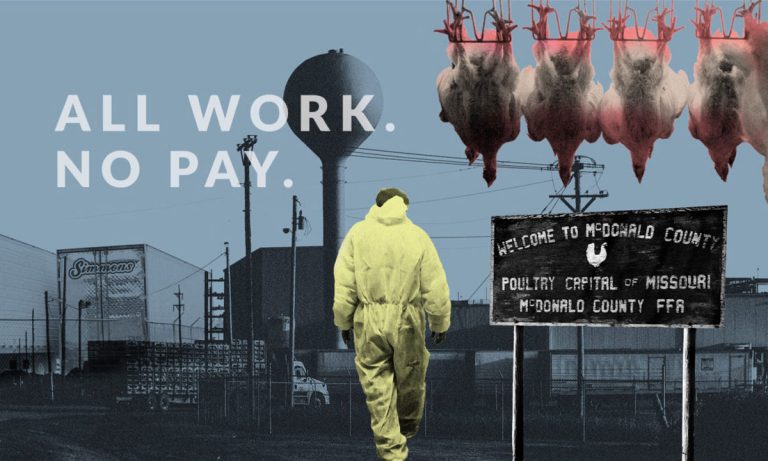
At CAAIR, about 200 men live on a sprawling, grassy compound in northeastern Oklahoma, and most work full time at Simmons Foods Inc., a company with annual revenue of $1.4 billion. They slaughter and process chickens for some of America’s largest retailers and restaurants, including Walmart, KFC and Popeyes Louisiana Kitchen. They also make pet food for PetSmart and Rachael Ray’s Nutrish brand.
Simmons Foods now is so reliant on CAAIR for some shifts that the plants likely would shut down if the men didn’t show up, according to former staff members and plant supervisors. Credit: Shane Bevel for Reveal
Chicken processing plants are notoriously dangerous and understaffed. The hours are long, the pay is low and the conditions are brutal.
Men in the CAAIR program said their hands became gnarled after days spent hanging thousands of chickens from metal shackles. One man said he was burned with acid while hosing down a trailer. Others were maimed by machines or contracted serious bacterial infections.
Those who were hurt and could no longer work often were kicked out of CAAIR and sent to prison, court records show. Most men worked through the pain, fearing the same fate.
“They work you to death. They work you every single day,” said Nate Turner, who graduated from CAAIR in 2015. “It’s a work camp. They know people are desperate to get out of jail, and they’ll do whatever they can do to stay out of prison.”
To unearth this story, Reveal interviewed scores of former participants and employees, court officials and judges and reviewed hundreds of pages of court documents, tax filings and workers’ compensation records.
At some rehabs, defendants get to keep their pay. At CAAIR and many others, they do not.
Legal experts said forcing defendants to work for free might violate their constitutional rights. The 13th Amendment bans slavery and involuntary servitude in the United States, except as punishment for convicts. That’s why prison labor programs are legal. But many defendants sent to programs such as CAAIR have not yet been convicted of crimes, and some later have their cases dismissed.
“You’ve got to be kidding me,” Noah Zatz, a professor specializing in labor law at UCLA, said when presented with Reveal’s findings. “That’s a very strong 13th Amendment violation case.”
CAAIR has become indispensable to the criminal justice system, even though judges appear to be violating Oklahoma’s drug court law by using it in some cases, according to the law’s authors.
Drug courts in Oklahoma are required to send defendants for treatment at certified programs with trained counselors and state oversight. CAAIR is uncertified. Only one of its three counselors is licensed, and no state agency regulates it.
The program mainly relies on faith and work to treat addiction.
Sharon Cain runs the drug court in rural Stephens County and decides where to send defendants for treatment. She said state regulators don’t stop her from using CAAIR.
“I do what I wanna do. They don’t mess with me,” she said. “And I’m not saying that in a cocky way. They just know I’m going to do drug court the way I’ve always done it.”
The American Civil Liberties Union of Oklahoma now is considering legal action in response to Reveal’s reporting.
About 280 men are sent to CAAIR each year by courts throughout Oklahoma, as well as Arkansas, Texas and Missouri. Instead of paychecks, the men get bunk beds, meals and Alcoholics and Narcotics Anonymous meetings. If there’s time between work shifts, they can meet with a counselor or attend classes on anger management and parenting. Weekly Bible study is mandatory. For the first four months, so is church. Most days revolve around the work.
“Money is an obstacle for so many of these men,” said Janet Wilkerson, CAAIR’s founder and CEO. “We’re not going to charge them to come here, but they’re going to have to work. That’s a part of recovery, getting up like you and I do every day and going to a job.”
The program has become an invaluable labor source. Over the years, Simmons Foods repeatedly has laid off paid employees while expanding its use of CAAIR. Simmons now is so reliant on the program for some shifts that the plants likely would shut down if the men didn’t show up, according to former staff members and plant supervisors.
But Donny Epp, a spokesman for Simmons Foods, said the company does not depend on CAAIR to fill a labor shortage.
“It’s about building relationships with our community and supporting the opportunity to help people become productive citizens,” he said.
The arrangement also has paid off for CAAIR. In seven years, the program brought in more than $11 million in revenue, according to tax filings.
“They came up with a hell of an idea,” said Parker Grindstaff, who graduated earlier this year. “They’re making a killing off of us.”
***
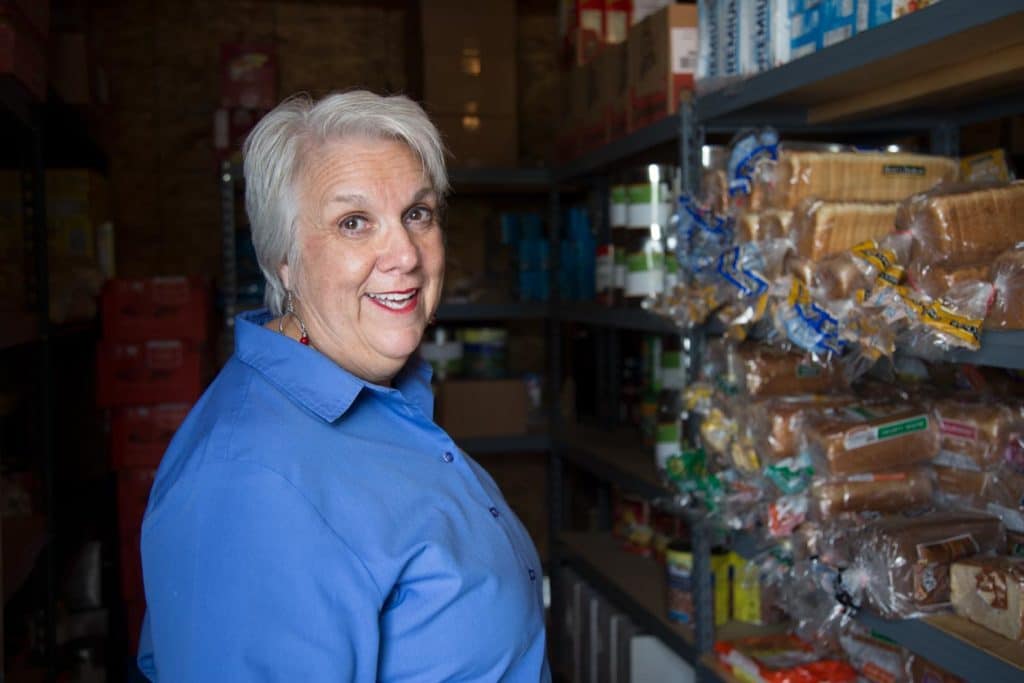
Janet Wilkerson, CAAIR’s founder and CEO, shows off the pantry that feeds the participants in her recovery program.Credit: Shoshana Walter/Reveal
Janet Wilkerson had a problem. As vice president of human resources for Peterson Farms Inc., she was having trouble filling the overnight shift at her chicken processing plants. The hours were long. The pay was low. And there never seemed to be enough workers.
Then a convicted meth dealer named Raymond Jones walked into her office in 2003 with a story and a proposal, according to a newspaper story at the time. After finding Jesus, Jones had overcome his addictions and decided to start a rehab. He asked Wilkerson to take a chance and hire his men. They were cheap, he promised, and they could work all hours. Their wages would fund his recovery program.
Wilkerson eagerly agreed. She called the arrangement a “win, win, win” for the men, chicken plants and Jones.
She was so taken with the idea that four years later, she created a nearly identical program of her own.
Her brother had died from alcoholism, and her husband’s drinking had nearly destroyed their marriage. She had long wanted to help others like them. The economics also made sense. The chicken plants needed workers, and Jones’ program was bringing in revenue of more than $2 million a year.
Wilkerson had the connections to make it happen. In addition to working in human resources at Peterson Farms, she also moonlighted as a spokeswoman for Simmons Foods and other top poultry companies. Wilkerson enlisted her assistant and another poultry executive and brought Jones along as a $250,000-a-year consultant.
Then she pitched the idea to her bosses. The companies wouldn’t have to pay workers’ compensation insurance, payroll taxes or medical care. They could replace the workers for any reason at any time. Like a temp agency, her program would pay for everything; the men just needed to work.
Simmons signed on. Later, Crystal Lake Farms and Tyson Foods Inc. did, too.
Jones agreed to introduce Wilkerson and her business partners to court officials. But his reputation was deteriorating. Plant supervisors said Jones’ workers sometimes would show up high. Workers complained that Jones wasn’t feeding them.
Wilkerson vowed to make her program better. She and her partners hired away one of Jones’ top managers and used men from his program to build their first dormitory. They worked for free, as community service. Then she stopped paying Jones and they parted ways.
By 2010, hundreds of men poured into CAAIR from courts across Oklahoma. So did the money, allowing the Wilkersons – Janet as CEO and her husband, Don, as vice president of operations – to draw combined salaries of $168,000 a year, nearly four times the median household income in their area.
That’s when Brad McGahey arrived.
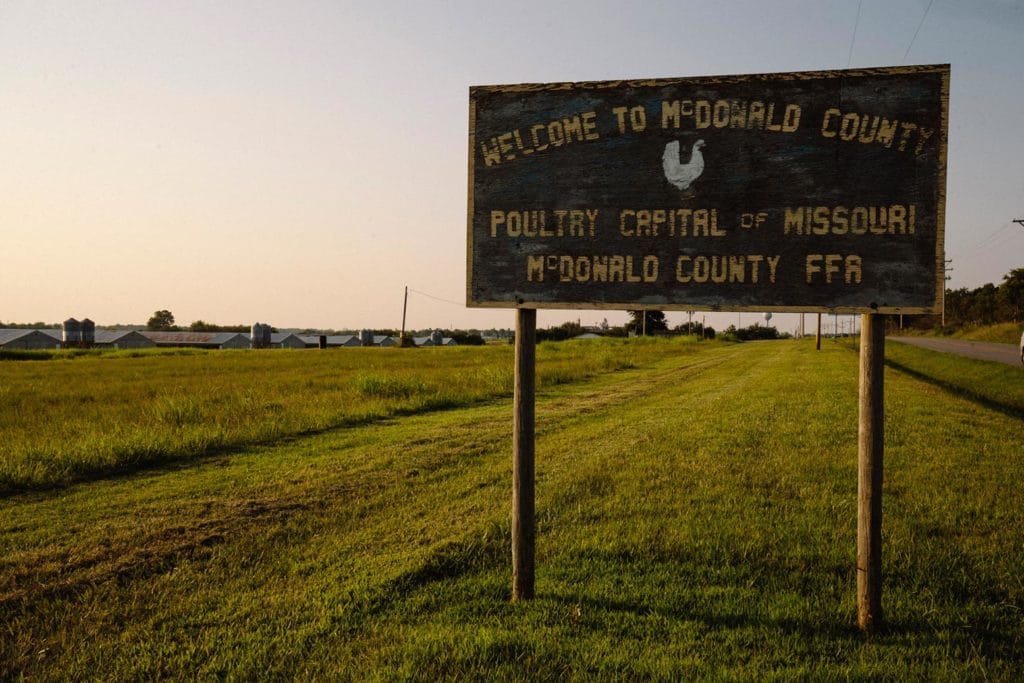
A county welcome sign stands near the Simmons Foods chicken processing plant in Southwest City, Mo.Credit: Shane Bevel for Reveal
At Simmons Foods, McGahey first went to work in evisceration, suctioning guts and blood out of slaughtered chickens speeding past him on metal hooks. Then he became a grader, arranging raw breasts, thighs and legs into orderly piles as they moved up a conveyor belt to packaging. It was monotonous work.
Growing up in the country, McGahey wasn’t bothered by the sight of dead animals. He’d gutted catfish and skinned deer all his life. But the first time he stepped into the Simmons plant, the stench of chicken blood and feces was overpowering.
“I almost threw up,” he remembered.
On May 27, 2010, three months into his time at CAAIR, something went wrong.
A machine dumped a mountain of parts onto the conveyor belt, causing chicken to pile up faster than he and his co-worker could sort it. As they plunged their hands into the heap of cold parts, McGahey remembers hearing a scream. His co-worker’s rubber glove was caught in the conveyor belt.
McGahey grabbed the woman’s arm, wresting her hand free. But the machine snagged his own hand. In a matter of seconds, McGahey’s wrist was jerked backward, lodged in the seams of the conveyor belt as it hurtled toward a narrow stainless steel chute overhead. Someone yanked the emergency kill cord, which should have stopped the machine, McGahey recalled. But it raced upward, dragging him along with it.
He felt a flash of panic. Then an excruciating crunch.
Medical notes later would say McGahey suffered a “severe crush injury.” The machine smashed his hand, breaking several bones and nearly severing a tendon in his wrist. When he finally yanked his wrist free, his hand was bent completely backward. The pain was so bad that he nearly fainted.
A nurse at the plant took one look at him and called CAAIR.
“The kid’s hand is mangled!” he recalled the nurse screaming into the phone. “He needs help!”
McGahey expected an ambulance. Instead, one of CAAIR’s top managers picked him up at the plant and drove him to the local hospital. Doctors took X-rays of McGahey’s hand, gave him a splint and ordered him not to work.
Back at CAAIR, he spent a sleepless night cradling his throbbing hand. He figured it would take months to heal and planned to rest. But CAAIR’s administrators would have none of it.
They called McGahey lazy and accused him of hurting himself on purpose to avoid working, former employees said. CAAIR told him that he had to go back to work – either at Simmons or around the campus until his hand healed, which wouldn’t count toward his one-year sentence.
Wilkerson said she doesn’t remember the specifics of McGahey’s case but acknowledged that CAAIR has given such ultimatums before.
“You can either work or you can go to prison,” McGahey remembered administrators telling him. “It’s up to you.”
He already had made up his mind.
“I’ll take prison over this place,” he said. “Anywhere is better than here.”
Most men sent to CAAIR are addicted to alcohol, meth, heroin or pain pills. They are usually young, white and can’t afford stays in private rehab programs.
Inside CAAIR’s dormitories, Bible verses and Simmons Foods posters line the walls. Participants usually sleep six to a room, crammed onto wooden bunk beds. They attend church services in a common room down the hall, decorated with quilts and wooden crosses.
During the one-year program, the men can’t have cellphones or money. If they relapse or break the rules, they can be kicked out or punished with extra time. In 2014, CAAIR reported that about 1 in 4 men completed the program.
Former employees said work takes priority over everything. If counseling or classes interfered with the job, the decision was clear. “It’s work,” said Aaron Snyder, who participated in the program and later worked as a dorm manager. “You’re going to work.”
The men also perform free labor for CAAIR’s founders, family and friends. A group of men said they helped remodel the Wilkersons’ master bedroom. Another said he helped one of their daughters pack boxes and move. Still others worked on an egg farm owned by the Wilkersons’ other daughter. The program told the courts that it was community service, according to employees.
The strict regimen has helped some men get clean. Those who arrive without a home, steady employment or food said they find their basic needs met at CAAIR. Those who complete the program without breaking any rules are eligible for a gift of $1,000 when they graduate.
“I have to say CAAIR was the hardest thing to do in my life,” said Bradley Schott, who graduated in 2014. “I went to basic training at 16. And (Army) Ranger school. And it wasn’t as hard as CAAIR, mentally or physically. But it saved my life.”
Jim Lovell, CAAIR’s vice president of program management, said there’s dignity in work.
“If working 40 hours a week is a slave camp, then all of America is a slave camp,” he said.
Men who were injured while at CAAIR rarely receive long-term help for their injuries. That’s because the program requires all men to sign a form stating that they are clients, not employees, and therefore have no right to workers’ comp. Reveal found that when men got hurt, CAAIR filed workers’ comp claims and kept the payouts. Injured men and their families never saw a dime.
Following Brandon Spurgin’s chicken plant injury, CAAIR filed for workers’ compensation on his behalf. CAAIR got $4,500 in insurance payments and Spurgin says he got nothing. Credit: Shane Bevel for Reveal
Brandon Spurgin was working in the chicken plants one night in 2014 when a metal door crashed down on his head, damaging his spine and leaving him with chronic pain, according to medical records. CAAIR filed for workers’ compensation on his behalf and took the $4,500 in insurance payments. Spurgin said he got nothing.
Janet Wilkerson acknowledged that’s standard practice.
“That’s fraudulent behavior,” said Eddie Walker, a former judge with the Arkansas Workers’ Compensation Commission. He said workers’ comp payments are required to go to the injured worker. “What’s being done is clearly inappropriate.”
Three years later, Spurgin’s still in pain and can no longer hold a full-time job.
In addition to injuries, some men at CAAIR experience serious drug withdrawal, seizures and mental health crises, according to former employees. But the program doesn’t employ trained medical staff and prohibits psychiatric medicine.
A judge in Tulsa sent Donald Basford to CAAIR in 2014 despite a documented history of severe mental health problems. The 36-year-old quickly unraveled, repeatedly complaining to staffers that he was “losing it” without his medication, Snyder, the former employee, recalled.
Basford ran away and was found dead inside a car in a church parking lot a few weeks later, according to an autopsy report. Medical examiners found no drugs in his badly decomposed body and weren’t able to determine Basford’s cause of death.
Other CAAIR men who had mental breakdowns or manic episodes were kicked out, according to former employees, opening the door for them to be sent to prison.
“You just don’t do that to people who obviously need some kind of help,” Snyder said. “It’s not right.”
CAAIR has a sprawling, grassy compound in northeastern Oklahoma. The one-year diversion program mainly relies on faith and work to treat addiction.Credit: Shane Bevel for Reveal
When the Oklahoma Legislature created the state’s drug court requirements 20 years ago, it was part of a growing realization nationwide of the costs – both financial and human – of handing down long prison sentences for drug-related charges.
In drug court, judges are required to put defendants through treatment rather than prison. Follow the rules, and defendants can have their cases dismissed.
Lawmakers wanted to ensure the quality of treatment, so they wrote an important provision into state law: Drug courts must use treatment providers inspected and certified by the state Department of Mental Health and Substance Abuse Services.
But affordable treatment is in short supply. Drug court defendants have waited up to nine months for a bed in a residential treatment facility, meanwhile relapsing or languishing in jail. As a result, some courts turn to uncertified programs such as CAAIR, even though it might violate the law, according to the law’s authors.
“That is insanity gone to sea,” former state Sen. Dick Wilkerson said when told of Reveal’s findings. (He is not related to CAAIR’s founder.) “That’s illegal. They can’t do that. That is the law, and it has to be followed.”
In Pontotoc County, Judge Thomas Landrith sometimes uses CAAIR in place of certified treatment. He said there’s never a wait list, and it costs the courts and state nothing.
“We tried to get residential treatment programs down here, but we never could really pull it off,” he said. “So recovery programs kind of fit that niche.”
Other judges said they were unaware of the law or have found ways around it.
Tulsa’s drug court, which sends the most defendants to CAAIR, said the law permits judges to use uncertified programs, as long as it’s not for treatment.
“The referral is to assist the participants in developing good job skills, life skills, work ethics and personal care skills,” said Vicki Cox, court administrator. “Participants are not sent to CAAIR for drug or alcohol treatment.”
But Reveal found that Tulsa’s drug court staff repeatedly described CAAIR as treatment in court records. Cox dismissed that as a record-keeping error.
Oklahoma’s Department of Mental Health and Substance Abuse Services funds and monitors drug courts. The agency knows that judges are using uncertified providers such as CAAIR, but officials say there’s little they can do. All they can do is cut some of the funding to drug courts that use those programs. But that’s little disincentive to judges.
No drug court judge has ever been disciplined for using uncertified programs, according to the Oklahoma Council on Judicial Complaints.
After Brad McGahey injured his hand and left CAAIR, a judge sentenced him to a year in state prison. He was released after two months due to overcrowding. Credit: Oklahoma Department of Corrections
Brad McGahey went straight from CAAIR to a Marshall County jail cell. Because he failed to complete the program, he had violated the rules of his probation. The judge sentenced him to a year in state prison.
McGahey was released after two months due to prison overcrowding.
His injury had not improved. One minute, his hand throbbed with pain. The next, it tingled and went numb. Sometimes it turned blue.
He found a lawyer and went to court for workers’ compensation. The process was slow, and CAAIR fought him every step of the way. In court in 2012, the program’s attorneys argued that McGahey’s recurring symptoms weren’t the result of the accident in the chicken plant.
“If you want to get a lie detector test up here, I’ll pay for it,” McGahey blurted in the middle of his testimony. “I know what happened. … I ain’t no liar, and you’re calling me one.”
The judge sided with McGahey. “Sounds like you’ve succeeded successfully in delaying the treatment for this person, counselor,” the judge told CAAIR’s attorney.
Three years after the accident, McGahey finally got his surgery. But it didn’t help.
“I believe that we got to Bradley so late in his treatment … that Bradley is going to have a permanent problem with his hand,” the doctor wrote in a status update to the court in September 2013.
McGahey grew depressed. He sold his four-wheeler to pay off his $500-per-month child support debt. He tried welding for two weeks, but his hand injury got in the way. He sought out other opportunities, such as trading and selling used cars, junk and metal. But something always went wrong, and he got into more trouble with the law.
When CAAIR’s attorney offered a settlement, McGahey took it. In 2014, he got a lump sum of $11,000.
But today, the pain persists. All that seems to help, McGahey says, are pain pills.
Every morning and throughout the day, McGahey chugs a can of Dr Pepper with hydrocodone pills. When his doctor cut him off from his various medications, McGahey found another doctor to write a prescription.
Before CAAIR, McGahey had no interest in drugs. Now, he says he can’t live without them
“I’m addicted to them pills,” McGahey said. “I have to take them.”
Brad McGahey had surgery on his left hand in 2013, but today, the pain persists. All that seems to help, he says, are pain pills.Credit: Olivia Merrion/Reveal
As McGahey sat on a plastic chair in front of his mother’s house, littered with items scavenged from garage sales, he remembered when he still had the use of two hands, when he was good at rodeo and could work on his family’s farm.
“When you can’t do something you love and it’s the only thing you ever known, then it’s taking part of your life away from you,” he said. “I’ve accepted it now and learned how to do with what I got. I just don’t want to see it ruin somebody else’s life.”
Courts still send defendants to CAAIR, and the program is expanding. Simmons Foods even donated funds for a third dormitory to house dozens more men.
“I was walking in the parking lot of the Simmons plant, and (Chairman) Mark Simmons told me he needed more men,” Wilkerson told a local reporter at the ribbon-cutting ceremony in 2015. “I told him to build me another dorm.”
CAAIR is now planning a fourth dormitory. It’s supposed to be the biggest yet.
This story was originally published by Reveal from The Center for Investigative Reporting, a nonprofit news organization based in the San Francisco Bay Area. Learn more at revealnews.org and subscribe to the Reveal podcast, produced with PRX, at revealnews.org/podcast.
The demand for legal marijuana products is still on the rise in America, according to a closely watched index report released earlier this week. The increased demand in July, the latest month in which data is available, jumped 1.6 percent — marking the third consecutive month for industry growth.
The market data is tracked by the AndCan Index, which monitors demand across the nation. AndCan Index data shows that since the start of 2015, the demand for legal cannabis products in the U.S. has grown by 16.3%. Since last November’s election, when four states voted to legalize recreational use of marijuana, overall U.S. demand has increased by 6.8%.
“This is only the fourth time since the start of 2015 where we’ve seen at least three consecutive months of growth in demand for cannabis products in the U.S.,” said AEG consultant Peter J. Schwartz, who oversees the AndCan Index as well as the firm’s report on The Market for Legal Cannabis Products in the 50 United States.
“By examining every state’s data in the fashion that we have, hot spots emerge — we can determine where, exactly, demand outpaces indicators for demographics, spending, and the like,” said Schwartz. “We can pinpoint the markets most poised for growth.”
The AndCan Index was launched in June 2017. It builds from more than two years of coverage of the U.S. cannabis market by Anderson Economic Group. The AndCan Index originates from tens of thousands of data points, including recreational and medical sales in states where cannabis products sales are legal.
The index, of course, does not track black market data. But the demand in the illicit market may be showing signs of slowing down as more states jump aboard the legalization train.
According to a recent report from Arcview Market Research, a marijuana market research firm, all marijuana sales generated $53.3 billion in 2016, including the United States and Canada. But only 13 percent of that $53.3 billion — or $6.7 billion — was spent in the legal market. Another $46.4 billion — or 87 percent — stayed in the black market.
The Arcview report found that the illicit market did shrink slightly in the past year. In 2015, the black market was responsible for 90 percent of sales, so the year-over-year drop was 3 percentage points.