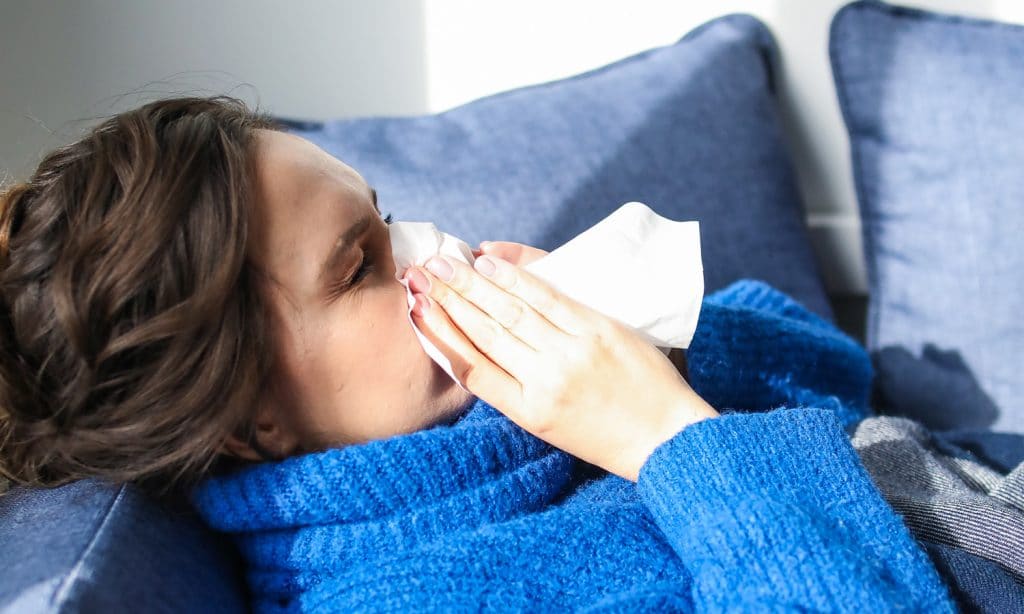
The winter is often associated with more colds and flu infections. Here’s how the weather affects viruses and our immune systems.
We all know that it’s easier to catch a cold or the flu when it’s cold out, but beyond that, we don’t know why. While COVID-19 hasn’t been around for long and hasn’t provided sufficient evidence for scientists to understand it fully, other colds and flus have been around for decades, providing researchers with ample data to examine and understand them.
According to CNN Health, there are several reasons why people are more sensitive to these type of viruses during the winter, with explanations ranging from the amount of sunlight they’re exposed to, to the amount of time they spend indoors and without much physical activity.
Scientists explain that viruses like the rhinovirus, responsible for the common cold, replicate faster and stay infectious for longer when there’s cold weather. This temperature alters the make up of the virus, making their membranes more solid and rubbery. This consistency makes it easier for the virus to transmit from person to person.
Photo by Tim Gouw via Unsplash
While wearing an appropriate coat might not impact whether you catch a cold or not, inhaling cold air may impact your health adversely, especially when your immune system is compromised. This air can impact your respiratory tract, making it easier for viruses to latch on.
Another influencing factor for colds and the winter is vitamin D, which we obtain from the sun. Due to the weather and the fact that people spend more time indoors, people are less exposed to this vitamin, which usually keeps your immune system in good shape. This, accompanied by less activity and more time spent indoors with others leaves your body more compromised for colds and flus.
As we’ve learned from this pandemic, putting yourself in situations where you’re in close contact with others is the most straight forward way of catching a disease. Measures like washing your hands often and wearing face masks are helpful for all diseases, while caring for your immune system by moving around and eating healthy will build up your immune system and protect you from the common cold.
There’s much we don’t know about COVID-19, but when it comes to viruses responsible for producing flus and colds, keeping a strong immune system is an effective protective measure you can adopt.
This year you can expect tech developments of the inconspicuous kind, meant to make working from home and online retail easier.
Unlike previous years, where tech was dominated by voice enabled technology and screens with resolutions that broke all sorts of records, experts predict that the coming technology will be discreet, almost easy to miss. The pandemic has a hand in this.
Now that a lot of us are working from home and have found remote approaches to most things in life, 2021 is expected to be a boon for this kind of tech, one that’s meant to facilitate remote communication, work, shopping and more. While these aren’t the technological developments you dreamed of when you were a kid (where is that flying car?) they are the ones we get and the ones that’ll have staying power over the long run.
Here are 5 tech developments we’ll see more of in 2021:
Smarter Wi-Fi
Photo by JESHOOTS.com via Pexels
Perhaps the biggest modern day problem we all encountered this year was faulty WiFi, especially when several people in the same household were using it. The New York Times reports that there will be a new wave of routers in 2021, ones that feature WiFi 6 and set a new network standard. “Let’s say your family owns smartphones, several computers and a game console. If all of them are being used to consume heavy amounts of data — to stream video, for example — Wi-Fi 6 does a better job at providing bandwidth to all the devices at the same time as opposed to letting one device hog most of it.”
While we’re all used to typing words into the search bar, online shopping can use a tech upgrade, especially now that visiting a store exposes people to some risks. Experts believe that augmented reality (AR) may play a part in the future of online retail, allowing you to virtually try on items and having an experience that’s closer to what you’d get when shopping in person. You can also expect to see more chat bot features in these sites, allowing you to make questions and get personalized answers.
Tech that results in less touching
Photo by Kerde Severin via Pexels
Safety reasons have resulted in less cash and credit card use, with some questioning if the use of cash is even necessary anymore. Hands-free technology is expected to be refined, with more stores and services accepting mobile wallets. This could be a great moment for technologies like Ultra Wide Band, which act as a radio signal between two devices, facilitating payments without touch, turning on cars without keys and opening doors without touching them.
Passwords have been progressively evolving, with phones and laptops accepting finger print and face recognition. Still, there’s always the dreaded typed in password, something that’s getting easier to break, with sites encouraging logins and exclusive passwords from people who must have dozens of logins and passwords in order to shop or do their work normally. You can expect more refined approaches this year when it comes to passwords, whether that’s phones and laptops recommending and keeping passwords for you, or a more widespread use of biometrics.
More vaccines
Photo by RF._.studio from Pexels
Finally, this year you can expect new vaccines, which might surprisingly be the most exciting entry on this list. The quick development and deployment of COVID-19 vaccines suggest that more are coming and that illnesses can be isolated and understood better within shorter stretch of time.
Numerous researchers and physicians have labeled cannabis a superfood, worthy of incorporation into your diet in some way or another. Here’s why.
Did you know that we’re supposed to get 5-9 servings of fruit and vegetables every day? This equates to roughly two cups of fruit and 2.5 cups of vegetables. Although this is the recommended amount of fruit and veggies we should eat according to the USDA (United States Dietary Association), most of the American population doesn’t come close to meeting these guidelines.
Fortunately, though, another plant consumed for centuries due to its plethora of medicinal, therapeutic, and nutritional benefits is cannabis. Recently, numerous researchers and physicians have labeled cannabis a superfood, worthy of incorporation into your diet in some way or another. Here’s why.
Medicinal, Therapeutic, and Nutritional Value of Cannabis
Cannabis’s many medicinal and therapeutic benefits have been well established, but the nutritional benefits of cannabis are still gaining recognition and public coverage. According to the British Dietetic Association (BDA), superfoods are unprocessed foods rich in vitamins, minerals, and nutrients, which are often derived from fruits, vegetables, and other herbs. Under this definition, numerous doctors believe cannabis can be grouped into the ‘superfoods’ category.
Besides cannabis’s array of medicinal and therapeutic benefits, the plant is an excellent source of vitamins and nutrients. In general, there are various parts of cannabis that can be consumed such as its leaves, stems, and buds whether they’re heated up or not. To reap cannabis’s nutritional benefits though, consuming raw parts of the plant is the way to go.
Photo by Francesco Carta fotografo/Getty Images
Three Reasons Why Cannabis is a Powerful Superfood
Cannabis sativa (hemp) seeds:
Cannabis sativa (hemp) seeds contain a multitude of nutritional benefits that can help improve one’s diet to some degree. Hemp is a variety of the Cannabis sativa plant species, often grown to produce industrial and commercial products including food, animal feed, and other useful materials like rope, textiles, and paper. Generally, hemp seeds are consumed for their high nutrient and protein content, especially by vegans and vegetarians.
Additionally, hemp seeds are often consumed for their fatty acids content in the form of Omega-3s and Omega-6s. Overall, humans need to consume a regular amount of fatty acids, especially because of the benefits they have on our heart and brain. Research has found that when one consumes Omega fatty acids, inflammation can be reduced, ADHD and arthritic pain can be managed better, and high cholesterol can be combatted. The presence of Omega fatty acids in hemp seeds is worth noting because they also help in the area of protein production.
Hemp seeds serves as a much healthier alternative for those who don’t consume fish but need to get their serving of fatty acids. They’re also an excellent source of Vitamin E, zinc, magnesium, iron, liver enzymes, antioxidants, protein, and tocopherols. Not only is hemp extremely versatile, some of its other nutritional benefits include the following: vegan, dairy-free, gluten-free, high plant-based protein content, high Omega fatty acids content, and simple to digest.
Photo by sweetlouise via Pixabay
Cannabis-Derived CBD:
Cannabis contains over 400 chemical entities, and more than sixty of them are cannabinoid compounds. One of the most medically and therapeutically beneficial cannabinoids is Cannabidiol (CBD), which has also been one of the most studied compounds so far. It turns out that CBD can help in more ways than one could imagine. For example, CBD can be derived from the whole cannabis plant and hemp, but this cannabinoid is especially unique because it’s non-psychoactive, non-addictive, non-toxic, and safe thus making it an ideal addition to food and drinks.
In addition, it was discovered that CBD has stronger antioxidant properties than Vitamin C and E combined. When we get sick, there are different foods, supplements, and medicines we can take to help us feel better. Whether you’re fighting off a cold or infection, CBD can deliver antioxidant, antibiotic, and anti-bacterial properties making it both a beneficial medicine and superfood.
Since cannabis continues to be examined and studied, CBD’s nutritional benefits are still being discovered. Even though cannabis isn’t a vegetable per say, it contains numerous vitamins, nutrients, and minerals like vegetables do, and CBD has a rich vitamin and neuroprotective antioxidant content.
Raw Cannabis’s Nutritional Benefits:
Lastly, although various cannabinoids deliver medicinal and therapeutic benefits when they’re heated up or decarboxylated, the true nutritional benefits come from the consumption of raw, non-psychoactive cannabinoids. Below are some of raw cannabinoids’ benefits:
Improve the productivity and efficiency of the cells within our body
Activates the brain’s endocannabinoid system thus activating an antioxidant release
Raw cannabinoids’ antioxidants act as a ‘cleaner’ by removing damaged cells out of the body
When orally ingested, therapeutic benefits are achieved more effectively
Can be incorporated into diet in numerous ways
For instance, you can grind up raw cannabis leaves, buds, or stems to use as seasonings or toppings for salads, soups, stews, oatmeal, porridge, etc. Also, juicing raw cannabis leaves is nutritionally beneficial, according to Dr. William Courtney. He recommends using 20-30 big shade leaves or two or three raw buds daily to reap numerous nutritional and therapeutic benefits. You can also grind up raw cannabis parts and add it into smoothies, shakes, and sauces.
The Unique Role of the Endocannabinoid System (ECS)
Moreover, all humans and mammals have an endocannabinoid system (ECS), which is one of the most integral physiological systems involved in the establishment and maintenance of one’s health. This system plays a vital role in the functioning of the brain, endocrine, and immune tissues. The ECS also plays a significant part in the secretion of hormones associated with reproductive functions and stress responses.
In addition, the ECS regulates homeostasis and influences the function of the food consumption centers of the body’s central nervous system (CNS) and gastrointestinal tract activity. Throughout our bodies are endocannabinoids and their receptors (CB1 and CB2), which are within the brain, connective tissues, glands, immune cells, and various organs. Within each tissue, the ECS plays a role in maintaining homeostasis, which is the maintenance of a stable internal environment regardless of different instabilities in the external environment.
Overall, not only is cannabis medically and therapeutically beneficial, this plant and byproducts of it can be nutritionally beneficial if raw forms of it are consumed. Whether you want a vitamin, nutrient, or mineral boost or an improvement in your well-being, try consuming raw cannabinoids and/or hemp seeds and see how much it improves your health and lifestyle.
A small amount of CBD or other cannabinoid formulation is probably not going to result in a significant change in computer or phone skills, especially if these skills are memorized.
There have been a considerable amount of studies done on different cannabinoid formulations, not just on CBD. The studies focused on all kinds of areas that could impact you at work, including memory, computer or telephone skills, even driving skills.
We don’t know exactly which cannabinoid causes any type of concerning problems surrounding any of these issues. The products that were tested in these settings were formulations. They were combinations of multiple different cannabinoids. It is possible that CBD could have an effect in any one of the places where all of these different cannabinoids impacted people. It’s worth keeping in mind and exercising a significant amount of caution so that you do things properly and safely at your workplace; you want to maintain an excellent work environment for yourself.
We used to think that people who used cannabinoid formulations regularly had ongoing difficulties with their memory and IQ. But in fact, further studies have shown that there’s really no significant changes in IQ.
Studies on CBD and Work
It was initially a British study that suggested a drop in IQ of seven points when people used cannabinoids regularly. But then a subsequent New Zealand study said that there was actually no significant change in IQ. There was a US study finally done that was very well done. It had almost twice the number of people studied than either the New Zealand or the British study. The US study also had a number of identical twins. One of whom was using cannabinoid formulations and one of whom who was not. In the identical twin pairs, there was no change in IQ.
The U.S. study involving several thousand people is our best research today to say that there is no impact on IQ with the use of cannabinoid formulations. However, significant heavy use of cannabinoid formulations can lead to changes in memory. Again, we don’t know which cannabinoid is implicated in this. It is possible that some people could see changes in their short term memory capacity with high dose usage or high serving sizes of CBD.
Photo by Retha Ferguson via Pexels
The advice previously was to wait for at least three months and memory function would return. Subsequent studies said that short term memory deficits would resolve after just three weeks.
The most recent data and the best data is suggesting that memory function will return in just one week after discontinuation of a cannabinoid formulation.
If you are noticing any changes in your memory, discontinuing should have resolved your problem in just one week.
Computer and Phone Skills
There’s also some concerns around computer skills and telephone skills. Even though a CBD is not psychoactive, it doesn’t get you high, doesn’t mean it can’t result in a considerable amount of calm. Both of these have been studied with cannabinoid formulations. It’s been very hard to determine if there’s any difference or any measurable difference that can be seen with computer and phone skills. There appears to be subtle changes. A lot of those changes are dependent on how long a person has been at their job. Also, how well memorized they have their job.
A lot of the tasks in a job are somewhat repetitive. After we’ve done them for a while, we can do them even if we’re not 100%.
A small amount of CBD or other cannabinoid formulation is probably not going to result in a significant change in computer or phone skills, especially if these skills are overlearned and memorized.
Photo by Ekaterina Bolovtsova via Pexels
There may be issues if you’re trying to perform a new task in the setting of having administered a cannabinoid formulation. There could be issues that you might be able to pick up in your own personal effectiveness or your own personal rapidness of getting your work done. These are not yet measurable by any testing measure applied so far.
Computer and phone skills, in conclusion, may be impacted by using CBD, but they don’t appear to be impacted in a way that can be measured by any particular test that we have available.At this point, they don’t appear to be negatively impacted to the point that we could argue that there’s a problem.
Driving Skills
There could be potential issues with driving. The driving data is all over the place. We don’t know if it’s the CBD that results in relaxation and changes to your driving skills or if it’s another portion of a cannabinoid formulation. However, it does appear that people who use cannabinoid formulations may have a little more lane weave. However, some of the best research we have looks at patients who have been taking cannabinoid formulations for years for management of chronic pain syndromes like multiple sclerosis. One company has 55,000 patient-years backing up their product that shows no increased risks of issues with motor vehicle violations, not even an increased risk of parking tickets.
So even though there may be a slight amount of lane weave, it’s really hard to say if cannabinoids are actually contributing to any risk with driving. However, that’s probably what’s come behind testing for some companies that are very rigorously testing people who are involved in transportation authority or who are driving heavy machinery. This is where your selection of CBD becomes so important.
Drug Testing
If your workplace testing for other cannabinoids that could be contained within CBD, a full spectrum or broad-spectrum product may cause a problem. If you’re getting drug tested, you’ll want to have a conversation with your human resources department about CBD and if CBD is something that you could safely consider. In many cases, it is, and you can give it a try despite undergoing drug testing with the assurance from your human resources department that that pure isolate is not something that they’re testing.
A CBD isolate is just exclusively CBD and doesn’t contain any other cannabinoids that may be picked up in a drug test.
I hope that you find great satisfaction in working with less anxiety and hopefully, also with some better sleep in the evenings. Thanks for adding CBD to your current supplement plan.
TikTok is known for its history lessons and helpful advice. Here are some great life hacks we’ll be using in 2021.
It’s an understatement to say that TikTok is a popular app. Known for its dance challenges and its young audience, the app is also a place for life hacks and advice. More so than any other social media platform, TikTok is a place where people post informational videos in brief and digestible chunks. While the veracity of the information may be up for debate, these clips have amassed tons of views. They’re also pretty fun.
From productivity boosts to ingenious ways of eating Nutella and transforming a large pizza box into a small one, there’s something on TikTok for everyone. Here are some of our favorites:
If you’re someone who loves podcasts or audiobooks, this hack can transform any article or book in your computer into an audio. By downloading the Chrome extension Podcast AI, the extension will do all the work for you and provide you with an audible version of the article you want to read.
Not all hacks are meant to improve your productivity. Some just help you eat chicken wings without getting your hands completely covered up in grease and sauce.
If you feel like doing some arts and crafts and also want to save your remaining pieces of pizza, you can try this hack. Is it easier to put the slices in Tupperware? Maybe. Is it fun to play with your pizza box? Absolutely.
Your inbox is a place that’s easy to lose control of, especially if you’ve had the same account for a while. The website unroll.me can assist by scanning your inbox and unsubscribing you from newsletters and emails you never take the time to read through. There’s no need to read through each email and finding the unsubscribe link at the bottom of each.
Despite her best efforts, this vital piece of wedding day information was leaked to the press before Kate and William’s Big Day.
It’s something many celebrities try to keep under wraps ahead of their wedding. In an age where nothing is secret, let alone the private lives of famous people, brides-to-be can only hope that details of their special day remain a surprise for their friends and family. But asking the media to respect privacy surrounding a momentous event is pretty unrealistic.
Kate Middleton found out the hard way when, before her nuptials to Prince William in April 2011, one of the major details of her wedding was leaked to the press. As it often does with celebs, speculation hit fever pitch about who would be designing the future Queen’s dress. And while the palace did manage to keep it a secret for a time, it was leaked to TheSunday Times a month before the ceremony that Sarah Burton, creative director of Alexander McQueen, was the lucky designer. Insiders say Kate was devastated by the reveal.
“The fashion secret of the year is out. When Catherine Middleton marries Prince William in Westminster Abbey she will be wearing a dress designed by Sarah Burton, creative director of Alexander McQueen, one of Britain’s edgiest labels,” the Sunday Times scoop read.
Both the label and the palace, attempting to maintain a veil of some sort of secrecy, denied the news. Clarence House responded by telling The Guardian, “We’re not commenting on the specific designer for the dress because Catherine Middleton wishes to keep the designer a secret until the wedding day.”
Photo by Sean Gallup/Staff/Getty Images
According to the Mirror, royal expert Katie Nicholl said Kate was heartbroken over the leak. in the documentary Secrets of the Royal Dressmakers, Nicholl shared that “Behind the scenes I think that caused tears at the Palace because Kate had done everything she could to keep the wedding dress a secret.”
Designer Burton denied any involvement up until the moment Kate stepped out of the car in front of the church. And as the Mirror noted, the leak didn’t seem to bother Kate on the big day. “She was the most beautiful bride and she couldn’t have looked happier to marry her prince.”
Results should be delivered between 24 to 72 hours once the sample is received by the lab.
COVID-19 tests are on high demand, with thousands of Americans waiting in line and signing up for cues in order to get tested. CNN reports that there’s now a COVID-19 test with FDA approval that can be administered at home. Better yet? It can be purchased on Amazon.
The DxTerity Covid-19 Saliva At-Home Collection Kit recently received emergency approval by the FDA, and, according to CNN, appears to be the only COVID-19 self-test for sale on the online retailer. The kit can apparently detect symptomatic and asymptomatic cases, and it can be purchased in singles or in a 10-pack costing $110 and $1,000 respectively.
The kit includes an empty tube for saliva, which people can fill and mail to a Los Angeles based lab with prepaid shipping. Results should be delivered between 24 to 72 hours once the sample is received by the lab.
Photo by Morsa Images/Getty Images
According to the product’s description on Amazon, the kit is easy to use and the test results are delivered in a way that’s easy to understand, featuring a fact sheet for patients and results that can be available online and for downloaded to be kept on the patient’s records.
In many states COVID-19 tests are free, but require people to stay in cues. Still, with rising COVID-19 cases, these facilities are usually overwhelmed and require people to spend long hours in line or to come the following day. At home test kits target can provide a solution for people who’d rather have the convenience of conducting their test at home or who want to avoid wait times.
One of the first lines of marijuana-related business that we can expect from the Democratic-controlled Congress in 2021 is an attempt to make the MORE Act law.
Nothing is stopping federal marijuana legalization now. Democrats have taken control of the U.S. Senate after beating the brakes off of the Republicans in Georgia’s runoff election. The victory ends six years of Republican domination in the upper chamber. But more than that, it puts the Democrats in control of both houses, allowing the party to push its legislative agenda full steam ahead. It’s a unique situation that finally gives marijuana reform a fighting chance at going nationwide.
Democrats have fought tooth and nail for the past few years to pass federal marijuana bills in the U.S. House of Representatives. But all of those efforts, both small and large, always ended up on the chopping block. And Senate Majority Leader Mitch McConnell, the self-proclaimed Grim Reaper of Capitol Hill, was always the man holding the ax.
He alone has ensured that not a single piece of marijuana-related legislation gets discussed in the Senate. But Democrats Jon Ossoff and Raphael Warnock defeating Republican Senators David Perdue and Kelly Loeffler in Georgia’s runoff elections means that he no longer holds the power. Mitch McConnell is finished.
Senate minority leader Chuck Schumer of New York, a man who stands in favor of marijuana reform, is now expected to take over as majority leader. In a recent statement, Schumer said, “It feels like a brand new day. For the first time in six years, Democrats will operate a majority in the United States Senate — and that will be very good for the American people.”
Good, indeed.
One of the first lines of marijuana-related business that we can expect from the Democratic-controlled Congress in 2021 is an attempt to make the MORE Act (Marijuana Opportunity and Expungement Act) law. The bill, which was approved in the House in December, calls for marijuana to be removed from the Controlled Substances Act, allowing a federally taxed and regulated pot market to unfold. It would make marijuana a part of legitimate commerce, just like alcohol and tobacco, allotting a portion of the tax revenue to rebuild communities ravaged by the drug war.
Under new Senate leadership, the MORE Act could easily reach the Senate floor for debate in the coming months. With a favorable vote, which is likely, the bill would then be sent to president-elect Joe Biden for a signature. Whether he would sign or not isn’t immediately known. During his campaign, Biden stopped short of supporting full-blown legalization. Yet, he outlined moves designed to decriminalize marijuana possession at the federal level and further cannabis research.
Photo by Elijah Nouvelage/Getty Images
Still, Some argue that vice-president-elect Kamala Harris, who sponsored the MORE Act in the Senate, might be able to persuade Biden to accept this broad reform. Considering the damage done by the coronavirus, Biden might be apt to go along with it. If for no other reason than he wants to be the president that Americans credit for rebuilding the economy.
Marijuana at the national level would create around one million new jobs and contribute billions in economic impact. It would mean more work for real estate pros, contractors, construction crews, and a slew of other businesses unrelated to weed long before retail reefer sales were ever rolled out. Marijuana creates jobs for everyone, and that would mean prosperity for the millions still out of work due to the pandemic.
Photo by Pool/Pool/Getty Images
The biggest takeaway from the Georgia runoffs is that Mitch McConnell’s reign of terror on the Hill is over. With a marijuana-motivated Democratic Congress in play, we will likely see more progress on pot over the next few years than ever before. There’s simply not much standing in the way of it at this juncture. But that doesn’t mean it’s smooth sailing all across the board.
Even with a more level-headed Congress, we are still talking about national politics. Yet, a betting man with $2 burning a hole in his pocket wouldn’t necessarily be a fool betting on marijuana legalization. The odds are now in favor of common sense and more than 60% of Americans.
What Democratic-domination on Capitol Hill doesn’t do is force states to get onboard with bud. Even if the MORE Act becomes law, it will not require states to legalize marijuana. Diehard areas of prohibition like Indiana and Kentucky might continue to consider weed a crime. But as the country learned shortly after the fall of alcohol prohibition in 1933, states clinging to an old way of thinking will eventually make the change. It just might take some longer than others. Mississippi was the last of the dry states, finally amending the law to allow alcohol sales in 1966.
Although it might still be too early to make predictions, cannabis advocates can rest easy knowing that 2021 will be the most exciting and perhaps the most fulfilling year the legalization movement has ever experienced. Anti-pot thinking has been mostly run out of the nation’s capital.
Helping consumers understand how CBD works on their pets will not only mitigate the risk of adverse effects, it will also mandate supply chain transparency.
Michigan allows veterinarians to discuss CBD treatment with pet owners. On the last day of 2020, Governor Gretchen Whitmer signed into law a piece of legislation (“HB 5085”) that gives veterinarians permission to discuss the potential therapeutic benefits and risks of using marijuana and hemp, especially cannabidiol (“CBD”), with pet owners.
The statutory language is sparse but its legislative analysis explains that HB 5085 aims for veterinarians to become “a trusted source of information, in a marketplace with many competing and confusing claims,” which the report explains “would ultimately benefit both pets’ health and their owners’ peace of mind.”
This new law may come as a surprise to many given the fact that the Food and Drug Administration (“FDA”) has yet to approve the use of CBD in pet products. Indeed, to date, no food additive petitions or ingredients for any substance derived from hemp in animal food have been approved or recognized as Generally Recognized As Safe (“GRAS”). Moreover, the FDA takes strong issue with promoting the therapeutic value of CBD products, as demonstrated in its issuance of warning letters to manufacturers of CBD pet products that dared making medical claims about their products.
Yet, if you review the FDA’s cannabis FAQ, you’ll notice that while the federal agency cautions pet owners against the use of these products, it also recommends that they talk to their veterinarian about “appropriate treatment options” for their pets. This is because the First Amendment prevents the federal government, as well as states, from telling doctors and other health professional what they can and cannot say.
In this regard, the new Michigan law is merely symbolic in that veterinarians already had the ability to discuss the risks and benefits of giving pets CBD products. What the new law doesn’t do, however, is authorize veterinarian to sell CBD pet products, such as pet treats, which is strictly prohibited in Michigan.
Unsplash/jonathan daniels, CC BY-SA
Like the FDA, the Michigan Department of Agriculture & Rural Development (“MDARD”)’s Pesticide and Plant Pest Management Division, Animal Feed Safety and Agriculture Products Section — that’s a mouthful — deems the addition of CBD into commercial feed products, such as pet treats, unlawful and expressly bans the sale of these products as dietary supplements. However, the state agency opines that “a person can choose to supplement their own pet’s food with hemp or hemp-derived products like CBD oil”, which MDARD claims may be sold in the state, provided the product meets certain labeling and marketing requirements.
According to a 2020 Pet Industry Green Paper, jointly published by Nielsen Holdings plc and Headset, nearly three-fourths of current U.S. consumers have pets, and almost one-fourth of these pet owners use CBD for themselves, their pets, or both. Yet, few understand its effect on their furry friends.
Therefore, in light of the significant CBD information gap that currently exists in the U.S., the passage of a bill like HB 5085, even if merely symbolic, is a step in the right direction. Helping consumers understand how CBD works on their pets will not only mitigate the risk of adverse effects, it will also mandate supply chain transparency, which will result in trust and guarantee quality, and thus, will help legitimize the CBD industry.
A new study shows that it doesn’t take much to live longer and increase health.
Multiple studies have been conducted on the dangers of sedentarism, and how this is related to health risks and death. This year, with the pandemic and the closure of many offices and public spaces, health experts are concerned about this reduced activity, and how this might impact the long term health of people of all ages. But do this for 11 minutes daily and live longer. A new study published in the British Journal of Sports Medicine shows some hopeful results.
The study was conducted by the Norwegian School of Sports Medicine, and relied on the data gathered by activity monitors, which accurately measured the amount of time people spent moving or sitting down.
Researchers analyzed more than 50,000 subjects mostly comprised of middle-aged people that lived in Europe or the United States. This method, unlike previous studies that rely on self-reported evidence, was more objective and hopeful in the picture it painted.
Photo by Islam Hassan via Unsplash
Results revealed differences depending on the amount of activity that people engaged in, but it still painted a good picture for anyone who tries their best to move a bit. While participants who exercised over 35 minutes a day reaped the best benefits and had increased lifespans, people who complied with just 11 minutes of movement a day, even if it consisted of a brisk walk, experienced noticeable positive results regardless of the amount of time they spent sitting down.
Researchers and health experts often link sedentarism with death, and suggest that people should make the time to maintain an active lifestyle, at times setting unrealistic goals for some people. While physical activity should always be encouraged, results like the ones provided by this study show that all movement, no matter how intense, produces positive and significant results. The study also provides an accessible way to get people to move and workout, since 11 minutes is much less daunting than other numbers.