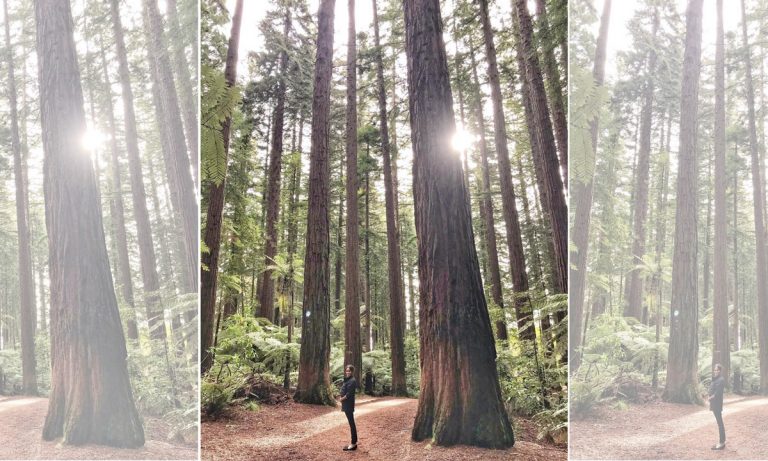
Kensington Palace shared a photo Prince Harry took of Meghan Markle during the couple’s royal tour to Australia, Fiji, Tonga and New Zealand. The adorable snapshot was taken during the couple’s Redwood Treewalk in Rotorua, New Zealand and featured the Duchess of Sussex cradling her baby bump.
In the caption of the photo, the future parents thanked all of their international hosts for their hospitality during their recent visit.
“Thank you New Zealand for the most wonderful last week of our tour,” the duo wrote. “It has been a privilege to meet so many friendly Kiwis. Australia, Fiji, Tonga and NZ—we leave feeling inspired and reminded of how every single one of us can make a difference. ‘The rain that refreshes the parched ground, is made up of single drops’ – Kate Sheppard.”
After the 24-year-old Saturday Night Live cast member joked about split in a promo for the upcoming episode of the show, the 25-year-old “God is a woman” singer took to Twitter send some shade to her ex.
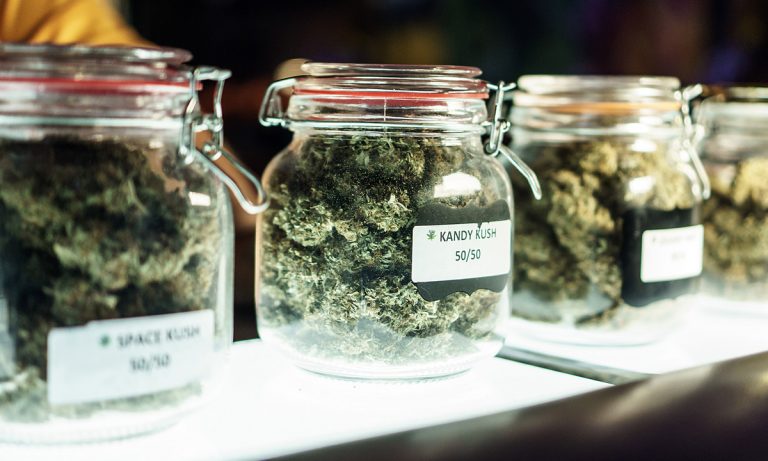
The midterm elections could loosen marijuana restrictions in the United States, as four states put ballot initiatives on legalization to a vote.
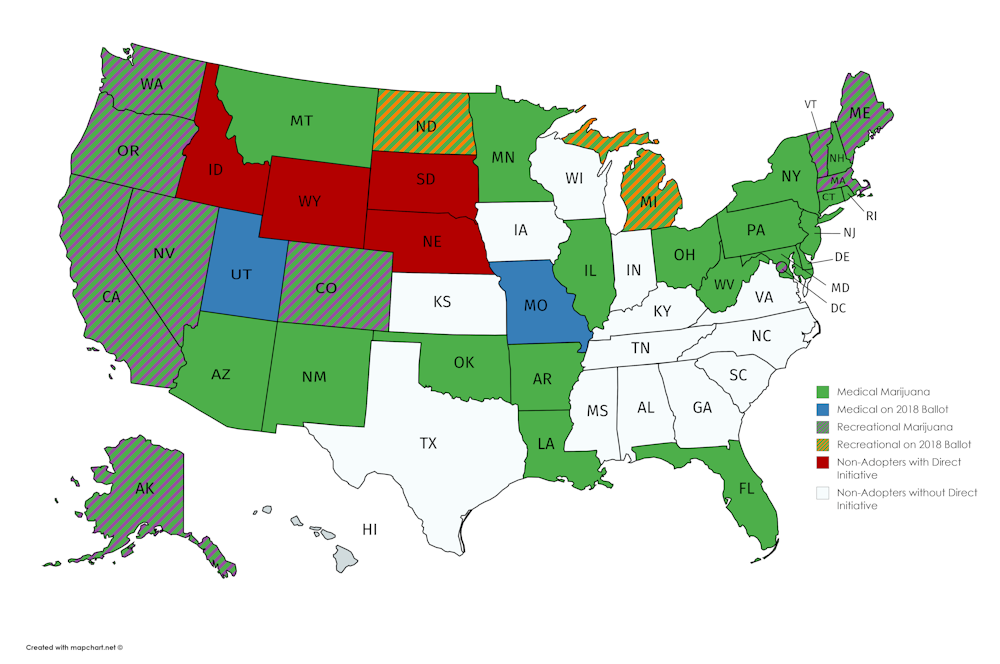
Voters in Utah and Missouri will choose whether patients should gain access to medical marijuana.
In Michigan and North Dakota, where medical marijuana is already legal, residents will decide whether to allow it for recreational use. If so, they would join nine U.S. states, Washington, D.C., Canada and Uruguay in launching a regulated recreational marijuana market.
Polling suggests that the upcoming marijuana initiatives in Michigan, Utah and Missouri will pass, while legalizing marijuana seems less likely in conservative North Dakota.
Two-thirds of all U.S. states will likely have some kind of legal marijuana by the end of this year. After that, the argument goes, its nationwide expansion is inevitable.
As marijuana policy researchers, we question that narrative.
Our research indicates that medical marijuana progress may well stall after this latest round of ballot initiatives. Recreational marijuana may continue to expand into states with legal medical marijuana but will ultimately hit a wall, too.
The reason for our caution has to do with the particular way marijuana legalization has occurred in the United States: at the ballot box.
Ballot initiatives have power
So far, every recreational marijuana law passed has occurred via ballot initiative, not through the state legislative process. Seven of the first eight medical marijuana laws – those in California, Alaska, Oregon, Washington, Maine and Nevada – were also adopted via ballot initiative.
Such direct initiatives – where citizens can put a policy on the ballot for approval – are a powerful, if nontraditional, form of policymaking in the United States.
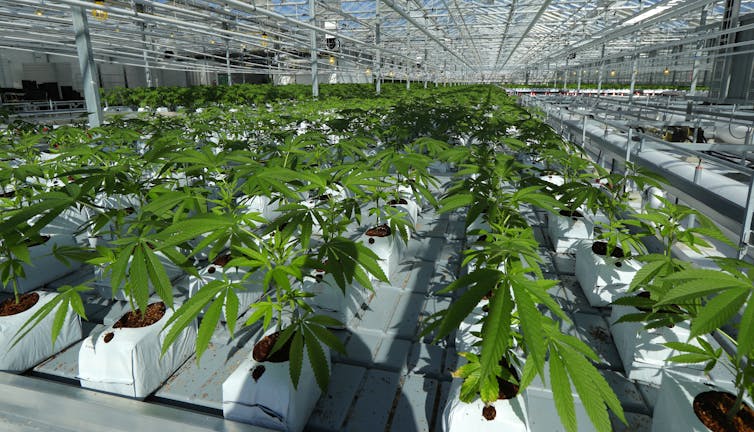
Canada legalized recreational marijuana on Oct. 17, becoming only the second country in the world, after Uruguay, to regulate a national marijuana market. AP Photo/Ted S. Warren
Even in states where ballot initiatives have little hope of passing, they can be an important force for policy change.
The Marijuana Policy Project, an advocacy organization, said it would put medical marijuana on Ohio’s ballot in 2016. In response, Ohio’s legislature moved quickly to craft and pass its own medical marijuana legislation.
Something similar may happen in Utah this fall. Gov. Gary Herbert opposes the expansive medical marijuana ballot initiative up for vote in his state but would support a more restrictive medical marijuana program.
Herbert says he will call a special session of the legislature to work on medical marijuana regardless of whether it succeeds at the ballot. Lawmakers are already working on compromise legislation that would be acceptable to conservative state legislators and the influential Mormon Church.
The limits of direct initiative
So the ballot initiative is powerful. But our analysis suggests its potential for liberalizing marijuana access in the U.S. is nearly tapped out.
Of the 19 U.S. states that have no form of legal marijuana, only six – Idaho, Wyoming, South Dakota, Nebraska, Utah and Missouri – allow for direct initiatives.
The remaining 13 states without legal marijuana are mostly conservative places like South Carolina and Alabama, where legislatures have indicatedreluctance to loosen restrictions. If voters there wanted medical or recreational marijuana, they would not have the option of bypassing policymakers to get the issue on the ballot.
Marijuana legalization won’t end with the 2018 midterms. There is still room for recreational marijuana to expand into the 22 states that currently have legal medicinal marijuana.
History shows that once people grow comfortable with medical marijuana – seeing its impacts on patients and tax revenues – full legalization often follows.
California fully legalized marijuana in 2016, 20 years after legalizing medical marijuana, following a national trend. AP Photo/Richard Vogel
In our analysis, the remaining 13 states are very unlikely to liberalize access to marijuana without a significant push by the federal government.
That’s unlikely, but not impossible, under the Trump administration.
Federal law still considers marijuana an illegal Schedule I drug under the Controlled Substances Act, meaning that, as far as the U.S. government is concerned, the plant has no medical value.
Productivity is complicated. There are days when you get a lot of work done really fast and others when it takes you an entire day to get through one simple task. While there’s no straight and easy way to get things done, there are several tricks and tips that you can learn to master in order to make the most out of your day.
Fast Company compiled a list of some tips from productivity experts that’ll make your days last longer and your time more valuable. Check out 5 of our favorites.
By walking fast or going up and down the stairs before an important call you can reinvigorate yourself, and improve your mood and performance. Short jolts of exercise can decrease the need of snacks and can also give you some perspective when you can’t find any inspiration or motivation for work.
According to psychiatrist Don Mordecai, sleep is very important because it regulates your mood and energy. You should sleep between seven and eight hours a night, and keep a regular bed time schedule. He recommends turning off all sources of blue light such as iPhones, iPads and laptops an hour before you go to bed so there are no distractions and nothing that can disturb your sleep.
You should make time for three healthy meals a day and a snack, since these will keep your blood sugar levels high and will help you concentrate and find motivation. Since a lot of people don’t have time to cook delicious and fancy things, maintaining a diet with a lot of protein and fibers is recommended since it gives you the nutrients you need and consists of simple dishes.
Make lists labeling what’s important and what’s less timely, allowing you to get things done in order and to give you some peace of mind. Check on your list throughout the day and tack off the things you’ve already accomplished. Doing this will make you feel like you’re getting things done and you’re succeeding at whatever it is you’re doing.
Personal trainer Jill McKay believes that you should do something you enjoy in the mornings in order to start the day off right. This can include meditating, working out, or having breakfast with your family. If you feel good in the morning then you’ll likely feel good throughout the rest of the day.
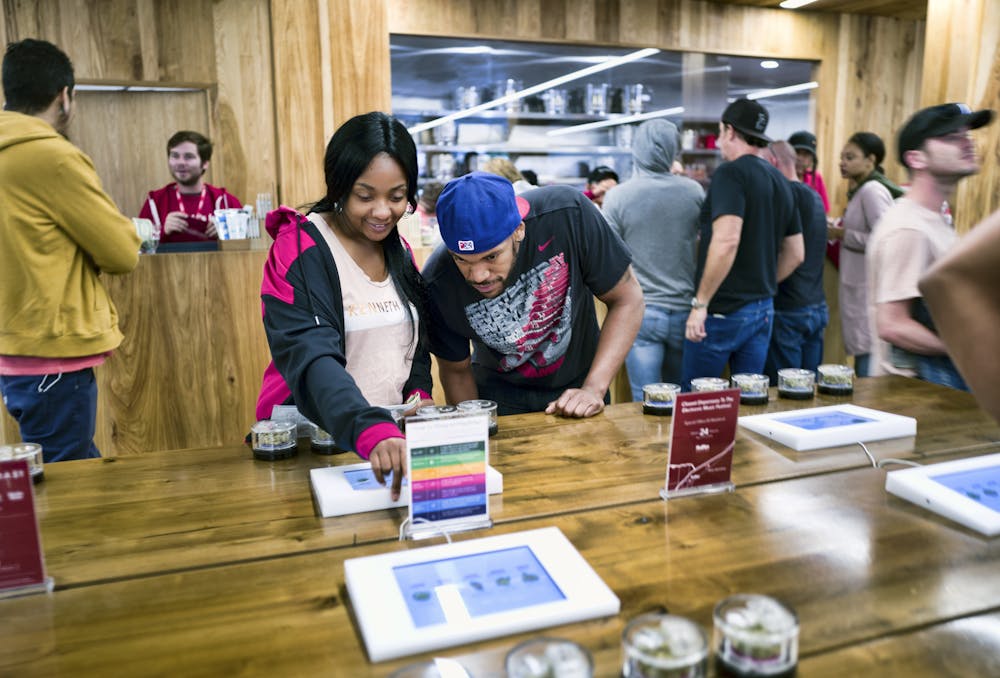
A new poll from Harris Research revealed consumers aren’t buying cannabis to get high, but rather to relieve pain (75%), relax (70%), sleep (60%) or manage anxiety (59%). That insight has profound implications on an industry increasingly faced with serving audiences searching for products for their health and wellness needs. The implications on retail – or the dispensary system in the cannabis industry – are poised to trigger a revolution in the consumer shopping experience within the industry and beyond.
The Harris Poll of 2,000 cannabis consumers or cannabis curious individuals in Colorado and California identified key areas where dispensaries are, or are positioned to, provide a new kind of customer experience in areas including education, one-on-one customer service, flexibility of customer journey and approach and store design. Ironically, it is the unique operating environment with all of its product complexity, regulatory structure and fast growth, that is driving innovation.
For example, the Harris survey shows that half of visitors to cannabis dispensaries do no research in advance, suggesting they are relying on the retail experience for the information they need to inform their purchasing decisions. This places a higher burden on dispensaries to provide top-down education and establishes the sales associates – “budtenders” – as an essential conduit to creating a positive customer experience that navigates a complex product array as well as key features and benefits.
“The cannabis industry is faced with unique challenges when it comes to retail, including a legacy of behaviors and stigma, the regulatory environment and the fact that it is still a very young market,” said Peter Barsoom, CEO of edibles company 1906. “Many industry leaders are turning this challenge into an opportunity to reinvent the retail experience by reevaluating everything – from the educational component, the one-on-one interaction with sales associates, the flexibility of the customer journey and overall design of next generation facilities.”
Education, Budtenders, Customer Journey And Design
A recent research report from Frog Design emphasized the importance of product education among first-time visitors and in generating repeat visits and loyalty. According to Frog Research, “Education will facilitate consumer desire to repeat and refine their next experience.” The Harris poll confirmed this finding citing product information and dispensary staff as the two strongest drivers of choice.
The Harris survey showed mixed feelings among consumers about budtenders. While a large segment of repeat customers viewed budtenders as useful guides into the cannabis world, others – particularly new consumers – see budtenders as unrelatable or even untrustworthy. Nearly half of dispensary visitors (47%) felt that the budtenders expected them to know what they wanted and a quarter of visitors (26%) didn’t feel informed about what effects they should expect from the products they purchased. In some cases, particularly with Millennial audiences, customers don’t want to talk to any sales person – no matter how informed.
Perhaps more acutely than in traditional retail environments, the cannabis industry is faced with a wide range of consumers in terms of experience and understanding. Chris Znerold, Chief Marketing Officer at dispensary chain Native Roots, sees the need for flexibility within the customer journey. “Native Roots stores are reinventing the dispensary experience around a ‘choose your own adventure’ type approach. We offer delivery and pick-up for our most informed customers who don’t want to have a personal interaction, highly trained sales associates to guide those who come in and need help, and 30-minute educational sessions and consultations for those new to the process.”
As the cannabis industry expands across geographies and moves from medicinal to adult use, more and more industry leaders are carefully considering the retail experience. “Dispensaries still have a long way to go, but there are some promising signs,” said James Andrus, principal of the Andrus Group, an architecture firm working in the cannabis space. “A new generation of cannabis entrepreneurs are looking to rewrite the rules on retail and that creates some exciting opportunities for use of space, design and how form and function work together to enhance the customer experience.”
New Audiences Are The Key To The Future
The Harris poll found that more than 20% of self-declared cannabis users or cannabis curious have never been to a dispensary. More strikingly, nearly half of women responding to the survey say they are unlikely to go to a dispensary, as are a quarter of respondents 55 or older.
“There is a lot of work to be done to create a cannabis retail environment that meets the needs of consumers who currently are not or are unlikely to visit a dispensary,” said Peter Barsoom, CEO of 1906. “Given that three quarters of shoppers are looking for something other than getting stoned, we are uniquely focused on creating products and a retail experience that meets those needs, addresses new consumers in an inviting manner and reinvents the entire industry model. The very things that make the cannabis industry unique and challenging – from regulation to pace of growth to social stigma – has forced us to innovate, think beyond the traditional and lead the way for the rest of retail.”
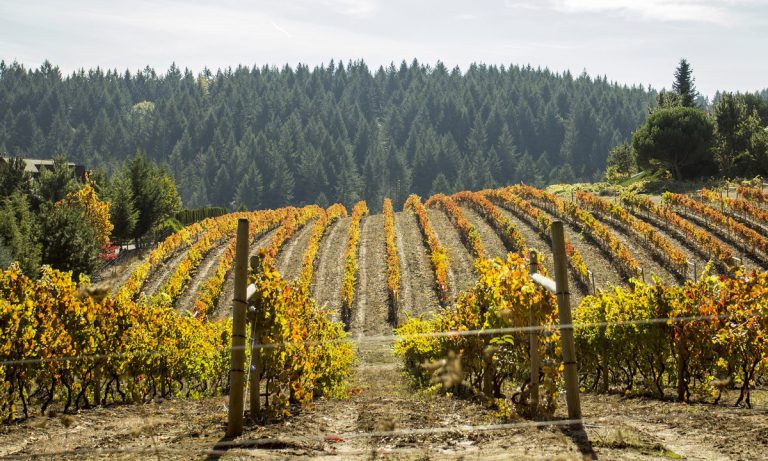
Farmers around the world grow their crops with the hope and desire of creating the best possible products, usually with their own tricks of the trade that set them apart. Planting methods, soil supplements, harvesting ways and watering practices all go into how the final product looks, tastes, smells and feels. Cannabis is no different and California is on the cusp of creating regional marijuana appellations, just like Champagne is to the sparkling wine world.
In Northern California, cannabis growers are known to compare their grows with those of the wineries they’re surrounded by, in that growing in a valley as opposed to a hillside 20 miles away, the same strain from a different farmer will come out unique. Then there is the drying and curing process, the trimming and the storage and transportation all to consider.
Craft cannabis is becoming the norm for legalized and medicalized states, and even on the illicit market. You have to look harder for “dirt weed” now than you do for dank. It’s no wonder that California is taking the route to regional branding. How the lines will be drawn in the dirt is up to the California Department of Food and Agriculture, and they plan to start a “county of origin” standard starting January 1, according to Mendocino Voice.
The CDFA is in the process of developing, “a process by which licensed cultivators may establish appellations standards, practices, and varietals applicable to cannabis grown in a certain geographical area in California” by 2021. After surveying a number of craft growers, the agency is now focusing on the application process for branding bud as an appellation.
There will be requirements that are written in stone once the program is up and running and it will be up to the farmers to self govern the crops to ensure that the labeling isn’t being used out of the context of what constitutes that region’s specific standards. And doing so is in their best financial interest. Setting yourself apart in this burgeoning market is a must and having a successful varietal could be the difference between becoming a household name and being left on the shelf.
Cannabis agriculture, especially when done outdoors as these varietals will be, is an undertaking with many, many rewards, and one could easily see how having certified variety would drive competition and thus the market itself. It will be interesting to see which strains and farms will resonate with cannabis connoisseurs. Perhaps weed tasting trips across the Emerald Triangle will compete with California’s infamous wine tasting tours in the near future.
A study sheds some light on a possible “super power” for cannabis consumers: Night vision.
Nearly 20 years ago, it was anecdotally reported that fishermen in Jamaica experienced “an uncanny ability to see in the dark” after a ganja session. A few years later, reports out of Morocco showed that fishermen and mountain dwellers had similar experiences after smoking hashish.
So researchers at McGill University in Montreal decided to get to the explore the science behind the phenomena.
According To The Guardian:
Now, another study provides hard evidence for the claim, revealing a cellular mechanism by which cannabis might improve night vision. The findings, published recently in the open access journal eLife, could eventually be applied to the treatment patients with degenerative eye diseases such as retinitis pigmentosa.
The researchers applied a synthetic cannabinoid to the eye tissue of tadpoles of an African toad. The experiment found that the cannabinoid made retinal cells more sensitive to light, improving the speed at which the eye responded.
“We didn’t believe what we were seeing,” a study author told the Montreal Gazette. “The cannabinoids were increasing the excitability of cells in the eye that connects to the brain.”
The experiment followed the tadpoles, showing them dark moving dots, which the tadpoles avoid in nature. All of the tadpoles performed well in normally lit conditions, but the tadpoles given the cannabinoid performed much better than those that didn’t in dark conditions.
What is the medicinal application for humans? Cannabis could be a viable treatment for retinitis pigmentosa and glaucoma.
Certain cannabinoids are known to have a neuroprotective effect on retinal cells, so improved night vision is not the only benefit. Patients with deteriorating eyesight — a common complaint among senior citizens — may derive benefit. Researchers also are optimistic that cannabis may actually slow down the progression eye disorders.
Netflix’s method of releasing all their content at once and all throughout the world has proven to be extremely successful, at least in terms of the company’s growth and recognition. The company is currently producing an insane amount of critically acclaimed TV, something that has put them in close competition with major players like HBO. Making news, Netflix will release movies in theaters before their lineup.
When it comes to films, Netflix has faced some trappings and conflicts, mainly because they’re not able to blend in as easily as they did with television. Despite the fact that Netflix has worked with critically acclaimed filmmakers in the past, these movies have been sort of omitted from film festivals and awards shows. The product becomes eclipsed by the company itself that doesn’t really advocate for the moviegoing experience. And among film aficionados, that’s a capital crime.
Variety reports that Netflix is finally giving three of their films alone time in theaters. The Ballad of Buster Scruggs and Bird Box will both have a one week run in select theaters before they appear on Netflix. Roma, Netflix’s biggest Oscar bet and one of the year’s most buzzed about films, will screen in theaters for three weeks starting November 21.
While Netflix says that these measures are done in order to serve their members and filmmakers, we all know that what they really want is to avoid rocking the boat. The Oscars don’t have a rule that prevents movies from being offered in theaters and on streaming services simultaneously, but by becoming invisible and more like other film studios, Netflix is betting that they’ll win something.
Maybe if Netflix stays quiet long enough, their movies will walk away with gold, with academy members only realizing this as they’re handing out statuettes.
With the generous geographical overlap Silicon Valley shares with the Bay Area and their pre-legalization embrace of marijuana, it should be much more apparent how the tech industry is involved in the burgeoning sector. Due to much corporate taboo, it’s not so simple to fish out the ways in which the federally prohibitive climate may be shifting in the Bay Area and other technological havens that play such a large role in our digital daily lives.
What is it about the cannabis industry that is bringing people with tech expertise or pursuits into the fold? Questions that will help illuminate the path from one major industry to this smaller but potentially groundbreaking one can help anyone looking to make the jump can use.
Cannabis’ true potential can only be unlocked when it’s fully legal, free of taboos, and companies can put money into cannabis based innovation that extends past intoxication and capital that it’s getting today.
Weasked three cannabis CEOs about their connections to tech as a company and as an industry, and this is what they said.
Steve Albarran, CEO and Co-founder of Confident Cannabis literally creates cannabis industry tech. They aim to create safe, efficient, and effective software to help growers, patients, and retail operations. He says that tech is a big part of breaking the taboo down for good, “The tech industry gets it. More than any other sector, tech operators, investors. and thinkers understand the obvious benefits of ending cannabis prohibition and the opportunity it represents. Not surprisingly, the people responsible for building our future are a lot less shackled by old stigmas.”
Patrick Rea, CEO and Co-founder of Canopy Boulder, talks about how investment and growth tools can legitimize this sector rapidly, which it desperately needs with such piecemeal legality. He tells The Fresh Toast, “The fact that the legal cannabis industry is still in its infancy, combined with its risk-tolerant nature, makes a great breeding ground and incubator for new technologies. With almost no current infrastructure, the opportunities for businesses and technologies within the space are endless. In almost any other industry areas like HR, marketing and data have long been established by large corporations; this is not so within cannabis.” Continuing to describe the benefit of tech and corporate knowledge in this space, Rea says, “In cannabis, federal prohibition has acted as a deterrent for many large, established competitors, giving young cannabis tech companies space to refine business models, build customers bases and, ultimately, become more valuable potential acquisitions. Having a tech background in cannabis is just as important in this industry as any other. The industry moves so quickly, with regulations changing constantly, and has so many unfamiliar elements that to enter the space without background in the application of those technologies could be fatal.”
Photos by Maria Penaloza
Innovation is the key to revolutionizing cannabis’ potential, according to PotBotics CEO David Goldstein, “To be an innovator you have to consider how to create a truly revolutionary product while pushing your industry forward. The cannabis industry, from its inception, has always been trying to overcome the issues associated with the difficulty to accurately describe, dose, and prescribe marijuana. As more research is being conducted on cannabis, it has become increasingly clear that large discrepancies exist within the naming and identification of strains. This variability in strains as well as variability in consumption methods creates an unideal situation for further growth of the industry. In order to grow, the cannabis industry desperately needs the assistance provided by new and emerging technology.”
His company took the concepts of tech and applied them to the physical act of cannabis consumption, an important leap forward for anyone interested in using cannabis to its full potential, “At PotBotics, we knew we needed to create something different that could provide a new type of consumer experience with vaping – one aimed at breaking down the past barriers of cannabis use and understanding while at the same time advancing the science of cannabis medicine for physicians and patients alike. This led us to develop RYAH, a smart-dose vaporizer that allows users to control everything from the temperature to the amount of vapor they’d like to inhale while collecting anonymous, HIPAA-compliant consumer data that provides new insights about the therapeutic properties of medical cannabis.”
These green bosses are making moves to take the best of tech and apply it to what is much more than a farming industry. Cannabis has the potential to create jobs, something previously attributed to tech more readily, and its high time we stop ignoring the implications of applying technology and its skilled thinkers to the future of this plant.
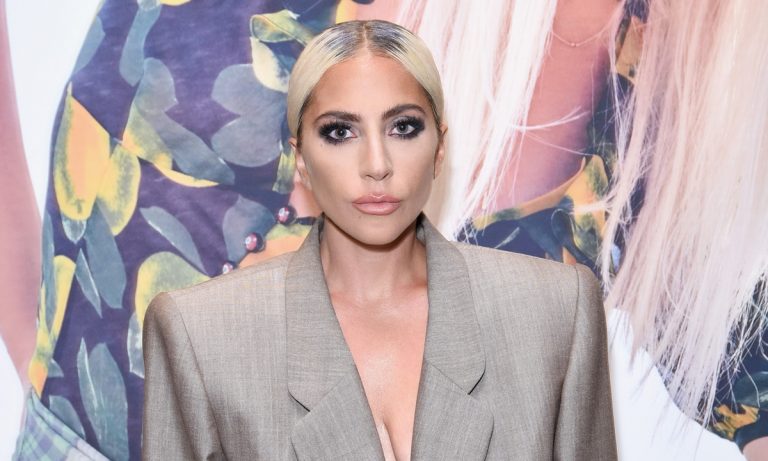
Lady Gaga is winning raves for her role in ‘A Star Is Born,’ but the part that she is taking most seriously is becoming a new step-mom.
“Now that Gaga and her fiancé have officially announced their engagement they are working on wedding details. But they are not planning the day alone. Gaga is making a special effort to make sure that her two new step-children feel very much a part of the big day,” sources tell STRAIGHT SHUTER.
“This relationship isn’t just about two people. It is about an entire new family and that is the reason she is being much more private with this engagement compared to her previous one. She considers becoming a step-mother as the most important thing she will ever do and is taking it very seriously. Lady understands that having her as a new mother might not be the easiest adjustment.
Meghan and Harry wanted to keep their baby news such a top royal secret that they didn’t even tell their best friends the happy news.
“Meghan didn’t tell any of her friends that she was pregnant. Most of them, including Amal Clooney and Serena Williams found out the same day that the rest of the world did,” sources tell STRAIGHT SHUTER. “Since Meghan married Prince Harry she has adjusted to her new high-profile life. She has a new phone number and a new secure email address. Her old ‘AOL’ account is no longer. It isn’t that she doesn’t trust Amal or Serena, it’s just she wanted to make sure that the birth of a new royal was handled by the press people within the palace. After all the ugly leaks to the press from her family, she doesn’t want to take any chances.”
With ‘Keeping Up With The Kardashians’ ratings dropping below 1 million viewers for the first time for two consecutive weeks, Kris Jenner and the family are freaking out worrying that the show will not get renewed when their contract expires in 2019.
“This is a total nightmare for Kris Jenner and the family. The show’s contract with E! expires in 2019 and right now Kris is renegotiating with the network. The ratings plummeting couldn’t have come at a worse time and although she isn’t saying anything publicly, Kris is blaming Kanye West,” sources tell STRAIGHT SHUTER. “Kanye has been saying some very controversial things over the past few weeks and for the first time, he is not just alienating his fan base, he is also turning off the Kardashians’ fan base. This is the real reason he left the country. The family wanted him away from the press and out of America until things were not so hot. Little did they know that he would be meeting with dictators in Uganda!”
In the midst of the nation’s current sparkling water obsession, it makes sense that some people would try to sell it as some sort of miracle worker for your skin.
According to The Cut, this trend originates from Japan and Korea, and it actually provides some benefits for your skin. The sparkling water facial or ‘fizzy face cleanse’, does several things for your skin that regular water isn’t capable of doing. Sparkling water cleanses your skin deeply, with the carbonation cleaning out the oil and dirt that penetrates your pores. Cosmopolitan reports that when sparkling water is at room temperature, it also becomes a vasodilator, triggering your blood vessels to open up and letting your skin breathe.
Another benefit that sparkling water has over tap water is that it has a similar pH to your skin, which is 5.5. Tap water has a pH of 7, which could sometimes lead to dryness, facilitating breakouts and acne. Dr. Kavita Mariwalla calls sparkling water a great exfoliator, helping you get rid of all sorts of dirt without the need of a washcloth or lotions.
In order to commit to this regimen you’re going to need a lot of sparkling water, at least a bowl per wash. Japanese and Korean beauty experts suggest dipping your entire face in a bowl full of a mix of sparkling and tap water, so that the carbonation isn’t too hard on your skin. Dip your face in the bowl for over 10 seconds and breathe out your nose if you feel some discomfort.
While all the sparkling water benefits sound super great, may we suggest investing in a soda maker? Buying that many bottles of sparkling water sounds crazy and also bad for the planet.