“They both know what the church is capable of … So they would no doubt feel like they are still being controlled.
They have to be cognizant not to say anything that will anger the Church or Tom,” says former Scientologist Leah Remini, who also adds, “Why haven’t Nicole or Katie spoken out against Scientology? I assume they were forced to sign prohibitive documents. Katie’s not allowed to have a meal with me and we used to be close friends. She could lose custody of Suri, it’s quite sick.”
A source told PEOPLE that Kim is embarrassed: “Having all this backlash against Kanye is embarrassing for her and her family, but she will never say that. She supports Kanye through and through and truly does think her husband is entitled to his own opinion.”
Her support of Hillary Clinton: “Kim didn’t blindly follow the pack of celebrities supporting Hillary during the election, though she did vote for her. She respects certain aspects of Trump, but in the end Hillary was her decision.”
Enrique Iglesias is very much in a relationship with Anna Kournikova and they are new parents. But last night at a concert, the Singer practically made out with a fan onstage! Anna, did you see these photos? NOT OK!
It didn’t take long for Apple’s new batch of iPhones to run into some trouble. Users are complaining about the devices’ poor battery life and the problems they’ve encountered when trying to charge the phones from an outlet.
Dozens of people have left comments and queries on Apple and Mac Forums, reporting that their new devices have poor cell reception, specifically the iPhone XS and the XS Max. The main problem that’s currently being reported is that some phones don’t charge when plugged in, especially when they’re locked and their screens are off. In order to fix the issue, users have to unlock their iPhones or have their screens on when connecting them so the charging process can begin.
#ChargeGate@UnboxTherapy My XS Max has the issue, but it’s not consistent. On my testing, 3 out of 10 attempts to charge failed until I woke the phone up. I would lean heavily toward software issue.
While Apple has made no comments regarding these issues,tech bloggers and YouTubers have documented them and have also figured out different ways of solving the problem themselves, assuring that if you download the beta version of the iOS 12.1 the problem goes away.
This is presumably a small software bug that’ll be fixed once Apple has heard the complaints and releases an iOS update. It’s not rare for first generations of devices to feature faulty bugs. Users have to be patient and active in online communities in order to fix the most prevalent problems and know what to do when they encounter a particularly annoying bug.
I know it may be hard to convince you, but let me try: Don’t kill the next spider you see in your home.
Why? Because spiders are an important part of nature and our indoor ecosystem – as well as being fellow organisms in their own right.
People like to think of their dwellings as safely insulated from the outside world, but many types of spiders can be found inside. Some are accidentally trapped, while others are short-term visitors. Some species even enjoy the great indoors, where they happily live out their lives and make more spiders. These arachnids are usually secretive, and almost all you meet are neither aggressive nor dangerous. And they may be providing services like eating pests – some even eat other spiders.
A cobweb spider dispatches some prey that got snagged in its web. Matt Bertone, CC BY-ND
My colleagues and I conducted a visual survey of 50 North Carolina homes to inventory just which arthropods live under our roofs. Every single house we visited was home to spiders. The most common species we encountered were cobweb spiders and cellar spiders.
Both build webs where they lie in wait for prey to get caught. Cellar spiders sometimes leave their webs to hunt other spiders on their turf, mimicking prey to catch their cousins for dinner.
Although they are generalist predators, apt to eat anything they can catch, spiders regularly capture nuisance pests and even disease-carrying insects – for example, mosquitoes. There’s even a species of jumping spider that prefers to eat blood-filled mosquitoes in African homes. So killing a spider doesn’t just cost the arachnid its life, it may take an important predator out of your home.
It’s natural to fear spiders. They have lots of legs and almost all are venomous – though the majority of species have venom too weak to cause issues in humans, if their fangs can pierce our skin at all. Even entomologists themselves can fall prey to arachnophobia. I know a few spider researchers who overcame their fear by observing and working with these fascinating creatures. If they can do it, so can you!
Spiders are not out to get you and actually prefer to avoid humans; we are much more dangerous to them than vice versa. Bites from spiders are extremely rare. Although there are a few medically important species like widow spiders and recluses, even their bites are uncommon and rarely cause serious issues.
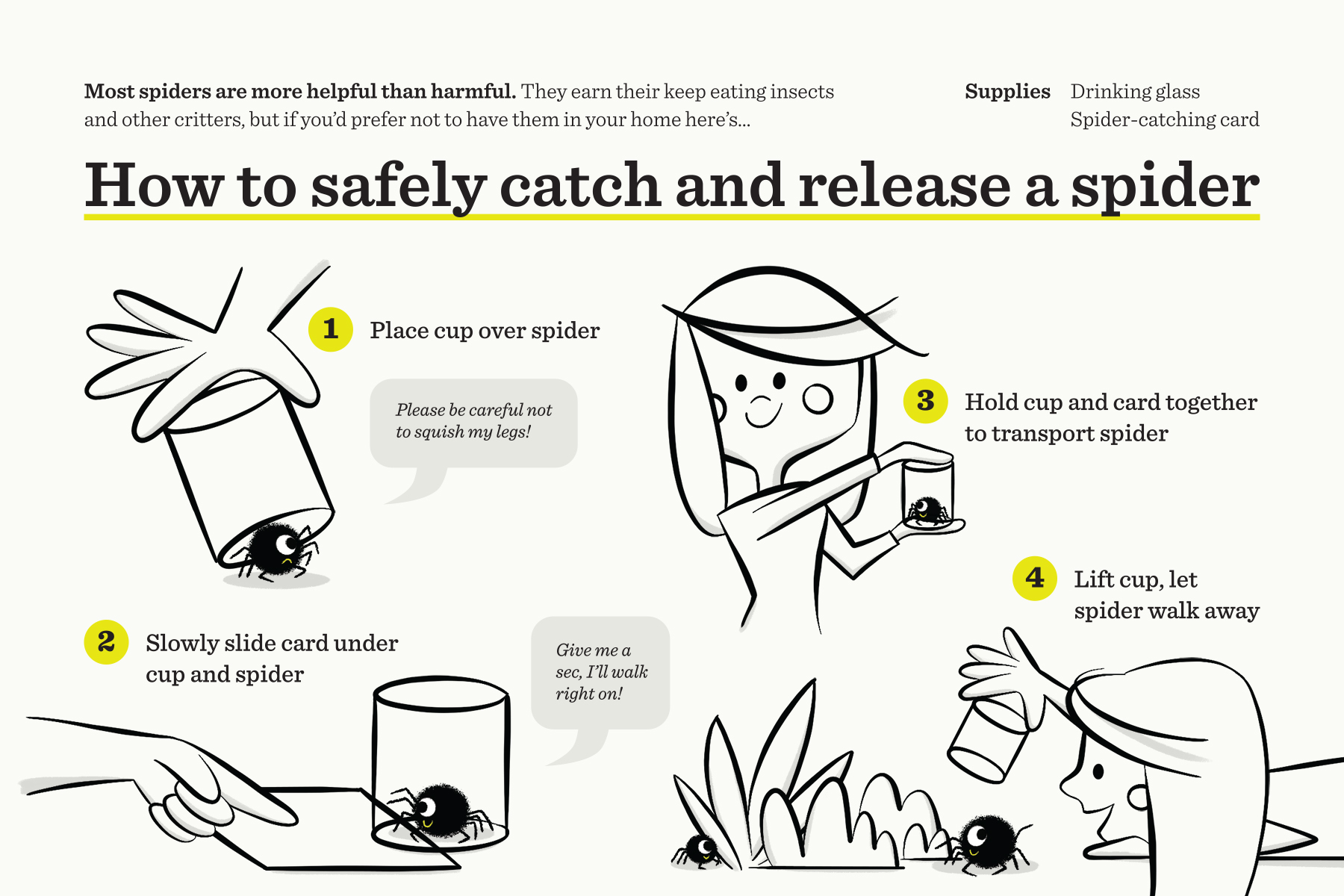
If you truly can’t stand that spider in your house, apartment, garage, or wherever, instead of smashing it, try to capture it and release it outside. It’ll find somewhere else to go, and both parties will be happier with the outcome.
But if you can stomach it, it’s OK to have spiders in your home. In fact, it’s normal. And frankly, even if you don’t see them, they’ll still be there. So consider a live-and-let-live approach to the next spider you encounter.
In August, Buzzfeed News reported that Donald Trump’s White House has been secretly staging a marijuana policy coordination committee. One of the committee’s primary intentions was to change the public narrative regarding cannabis and its legalization toward the negative. To accomplish this goal, requests were sent to various federal agencies to “identify marijuana threats; issues created by state marijuana initiatives; and consequences of use, production, and trafficking on national health, safety, and security.”
Though the White House denied any such committee existing at the time, they have since confirmed its existence, according to Buzzfeed News. But the White House denies skewing the public cannabis narrative with any bias or malice. In a letter to Colorado Sen. Michael Bennet (D-CO), the Office of National Drug Control Policy (ONDCP) denied any intention to dismiss health and social benefits regarding cannabis.
“I assure you that ONDCP seeks all perspectives, positive or negative, when formulating Administration policy. You have my full and firm commitment that ONDCP will be completely objective and dispassionate in collecting all relevant facts and peer-reviewed scientific research on all drugs, including marijuana,” ONDCP acting Director James Carroll wrote in a letter to Bennet dated Sept. 21.
Buzzfeed’s initial report caused considerable backlash among politicians and constituents alike. Among those politicians was Bennet, who labeled the committee as an “intentional effort to mislead the American people.”
“At a time when we should be investing in objective and peer-reviewed scientific research on marijuana and the effects of legalization, the White House is instead using taxpayer money to spread a politically-driven narrative,” Bennet wrote in a letter back in August.
That August letter also included an olive branch from Bennett. He told the ONDCP that the eight state with adult-use marijuana legalization were willing to work with the administration.
Now Bennet is hoping the White House keeps their new promise.
“In Colorado, we’ve made a deliberate effort to ensure fact-based data informs our marijuana policies,” the senator said in a statement to Buzzfeed. “Government-sponsored propaganda shouldn’t undermine that effort. I intend to hold the ONDCP to its commitment to present objective and scientific information about marijuana to the American public.”
In a strategic, if not ominous, move, Denver’s U.S. Attorney’s Office is considering taking focus off of actual illegal drug trade and using those resources to expose legal, licensed dispensaries and other cannabis businesses as fronts for a lucrative drug trade that goes outside the bounds of the written law.
Up to this point, Colorado has focused entirely on prosecuting completely illegal operations, ones hidden away from the government and the public in general and that are meant to be distributed exclusively in the illegal marketplace.
“Where has our breathless sprint into full-scale marijuana commercialization led Colorado?” Troyer asks in a Denver Post op-ed. The question seems whimsical, but the litany of his following concerns is as serious as it gets. This is one Colorado resident, with the privilege of power, who was not and will not be part of the cannabis supporting majority.
In the op-ed, Troyer says of his many observations, including increases in plant and edible potency as well as an increase in alcohol use since legalization that, “these impacts are why you may start seeing U.S. attorneys shift toward criminally charging licensed marijuana businesses and their investors. After all, a U.S. attorney is responsible for public safety.”
He went on to say, “Now that federal enforcement has shot down marijuana grows on federal lands, the crosshairs may appropriately shift to the public harms caused by licensed businesses and their investors, particularly those who are not complying with state law or trying to use purported state compliance as a shield.”
The statements are ripe with judgment, stigma and even a threatening voice. Rather than focus on making sure regulations are being followed and making corrections where need be, the U.S. attorney seems to be on his own mission of malevolence. Looking at compliant businesses and then rubbing your hands together like a nefarious Mr. Burns is no way to deal out justice, in fact it seems to be very non judicial indeed.
While naturally Colorado cannabis advocates are in favor of stopping illegalities in the movement, they are wary of Troyer targeting businesses that are actually following the rules. “Targeting legal dispensaries that are doing their best to follow the letter of Colorado’s laws makes no sense without meeting with the owners and discussing their interpretation of the laws,” stated Kristi Kelly, executive director of the Marijuana Industry Group.
The cannabis industry is experiencing an all-time high when it comes to growth and acceptance for the plant that powers their business. Grassroots legalization efforts are happening all across the country, while surging stocks for cannabis companies, like Tilray, have reminded investors of the dotcom boom. Even politicians have turned heel, joining the Green Rush however they can.
Now you too can participate (from the comforts of your computer) thanks to a tycoon game-parody called Weedcraft Inc. Published by Devolver Digital, the game allows players the typical mechanics and systems found in a tycoon game, but wrapped in the specificity found in starting a marijuana business. Instead of a free-for-all sandbox experience, Weedcraft Inc. will follow a loose narrative, as players explore different vignettes of the cannabis start-up enterprise.
“Right now, it’s like the end of Prohibition meets the Gold Rush,” Scott Alexander, the game’s main writer, told Polygon. “The federal illegality combined with the state-by-state legalization has created a financial morass and just a weird, interesting place. And we thought, ‘Well, that’s a tycoon game waiting to happen.’”
Our demo was centered around the introductory vignette: two brothers who saw their ailing father lean on medical marijuana during his cancer treatment decided to open a pot-dealing business together in Detroit. Your beginnings are very humble: three pots in a basement, a small overhead heat bulb, some packs of seeds and soil. Plant seeds. Add water when prompted. Prune at intervals. Harvest. There’s a fast-forward option to change how fast time flows as you get more comfortable with the game’s rhythm. Those plants in turn become the first product you sell at the market, here with little to no competition and a handful of archetypical customers.
According to Alexander, the game will change based on the state and situation players find themselves in depending on the vignette. You can also play the game with varying degrees of morality and legality; bribing cops or building false storefronts to hide your cannabis farms is totally allowed. The line the game developers won’t cross? You won’t see any kids smoking weed on screen. The style in which you play the game will also affect whatever bonuses and abilities you’ll acquire.
“There are certain perks you can only get if you’re super shady,” Alexander said. “There are certain perks you can only get if you’re decent.”
“Playing fully decent is like getting a cultural victory in Civilization,” he added. “[It’s like,] ‘Can I play the whole game without fucking anyone over?’”
According to Devolver Digital co-founder Mike Wilson, you can expect Weedcraft Inc. to debut in early 2019
Before Meghan Markle married Prince Harry, no one knew or cared about royal protocol. Now, nearly five months after the fact, it’s a phrase that we’ve heard thrown around in different situations with publications claiming that Markle has broken it or is adapting these rules for a new generation of people.
Now that the couple’s first royal tour is about to begin, people are wondering what the deal is with royal protocol, and how much preparation Markle will have to endure in order to meet the Kensington Palace’s impossibly high standards.
Myka Meier, a specialist in etiquette who was trained by a member of The Queen’s Household, told Cosmo that Markle will undergo rigorous training that’ll prepare her before formal engagements, explaining:
In order to show respect to the people she is meeting, she will be briefed ahead of each event on the Senior people she will be meeting and how to greet and address them, solely in order to show respect. From assisting her with what to wear all the way to important topics to speak about, she will have help to ensure she is fully prepared.
Interestingly enough, when royals travel overseas they sometimes have to abandon the Queen’s protocol, adopting the customs of the country they’re in. “Often we see royals wearing outfits from local designers, too, to show respect and support for the country they are visiting.”
All royals will be briefed before each formal meeting about religious, economic and political topics in order to avoid any embarrassments. Royal protocol and royal aids leave little room for royals to mess things up, avoiding putting the Queen and their country in an uncomfortable position.
Californians with a criminal record stemming from a marijuana conviction will now have an opportunity to get their lives back on track. The state recently put a new law on the books that will provide marijuana offenders with a simpler means to wipe their records clean or get their sentences drastically reduced. It is a policy that advocates are calling “transformative,” as it will give hundreds of thousands of people hope for a better future.
On Sunday, Governor Jerry Brown signed the proposal (Assembly Bill 1793) that made this happen. It is a measure that picks up where the state’s marijuana legalization initiative left off by giving people convicted of marijuana crimes the ability to petition the courts and have their misdemeanors expunged and their felonies reduced, according to the Los Angeles Times. The new law streamlines the process and makes it easier for people to get out from under this particular drug-related conviction.
“AB 1793 will bring people closer to realizing their existing rights by creating a simpler pathway for Californians to turn the page and make a fresh start,” Assemblyman Rob Bonta said in a statement. “Long after paying their debt to society, people shouldn’t continue to face the collateral consequences, like being denied a job or housing, because they have an outdated conviction on their records.”
Although a handful of states presently have an arrangement in place that allows marijuana convicts to have their records wiped clean, California is the first state to automate a system dedicated to helping these people get it done.
The new law requires the state Justice Department identify all of the marijuana offenders who might qualify for expungement and put that information into the hands of local district attorneys by the summer of 2019. From there, prosecutors can review each case and have the courts modify the records. An estimated 218,000 residents could benefit from this law.
When California approved Proposition 64, legalizing marijuana for recreational use, the law came with an expungement clause. But many have argued that the act, how it was designed, was difficult, time-consuming and costly to navigate correctly. Moreover, it has only been a convenient option for those who can afford an attorney to see it through.
“It was so inaccessible for a variety of reasons,” Rodney Holcombe of the Drug Policy Alliance told USA Today. “This (new law) will empower people. My heart goes out to people who have had to navigate this process on their own. It’s confusing, expensive and tiring.”
Governor Brown, however, did not offer the same consideration when it comes to allowing sick children to bring medical marijuana on school campuses. He argued the language was too broad and that it might contribute to exposing minors to marijuana.
In a situation that speaks volumes as to how the U.S. is perceived in Canada, we have on one hand the U.S. threatening Canadian cannabis industry workers with not being able to enter its borders again. And on the other hand, we have Canadian residents and pot professionals that seem to be totally okay with that.
The B.C. area expects to have all pot positions necessary for a thriving industry filled and in place by the October 17 deadline, when cannabis becomes officially legal in Canada. The B.C. Liquor Distribution Branch said it is on target with jobs and the B.C. Government Employees Union said members have not reported hesitation at filling said marijuana jobs.
The lack of B.C. workers’ concern is regardless of reports inferring that U.S. border agents might deny entrance to Canadians who are linked to the legal cannabis industry. The threats admittedly ring empty, as the U.S. itself has legalized or medicalized marijuana in a majority of its states. It feels like we’re on the cusp of de- or rescheduling cannabis and now we can’t play nice with those who went first.
B.C. Liquor Distribution branch spokesman Viviana Zanocco has said that anyone with concerns about the U.S. warnings should check Canadian government websites for updates on the situation, as it is yet unfolding.
According to the Vancouver Sun, Zanocco said, “The incidents reported in the media and their potential repercussions are of significant concern to us. Many of us are traveling to the U.S. with our families this summer, or enjoy shopping south of the border on a regular basis, and want to continue doing so while feeling safe and secure.”
The best laid plans of mice and men often go awry, as the poem goes, and these restrictive rules aren’t just bad for relations between two neighboring countries, it impacts the U.S. economy and people’s desire to give it a boost with their tourism and shopping.
Stephanie Smith, president of the B.C. Government Employees Union, called the idea of a travel ban “outrageous,” and said the union has yet to hear from any members who are concerned about it. “We understand that, really, this is a government to government issue.”
“Our role is going to be to work with the employer to make sure that anybody who does take a job in the new branch understands the potential outcomes…” continued Smith, “We just feel really, really strongly that people who work in a legal industry and, in fact, are working for a provincial government, should not be punished for doing so.”
Just when you thought you couldn’t love Her Majesty more, word comes that she is “thrilled” to have a fake waving machine to use in case her royal arm is too tired to greet the plebeians of England.
Of course, this is not a device created by the monarchy to ease the physical stress of ruling a country. It’s a gag gift from a group of students in Australia.
The Queen’s daughter, Princess Anne, is quoted in a new book, Queen of the World, explaining:
They gave her a stuffed glove on a wooden lever so you could tweak the end of the lever and this hand went to and fro,’ the quote reads. ‘I think they thought it was cheeky, but Her Majesty was thrilled.
Robert Hardman, the author of the book, which accompanies the HBO documentary of the same name, says the Queen was rather taken with it and “I think it ended up at Balmoral. ‘I don’t think she ever used it in public, but I hear it became a much-loved family joke.”
But while the Queen may store her fake wave machine in her closet somewhere, away from the corgis, the crew aboard the royal yacht Britannia actually did use a stunt hand (or several). According to Hardman’s book, they would hire people to do the waving because, according to one crew member, “It was exhausting to wave all the way through, but they didn’t want to upset the locals, so we had a party whose job was just to wave.”