As more and more states jump on the cannabis legalization bandwagon, one sticky problem is slowly being addressed: How does society make things right again for those who were previously convicted of marijuana possession? Individual states — and, indeed, individual cities — have come up with creative ways to solve the issue.
In San Francisco, the historic home of the medical marijuana movement, the district attorney’s office is turning to high-tech to erase the crime from the records of War on Drugs victims.
According to a report published in Fast Company, a machine-learning algorithm developed by the nonprofit Code for America “can read through charging documents, identify codes for various crimes, and then automatically determine which felony convictions can be downgraded to a misdemeanor (those who also committed violent crimes, for example, can’t have their records downgraded). Then the tool automatically fills out required forms that the district attorney can file with the court.”
When Californians overwhelmingly voted in 2016 for the Adult Use of Marijuana Act(Proposition 64), it also meant that citizens with previous non-violent marijuana convictions could petition to have those crimes removed from their criminal record or downgraded to lower-level crimes. But it was a hardship for many Californians because of red tape, bureaucratic hoops — and the need to hire a lawyer to handle the paperwork.
But, thanks to the code for America’s algorithm, the city’s district attorney’s office can quickly scan the records and do the bulk of the heavy lifting.
“If you have a felony conviction, or in many cases, if you have a misdemeanor conviction, there are many employers who will not hire you,” George Gascón, San Francisco district attorney, told Fast Company. “There are many landlords that will not allow you to rent or lease a place for them. There are certain types of student loans that you would not qualify because of the felony conviction. So we know that having a felony conviction – for offenses that have been legalized – still holds back a lot of people. Mostly, quite frankly, poor people, and people in communities of color.”
Federal government data shows that, although rates of marijuana use are similar in black and white populations, someone who is black is nearly four times as likely to be arrested for possession. In California, until marijuana use was legalized, black people were more than twice as likely to be arrested.
For Gascón, this is a matter of social justice — and just being a good citizen. “There are two major components to reducing the likelihood that people will commit crimes. One is employment and the other one is housing. If you have a steady job and you have housing, you’re less likely to engage in other criminal activity.”
San Francisco plans to share the program with district attorneys throughout the nation. “This entire system will be put in the public domain so anybody can use it,” says Gascón.
Over the years, cannabis has helped fuel some Olympic athletes, most notably British Columbia snowboarder Ross Rebagliati. But here’s a first: Cannabis will help build Olympic venues for the 2022 Beijing Winter Games.
The Calgary Herald reported this week that industrial hemp fiber grown in Alberta will be a main structural component of the bobsled and luge runs.
According to the Herald, 360 pounds (163 kilograms) of hemp was shipped last week to China to reinforce the concrete used to build the runs in Xiaohaituo, just outside of Beijing. Canadian Greenfield Technologies is the company responsible for growing and processing the hemp product called NForce-Fiber l.
Canadian Greenfield Technologies Corp. is led by an award-winning team of engineers and has been in business for more than 30 years, but this will be the company’s first Olympics. According to the company’s website, its hemp fiber products is a one-of-a-kind product currently being used in swimming pools and skateboard parks across North America.
But the Olympics are a big deal for Stephen Christensen, the company’s general manager. “I thought we’d be successful, but there aren’t a lot of concrete projects like a bobsled track,” he told the Herald. “We’re getting some international acknowledgment.”
A third-party testing process demonstrated hemp fiber’s superiority over plastic or glass as a reinforcement for concrete structures. “They tried doing it without fiber and got quite the number of cracks and came back to us,” he said. “They’ve got very stringent quality control.”
The company began researching hemp applications six years ago and produces gardening items, food preservers, beauty products and even cat litter.
Alberta is the hub of Canada’s $200-million hemp industry, which is an international export leader. The type of cannabis grown to yield hemp contains nearly undetectable traces of THC, cannabis’ psychoactive component.
No, but really — how does a person have have better sex or a better relationship? The Fresh Toast has enlisted Rachel Krantz, a sex writer and proud canna-enthusiast, to help readers out with some answers as its sex columnist. No question is off limits, and all questions will remain anonymous. Please send your sex and relationship inquiries to freshlove@thefreshtoast.com. Now, onto this week’s topic: simple tips for online dating.
Q: Hi. I’m a guy who got out of a long relationship a few months ago. I’m ready to get back out there, and I signed up for OkCupid, but I feel like I’m not having the best luck. Do you have any tips for online dating successfully?
A: As it turns out, I met my partner on OKCupid. I’m a big fan of the site’s algorithm for finding matches — and I continue to use it, since we have a non-monogamous relationship and have kept up profiles for dating outside the relationship. Whatever you’re looking for, I think that certain tips for online dating could prove useful no matter what. Here are mine.
Especially if you like women and are a man, I’d suggest that friend be your sister or other best female buddy who won’t mince words. Have her look over your pictures and what you’ve written, and ask what she’d change, or what doesn’t read as authentic. Tell her to be as honest as possible, and change anything you think is legit (though don’t let her convince you to do anything that feels inauthentic, either).
Answer Questions Authentically, Not Aspiration-ally
I think this is the only way to make OKCupid’s algorithm work for you — but it is also true for other sites with personality questions. You have to answer at least 100 questions as honestly as possible, based on how you actually feel and how you know you are — not the way you think others would want you to be, or you wish you were. Otherwise, the algorithm won’t work. On OKCupid, it’s also important to select “very important” to your preferred partner responses more often than you might think. If you say their answer is “irrelevant” or “only a little important” for each question in an effort to be accommodating, the algorithm won’t work as well. The more questions you can answer, the more accurate your matches will be.
If You’re Using An App That Pulls From Facebook, Be Sure Your Profile Is Up-To-Date
Lots of apps like Tinder and Bumble pull from your Facebook to match you with people. They also note what pages you’ve liked and use that information to match you, so make sure any likes and groups on your Facebook are up-to-date. You’ll also want to be careful to consider whether you want your place of employment to be featured on the app, since that’s also pulled from your Facebook.
Don’t Use The Words “Baby,” “Sweetie,” Or Otherwise Be Lazy
I can’t tell you how many times guys open by calling me their “baby,” “sweetie,” “honey,” or otherwise opening with an empty physical compliment. You need to personalize each message based on actual ideas in the other person’s profile — the time you put in will mean a lot, especially to women, who are often overwhelmed by messages. Be confident, concise, polite, and always ask a question that could lead to further conversation. Make any compliment implicit.
For example, when my partner messaged me the first time, he said (among other things), “I’m curious about the sound of this unselfconscious laughter,” something I’d noted “I was good at” on my profile. The compliment, that he’d love to hear me laugh, was subtle and effective, and communicated he’d read my profile in full.
Exchange messages for a while. Wait till you get their number and text before asking them out. Suggest talking on the phone to see if there’s chemistry, even. Either way, the less you rush things, the more interested the other person will likely be. Keep the interest and effort going, but avoid seeming desperate or like all your eggs are in one basket. If the other person isn’t reciprocating with questions or enthusiastic responses, they might not be interested, and your time is better spent elsewhere.
I find it’s best to think of online dating like being recruited for a job — you’re not desperate for hire, but if you’re interested, you want to represent yourself well, be considerate, and ask plenty of questions to sense whether this would be a good next move for you. Thinking of a first date in this light — rather than as if you’re unemployed and desperate for work — will set you up for the most success in the longterm. Everyone wants to feel like they’re getting a good deal, but no one wants to deal with someone who’s arrogant, either. Sexiness lies in being confident in what you have to offer, demonstrating it, listening, and demonstrating deliberate, earned interest.
Best of luck to you, and remember: as much as it might feel otherwise sometimes, a message reply doesn’t determine your self-worth. Only you can do that.
It seems the United States is finally catching on to Aleister Crowley’s ages old ethos of “Do what thou wilt shall be the whole of the Law.” Well, perhaps the governmental grind isn’t quite ready unleash its citizens into an borderline anarchist society, but the people have been given a little more freedom than what they’ve had in the past.
Earlier this week, the U.S Supreme Court overturned the country’s prohibition on sports gambling. This means it might not be long before American citizens have the ability to wager on every sporting event imaginable. Interestingly, not only does the ruling serve to beef up the $100 billion gambling industry, removing it from the hands of criminal organizations, it is an encouraging in the grand scheme of marijuana reform.
In the case of Murphy vs. NCAA, the Supreme Court voted 7-to-2 to end the ban on sports gambling in the Untied States. “The legalization of sports gambling requires an important policy choice, but the choice is not ours to make,” the nation’s highest court declared. “Congress can regulate sports gambling directly, but if it elects not to do so, each State is free to act on its own.”
The last part of Supreme Court’s verdict is important, as a move to uphold the outlaw status on sports gambling would have blown the states rights issue right out of the water. This could have been bad news for those jurisdictions that have legalized marijuana.
Although there are no guarantees that a weed war would have been waged, the decision could have given the federal government the ability to step in and shakedown the cannabis trade. But because the decision went in the appropriate direction, the marijuana issue is now less susceptible to challenges by the federal government.
It is possible for Congress to ban sports gambling nationwide, but it cannot dictate those terms at the state level,” legal experts say. States have the authority to essentially “do what thou wilt” without the risk of catching any heat from national law enforcement agencies. This includes marijuana legalization. The federal government cannot force states back into a prohibitionary standard. Although it has always been this way, the Supreme Court decision provides some much-needed clarity.
It’s funny how this case, which was filed by former New Jersey Governor Chris Christie, ended with some wise words from the one of the most ardent opponents of marijuana legalization in the country. Christie posted to Twitter on Monday: This is “a great day for the rights of states and their people to make their own decisions. New Jersey citizens wanted sports gambling and the federal Gov’t had no right to tell them no.”
The best and most delightful news you’ll read today is the fact that sharks can chill out to jazz.
Mashable reports that researchers from Australia’s Macquairie University have demonstrated that sharks have a complex ear, being able to differentiate between different types of music. The study used baby sharks that were trained to associate music with food. The scientists would play jazz for the animals and they would swim towards their feeding station.
Sound has always been a big deal for aquatic animals, which is used to lead them to food and helping them avoid obstacles and other objects.While some animals, like dolphins, have particularly layered hearing, sharks’ capabilities have been less studied. Still, hearing is very important for them because they’re capable of listening to sound frequencies from 90 to 250 meters away.
This newest study consisted of playing different types of music on different stations, with jazz being the one where sharks get their food. While the experiment wasn’t a total success, 5 out of 8 sharks were able to recognize jazz and associate it with their food. If researchers played classical music then the sharks would simply get confused.
It was obvious that the sharks knew that they had to do something when the classical music was played, but they couldn’t figure out that they had to go to a different location”
While sharks have always been perceived as simple animals, this study proves that there’s a lot more going on, and that maybe they’re smarter than what we give them credit for. They also like jazz, which is weirdly fitting.
When we’re hungry, we are apt to think that grabbing some quick food will ease our low blood-sugar and turn our hangry appetite into a satisfied one. But there is a nasty side-effect to your drive-through urge.
Business Insidertook a spin through a forthcoming book called The Happiness Diet and, according to author and mental health advocate Rachel Kelly, our gut produces about 90% of our serotonin, the chemical responsible for making us feel good. And, in a nutshell, fast-food hampers its production. According to Kelly, fast-food, salty snacks and margarine are just some of the foods to avoid for the sake of everyone around you.
If you didn’t already know, french fries are drenched in trans fats, which not only increases the risk of heart disease, it creates and imbalance of healthy omega-3 fat. And that, in turn, creates feelings of sadness, pessimism and aggression.
In a study of 106 healthy volunteers, researchers found that participants who had lower blood levels of omega-3 polyunsaturated fatty acids were more likely to report mild or moderate symptoms of depression, a more negative outlook and be more impulsive. Conversely, those with higher blood levels of omega-3s were found to be more agreeable.
“A number of previous studies have linked low levels of omega-3 to clinically significant conditions such as major depressive disorder, bipolar disorder, schizophrenia, substance abuse and attention deficit disorder,” said Sarah Conklin, Ph.D., a postdoctoral scholar with the Cardiovascular Behavioral Medicine Program at the University of Pittsburgh School of Medicine. “However, few studies have shown that these relationships also occur in healthy adults.”
Soft drinks, which often accompany a burger and fries, is no better — even the diet variety. The artificial sweetener found in diet cola (aspartame) contains something called phenylalanine, which, according to the National Institutes of Health, has the power to mess up our levels of serotonin (a neurotransmitter that influences mood, among other things), which means you should probably opt for something more natural to drink.
Kelly says cereal and snack bars are also not a great choice, especially the ones with high sugar content. So when you’re in the grocery aisle, make sure to chose labels that have 8 grams of sugar or less. As we all know, sugar highs are followed by sugar lows. And when that happens, we get stressed and moody.
As the date of the royal wedding fast approaches, so does rapid speculation of who received an invitation to Meghan Markle and Prince Harry’s nuptials. Various sources have reported the guest list includes some 600 possible attendees and everyone’s wondering if their fave made the cut.
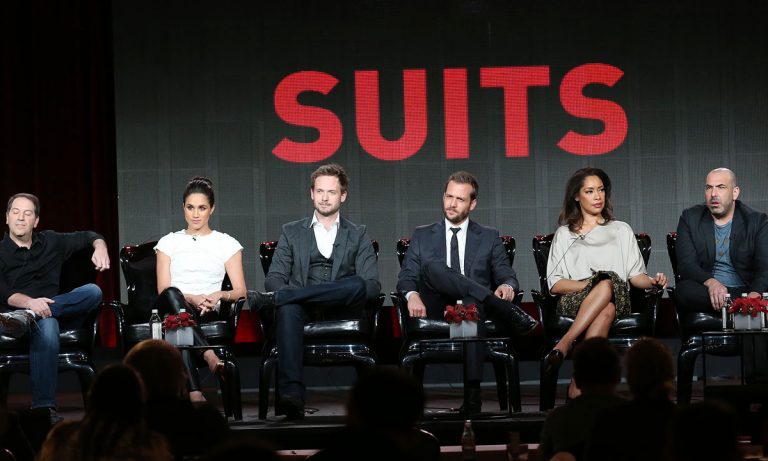
But what about Markle’s former “Suits” co-stars? Every bride- and groom-to-be makes tough decision (apologies in advance to that B-level college buddy who didn’t quite qualify) though in Markle’s case, she hasn’t forgotten her work friends.
According to sources, “The cast has been contacted in regards to invites from Kensington Palace.” What’s more, it appears “the cast and key executives from the hit U.S. show are on the invite list for the royal wedding.”
If you care about these types of things, you’re probably wondering just who did and didn’t receive invitations. And though we can’t definitively answer such an important question, social media does give us a clue because—*cue dramatic music*—some “Suits” castmates have been dropping heavy hints with nearby travel pics.
Last week, Patrick Adams was low-key flexing with some “totally spontaneous” motorcycle pics. His location? Morocco, which is a mere 32 hour drive away from the U.K.. Adams, in case you forgot, played Mike Ross, Markle’s husband on the show.
Also we have Sarah Rafferty just “casually” posting some Instagrams with her daughter in Paris. Proud mom sharing an intimate moment with her child on a social media platform or a bat-signal suggesting she’s nearby for the royal wedding? You decide.
Then there’s perhaps the most blatant clue of all. That would be Jacinda Barrett. She’s married to “Suits” actor Gabriel Macht and you won’t believe where she’s posting Instagrams from. That’s right. Buckingham Palace, a.k.a. the home of the Royal Family.
It’s estimated that every day 37 trillion cells in your body will have trillions of new mutations. If you’re doing something out of the ordinary, like sunbathing or having a drink, then science says you’ll be “mutating” even more. Which is creepy, because that’s a scary word unless you’re watching X-Men.
A million things could go wrong in each of these processes but somehow, most of us are fine and go about our days without even knowing something’s up.
The Atlantic reports that our human genome can be compared to a finely tuned car, and that many of our everyday mutations are as simple as changing the tint of our car window. For example, humans are constantly shedding their stomach lining, which means that those cells are dividing themselves frequently to replace others. You won’t grow an extra arm out of it or get cancer, because these mutations are not a big deal.
Other mutations, however, are more complex. For example, smokers’ lung cells come in frequent contact with tobacco smoke, causing more mutations than normal. The same happens with your skin, which gets frequently exposed to sunlight.
According to experts, the older people are, the likelier they are to have cancer because it gives them more time to accumulate the wrong set of mutations. Which is so strange and not reassuring at all. At least human history proves that our bodies kind of know what they’re doing; after thousands of years, we’re still here.
“Overdosing” happens because of lack of understanding regarding how to calculate how much THC is in a serving, and how the THC affects your body.
For how popular edibles are, there’s a surprisingly little information out there about the process of making them. We’ve all heard that story from a friend about how easy it is to “overdose” on edibles, even for the most seasoned of marijuana enthusiasts. This is all due to a lack of understanding regarding how to calculate how much THC is in a serving, and how the THC present in edibles affects your body.
Here’s a simple set of guidelines to follow when it comes to prepping and consuming your own edibles, because there’s no such thing as having too much information:
Identify How Much THC Is In The Strain You’re Cooking With
On average, most strains have about 10 percent THC. Strains with 15 – 20 percent are above average and the ones with over 30 percent are often medicinal. Be sure to look up your strain online or ask your provider about how much THC the strain contains.
How Much Should You Start With
If your strain has 10 percent THC, then a gram of cannabis contains 100mg of THC. This simple math problem will allow you to know, or to give an educated guess, on how much THC you have per serving. This will grant you some power over your high and prepare you for your edible.
A good starting point for beginners would be 5 milligrams per serving. 3 grams of ground marijuana equals 300 milligrams of THC. If you make 60 cookies, each one will have 5 milligrams of THC and you’ll be the best cannabis cook there ever was.
Tips For The Best Cooking Experience Ever
Prep your kitchen! Wash your utensils so that you avoid contamination and be sure to prop open a window or two because it will get aromatic.
Eating cannabis with protein rich and fatty foods will elongate the effects of marijuana on the body. Eating cannabis in an alcohol base will produce effects with a shorter duration. Keep this in mind when consuming.
Patience is also key when consuming an edible. If it’s been two hours since you consumed the edible and you’re still not feeling high, eat something that’s rich in proteins which will kickstart the effect of marijuana. On the other hand, if you’re feeling a little too high, try raising your blood sugar with some OJ or something that’ll get your spirits up. Ingest wisely!
For college students across the country, commencement formally marks the transition from student to graduate. Per tradition, most schools feature speakers, give out awards, organize departmental dinners – and, of course, designate caps and gowns for students to wear when they receive their diploma.
But in the midst of the official pomp and circumstance, more and more graduates are adding a personal touch: They’ll decorate their graduation caps, also known as mortarboards.
As a folklorist, I pay close attention to the creative ways in which people choose to express themselves, which can tell us a lot about their beliefs, perspectives and aspirations.
When I attended my first University of Nevada, Las Vegas, commencement ceremony as a faculty member in 2011, it struck me how widespread the practice of decorating mortarboards had become. I wanted to learn more about how graduates were decorating their caps, what messages individuals wanted to convey and what these messages revealed, more broadly, about their college experiences.
So I began gathering data on the caps from photographs, surveys and interviews. Much of it will eventually be digitally archived by the Center for Folklore Studies at The Ohio State University. While the project is still ongoing, I’ve begun to identify a few key trends.
Celebrating The Accomplishment
The practice of embellishing mortarboards is by no means new. In the 1960s, some graduates would affix peace signs to the top of their caps to protest the Vietnam War. When I completed my B.A. at University of California, Berkeley, in 2003, it was not uncommon to see decorated caps atop the heads of graduates.
Today, however, it seems to have become much more popular – which can probably be attributed, at least in part, to social media. As one person I interviewed put it, these caps are very “Instagrammable”: visually appealing, easy to photograph and sure to garner likes and comments.
It makes sense that people would want to announce the accomplishment of graduation, and a photo of a personalized cap posted on social media is one way to do so. Sharing images of customized caps inspires others to do the same, and so the practice spreads.
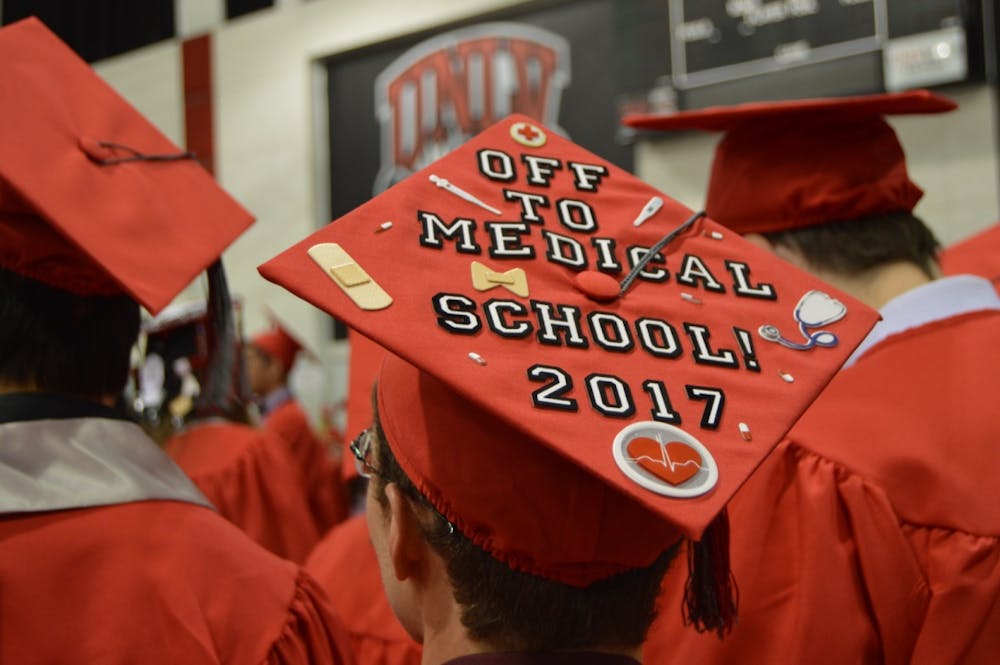
Not surprisingly, many of the messages on decorated caps reaffirm the value of higher education and look optimistically to the future (“The Best is Yet to Come,” “Time to Spread Your Wings”). Others reflect school pride by including a university logo or mascot or identifying the graduate’s major or academic accomplishments.
One student is already looking ahead to med school. Sheila Bock, Author provided
Identity often influences what appears on the caps. You’ll see students reference their family, their veteran status, their hometown, religious beliefs and personal obstacles they’ve overcome.
A University of Massachusetts at Amherst student thanks her parents on her mortarboard. AP Photo/Beth J. Harpaz
Was It All Worth It?
Humor is also common. Sometimes it’s deployed to highlight the graduate’s personality or mock the formality of the occasion, with phrases like “Thanks Mom, Dad and Alcohol.” One cap had a 3-D model of a beer pong table – little cups included – affixed to it.
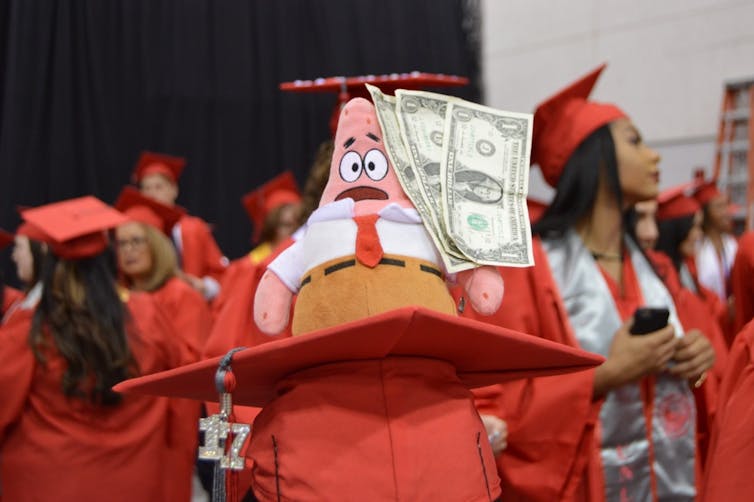
But graduates will also use humor to engage with more serious issues. One 2017 UNLV graduate’s cap, for example, featured a homemade version of the “I Have Three Dollars” meme, which features Patrick Star from the animated children’s television show “SpongeBob SquarePants.”
The degree is taken care of – but what about the debt? Sheila Bock, Author provided
While making a humorous pop culture reference, the student was really calling attention to her experience of being a poor college student – and the fact that she’ll be carrying significant student loan debt well into the future.
It’s just one of many examples that show how graduates can creatively use the space on their mortarboards to resist the celebratory mood of commencement, questioning whether the time and money spent on a degree was really worth it (“My $35K Hat,” “Was the BS Worth the BS?”).
Taking A Stand
Like the graduates protesting the Vietnam War in the 1960s, today’s graduates are also making political statements. Slogans like “Black Lives Matter” or images of raised, clenched fists will appear on caps.
The mortarboard has become a space to make political statements. Sheila Bock, Author provided
The University of Nevada, Las Vegas, where I have collected the majority of my data so far, is among the most diverse campuses in the nation. In observing and tracking mortarboard cap decorations over the last couple of years, I have seen a marked increase in the number of caps that highlight the wearer’s racial and ethnic identities (“Black Girl Magic,” “This Xicana from El Chuco. ¡Si Pudo!”).
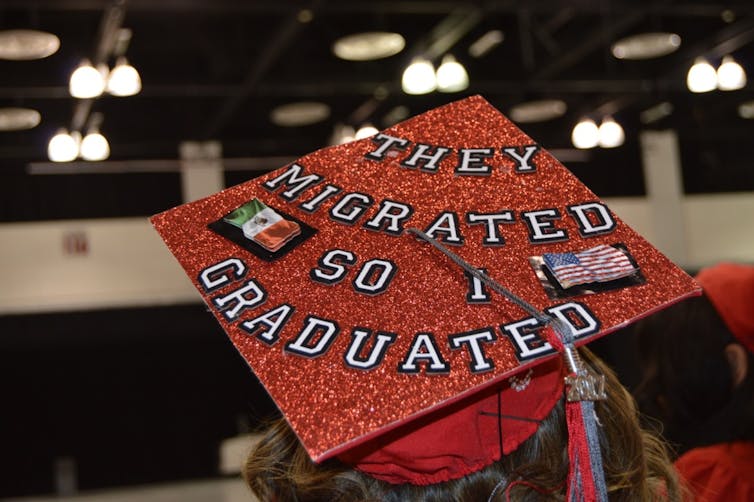
Then there are the mortarboards that point to the immigrant status of graduates or their families: “They Migrated So I Graduated,” “Product of Immigration,” “A Product of 2 Refugees Now with 2 Degrees.”
For the children of immigrants, receiving a college degree can be a huge milestone in their larger family story. Sheila Bock, Author provided
To these graduates, it’s important to show that the procurement of a college degree is part of an ongoing family immigration story characterized by hard work and perseverance. Images of butterflies – a symbol of the immigrant rights movement – also dot many caps. A good number reference the DREAM Act and the hostile political climate immigrants and their families find themselves in.
Everyone experiences college differently. For every student who spreads their wings socially or falls in love with their major, there are those who struggle to stay on top of tuition bills and keep up their grades.
While all of these students end up in the same place on graduation day, a critical look at these mortarboards gives us both a glimpse into the varied paths students take to graduation and the different futures that await them.







 While all of these students end up in the same place on graduation day, a critical look at these mortarboards gives us both a glimpse into the varied paths students take to graduation and the different futures that await them.
