A New Jersey Appellate Court earlier this week claimed the health benefits of cannabis are abundantly and glaringly apparent now,” forcing the state lawmakers to review its medical marijuana program.
In an unprecedented ruling, two out of three judges on the appellate court panel essentially confirmed that marijuana is medicine, saying that Gov. Chris Christie and his administration are required to revisit the legal status of the state’s law regarding marijuana.
For more than four decades, marijuana has been classified as a Schedule 1 drug under federal and state laws. The classification means that the herb has a “high potential for abuse” and is in the category as heroin and LSD.
The court’s ruling said that Steve Lee, the former director of the Division of Consumer Affairs, had the state’s legal authority to reclassify marijuana, despite the federal mandate. In 2014, Lee, citing the 1971 federal law, refused the rescheduling request from plaintiff Steven Kadonsky, who was serving a life sentence for trafficking. Kadonsky’s defense team claimed that marijuana was incorrectly scheduled under New Jersey law.
The judges, noting that New Jersey had allowed medical marijuana since 2010, agreed. If New Jersey citizens were allowed to use cannabis to treat pain, PTSD, and other qualifying conditions, the state had standing to consider rescheduling.
The court’s ruling does not change marijuana’s legal status in New Jersey and the Attorney General’s Office plans to appeal the decision to the Supreme Court. But the decision could be an impetus for rescheduling marijuana.
Judge Michael Guadagno, who wrote the majority opinion for the appellate panel, is married to Lt. Gov. Kim Guadagno, the Republican front-runner in November’s governor’s race. Although the gubernatorial candidate is an ardent opponent of recreational marijuana, she has gone on record as saying she would make it easier for people to have access to medical marijuana.
Her likely Democratic opponent Phil Murphy wants to “legalize marijuana so police can focus resources on violent crime.”
For every cause, there is an effect. For every bud you smoke, there is a reaction. The key to combating these effects such as sleepiness, hunger and extensive euphoria is knowing which type of strain is perfect for what you’re trying to accomplish.
For example, marijuana that’s higher on the THC side might have you feeling happy and euphoric, but also might have a dizzying cerebral high that’s not too great if you want to socialize with people or be productive. (FYI, I’m talking about you Blue Dream).
Know that there are multiple ways to consume marijuana, you can eat or drink it, rub it into your skin, vape, smoke and much more. Ask the budtenders at your local store which products have the strains listed and then pick how you want to put it into your body.
The following are 10 strains you can order to help you focus.
Harlequin
Harlequin is the answer to your prayers. This sativa strain is spicy and herbal with a higher dose of CBD that will get your mind right on track. Plus, you’ll feel relaxed without becoming too sedated.
Blue Widow
Blue Widow is a hybrid strain that’ll even make the most mundane task, seem interesting. You can focus and get some enjoyment out of whatever it is that may require your attention. The strong sweet buds will definitely put you in a good mood, too
Ghost Train Haze
No you won’t be taken on a spooky, scary ride. In fact, Ghost Train Haze is the perfect combination of concentration and happiness. Plus, the sativa-dominant strain has a complex collection of flavors that’ll satisfy your senses.
Kali Mist
A lightweight sativa strain that’s part earthy and part sweet, Kali Mist is just what you need to be productive and sharp throughout the day.
Allen Wrench
If there was ever a sativa strain that would make cranking out hours of paperwork, dealing with obnoxious colleagues and insane management, slightly less gruesome, Allen Wrench is it. It’s citrusy and woody and the perfect happy high for concentration.
Blueberry Headband
This hybrid strain is 50/50 sativa and indica that produces a great cerebral high. You’ll feel happy and uplifted without the jitteriness to interfere with your productivity.
Super Sour Diesel
This strain is perfect for cranking out at-home projects. (It’s super dank and pungent smell might not be the best bud to indulge in before work).
Permafrost
Permafrost is actually great for treating patients with ADD/ADHD because of it’s relaxing, calming abilities that will have you focused, but not too fixated. The pine-like aromas are also very, very soothing.
Jesus OG
This herb deserves an amen. The lemony aromas create a nice high that call for clarity and functionality. Jesus OG is a sativa-dominant strain so you’ll be uplifted and inspired, while focused and driven.
Cherry Bomb
Cherry bomb is a fruity hybrid strain that’s explosive in the best way possible. It’s musky and berry, but it’s strong sativa buzz makes it a great daytime companion. You’ll feel happy, relaxed and have enough energy to concentrate fully.
You might have heard of the 80/20 principle. Many celebrities claim that it’s one of the most successful methods of maintaining and losing weight. More than a fad or strict diet that people struggle to maintain for a couple of weeks, the 80/20 principle is a lifestyle and something that, once you commit to it, can be maintained for really long periods of time.
Without getting into the math of it, the focus of the method is to eat clean and healthy foods for 80 percent of your meals, leaving you with a 20 percent window where you can do and eat what you please. If you eat 3 meals a day, that means that during your week you have 3 meals where you can go crazy. A lot of experts suggest that, when starting off the method or when looking for weight loss, you should follow the 90/10 rule, which leaves you with a more strict plan that has less cheat meals per week. Once you find your groove and get to your desired weight, you can add more cheat meals and be more lenient.
The 80/20 method is a smart way of changing your relationship to food and of helping you be more comfortable with yourself. Popsugar interviewed Yumi Lee, Jessica Alba’s trainer, who vouches for this meal plan, claiming that it’s the reason why the actress is able to maintain her weight while also having a life.
“You can’t be a 100 percent all the time, but you can be 80 percent all the time.”
It’s understandable why this diet has so many followers and devotees. Diets and weight loss programs encourage people to eat healthy and to limit themselves, but this gets harder the longer you’ve been trying to lose weight, which is why the 80/20 rule sounds so great. Instead of limiting yourself and setting unrealistic goals for your diet, the rule suggests a change of lifestyle, which, even though it takes work, will probably provide better and longer lasting results.
While there are some women in the world who are very particular when it comes to their sex life, every woman appreciates simple things.
Sex can be pretty complicated, but good etiquette while getting down might be even more important than talent when it comes to providing orgasms and having a good time. While there are some women in the world who are very particular when it comes to their sex life, every woman (and we mean every woman) appreciates these 5 simple things, which should be implicit.
Once committed to memory these 5 simple acts will help you become the great sex partner you’re meant to be, no matter your level of expertise, trust us:
If you’re only worried about yourself while having sex you might end up having fun, but you probably won’t get a second date. The majority of women want to have sex with someone who’s into them and who tends to their needs. To be the best partner you can be, you have to put in your work and invest yourself in whatever it is that you’re doing. It’ll be worth it in the long run.
Using the necessary protection shouldn’t be a demand that women make, it should be implicit. Acting surprised when women ask you to wear a condom is inexcusable, and will only make you seem annoying and immature.
It’s important for you to value her orgasm as much as your own, no matter how exhausted you are after you have sex. Get to know yourself and your body, so you can prevent that after sex slump and get her to orgasm before you fall asleep.
It’s very important to have clean sheets once you bring someone home and to not make them have sex in a crusty and crumbly bed. Please, do your laundry and clean up your place before you have visitors.
It should go without saying, but it’s very important that you invest the necessary amount of time and dedication into foreplay. Make the moment last and enjoy every second of it, even though it’ll require a little patience. Foreplay will also get her body and mind ready for sex, facilitating a sexier and better experience between the two of you.
The disconnect that the East Coast carries to actual, in-the-ground-cannabis, has far and surpassed what could be called a shame. How many of us have seen a plant up close? Seen a row of plants? Smelled a mountain brisk from late morning clouds pumping the blood of the plant itself all over you? Something that once grew freely and was made into goods is now whispers and passwords and mostly come from places in the world that don’t feel like our plane of reality.
Having the opportunity to see them up close and in their happy place was a pleasure and a privilege, and one that has sharpened my focus on what’s important in the context we exist in. Being a passerby in a cool community of humans who have turned an affinity with nature into a daily quasi-wildcraft is the sweetest part. In the lands of Northern California, nature makes the schedule.
Photos by Danielle Guercio
When I arrived, there was work to do for sure, as there’s always something to do on a farm, but nothing in the weed wing was urgent or timely, so we shifted gears for a day to press grapes from the mountainside vineyard that needed immediate attention. This really drove home that pretty much everywhere that grows wine quality grapes can also sustain cannabis cultivation. Pressing grapes is in my Mediterranean blood, so I found it incredibly fun and informative, since I’d never done it before. Bucket after bucket we loaded into a hydraulic press imported from Italy. The smell of these wine grapes after their sugary sojourn in a fermentation tub was crisp, thick, and warm, like a cut apple. I got a whole new respect for my one uncle’s private wine stash that he maintains year after year like the Sicilian grandpa he is.
Photos by Danielle Guercio
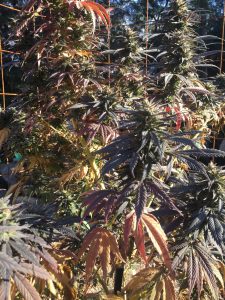
When I finally rolled up to the side of the mountain where the greenery lived, I took as many lingering glances at the geometric beauty of the blooming flowers and all of their pistil and crystalline curling leaves as I could. I was trying to imprint forever on my mind what I’d normally only seen in magazines or online. One plant in particular, a 6 foot tall and 4 foot wide specimen of God’s Gift, was painted with sunlight for most of the day which made its variant shades seem like they leapt right out of a paint palette. Each plant has its own thickly perfumed perimeter, enveloping most of the surrounding area with a melange of all of the strains populating any given area.
Photos by Danielle Guercio
Just like with wine, growing weed takes hours and hours and hours of labor from ground to harvest and processing. It was incredible to be able to participate in even just the smallest part of that day to day attention that pumps out quality buds to most of America. It completed a cycle that as a lifelong East Coaster, I was completely divorced from. The actual earth based part of cannabis consumption couldn’t be more foreign to someone like me. The day flew as I carted pile after pile of dirt to be preserved for the next year. The work was physical as to be expected, and it puts a completely different lens on what we’re smoking, eating, and vaping everyday, 3000 miles away.
Photos by Danielle Guercio
At risk of wildfires and wild weather, weed is worth as much as gold so things must ebb and flow to gain as much benefit as possible. Growers never know when Mother Nature can send them a curveball, and there are many. Those who produce cannabis have to be on the same wavelength as the ground they stand and grow on. Experiencing this deeper connection to the plant will be enriching my connection anything green I touch for the rest of my life.
Thanks to a sky-high Rotten Tomatoes score and an extremely enticing trailer, the anticipation for Thor: Ragnarok couldn’t be higher. Of all the Hulk smashing and zippy liners, one thing that really stood out was seeing Thor’s mystical hammer Mjolnir being destroyed by the Goddess of Death, Hela.
For the Marvel Cinematic Universe these are new waters we’re treading. As far as movie fans know, Mjolnir was simply indestructible. But for us nerdy comic fans, this is old hat, it’s happened at least six times.
Let’s explore just how and why Thor’s legendary hammer has previously crumbled.
The Destroyer Destroys
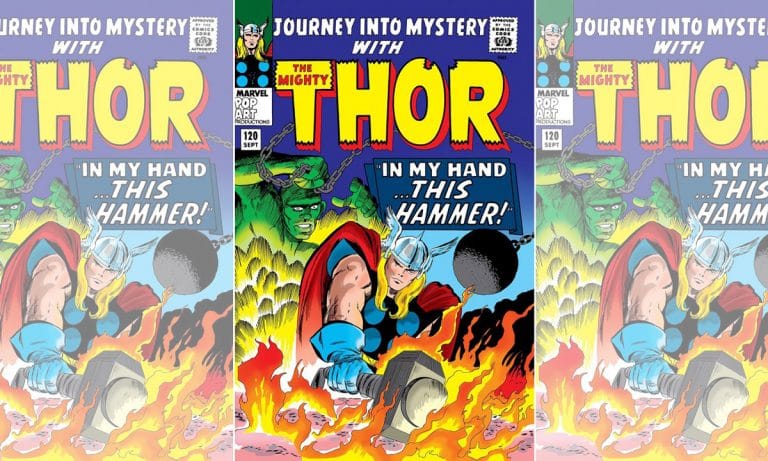
The first time the unthinkable happened was way back in 1965 in Journey Into Mystery #118. After some of Loki’s patented tomfoolery, the dreaded Destroyer armor was unleashed on Earth and was causing quite a ruckus. Worthy of note is that the Destroyer was able to actually lift Thor’s hammer—a feat that had not been achieved by anyone other than Thor himself at this point.
But, not only could the Destroyer lift it, he could also destroy it. He fired immense energy from his fingertips slicing poor Mjolnir in half. Luckily Odin (Thor’s All-Father) intervened and stopped the Destroyer’s onslaught. Thor then boogied on over to Pittsburg and got his hammer fixed up using a blast furnace. Classic Jack Kirby and Stan Lee goodness!
Molecule Reconstruction
Cover art via Marvel
The next time Mjolnir got broked it had some friends to share in its pain. Molecule Man often plays the supervillain to our faithful heroes, using his power to change matter and manipulate reality at the atomic scale for evil.
In battle with Marvel’s biggest heroes, Molecule Man atomized Thor’s Mjolnir, as well as Captain America’s shield, and Silver Surfer’s surfboard. Later he comes to his senses and reconstitutes our heroes’ weapons and agrees to go to therapy. Not every story has to have a super cool ending, sometimes it’s okay for things to just end. (From Avengers #215, 1981)
Self-Inflicted Hammer Wound
The unthinkable is becoming pretty thinkable at this point. Mjolnir can be broken, it just takes somebody really powerful to do it. What makes the third time interesting is Thor himself breaks Mjolnir, this time, by bashing it against a freaking Celestial’s head!
Celestials are these enormous 2000-foot tall space gods. They travel across the universe seeding life on planets, then destroying that life if they don’t think it’s progressed enough after an amount of time. In Thor #388 the Celestials ran afoul of a thunder god who meant to oppose them in their bid to end life on Earth. After a short time, the Celestial known as Exitar saw no point in continuing the fight. He healed Thor’s wounds and fixed his hammer and the Earth lived to see another sunrise.
Two Becomes One
In Thor Vol. 2 #10, the Dark Gods had enslaved Odin and taken over Asgard while Thor was busy being a superhero on Earth. The Dark God Perrikus sliced Mjolnir in two with his badass sword, then tried to lift what was left of the handle. Unfortunately, he wasn’t even worthy enough to lift the handle as the Odin’s enchantment remained intact.
Thor got the pieces of his hammer back together, and they uhhh… they just kind of reformed, and the hammer was whole again, because comics! He then gives Perrikus the beat down of an immortal lifetime, saves Odin, Asgard and the day.
Ragnarok
Loki had the fire giant Surtur forge several hammers from the same mold that Mjolnir was made from. He then gave the hammers to Thor’s greatest foes, like Ulik the Troll and Fenrir. They attacked and destroyed not only Mjolnir, but Asgard as well. This kicked Ragnarok off, and brought Thor to the end and back again as he sacrificed both his eyes and his life for the power to change the cycle of Ragnarok forever. Thor Vol. 2 #80 (2004)
More Loki Tricks
Cover art via Marvel
The most recent Mjolnir destruction time was again another Loki prank. Loki brings Thor’s grandfather Bor from the past into the present. Then in true Loki fashion, he makes Bor see illusions of demons, when there’s nothing there but regular old New York townsfolk. Thor attempts to stop him, and an enormous battle ensues.
Never having met his grandfather, Thor holds nothing back, he bashes the elder god so hard against the head that it breaks Mjolnir and kills Bor. Thor then learns that he killed his own grandfather and is banished from Asgard, so that Loki could continue his schemes unimpeded. Thor had to call in help from Dr. Strange to fix Mjolnir this time, and had to share some of his own life essence to get his hammer back. Bet he wishes it was still the 90’s so his hammer would just reform at will. Thor #600 (2009)
So that’s all the times poor Mjolnir has been broken. That poor hammer has seen some stuff, man.
Last month, President Donald Trump declared the opioid overdose crisis “a national health emergency” and assured the American people that “we can be the generation that ends the epidemic.” But in Trump’s major announcement was short on substance.
In the Oct. 26 speech, he reiterated the false notion that building the US-Mexico wall would stop the flow of drugs into the country. His other major “really tough, really big, really great” advertising campaign that would convince Americans never to do drugs in the first place.
Drug policy experts were not impressed and hoped that Trump’s special commission on the opioid crisis, led by New Jersey Gov. Chris Christie, would fill in the gaps.
On Wednesday, the opioid commission revealed its report and it, indeed, is more specific than Trump’s vague proposals. The panel lists 56 recommendations in The President’s Commission On Combating Drug Addiction And The Opioid Crisis, highlighted by a call for more drug courts and easier access to opioid alternative for pain patients.
Missing from the 56 suggestions, is any consideration for cannabis as a pain therapy. The report not only dismissed medical marijuana as a possible treatment to help get opiate addicts, it took an illogical swipe at the idea. In a letter addressed to Trump, Christie wrote:
“The Commission acknowledges that there is an active movement to promote the use of marijuana as an alternative medication for chronic pain and as a treatment for opioid addiction. … The Commission found this very disturbing. There is a lack of sophisticated outcome data on dose, potency, and abuse potential for marijuana. This mirrors the lack of data in the 1990’s and early 2000’s when opioid prescribing multiplied across health care settings and led to the current epidemic of abuse, misuse and addiction. The Commission urges that the same mistake is not made with the uninformed rush to put another drug legally on the market in the midst of an overdose epidemic.”
Christie’s statement flies in the face of science. There are plenty of research demonstrating that legal cannabis access is associated with reduced rates of opioid use, spending, abuse, hospitalization, and mortality. The National Institute on Drug Abuse recently updated its webpage on marijuana, specifically detailing its ability to lower the use of prescription opioids in states where it is legal.
Cannabis is effective at treating chronic pain and many patients have chosen an herbal solution rather than prescription opiates. Clearly, more studies need to be done, but for a governmental commission to shut down the possibility is troubling.
But the report is not surprising, considering who is on the committee. As Vice News reports:
Christie, a former federal prosecutor, has previously railed against marijuana legalization, calling it “beyond stupidity” and describing tax revenue from legal weed sales as “blood money.”
“We are in the midst of the public health crisis on opiates,” Christie said in a speech in May. “But people are saying pot’s OK. This is nothing more than crazy liberals who want to say everything’s OK. Baloney.”
Other members of the opioid commission have also publicly opposed marijuana legalization. Dr. Bertha Madras, a Harvard Medical School professor and the former deputy director for demand reduction in the Drug Czar’s office, has advocated for keeping weed in the same restrictive category of illegal drugs as heroin. Gov. Charlie Baker of Massachusetts, where voters approved a recreational marijuana law last year, said previously that “marijuana is not safe” and causes “severe mental health issues.”
Another committee member, former Congressman Patrick Kennedy, who is a recovering opioid and alcohol addict,has spent the last six years railing against marijuana legalization. He has called marijuana is a “Trojan horse” and warned that cannabis consumption is a “hazard to public health.” Since 2013, he has been involved with Smart Approaches to Marijuana, an anti-marijuana organization led by Kevin Sabet.
There were many positive recommendations in the report, but the Trump administration’s anti-science rhetoric remains a concern to drug policy advocates. “President Trump’s remarks on the opioid overdose crisis last week emphasized a ‘just say no’ approach and escalating the drug war,” said Grant Smith, deputy director of national affairs with the Drug Policy Alliance. “The opioid commission was a mixed bag, with some good public health recommendations. The question now is how will they stand up to President Trump’s punitive approach to the opioid overdose crisis?”
More than half a million Americans died of drug overdoses from 2000 to 2015, according to the Centers for Disease Control and Prevention. Each day, 91 people in this country die from an opioid overdose — more than 33,00o a year. Drug overdose is the leading cause of accidental death in the U.S. and opioid addiction is driving this epidemic. In 2015, more than 20,000 overdose deaths were reported related to prescription pain relievers, with another 13,ooo overdose deaths related to heroin.
Are you struggling to get a good night’s sleep? Give Calm No. 101 a try. A little inspiration while you write? Give Created No. 301. Or maybe you a boost of energy before going for a hike? Give Charge No. 501. Silly strain names like “God’s Gift” may soon be a thing of the past.
CANNDESCENT, a California cannabis grower, is eschewing strain names such as Gorilla Glue, Green Crack and Alaskan Thunderfuck and choosing instead to offer names that are more consumer friendly.
“You shouldn’t need to bio-hack your body through a periodic table of ominous strain names like Durban Poison and Trainwreck just to buy some pot,” said Adrian Sedlin, CEO of CANNDESCENT. “The way Apple made computing more intuitive and Google streamlined search, we want to democratize strain selection and provide users the opportunity to curate their life experience. Google asked, ‘What do you want to know?’ CANNDESCENT asks, ‘How do you want to feel?’ ”
It is a trend the industry is embracing. The stoner nomenclature of strain-naming simply does not resonate with today’s new consumer base. Why would a patient in his 70s want to purchase a medicine called AK-47? Sure, the cannabis aficionado most likely will be familiar with that specific type of marijuana. But as the herb becomes more mainstream, consumers are desiring clarity.
“Our biggest opportunity rests with the 98 percent of adults who are not regularly enjoying cannabis,” said Sedlin. “We seek to educate them.”
Educating is a large part of CANNDESCENT’s mission.
“Strain names no longer communicate usable information because different growers cultivate the same strain using different phenotypes, grow mediums, nutrients, environments, skills, and pesticides.” said Rick Fisher, CANNDESCENT’s executive vice president of operations. “Selecting CANNDESCENT Connect No. 401 or any of our strains, users know CANNDESCENT made it and millions of dollars went into creating a robust, reliable and pesticide-free experience.” Fisher added.
The company offers 24 strains under the existing system, and noted that it can accommodate up to 500 strains with plans to add new strains over time.
Retailers See The Light, Too
CANNDESCENT may be the first cultivator to move toward the improved naming convention, but retailers have also seen the light.
Sean Miller, managing partner at Origins, a premier Seattle cannabis retail store, is one of them.
“At Origins we recognized there is natural bias for cannabis recommendations without structured cannabis guide training and product categories,” Miller said. “To limit the traditional recommendation bias where cannabis guides recommend their favorite strains rather than a strain that best fits the clients’ needs, Origins has organized its strains by cannabinoid profile and ratio, which are then categorized into “Lifestyles.”
“Once we have established a strain’s Lifestyle, cannabis guides receive training on each Lifestyle and strains within the Lifestyle. With these tools we have found that cannabis guides are empowered with relevant data and information to make educated recommendations versus relying on personal favorites. Origins goal is to provide relevant recommendations thus creating loyal and educated clients,” Miller added.
Vela, another top-shelf Seattle retailer, provides its customers with the “Vela Spectrum.” Each of the cannabis products in the store is sorted along the spectrum to provide a clearer understanding of your choices.
The “Spectrum” categories include:
Hush
Unwind
Flourish
Ignite
Each of the four main spectrum fields then include six sub-categories.
Hush, for example, breaks down into:
Anchored
Calm
Body Melt
Deep Relaxation
Sleepy
Tranquil
It’s a trend whose time has come. Goodbye, Cat Piss. Goodbye, Hog’s Breath. And hello names that will help the consumer.
We’ve all been there before. You sit down for a nice meal with an old friend and new lover. After some fragrant libations and toasty conversations, the food arrives and you can’t wait to dig in. But wait you must. Because someone pulls out their phone to snap foodie pics to post on Snapchat or Instagram. Most everyone has been guilty of it at some time or another. Judging by these top foodie hashtags of last year and the rise of celebrity foodies, this type of food picture-taking act isn’t disappearing anytime soon.
So what to do? Really, at the end of the day, this isn’t the biggest deal in the world. If you really hate when your dinner partner snaps a picture, then just say something. But if you want to play a killer prank on your foodie friend, social media star Kevin Freshwater has the trick for you.
In a recent video he uploaded to his accounts, Freshwater sits across from his eating partner for the meal, filming them posing their ultimate foodie pic. But right before they snap the picture, he mushes the meal with his fork or spoon, ruining the shot forever.
Their shocked expressions are truly something to cherish.
Former presidents are just like you. Barack Obama, the 44th President of the United States, has been summoned juror at a Cook County, Illinois court this month. Obama owns homes in both Washington DC and Chicago’s Kenwood neighborhood, making him applicable to serve.
Chief Judge Tim Evans told the Chicago Tribune that Obama will fulfill his civic duty, though Evans wouldn’t mention the court or date of the hearing. Evans said Obama has “he made it crystal-clear to me through his representative that he would carry out his public duty as a citizen and resident of this community.”
Additional accommodations will be made to service Obama’s heightened security presence.
“Obviously we will make certain that he has all the accouterments that accompany a former president,” Evans said. “His safety will be uppermost in our minds.”
Obama will become the highest-profile juror in Cook County’s history, though he joins celebrated celebrities like Oprah and Mr. T, who also served as county jurors. Other politicians have served as well, including governors and mayors, according to the Tribune.
For his services, Obama will be compensated like any other juror—a $17.25 daily wage. That’s a slight pay cut for someone NPR reports received a $400,000 check for just a single speech to a Wall Street firm.
“He’s a great citizen of his city and this county,” Evans told NPR. “We’re happy that he recognizes his responsibility as a citizen to serve just as anybody else would.”