Cannabis, no matter how it’s used, always provides relief and therapeutic effects, be that for those who need help destressing at the end of the day, or for patients who are treating more serious symptoms and side effects. While medical cannabis is mostly used for treating the symptoms of some serious illnesses, many researchers and studies believe it can also work to prevent illness.
Here are 4 areas where marijuana is one of the best preventative medicine:
A study from 2009 claims that the use of cannabis for over a 20-year-time period is linked to reduced head and neck squamous cancer. These preventative effects were also displayed in animal studies from 2012.
Inflammation
THC and CBD interact with the endocannabinoids in our bodies, preventing inflammation in diseases like arthritis, cancer and diabetes. Herb.com reports that animal studies conducted in 2008 demonstrated that cannabis lowered inflammation on the limbs of 70 percent on the tested animals.
Heart Disease
Massroots.com reports several studies that showed positive results when it comes to cannabis and heart disease. A 2013 study where researchers fed small doses of cannabis to mice found that the plant produced a 5 percent improvement in the efficiency of their heart ventricles. Other studies have shown that small doses of cannabis help the ventricles in the heart relax, increasing blood flow.
Aging
Cannabis, CBD oils and balms have proven to be very efficient for the skin, reducing aging, the development of wrinkles, bags and managing the symptoms of diseases like eczema and acne.
Everybody knows that because marijuana is a Schedule 1 drug under the Controlled Substances Act, it is illegal to sell under federal law. Last year, the FDA again reviewed the published scientific literature on medical marijuana and recommended that marijuana stay in Schedule 1. The DEA relied upon this finding in its August 2016 ruling upholding the cannabis ban.
What everybody doesn’t know is that the FDA’s website says that it “actively supports the development of drugs from marijuana.”
Some statements are even more emphatic: “FDA needs to do all it can to support the needed scientific research with marijuana to characterize its therapeutic promise.” What? Is the FDA suffering from cannabis cognitive dissonance? Not at all. Under the Food, Drug & Cosmetic Act (FDCA), the FDA has the power to approve drugs, based on scientific evidence.
The reason cannabis hasn’t been rescheduled is because, according to the FDA, there is not sufficient evidence to show a currently accepted medical use.
Where does the FDA get off saying there is no medical use? A look at the FDA’s history is instructive. Modern drug regulation started in the beginning of the last century when the market was filled with unregulated patent medicines claiming to cure everything from constipation to cancer. Many of these medicines, e.g., Johnson’s Mild Combination Treatment for Cancer, were merely worthless.
But some were poison. Elixir Sulfanimide was marketed in the 1930s as a raspberry antibiotic syrup. Unfortunately, this elixir contained diethylene glycol, a known toxin, and killed over 100 people, mostly children. The manufacturer performed no safety testing–because none was required. This and other tragedies in the 1930s led Congress to pass the Food, Drug & Cosmetic Act, the first comprehensive law requiring that medicines be proven safe and effective. This history shows the importance that the FDA places on its core mission of making sure that drugs are safe and effective, relying on scientific evidence including human and animal trials.
As previous readers of this blog might recall, the FDA will usually treat any substance that is “intended for use in the diagnosis, cure, mitigation, treatment, or prevention of disease,” or that will “affect the structure or any function of the body of man or other animals,” as a drug. The FDA’s key decision in approving new drugs is whether the drug is safe and effective for its proposed uses.
So How Do You Perform Scientific Research?
On its website, the FDA tells you how: “The FDA believes that scientifically valid research conducted under an [Investigational New Drug] application [INDA] is the best way to determine what patients could benefit from the use of drugs derived from marijuana.” The INDA is the method that most proposed new drugs begin the approval process. Once the proposed new drug has undergone the (extensive) testing required by the INDA, the test data can be used to file a New Drug Application (NDA). Virtually all prescription drugs sold in the U.S. are approved under an NDA.
Marinol was approved in 1985 to treat nausea caused by cancer chemotherapy, and Sydros, a liquid form of dronabinol, the active ingredient in Marinol, was approved earlier this year. Cesamet (nabilone) was approved in 1985 and 2006 for nausea and neuropathic pain. The active ingredients in all of these drugs are synthetic forms of THC. So we know that cannabis can be approved as a medicine.
Why Aren’t There More FDA-Approved Cannabis Drugs?
To find out, be sure to read our next installment, in which we will examine what you need to get an INDA and an NDA. Bring lots of paper or its equivalent; you will need to take notes.
For more on the FDA and cannabis, check out the following:
John Mansfieldis an attorney at Harris Bricken, a law firm with lawyers in Seattle, Portland, Los Angeles, San Francisco, Barcelona, and Beijing. This story was originally published on the Canna Law Blog.
Huntington’s disease is known as the fatal genetic disorder that causes a progressive breakdown of the nerve cells. HD diminishes a person’s physical and mental abilities over time, often causing uncontrollable and impulsive movements. As of yet, there’s no cure for HD.
However, a recent study shows that smoking cannabis may slow down the progression of Huntington’s Disease. The mental and physical inabilities and impulses patients experience over time, are directly linked to the striatum – the brain’s area that controls the brains outputs (thoughts and actions). This area is known to carry CB1 receptors, which are cannabinoid receptors, but patients with HD have a reduced amount of these receptors.
Researchers in Madrid sought to learn about the connection between reduced cannabinoid receptors and the development and progression of the disease. In their experiment, they used mice that carried the HD gene (the human version) and expressed a decreased amount of receptors and compared them to mice only carrying the HD gene.
The researchers then ran tests that examined motor coordination, exploration and strength. The results were astonishing: The mice that carried HD and also had reduced CB1 receptors, had their HD symptoms appear about 30 days sooner when compared to the mice only carrying the HD gene. Also, the disease in the first group of mice seemed to develop rapidly compared to the other mice.
Researchers also noted that the lack of CB1 receptors was linked to the breakdown of the nerve cells, causing the striatum to function ineffectively.
As the last part of the experiment, the researchers gave the mice carrying the HD gene only, doses of THC. Since this group of mice didn’t appear to have lost a significant amount of CB1 receptors, they would still be receptive to the THC. The Spanish researchers wanted to see if administering THC in the HD carrying mice would make the CB1 receptors stronger.
It did.
The THC enhanced the motor skills in the mice, decreased the progression of symptoms and helped the functionality of the striatum. The experiment proved that some THC (the psychoactive component of cannabis) can have a huge impact on those suffering from HD.
No, THC hasn’t been crowned the king of conquering Huntington’s Disease, but cannabis with THC can help curtail and prolong the symptoms of a disease that over 30,000 Americans are battling.
In just two weeks Michigan medical marijuana facilities will apply for licenses to do business in the state. Ahead of this date, the Department of Licensing and Regulatory Affairs has finally released a comprehensive set of rules that will dictate business practices.
The emergency administrative rules are designed to preserve patient protections and provide them with access to safe medical marihuana,” Bureau of Medical Marihuana Regulation Director Andrew Brisbo told MLive.
“These rules also allow growers, processors, secure transporters, provisioning centers, and safety compliance facilities to operate under clear requirements.”
Though the department had announced some select requirements of operations with regards to issues like license stacking and capitalization standards, it had not fully released a clear view of what the marijuana business would look like in Michigan.
The legislature last year passed new laws allowing licensed businesses to grow, process, transport, test and dispense medical marijuana. The laws brought businesses like medical marijuana dispensaries out of a legal grey area and put LARA and its newly-formed BMMR in charge of hammering out the details of what would be allowed and disallowed under the new system.
While there was concerted lobbying behind the scenes by businesses vying to grab a piece of what is expected to be a $837 million business, these rules have been filed under emergency status due to the expedited time crunch. Applications for medical marijuana businesses open in Michigan Dec. 15.
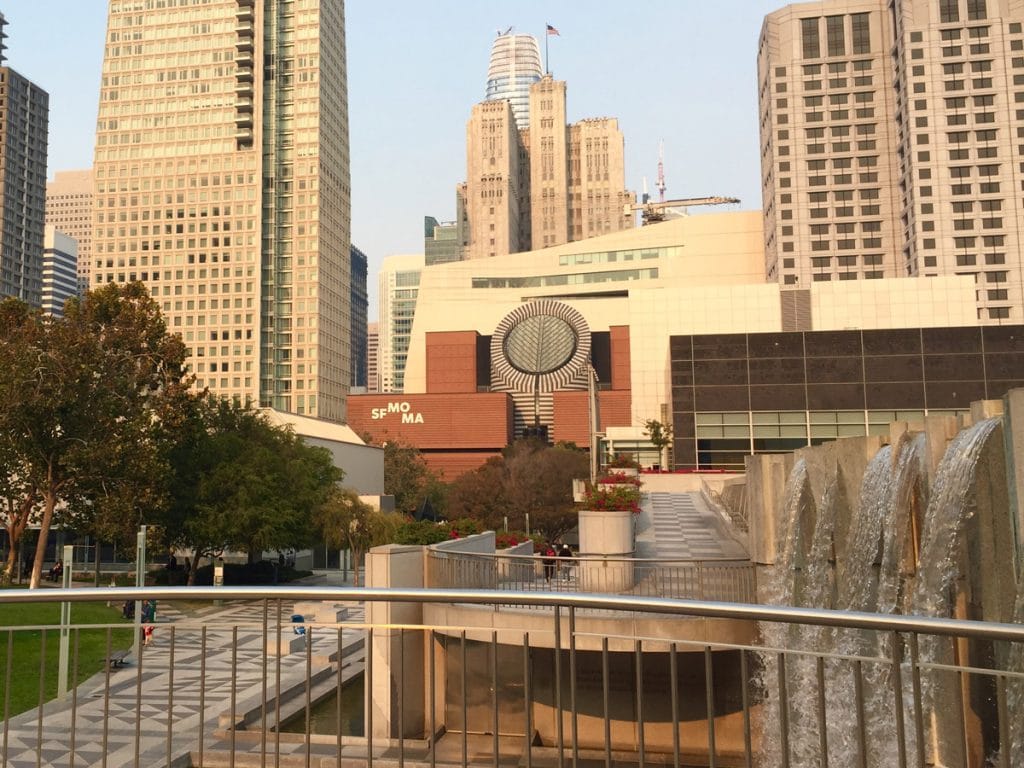
Living up to its reputation as one of the weed friendliest cities in the world, San Francisco, is also where it began to enter the mainstream zeitgeist. Though it’s been 50 years since the original Summer of Love, the echoes are there in ways that aren’t as clear on your first few visits to the colorful, unique and complex city, so you find yourself returning, hopefully from a new angle each time.
If you’re there to eat bourgie foods and see all of the tourist spots or your there to stuff burritos and shred skate spots, San Fran is one of the best places to indulge in cannabis. Unlike legal locales like Seattle and Portland, no one really cares if you turn and burn while stomping the streets, or post up in a park to pass it around. The city has got a lot to see if you’ve never been, and doesn’t run out of things to check out if you look closely.
Don’t be like me and wait until your second visit to see the Golden Gate Bridge or feast on the Pacific sunset. You can do both in one shot with a quick jaunt to Baker Beach, smoke spot of the ages, for all ages. This was both the site of a military base and the original Burning Man festival, and is a vista for all of the photos any visitor could want, with plenty of room for a crowd.
Haight-Ashbury District
Photos by Danielle Guercio
The cradle of hippiedom, the Haight still bears the markings of its formative era. Though now known for overpriced apartments, it’s an excellent spot for a high afternoon full of shopping in vintage shops, crystal corners, and people watching. With easy access to other neighborhoods and Golden Gate Park and it’s panhandle, this is an all-weather stop.
Mission Dolores Park
Photos by Danielle Guercio
In sunny weather, people hang out at Dolores Park, which has served as everything from original indigenous village to refuge for earthquake victims. It’s generally a bit warmer in the Mission than other neighborhoods, and the park is centrally located to the rest of the city, so many use this as a regular picnic spot. Lunch breakers and after class crews all roll out their blankets to soak up the sun and smoke a J at this popular hillside park. It’s got a legendary view of the downtown area, is full of interesting characters, and has all manner of dogs and creatures. This is a long time local smoke spot, where if you’re lucky enough to spot the rum and coconuts guy, your day may just be made.
Gordo Taqueria
Photos by Danielle Guercio
A burrito is the quintessential SF food, and with a large Latinx population from Mexico, it’s some of the tastiest food in town, across all genres. One of the best parts about visiting is the ubiquitous, affordable, and revered burrito lifestyle. Gordo’s is historic for being the rumored recipe at Dos Toros in NYC, the closest thing we have to SF burritos from a non-Mexican source.
Cafe Flore
Photos by Danielle Guercio
This cafe will be one of the first legal recreational spaces in California once the deadline has passed, and it’s perfect considering the cafe’s history as a cannabis activist meetingplace. It’s an iconic cafe in the Castro district that has been proudly the serving LGBTQIA community and SF since the late 70s, and it continues today to be a progressive icon. Here’s hoping next time i’m in town it’s a legal cannabis lounge in the spirit of Brownie Mary, a now deceased regular who was known for giving medicated brownies to people suffering from AIDS and cancer, before it was legal.
Photos by Danielle Guercio
If you’re going to San Fran before 2017 is out, you’ll have a great time, but you may want to wait until at least January 1st 2018, when cannabis will become fully recreationally legal in the state of California. It won’t change much to many Californians, and the historical smoke spots will be even more cherished from a time when things were more civilly disobedient.
Our day-to-day lives can be hectic and rushed, forcing us to jump from one place to another in order to get our tasks and responsibilities in order. While this can work for a while, there comes a point when the pressure takes a toll on your body, leaving us in a heaps of exhaustion. Patience is key for long-term success and for finding an emotional balance in your life, but patience is a virtue many of us don’t have. Luckily, the types of marijuana below can help you regain perspective.
Know that there are multiple ways to consume marijuana, you can eat or drink it, rub it into your skin, vape, smoke and much more. Ask the budtenders at your local dispensary which products have the strains listed and then pick how you want to put it into your body.
Here we’ve compiled a list of 10 types of marijuana that’ll have you feeling relaxed and patient, making you think before you act while also maintaining your chill:
http://giphy.com/gifs/yoda-Ll1rEkDebTIdO
Strawberry Milkshake
This delicious strain will leave your muscles relaxed, freeing them from any pain or ailment, and your brain tranquilized. It’s the perfect cure for sleepless nights where your brain can’t seem to stop running.
Star Tonic
This type of marijuana is sometimes used for medical purposes since it works wonders in relaxing your body and helping when it comes to pain and tension. Star Tonic will also leave you with some energy, perfect for carrying out activities that don’t involve your couch.
PVC OG
This California strain will relax body and soul without compromising productivity. It’ll help you get a lot of work done without the added stressor of anxiety and wandering thoughts.
Juliet
This type of marijuana will make you happy and calm, giving your brain the necessary focus and relaxation to carry out activities that can involve work related stuff, carrying out house chores and social situations.
Skywalker Alien boasts the coolest name out of this whole list and it also comes with a bunch of great effects that focus on your brain, leaving you with a cerebral high that’ll be relaxing, happy and stress-free.
Green Python
This indica dominant strain while make you feel super relaxed and giggly, perfect for cooling down after a stressful day.
Brooklyn Mango
This strain has delicious and fruity smells and flavors that include pineapple, mango and lemon. It’ll leave you feeling calm and comforted while stimulating your brain.
Grape Kush
With sharp and fruity aromas, Grape Kush will leave you feeling powerful and calm, inducing a full body high of blissful peace.
Electric Kool Aid
This is a great strain to use during the daytime, activating your brain cells and producing inspiring and creative effects while also relaxing your muscles.
Now that Prince Harry is off the market, talk has turned to a member of the Royal family who’s not only an eligible royal, but 22-years-old and a model.
Her name is Lady Amelia Windsor and she’s the granddaughter of the Duke of Kent (the Queen’s cousin). She made a splash earlier this week when she wore a braless, sheer number to the British Fashion Awards.
And while she may be the 36th in line for the throne, she has already been crowned one of the fashion industry’s “it” girls, having appeared on the cover of Tatler and in fashion shows for Dolce & Gabbana. According to The Sun, she was also featured in a campaign for the Italian fashion power house alongside Princess Olympia of Greece.
https://www.instagram.com/p/BcU2KSoHJP_
Brits have considered Amelia one of the most beautiful Royals for awhile now — Tatler labeled her “most beautiful royal” in 2016 and this past June, Elle UK called her the “coolest member of the British royal family.” Now, she’s a staple at fashion and society events, having landed a modeling contract with Storm agency, which boasts a portfolio that includes Cara Delevingne and Kate Moss.
https://www.instagram.com/p/BbzdD7onNBi
According to The Daily Mail, Amelia could make a nice living with brand collaborations alone, quoting one industry expert as saying she could make £1 million (about $1.3 million) a year.
Armpits are the bane of many people’s lives: they’re the only body part that forces you to go the extra mile and purchase deodorant for no other reason than the fact that that’s just the way it is. The biological truth is that armpits are a place where a lot of sweat and bacteria gathers, the combination resulting in bad smell. Bacteria loves armpits, being a safe place for them since it’s warm, protective, and moist.
Now, why does the right armpit smell more than the left one for most people? Simply put, because there are more right-handed people than left handed, which means that the arm that’s most used is the one that produces more sweat, leading to stinkiness when coupled with bacteria. Boom.
To prevent this from happening, you could pay more attention to your smelly armpit, washing both thoroughly, shaving, and using medicated deodorant (if you’re situation really is that dire). There you go, you have no excuse to smell bad ever again.
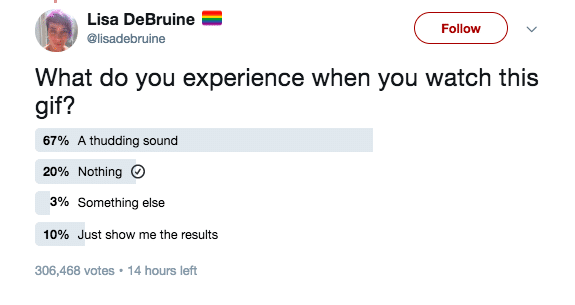
What do you hear when you watch this .gif of a transmission tower “jumping rope”? If you’re in the majority, you hear the tower land each time it jumps over the power line.
This entire discussion was sparked earlier this week when Dr. Lisa DeBruine from the Institute of Neuroscience & Psychology at the University of Glasgow posted the .gif on Twitter. She then took a poll on how many people had an audible reaction and, as of press time, the majority hear a “thudding sound.”
Happy Toast, which is responsible for creating the .gif, figured out that the “sound” some people hear is not necessarily tied to the towers:
So, why do some people hear the thud while others don’t?
Dr. DeBruine told the BBC that she doesn’t know why some people hear it, while others feel it and some don’t perceive a thing. “Some deaf and hard of hearing people have reported all three perceptions, as have people with aphantasia” (a lack of visual imagery).
She adds, “I thought some of the vision scientists I follow [on Twitter] would be able to explain it right away, but it seems like there are several plausible explanations and no clear consensus.”
But there is one person whose reaction to the Twitter thread was quite useful. Chris Fassnidge, a doctoral candidate in psychology at London’s City University, tells the BBC that he suspects the phenomenon is related to Visually-Evoked Auditory Response.
This is the ability of some people to hear moving objects even though they don’t make a sound, which may be a subtle form of synaesthesia – the triggering of one sense by another.
We are constantly surrounded by movements that make a sound, whether they are footsteps as people walk, lip movements while they talk, a ball bouncing in the playground, or the crash as we drop a glass.
The ultimate answer to why only some people have this ability to “hear” silent objects still isn’t entirely clear. Fassnidge says what determines who experiences vEAR and how intensely “is probably individual differences in how our brain is wired.”
Consumers in the United States and Canada will spend $10 billion on cannabis in 2017, according to a new study released on Wednesday. That is a 33 percent jump from last year’s retail data.
Arcview Market Research, authors of the report, forecast that by 2021 the legal market will reach $24.5 billion, a 28 percent compound annual growth rate. The report notes that despite continued federal prohibition, North American consumers continue to rapidly transition their cannabis consumption out of the illicit market and into state-sanctioned retail stores.
“Aside from cryptocurrency, there is simply no other industry changing as rapidly or as unevenly as the cannabis sector,” said Troy Dayton, CEO of The Arcview Group. “That makes capturing the data, predicting consumer behavior, and forecasting political developments both extraordinarily difficult and complicated, and one of the most vital tools for investors, entrepreneurs, and regulators trying to make sense of it all.”
California’s medical market is already as big as the total markets in Colorado, Washington, and Oregon combined, according to BDS Analytics’ GreenEdge point-of-sale tracking service, which added California to its databanks over the summer.
Nevada retailers were allowed to open sales to all adults earlier than expected, and generated more than $27 million the first month of adult-use sales, according to the Nevada Department of Taxation.
International markets saw major advances in 2017, including the launch of a medical cannabis program for Germany’s population of 82 million people.
Despite a pullback by the stocks of US-based publicly traded cannabis-related companies, investment continued to pour into the cannabis business, including the C$101 million IPO of Canadian licensed producer MedReleaf, the largest ever cannabis-related IPO.
“Our data shows positive indicators across the board for the legal cannabis industry, in North America and around the globe,” said Tom Adams, Editor-in-Chief at Arcview Market Research and Principal Analyst at BDS Analytics. “The passage of the 2016 ballot initiatives and continued maturation of the existing Adult-Use markets are the primary drivers of the growth this year. That’s nothing compared to what we can expect in 2018 and beyond from Nevada’s tourism, and California and Canada planning to launch Adult-Use sales in 2018.”