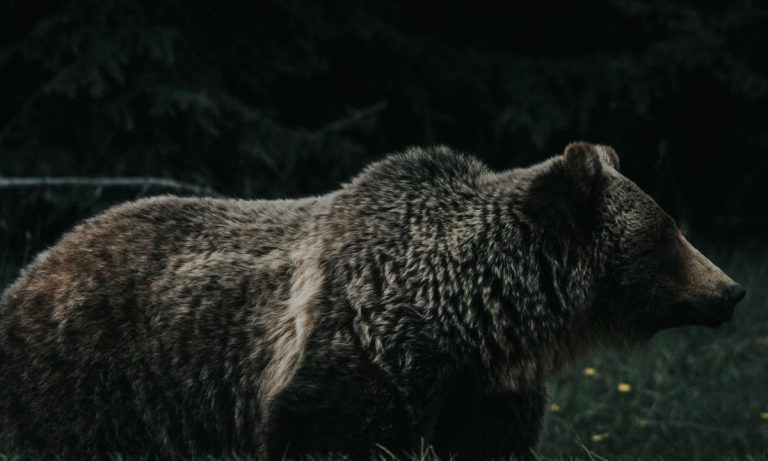
A couple in Durango, Colorado woke up to a wild car theft: Someone had tried to take their SUV for a joyride, but crashed it into a mailbox not far from the driveway. The thief, it turned out, was a confused bear.
The bear somehow got into the SUV and ripped apart the inside, destroying the steering column, radio and back windows. In all of that effort, it knocked the parking brake loose, beginning a short ride down the driveway.
According to the Durango Herald, officers have responded to more than 200 bear-related calls so far this year, compared to 56 total bear calls last year. This summer has been hard on the bear population, as a late frost cut down on the natural food supplies they rely on in the mountains—driving them toward humans’ garbage cans and anything that seems like a potential food source. In May, another “huge (expletive) bear” was trapped in a woman’s SUV in Durango, but that one didn’t manage to take the vehicle anywhere—it just trashed the interior trying to get out.
The owners of the car were at least in good spirits about the ordeal, joking, “Usually, I don’t get up at 5 o’clock unless there is a bear driving a car down the street.”
I understand people cannot be expected to know what they don’t know. However, in light of your recent discovery of the depth of the opioid epidemic, I do hope you, as well as the members of your team, are committed to learning and having an open-minded approach to finding solutions. After all, rule number one of brainstorming is there are no “dumb-ideas.” I implore you, please, listen to all options and leave no stone unturned … 142 people today were counting on you, along with another 142 tomorrow, and 142 the day after that.
Mr. Christie, simply attempting to understand something foreign to you is a step in the right direction. So today, on behalf of 60,000 or more people who will die this year, I am begging you … put everything you think you know aside for just a few minutes and read our story.
The Story Of An Opiate Survivor
I met my husband, Gary, in the summer of 2012. We were both hard-working, Midwesterners; I had been climbing the corporate ladder for the better part of two decades, and he had spent 15 years doing grueling, physical labor at a factory in Iowa.
Over the course of that 15 years, the job took a toll on Gary’s health. Repetitive factory labor wore down the discs in his neck, and eventually he had to have surgery. Unfortunately, just a couple of weeks out of surgery, Gary slipped and fell, and his neck will never be the same. He was always in constant pain, but the doctors had no problem keeping him readily supplied with plenty of opiates. In fact, I attended several appointments with him before we were even married where the doctor simply told him, “You’ll probably have to take these the rest of your life.”
We were married in the spring of 2013, just a few days after we moved to the state of Minnesota for a promotion in my career; I was going to manage the IT department for a large, affluent suburb of Minneapolis. This was a huge break in my career and a big step for us. However, what should’ve been the best years of our life together, ended in nightmare.
Moving to Minnesota meant finding a new doctor for Gary. He couldn’t function without opiates, and a lapse in his prescriptions would most certainly result in withdrawal sickness – pain, nausea, vomiting, tremors, mood swings, muscle spasms, and insomnia. Getting a new doctor, in a new state, meant we had to go through several medical procedures to “prove” Gary’s need. Costly MRI’s and several x-rays later, the doctors told us he would have to be seen at a pain clinic to get the medication he needs.
We spent two years and several thousand dollars out-of-pocket, only to have Minnesota doctors nearly kill him with prescriptions.
At one point in time he was prescribed 4 hydrocodone, 4 Percocet, and 2 fentanyl patches EVERY DAY. The drugs were killing him, but the side effects were killing me. Under the influence of this number of opiates, my husband couldn’t work, he couldn’t legally drive, and the mind-altering effects of the drug often turned him into a monster. I was married to Dr. Jekyll and Mr. Hyde and after a long, stressful day at the office, I rarely knew which I was going to face when I got home.
By January of 2016, I couldn’t continue to live the way were living. I left my husband, my home, my career, and everything I had. I couldn’t break the pattern without drastic measures … so I paid Gary’s bills ahead, packed what I could carry in my car, and left. I had no idea where I was going, or what I was going to do. I just knew I had to get out.
Go West, My Dear, Go West
My only goal when I left the house was to drive south until there was no snow, and then head west. I had no particular destination in mind.
My brakes went out just north of Denver.
Homeless and alone in a city where I knew no one at all, my only priority was getting a job. Any job, I didn’t care if I was washing dishes, I had to eat. On day six, I met a woman over lunch who offered me the opportunity to interview for a job in a new cannabis dispensary. Long story short … I got the job … and what I would learn over the course of the next several weeks would save my marriage and my husband’s life.
‘We Have Hope’
After landing in the cannabis industry, as any good employee would do at a new job, I was reading and researching everything I could get my hands on. I was reading psychology reviews, scientific studies, and anecdotal stories. I wanted to learn as much as I could.
By week six, I reached out to Gary, and told him… “We have hope.”
I told him what I had learned and said, “Come to Colorado, leave the opiates in Minnesota, and let’s give this a try.”
No Withdrawal
On March 18th, 2016, Gary took his last opiate painkiller he will ever take. According to science, quitting a 10-year opiate addiction cold-turkey could’ve killed him and it certainly wasn’t supposed to be easy. Although he had managed to stop taking everything except the hydrocodone, he should’ve gone through at least some symptoms of withdrawal, but with the use of responsible cannabis therapy, not only did my husband survive opiate withdrawal, he thrived. I have pictures of him on day 10 of no opiates hiking the Garden of the Gods.
Today, Gary is healthy, happy, and doesn’t rely on any prescription medications, including high blood pressure, cholesterol, and anxiety medications his doctors have had him on. He has lost 85 pounds. He has type 2 diabetes under control; and he hasn’t had the need to see a doctor in 18 months. He is active, alert, and engaged in his life, which is something that was missing when he was STONED on opiates all day long.
He still has episodes of pain, don’t get me wrong, nothing will ever completely heal Gary’s problems with his neck and spine. However, instead of taking a myriad of pills that interact with each other, cause issues with organs, and could potentially cause his death … today he uses cannabis, responsibly. A bite or two of a brownie here and there is all it takes. He’s not getting “high” from his medicine anymore and the assurance we get with knowing he can never overdose and die from his medicine helps put us both at ease.
Mr. Christie, I am not saying that cannabis is the answer for everyone, although I do believe it has a wide-range of benefits for a plethora of ailments. However, my question is this… why can it not be the right solution for some? Why do we have to FORCE people to use pharmaceuticals when cannabis clearly works better in some circumstances?
Of the 60,000 people who died in 2016, how many of them COULD’VE been saved had they had the same opportunity my husband did? If it worked for him, it will clearly work for someone else.
What will you tell their families now that we have spoken, you have heard my husband’s story, and you have seen evidence that cannabis MAY have been the solution that their loved one needed before they died?
Can you face someone who has lost a son, a daughter, a sister, a brother, or any other close family or friend to overdose … look them in the eye, and tell them, beyond the shadow of a doubt, there’s no way cannabis would’ve helped?
The Invitation
As I stated at the beginning of my letter, there is no way for someone to know what they don’t know or aren’t willing to learn, so Mr. Christie, my letter now becomes an invitation.
My husband and I own a beautiful ranch in the Rocky Mountains, just west of Pikes Peak. We would love to host you and your entire committee on our ranch. I want to introduce ourselves to you as human beings, as Americans, and as forthright cannabis users. I want you to see the story the papers in front of you don’t tell. I want you to put a face to the issue at hand, I want you to see that not all people who use cannabis are bad people.
More than anything, Mr. Christie, I want you to show me that we – hard-working, American citizens, matter to you. I want YOU, Mr. Christie, to have the opportunity to show the nation that you can hear us. Right now, you and your team, as well as, the entire federal government is being chastised for not listening to your constituents.
I urge you, take me up on this offer, Mr. Christie. Come to our ranch, enjoy the peace and quiet of being nestled away from it all in the Rocky Mountains, watch the mule deer wander through our yard, or wake up early enough to see the sunrise over Pikes Peak.
Send your security out, let them do their thing … you can keep this very private or you can make it a media spectacle to show voters you are at least considering all options and trying to learn from the very people that the opioid epidemic has impacted. We really just want the opportunity to show you another side to responsible cannabis therapy than you may be considering.
Come to Colorado, Mr. Christie … you still have something to learn.
Kristina Etter is a Colorado-based writer focusing on cannabis and mindfulness. Her writing helps dispel the stereotypes and stigmas associated with cannabis consumption.
What happens when the government grants a tier-3 cannabis grow license to an illicit marijuana dealer? What happens when a bon vivant like Kevin suddenly becomes a ‘legitimate’ businessman? What will this process look like?
Grow Op is a web series for those who are winging it:
Crispin says that he does NOT want to be involved in Charles’ project. He grabs him by the shoulders and passionately tells him “You can’t do this to me.” He kisses his cheek and gets on a conference call as Charles sadly looks on from the outside.
Episode 5: I Get To Be Proud Of My Work
Kevin gets ready for his first interview. He’s feeling good because he just won the marijuana lottery. Even though he doesn’t have much of a plan, he knows he’s going to build something to be proud of. Maybe.
This episode gets awkward. Kevin need money, but when he starts to explain fact that the government has granted him permission to grow weed that can fill up half of a football stadium, everyone gets weird.
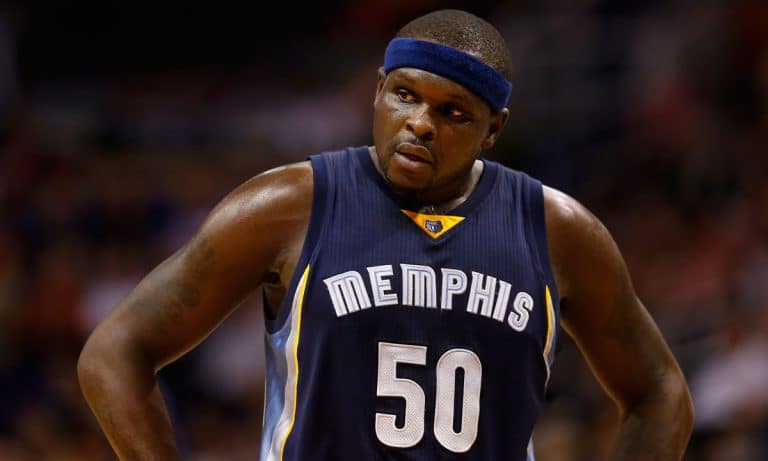
Sacramento Kings forward Zach Randolph was one of two people arrested by the Los Angeles County Sherriff’s Office late Wednesday night. Randolph is facing a felony charge of marijuana possession with intent to sell, according to police reports.
LAPD officers reported to a disturbance call in the Nickerson Garden Housing Project in the LA Watts neighborhood around 10 p.m. They discovered a group of individuals blocking off a street while drinking alcohol, smoking marijuana, and playing loud music. When cops attempted to disperse the crowd, the action escalated.
“[A] mob formed and began to destroy police cruisers and throw objects at officers, prompting them to call for backup,” according to CBS Los Angeles.
Nickerson Gardens 112th & Zamora officer needs help call floods the area with LAPD & Sheriffs no arrests @CBSLApic.twitter.com/MQGvOMNfP6
Two people were arrested, including Randolph. According to TMZ Sports, Randolph had “roughly 2 pounds of weed on him” in a “large backpack.” This is what, TMZ reports, caused Randolph to be charged with a felony of intent to sell.
Randolph was released on a $20,000 bail Thursday morning.
Randolph’s felony charge deserves an explanation in California, a state that legalized recreational marijuana. California’s Prop 64 designates individuals can have up to an ounce of marijuana on them (28.5 grams to be exact). Randolph’s reported possession of two pound of weed is obviously more than the state allows.
However, Prop 64 designates that possession with intent to sale is generally punishable as a misdemeanor. Felony enhancement is allowed under “special circumstances and three-time offenders.”
While Randolph was arrested under an investigation of drunk driving in 2009 within the Los Angeles area, he is not a three-time offender. The felony charge, one can speculate, stems from the amount of weed in Randolph’s possession coupled with the damage inflicted on police and police cruisers.
Randolph signed a two-year contract with the Sacramento Kings in July worth $24 million. He is yet to make a public comment on the incident.
As Taylor Swift gears up to return to music with a brand new album, insiders say she’s changing her image. A source says her infamous “girl squad” is DONE! The insider says that Taylor “realizes that came off as elitist” and wants a “more grown-up persona”
Jessica Biel Was Never An NSYNC Fan
The 35-year-old actress spilled that she never listened to her hubby’s former band during a recent Reddit AMA session. When a fan asked if she was a Team Backstreet Boysor Team *NSYNC, she made the big reveal.
“I was such a theater nerd at that time that I literally wasn’t listening to either of those groups,” she confessed. Jessica added, “I was listening to soundtracks, like Rent and old 50’s, 60’s music. I can be a little off on my timing. But if I had been cool, DUH, *NSYNC all the way, baby!
Love the fresh dirt we bring over daily from Naughty Gossip? Let us know in the comments!
The Wine Industry Network (WIN) hosted nearly 500 people to the first Wine & Weed Symposium on August 3rd at the Hyatt Vineyard Creek in Santa Rosa, CA. The one-day business focused conference was intended to create a dialogue between the wine and cannabis industries and examine the impact that the legalization of recreational cannabis use in California will have on the wine industry.
Of the day’s registered attendees, 45 percent were wine industry professionals, 26 percent were cannabis industry professionals, 18 percent have ties to both industries, and the remaining people in attendance were from other industries altogether. Polling the audience during the show, 77 percent of attendees predicted more collaboration than competition between the two industries.
Featuring experts from both categories, the day began with opening remarks from California Senator Mike McGuire who provided an overview of two of the state’s major agricultural crops, cannabis and wine, and how these industries will coexist. He also discussed the work that our leaders are doing to quickly provide legislation as the prohibition on cannabis ends.
In addition to the Senator, other notable cannabis leaders Hezekiah Allen, executive director of the California Growers Association, Aaron Smith, co-founder and executive director of the National Cannabis Industry Association, and Tawnie Logan, chairwoman of the Sonoma County Growers Alliance and California Growers Association weighed in on a wide range of topics including regulations around licensing, hospitality, and mixed-use farming.
Attendees were also introduced to new economic opportunities not only from the varied line up of speakers, but also from the 40+ exhibiting companies from the wine and cannabis industries who displayed their products and services.
“Our goals were to educate the wine industry on the current state of legalization of cannabis and to establish a dialogue between the two industries,” said George Christie, President of Wine Industry Network. “We were successful on both fronts. Our wine industry attendees left with a greater understanding of the emerging cannabis industry and everyone that attended saw the opportunities that collaboration could mean to both.”
I’ve always believed in a classical education.That’s why, when my son, Eamon, was 10 and showed a curiosity about music, I turned him onto the Sex Pistols.I had no one to blame but myself when he played Never Mind the Bollocks 17 times a day.By the time he was 18, he was fronting a band and headed to NYU to major in The Music Business. (Apparently, there still is a Business.)Resigned to what I’d wrought, I suggested last summer that he round out his schooling – by taking what I dubbed the “Roots of Rock Road Trip.”
In truth, it was a selfish proposal.For years, I’d dreamt about rambling down Hank Williams’ Lost Highway — making my pilgrimage to the Crossroads where Robert Johnson sold his soul to the devil.I’d been compiling a playlist – blues, bluegrass, rhythm and blues, swamp rock, rockabilly, and other Southern specialties – that I was itching to inflict on my passengers.
Happily, Eamon and my wife, Joanna, went for it, even though we’d be hitting the blacktop in August. We flew into Memphis and rented a Plymouth Grand Voyager.We started on a solemn note, we visited the National Civil Rights Museum, where the long road to freedom is retraced in powerful exhibits culminating in the actual Lorraine Motel room where Dr. Martin Luther King Jr. spent his last night.Walking out of the museum, we felt it was fitting to have lunch at the nearby Arcade Restaurant, opened in 1919.
“Is it true Dr. King had his last meal here?” I asked our waitress.
“I never heard that,” she said. “But he ate here all the time. He’d sit in that back booth, so he could sneak out the side door.”
“Why was that?” I inquired.
“He was always being hounded by his fans.He didn’t want to have sign a lot of autographs.”
The waitress shared many surprising things about Dr. King until we deciphered that she thought I’d said, “The King,” as in, his majesty Elvis Aaron Presley. Elvis too had been a regular at the Arcade. In fact, even as we sat in our booth, he was dining at two different tables.
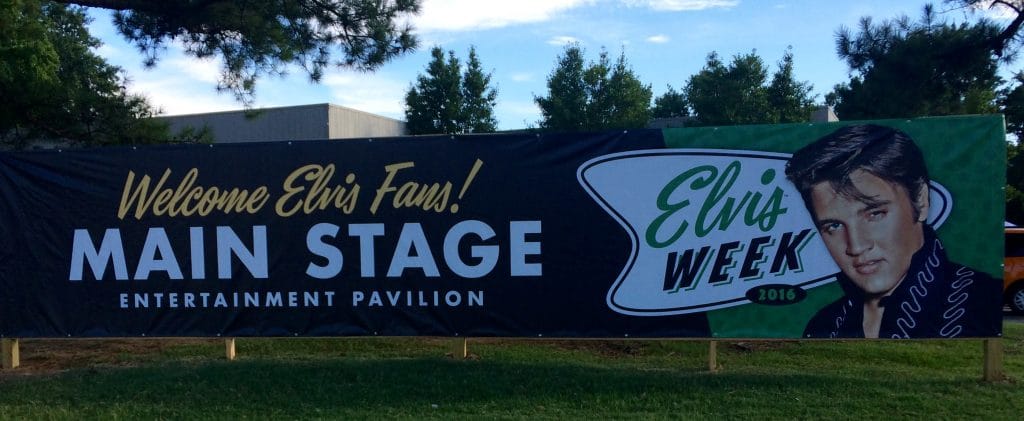
For this was Elvis Week, when impersonators from all over the world come to Memphis to pay tribute to the city’s favorite son. We couldn’t turn a corner without crashing into some pompadoured gent with mutton chops — curling his lip, turning up his collar.Later that day, we stopped by the 148-year-old Peabody Hotel to watch the daily ritual of ducks waddling out of the lobby fountain and into an elevator to their penthouse.While there, we browsed through the Peabody branch of Lansky Brothers,“Clothier to the King.” The 70-year-old store was filled with Elvises, all stocking up on replicas of their idol’s vestments.Our son had no prior affection for Elvis, but he couldn’t resist buying a gardenia-print sport jacket washed up from Blue Hawaii.
That night we surrendered to the cult, heading to the gilded Orpheum Theater for the semi-finals of the 10th Ultimate Elvis Tribute Artist Contest — part of Elvis Week (now in its 40th year).I was expecting to laugh, remembering Andy Kaufman’slip-syncing on SNL.But the Elvises who strutted onstage in white sequined jumpsuits and gold lame capes could actually sing.Naturally, Japan had produced an uncanny copy — scarf-tossing Yukihiro Nishijima.By the time I left, I knew one thing: Elvis was alive.
Photos courtesy of George Rush
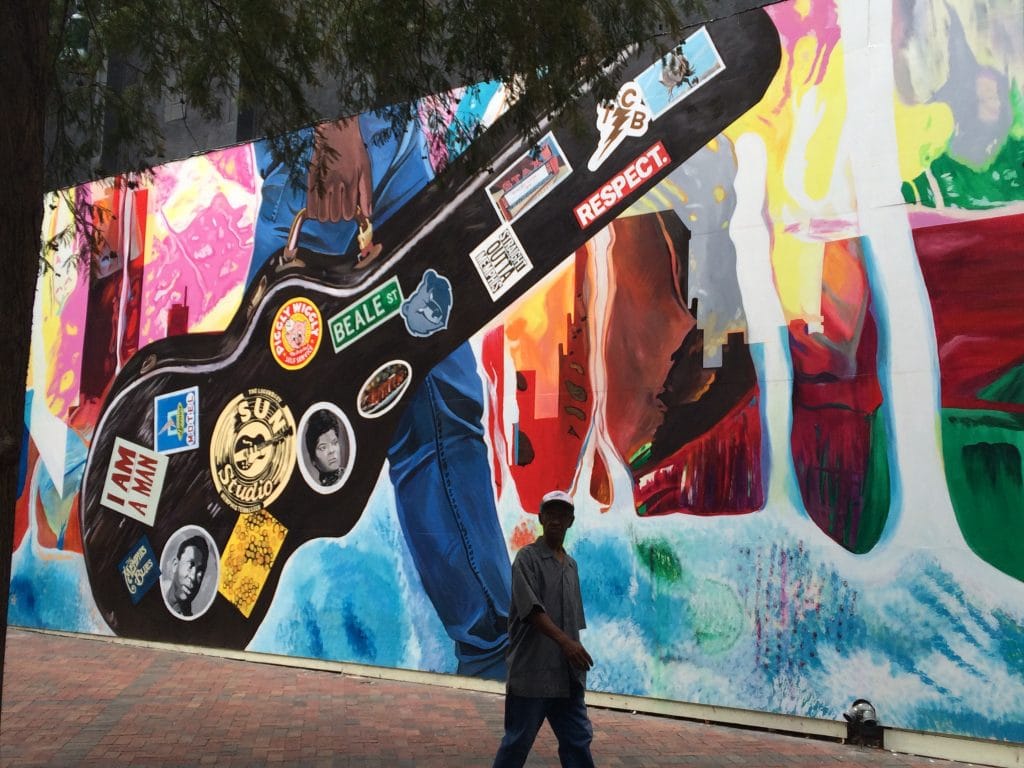
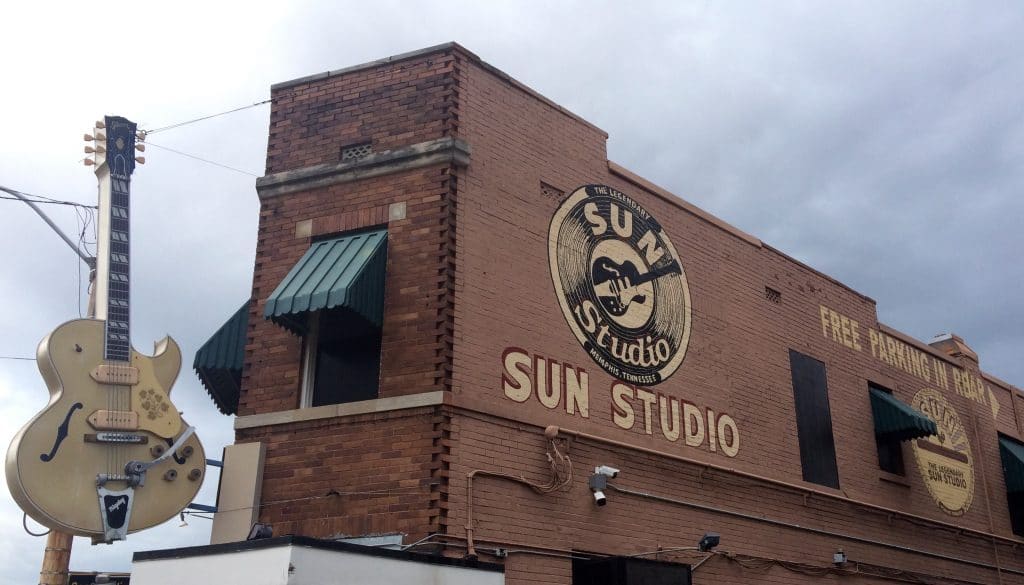
We packed our next two days with some of the essential Memphis experiences: Beale Street, where Louis Armstrong, Albert King, and Memphis Minnie perfected their art and where, after several decades of decay, live music again spilled onto the pavement…Sun Record Studios, where Elvis, Jerry Lee Lewis, Carl Perkins, and Johnny Cash had their “Million-Dollar” jam one December day…the Stax Museum, on the site of the studio where Rufus Thomas, Wilson Pickett, the Staple Singers, and Otis Redding sliced fat slabs of soul…the Rock and Soul Museum, illustrating how Memphis’ black and white musicians cross-pollinated sounds that defied racial barriers…the Gibson Guitar factory, where we saw Les Pauls being hewn….and Charlie Vergos’ Rendezvous, theback-alley, subterranean BBQ joint where the Rolling Stones once jammed.
Photos courtesy of George Rush
Our blaze through Memphis finished at Elvis’ former home. Graceland has grown into an amusement complex that straddles Elvis Presley Boulevard. One of its better attractions remains the museum holding more than 20 of Elvis’ vehicles.Among them are his pink 1955 Cadillac Fleetwood Series 60 (purchased after his first pink Caddy was totaled in an accident), his cream-colored 1956 Lincoln Continental Mark II, his purple 1956 Cadillac Eldorado, his black 1960 Rolls Royce Silver Cloud, his midnight blue 1970 six-door Mercedes Benz 600 limo, his 1975 Dino Ferrari, and his recently recovered black 1973 Stutz Blackhawk, which he drove on the night of his death.
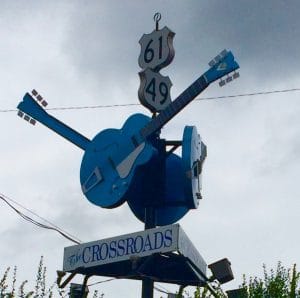
It was time to descend into the Delta. We merged onto U.S. Route 61, the “Blues Highway” extolled by Sunnyland Slim and Bob Dylan. Mississippi is a heavily forested state but, here, on the flat flood plain that flanks its namesake river, a vast mural stretched above the road – a downpour at one end, sunbeams at the other.About 90 minutes south of Memphis, we rolled into Clarksdale.The former cotton port has become the unofficial capital of the blues, thanks partly to the legend that it was here that Satan bestowed unearthly gifts upon young guitarist Robert Johnson.Several towns claim to have been the scene of this Faustian transaction. But only in Clarksdale, at the intersection of Routes 61 and 49, will you find a pole crowned with three giant guitars and a sign proclaiming this the true Crossroads.
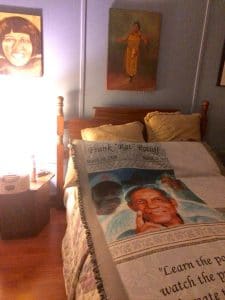
Without question, some of the greatest blues players have lived in Clarksdale, or blown through.Checking into the humble Riverside Hotel, we learned about some of its previous guests from Zee Ratliff, who runs the place with her mom, Joyce.
“John Lee Hooker, used to play here on the front steps, “ said Zee, who had a bad leg and lovely smile.
She showed us around the one-story railroad-style inn.“This is Room 7,” she said, “where Ike Turner used to sleep.Down in the basement, Ike and his Kings of Rhythm hammered out their paean to the Oldsmobile, “Rocket ’88,” often called the first rock n’ roll recording.
“Robert Nighthawk slept in this room with his wife,” Zee said.“He kept his girlfriend down the hall.”Small wonder the Chicago-bound bluesman checked out in a hurry, forgetting his suitcase.It’s still here.
Photos courtesy of George Rush
Room #2 is where Bessie Smith is believed to have died in 1937, back when the hotel was the G.T. Thomas Afro-American Hospital. An ambulance brought the Empress of the Blues here from the scene of a car accident on Rt. 61.
Photos of other guests lined the hallway — Howlin’ Wolf, Sonny Boy Williamson II, Muddy Waters, Duke Ellington, and John Kennedy, Jr., who passed through in 1991.
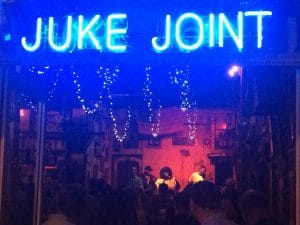
We’d come to Clarksdale for the three-day Sunflower Blues and Gospel Festival.(The 30th annual fest is scheduled for Aug. 11-13, 2017).The free fest has drawn the likes of Mose Allison, Charlie Musselwhite, Koko Taylor, James “Son” Thomas, Bobby Blue Bland, and Led Zeppelin’s Robert Plant.The Sunflower and the Juke Joint Festival in April have turned Clarksdale into a destination for blues travelers, like Elvis Costello, who recorded here in 2004.But, with or without a festival, you can hear blues all year long at old and new juke joints. We hotfooted it over to the Ground Zero Blues Club, opened in 2001 by Oscar-winner Morgan Freeman and local friends.On the menu: fried catfish and smoking Kingfish – as in, Christone “Kingfish” Ingram. The husky, 17-year-old Clarksdale lad has been diagnosed with Asperger Syndrome, which in his case manifests itself in virtuoso guitar playing that’s propelled him to a gig at the White House.
Photos courtesy of George Rush
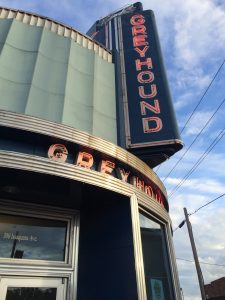
Kingfish’s set — exhaustively Snapchatted by my son — was an excellent start to the weekend.The next morning, we strolled around Clarksdale.The “Gold Buckle on the Cotton Belt” looked pretty rusted downtown. But some eminent ghosts lingered around the once-jumping blocks of the New World district. Wasn’t that Sam Cooke, loitering outside the old Paramount Theater?And Son House, slinking out the Alcazar Hotel? And there was Jimmy Reed, standing in the line at the art deco Greyhound Bus Terminal.
Photos courtesy of George Rush
Sprouting up amidst the boarded-up storefronts were boutiques and galleries and espresso dispensaries, many of them started by young transplants.Among those helping to revive Clarksdale was John Ruskey, an artist, writer, and outdoorsman whose Quapaw Canoe Company runs expeditions on the lower Mississippi, using gorgeous 12-person wooden vessels Ruskey builds himself.
The mighty Miss was storm-tossed this particular Saturday, so Eamon and I opted for a paddle down the gentler, pine-and-cypress-lined Sunflower River.Back on land, needing another shot of blues, we headed to the fest’s main outdoor stage. There, from 10 a.m. till 11:30 p.m., performers like Jimmy “Duck” Holmes, James “Super Chikan” Johnson, and Bill “Howl-N-Madd” Perry delivered some down-home grief counseling to a lawn filled with fans.Practically every street corner had a bluesman — sometimes better than the headliner.We were ambling down one boulevard when we heard some exquisite moaning coming out of the Delta Amusement Café.Inside, Terry “Harmonica” Bean was hypnotizing an audience that consisted of one Japanese couple….and us, once we entered his force field.
Photos courtesy of George Rush
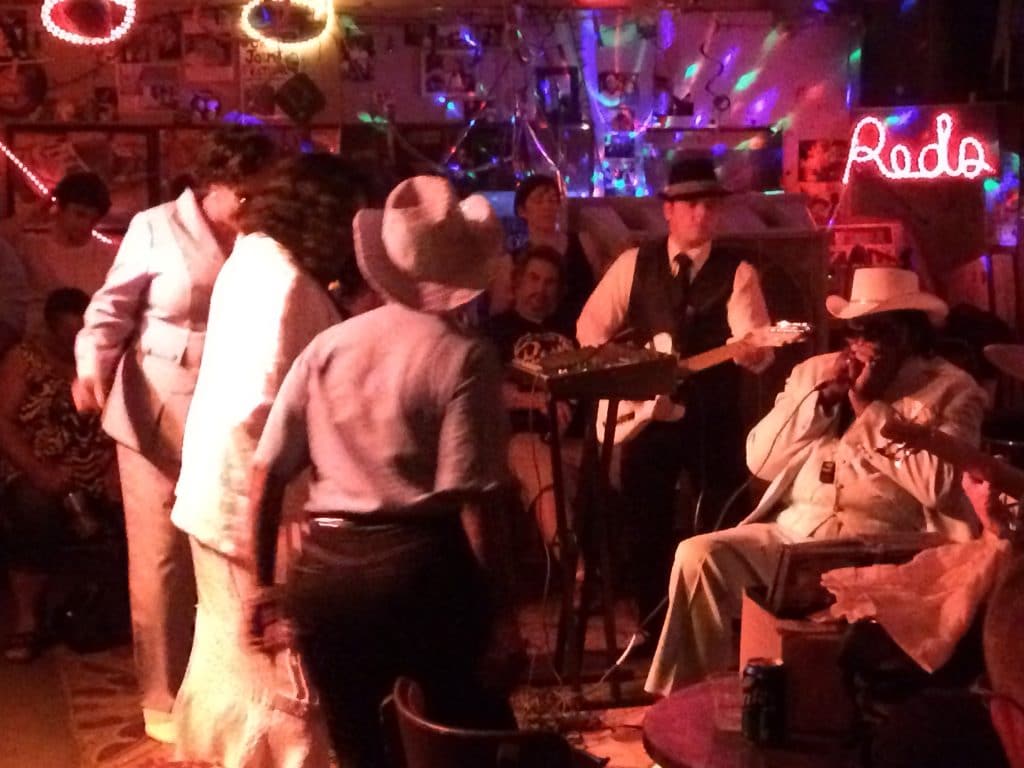
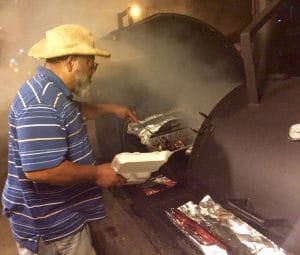
Around 10 p.m., we moved onto Red’s Lounge, one of Clarksdale’s most venerable dives. Parked outside was the tour bus of Big George Brock. Some soulful songstresses and young-blood blueshounds warmed up the audience for Mr. Brock, a husky white-suited gentleman who finally sauntered in on a cane, sat down before the mic, and uncoiled his pain. Outside, the club’s bearded proprietor, Red Padden, manned a smoker the size of the Civil War ironclad. Like the pork shoulder he was cooking, Red had a crusty exterior.But he didn’t stint on his sublime BBQ, which he plopped into a Styrofoam container next to some slaw and beans.I’d no sooner thanked him than he yelled, “Wait a minute!” – then invited me to grab a fist full of Wonder Bread.
Photos courtesy of George Rush
Heartache works up an appetite. In Clarksdale, even breakfast is served with a jam. Certainly at the Bluesberry Café the next morning.The restaurant had a little stage where a raspy-throated cat explained that he could only do one more song because “I gotta get back to washing dishes.”
After I finished my two eggs and a pork-chop, I asked Eamon, “Have you seen our waitress?”
“She’s onstage,” he said, “playing drums.”
Most of the other diners were on the dance floor.Boogieing out of the restaurant, we checked out the Delta Blues Museum.Housed in a freight depot built in 1918, the museum is an arsenal of guitars, harmonicas, and clothing belonging to blues legends.I wondered if donning Bobby Rush’s signed shoes or Otis Rush’s fringed vest might awaken some latent in me.Most impressive was the reconstructed cabin where Muddy Waters spent his first 30 years on the nearby Stovall Plantation.We also poked around the Rock and Blues Museum, a labor-of-love that Dutchman Theo Dasbach installed in a Clarksdale store a decade ago. Dasbach’s 4,000-plus treasures include a 1905 Edison phonograph, super-rare 78s, and memorabilia of Chuck Berry, the Beatles, the Stones, and the Doors.
Taking our leave from Clarksdale, we drove 45 minutes south to the Dockery Plantation. The still-operating farm, founded in 1895, is often called the “birthplace of the blues” because Henry Sloan, Charlie Patton, Robert Johnson, Son House, Howlin’ Wolf, and other pioneers worked, lived, and played there.Walking among its vine-shrouded buildings, Eamon encountered a snake.His mother joked that “it must be the devil,” trying to beguile another young guitarist.
A half-hour south, we came to Indianola, hometown of one Riley B. King, better known as B.B.At the corner of Second and Church, the spot where he busked as a child, King had left his hand and foot prints in the sidewalk cement.Before his death in 2015, he used to return here every year to perform. He now rests at the B.B. King Museum.His mausoleum was closed so we contented ourselves with a nearby juke joint, the Cozy Corner Café, lured by its exterior mural of local heroes and astrological forecasts.The Cozy Corner had it all — a pool table, a bar, a pink couch, an American flag, two guys playing dominoes, and, on the juke box, Albert King promising, “I’ll Play the Blues for You.”The owners, Ronnie and Betty Ward, offered us a brownie with cream cheese frosting and some conversation about Hillary Clinton, whose poster hung behind the bar.They couldn’t have been friendlier.
We headed east, passing through Greenwood. The scene of civil rights marches in the 1960s, the handsome town has no fewer than seven Blues Trail markers, including one commemorating Robert Johnson, said to have been killed at a juke joint near the intersection of Routes 82 and 49E – poisoned by the husband of a woman Johnson had been seeing. Details of his death remain so murky that two local cemeteries (Payne Chapel and Mt. Zion MB Church) both have Robert Johnson gravestones.
We finished the day in Oxford.The University of Mississippi, battleground of integration, now features the world’s largest collection of blues recordings.The following morning, we checked out William Faulkner’s stately Rowan Oak mansion (the Nobel Prize winner’s outline for A Fable is still scrawled on the wall).We also swung by Square Books (Oxford’s literary hub), Boure (flagship of star chef John Currence’s City Grocery “dine-asty”), and Fat Possum Records (a vinyl “parlour” that includes Fat Possum’s own releases, ranging from blues patriarch R.L. Burnside to the Black Keys and Iggy Pop).We could not locate Ole Miss’ hidden marijuana farm, the only federally licensed facility for pot cultivation.
An hour east of Oxford was Tupelo, the Bethlehem of Rock inasmuch as it was the birthplace of Elvis Aaron Presley.When I visited two decades ago, I could barely pick out the one-story Presley clapboard from other humble houses on a side street.It’s since been turned into a tourist complex that includes a study center and memorial chapel. There’s also a gurgling Fountain of Life — circled by stone tablets marking the sacred chapters of the Presley saga. “1939 – Home and Car Repossessed; [father] Vernon Released From Prison.” A replica of that car, a green Plymouth sedan that transported the Promised One to Memphis, sits nearby.Our own prodigal son posed next to a reproduction of the outhouse young Elvis would have used.
Ninety minutes north we arrived in Alabama at the former Muscle Shoals Sound Studio.Night had fallen but we had to snap a few pics outside 3614 Jackson Highway, the onetime coffin factory where The Swampers rhythm section had laid down gold and platinum grooves for Lynyrd Skynyrd, Joe Cocker, Levon Helm, Paul Simon, Bob Seger, Rod Stewart, Willie Nelson, and The Rolling Stones, to name a few.The following morning we stopped at the Swampers’ original workplace, the still-operating FAME Studios — pulling into the parking lot where young Duane Allman once pitched a tent in the hope of recording with Wilson Pickett. (He succeeded.) Still operating and giving tours, FAME was the laboratory for such hit-makers as Bobbie Gentry, Bettye LaVette, Etta James, Aretha Franklin, and Drive By Truckers. (The 2013 doc, Muscle Shoals, tells the soulful saga of the rival studios.)
Photos courtesy of George Rush
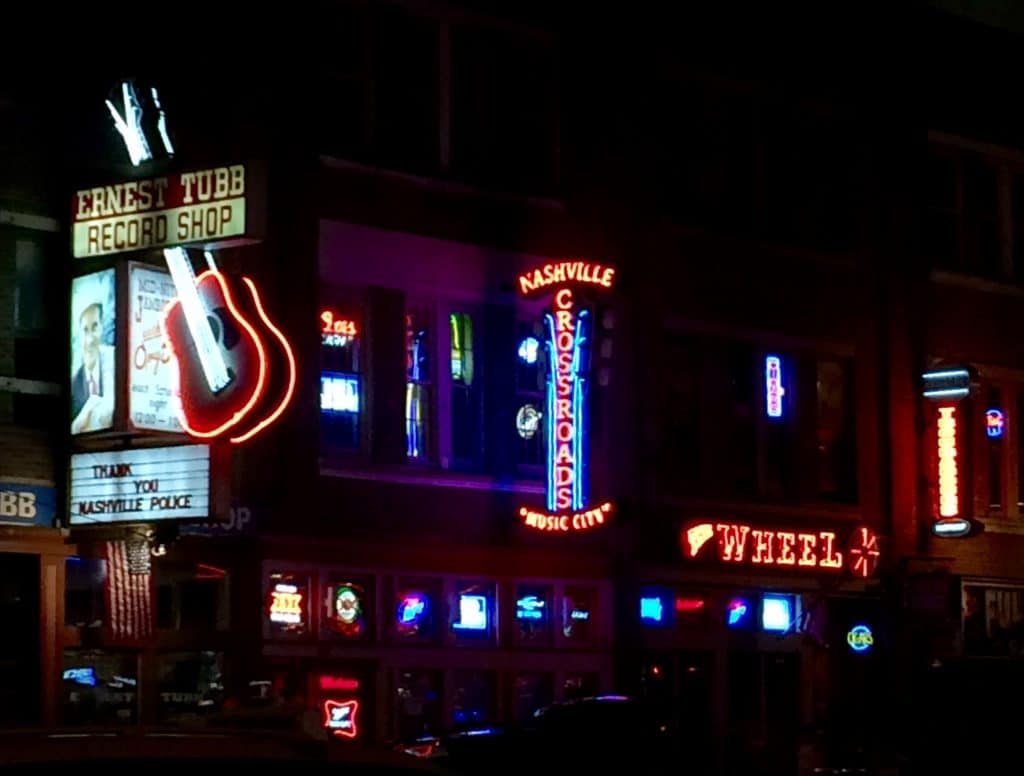
We crossed the Tennessee River and pushed north two and half hours to the final destination of our musical hajj — Nashville.There we did some daytime honky tonkin’ on lower Broadway. Winkin’ and blinkin’ neon beckoned us, like so many previous hayseeds, into Tootsie’s Orchid Lounge, Robert’s Western World, and Legends Corner. After a few longnecks and some pulled pork at Jack’s, we rifled through the vinyl at the Ernest Tubb Record Shop, opened in 1947. I genuflected outside the Ryman Auditorium, home to the Grand Ole Oprey from 1943 to 1974 and now a showcase for such un-country acts as Coldplay to the Foo Fighters.
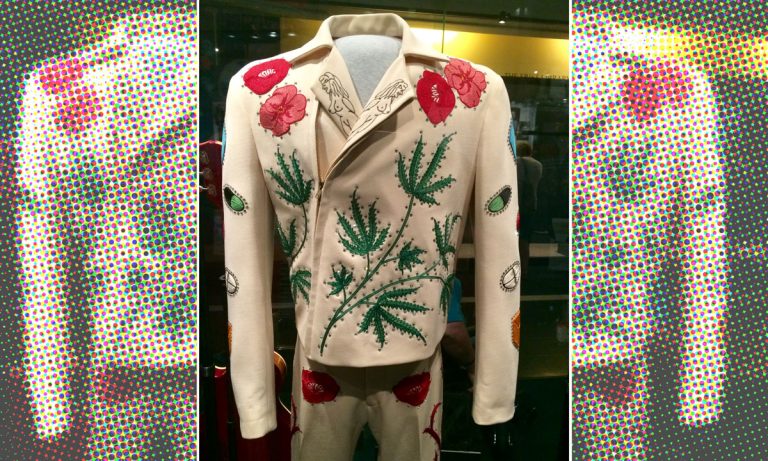
We proceeded to the Country Music Hall of Fame and Museum, whose 2014 renovation has expanded its size to 350,000-square-feet. Even Eamon, who only tolerates country music, found the collection diverting.Among its treasures: Elvis’ Solid Gold Cadillac, glistening with paint made of ground diamonds and fish scales and outfitted with TV, phone, record player, and fridge, and Webb Pierce’s 1962 Pontiac Bonneville, festooned with silver dollars, Winchester rifles, and a steer horn on the grille. The centerpiece exhibit was “Dylan, Cash, and The Nashville Cats,” an immersive study of how out-of-town longhairs and Music City’s fabled session men devised country rock.Don’t miss Gram Parsons’ Flying Burrito Brothers suit, embroidered with cannabis leaves and poppies. (The exhibit is up till December 2017.)
Photos courtesy of George Rush
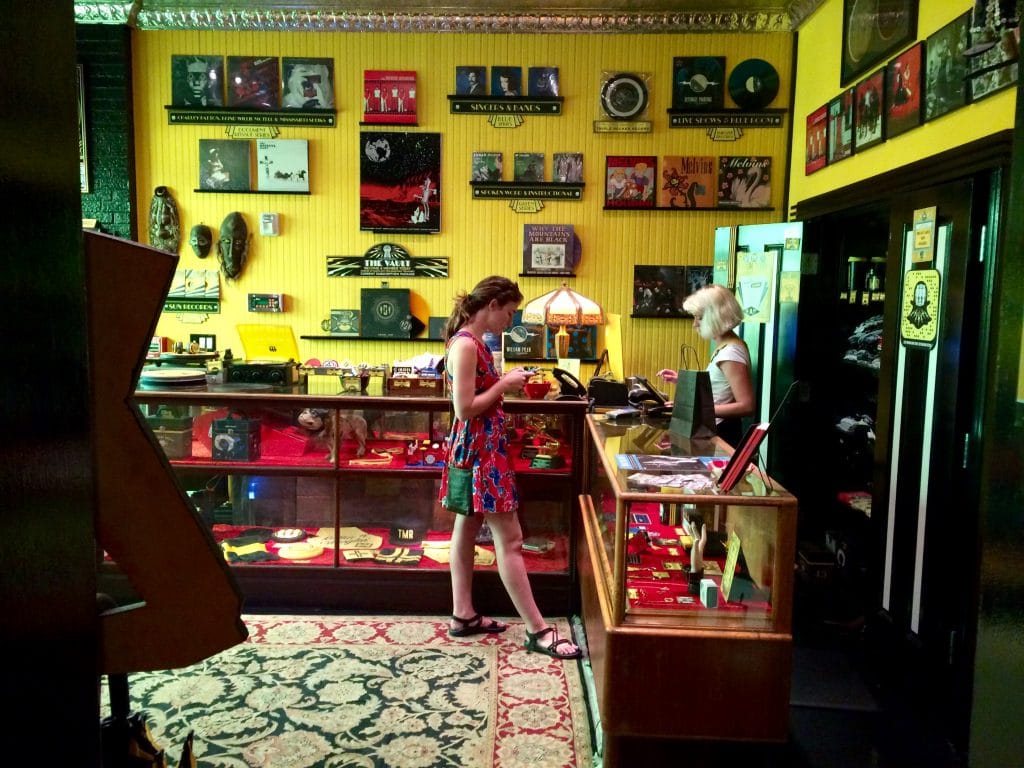
Nashville has become a home to a lot of émigré artists with very little twang.No place embodies its modern sensibility like Third Man Records. Jack White’s hive of cool features a store staffed by young people in the bumblebee colors of yellow and black.Besides stocking new and classic vinyl, the shop offers a refurbished 1947 Voice-o-Graph machine.For $20, you can step into the wooden phone-booth-sized contraption and record a six-inch phonographic disc.They keep a guitar on hand, or you can bring your own.Third Man also boasts the world’s only live venue with direct-to-acetate recording capabilities. Jerry Lee Lewis, Beck, Stephen Colbert, and bands on White’s label have cut discs there.On our trip’s final night, Eamon and I stopped by Third Man’s club.The headliner was Joyce Manor, a thrashing punk unit from Torrance, California.A hundred or so kids ricocheted off the walls under a taxidermied elephant head. It was a far cry, or yodel, from the Grand Ole Oprey. Ernest Tubb would’ve had them all committed.But for a kid raised on the Sex Pistols, the mosh pit was a relief from dad’s daily roots regimen — a sign that we could finally exit the Lost Highway and head home.
The 2017 Sunflower River Blues and Gospel Festival in Clarksdale, MS, runs from August 11 to 13. The 2017 Elvis Week will mark the 40thanniversary of the King’s passing between August 11 and 19. Useful baedekers to the Deep South’s music, history, and food are Lonely Planet Road Trip: Blues & BBQ, by Tom Downs, and Memphis & The Delta Blues Trail, by Melissa and Justin Gage. You can track Blues Trail historic markers online or via a free app. The excellent American Music Triangle website helps you design your own route to the best blues, country and R&B sites in Tennessee, Mississippi, Louisiana, and Alabama.
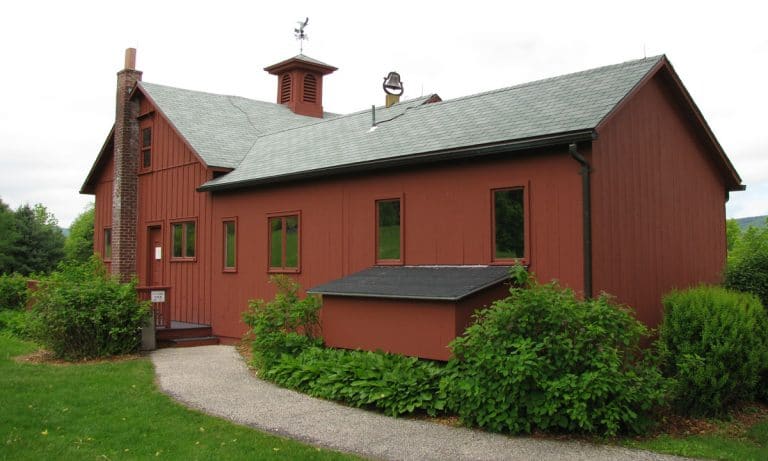
A medical dispensary group is eyeing an unusual location to set up shop in Vermont—the Norman Rockwell Museum. Representative of Lily Pad Organics have applied to establish the dispensary in Rutland, Vermont, reports the Rutland Herald. It would be the state’s fifth medical dispensary.
The Rutland Town Board will reportedly discuss the issue Aug. 22. The Museum has been on sale for several years.
Republican Gov. Phil Scott recently signed legislation to increase the number of medical dispensaries from four to five. The state has received several applicants, the Rockwell Museum among them. Lindsay Wells, administrator for the medical marijuana program for the Department of Public Safety, said the state will make its decision on the fifth dispensary in September.
Rockwell was well-regarded for his portraits of small-town, rural American life. He lived in Arlington, Vermont from 1943 to 1953 and his work appeared on more than 300 covers of the Saturday Evening Post.
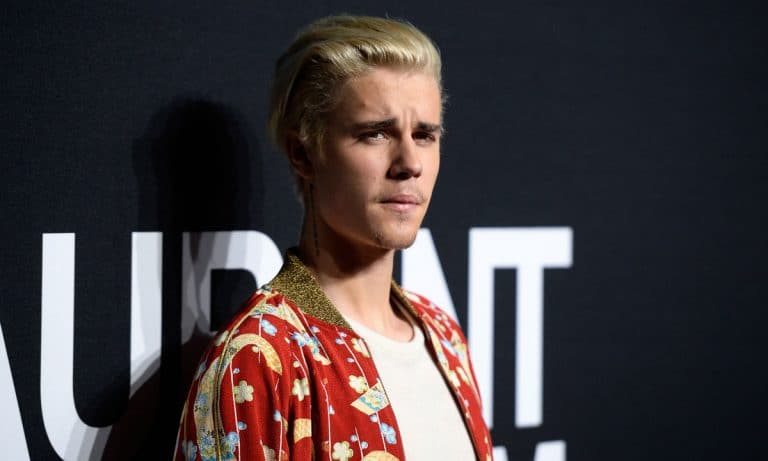
Justin Bieber has been looking at million dollar properties in New Jersey, and not because he wants to be close to the Shore, he wants to be close to his preacher and his growing disciples.
“Pastor Carl Lentz has enormous power over Justin and his life. He is now the closest adviser in Bieber’s circle and Justin values the Pastor’s opinion above everyone else’s. Justin is estranged from his mother, and has no relationship with his dad, Jeremy. The Pastor is now the only family Justin has which is why he is looking for twelve disciples,” sources tell Straight Shuter. “God has always been an important part of Justin’s life and he see’s Pastor Carl as his path towards finding happiness. He sees Hillsong Church as his number one priority. It is more important to Justin than music.”
However, one insider reveals that Justin is talking about combining both his passions and is going to record a religious album, singing songs of faith and inspiration.
Digging Up Princess Diana – Moving Grave To London
“Diana was buried on a island on her family estate to give her privacy and in the hope that paying guests would visit her childhood home to pay their respect. But now there is talk within the family about moving her to London where it will be easier for folks to visit the People’s Princess,” sources tell Straight Shuter. “The crowds of tourist have never descend upon her final resting place in the numbers they had hoped. No decision has been made yet, but it seems like the right time to return Diana to London where her children are.”
As strange as this sounds it is not without precedent. Recently Judy Garland’s remains where flown from New York to LA to be closer to her kids.
Love the fresh dirt we bring over daily from Naughty Gossip? Let us know in the comments!

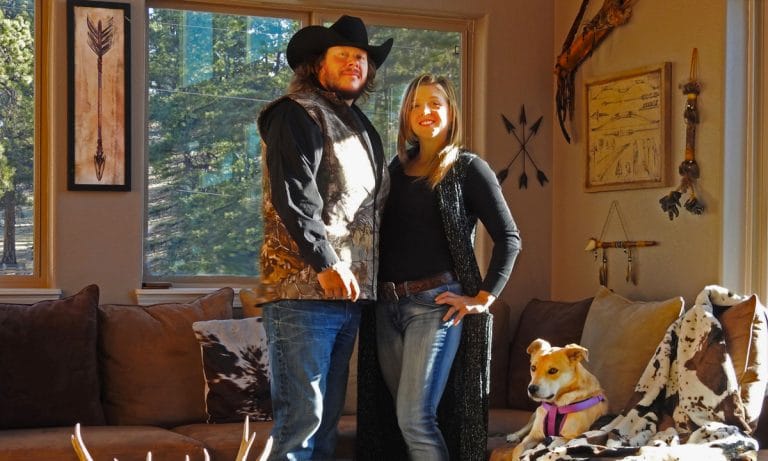
 I met my husband, Gary, in the summer of 2012. We were both hard-working, Midwesterners; I had been climbing the corporate ladder for the better part of two decades, and he had spent 15 years doing grueling, physical labor at a factory in Iowa.