Though CBS won’t air a medical marijuana ad during its Super Bowl broadcast, that won’t stop others closely associated with football from joining the weed game. Joe Montana, the four-time Super Bowl champion and quarterback legend, announced his venture firm would invest $75 million into a California-based marijuana company, per the Associated Press.
Caliva, the San Jose retailer that calls itself the “most trusted brand in cannabis,” is the recipient of the investment, which will be used to flesh out a vertically integrated company, including a farm, retail store, delivery center, and more. While it’s unknown the amount Montana personally put up, this isn’t first time the football great has invested in marijuana. Previously he invested in the marijuana media company Herb.
Adrenaline still racing from being back on the sidelines with my beautiful wife at Arrowhead. Thanks for having us @Chiefs! Hats off to two absolute superstars and their teams @patrickmahomes5 and @TB12sports…And the gunslinger in the booth @tonyromo – Incredible game! pic.twitter.com/OSzVzOTNhR
Montana told the Associated Press his firm was investing in an industry he believes “can provide relief to many people and can make a serious impact on opioid use or addiction.”Although Montana has maintained a public dalliance with the cannabis industry, he’s not stated whether he uses the plant either medically or recreationally.
Others like Willis McGahee and Eben Britton have been vocal advocates for allowing NFL players to use medical marijuana. Meanwhile, Martellus Bennett estimated last year that 9 out of 10 NFL athletes use marijuana. He added that he’s often more surprised when teammates would tell Bennett they didn’t smoke than when they did.
We’ve all heard of weed brownies and candies, but have you ever tried infused almond milk? As more states legalize, cannabis companies are creating a variety of edibles unlike anything you could score in your college dorm. Here are 7 new ways to consume cannabis.
If you’re looking for a smoke-free alternative to herb, or you simply love the body high of a good edible.
Though it doesn’t actually contain alcohol, Ceria Brewing Co’s cannabis-infused beer is the perfect way to unwind after a long day. Each bottle contains 5mg of THC, providing a mellow high that can be enjoyed socially (and not just from your couch).
Cotton Candy
Spice up a childhood favorite with a Kandy Care’s award-winning Cotton Kandy, available in Phaded Pink and Blazed Blue. Each package contains 55mg of THC, which is approximately 4 servings depending on your tolerance.
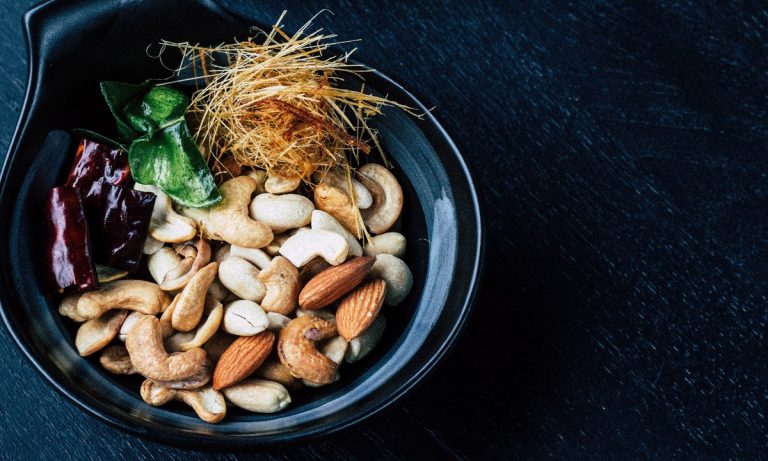
Are you nuts for nuts? Kush Nuts has you covered with their healthy blend of almonds, cashews, rosemary and garlic, infused with quality cannabis. They come in three sizes ranging from 45mg to 180mg of THC and each bag is strain specific so you know what effect to expect.
Cheese Crackers
If you’re looking to get away from sugary edible options, check out Love’s Oven’s savory cheddar crackers. Each package contains 10 crackers dosed with 10mg of THC each, or you can opt for 20 microdosed crackers which have 10mg in the whole package.
Granola
Pura Vida’s medicated granola packs a punch with 250mg of THC in each bag, which they recommend should be taken in 10 doses. It comes in yummy flavors like Cinnamon & Coconut and Dark Chocolate & Cranberry, plus it’s organic, vegan and gluten-free.
With THC and CBD-infused options ranging from 1mg to 5mg, Mr. Moxey’s Mints offers a minty fresh variety for cannabis consumers looking to microdose. Each artisanal blend is loaded up with other good-for-you herbs like ginseng, chamomile, and echinacea.
Almond Milk
Perfect for your morning coffee or cereal, Mary Jane Juice Co.’s Vanilla Almond Milk is infused with 100mg of THC in each bottle. For people who want to wake and bake without smoking, this is an awesome and versatile option.
The future of marijuana legalization in the U.S. looks a lot brighter now that Democrats have reclaimed the House of Representatives following the 2018 Midterm Elections held this past November.
Former NFL player Colin Allred’s (D-TX) defeat of Pete Sessions (R-TX) in their North Dallas district marked what might be the brightest ray of hope for legalization efforts. Sessions had been the Chairman of the often overlooked but surprisingly important House Rules Committee Chairman in 2013.
Under Sessions’ leadership, the House Rules Committee has been “the place proposed marijuana laws go to die,” according toThe Boston Globe.
Sessions reportedly prevented at least 34 pro-marijuana legislation proposals from reaching the House floor. Of these were measures to allow state marijuana businesses access to banking services, fortify protection against prosecution at the federal level for medical marijuana patients, allow a number of states to pursue marijuana legalization without federal resistance, and stop discrimination against medical marijuana patients within the U.S. Veterans Association.
Sessions’ loss in the 2018 Midterms allowed for Rep. Jim McGovern (D-MA) to take over his position as Rules Committee Chair. Unlike Sessions, McGovern has pledged not to block marijuana legalization out of respect for the voters and legislatures continuing to pass pro-marijuana legislation on local and state levels in spite of out-of-date federal statutes standing in their way.
Legal marijuana advocates already consider Sessions’ ousting a major step forward, despite newly re-elected Speaker of the House Nancy Pelosi’s (D-CA) refusal to say whether or not she would bring pro-marijuana legalization to the House floor. Rep. Earl Blumenauer (D-OR) told Rolling Stone, “All we need is to not have what happened with Republicans, where Republican leadership stopped the process. If they would have just stood out of the way we could have moved this stuff forward, and we’ll now be able to do that.”
While Sessions’ loss is undoubtedly a big win for legal weed, legalization proponents have even more cause to be hopeful going forward.
Other newly elected Democratic Representatives have also publicly come out in support of legalizing marijuana. Freshman Representative Alexandria Ocasio-Cortez (D-NY) recently tweeted a High Times article detailing her partnership with healthcare and tax reform expert Dan Riffle, who was once the director of federal policy for the Marijuana Policy Project but left his position due to the large-scale influence of big business on marijuana legislation. Ocasio-Cortez added, “#LegalizeIt, and demand justice for communities ravaged by the War on Drugs.”
The new House Democratic majority could also aid pro-marijuana legislation proposed in the Senate. Introduced by Sen. Elizabeth Warren (D-MA) and Sen. Cory Gardner (R-CO) early in June 2018, the States Act aims to support and protect individual states as they determine their own marijuana legislation. It was reportedly blocked by Pete Sessions during his tenure as the Chair of the House Rules Committee, despite support from President Trump. With Sessions no longer blocking the way, legalization efforts in the Senate like the States Act now have a crucial window to make progress in getting the States Act passed, and helping to pave the way for legal weed in the U.S.
Marijuana legalization in the U.S. still faces a number of obstacles. A memorandum issued by Rep. Blumenauer in October 2018 to the leaders of the Democratic party calling for the achievement of such “desperately needed” marijuana legislation reforms by the end of 2019 seems even too optimistic right now. But the new Democratic House majority seems by all accounts to be a huge breakthrough for legal weed.
Time will tell, but if there was ever a time to be hopeful, it’s probably now.
Brad Pitt is reportedly keeping his dating relationship with Charlize Theron as quiet as possible so as not to anger his ex Angelina Jolie.
Pitt’s ex-bodyguard Kris Herzog gave an explosive interview to the Sun on Sunday, and said of the actor and Theron, “At the minimum, they’re friends with benefits.” But Herzog believes Pitt’s fear of Jolie during their custody situation has caused him to tread carefully in his new relationship with the blonde beauty.
It’s been reported that Pitt and Theron looked like they were an item together at a private house in Beverly Hills. Herzog confirmed to the Sun on Sunday the report that Theron’s ex, Sean Penn, set her up with Pitt.
“I spoke to Charlize about four months ago and she told me Sean Penn had introduced them,” Herzog said. “I know as a fact they’ve been together for the last four months,” Pitt’s former protector noted. “I’ve seen them once myself together. They’re definitely dating but they’re keeping it secret until they work out whether it’s going to be long-term.”
Herzog, owner of The Bodyguard Group of Beverly Hills, also claimed that Pitt has tried to hide his romance with Theron from estranged ex-wife Jolie. As Radar readers know, Pitt and Jolie have fought a bitter divorce battle for more than two years. But they recently came to a delicate child custody agreement.
“Everything Brad does is vetted through how it’s going to affect his relationship with Angelina,” Herzog alleged. “Because if he p***es her off, it’s going to f*** up their child custody situation.”
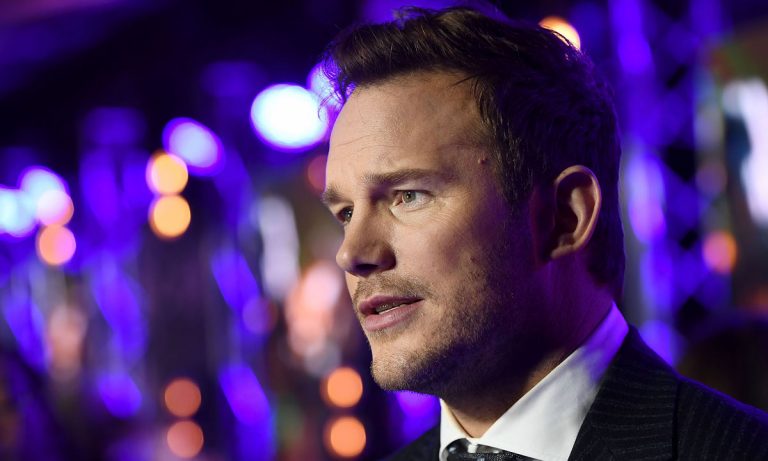
After months of dating extremely privately, Chris Pratt has officially put a ring on it-he’s engaged to Katherine Schwarzenegger. The newly engaged couple is reportedly planning a big, traditional wedding for this summer, but venues and caterers are apparently not the only thing on their mind.
In his first interview since popping the question, Pratt has told ET that he sees “lots of kids” in his and Schwarzenegger’s future.
“The future? Oh. Lots of kids,” he said. “Maybe less time spent working, more time spent enjoying life.”
He continued, “I always want to be that guy that works to live, not lives to work. I think [I want to spend] just a lot of time at the farm and a lot of time catching a lot of fish and seeing lots of sunsets.”
Diana and Charles announced their separation in 1992, 11 years after tying the knot, but it took another four years to reach an agreement for the divorce settlement.
Queen Elizabeth II reportedly wouldn’t have minded Diana retaining her title of Her Royal Highness, but Charles insisted she drop it when the marriage came to an official end.
Without it, Diana would need to curtsey to anyone in the royal family—technically even her sons, William and Harry. These are 9 more things Princess Diana lost after her divorce—and what she actually got to keep.
Despite the smack in the face of losing her royal title, Diana did have something to gain: a whole lot of money. Her lawyer and Buckingham Palace announced that she’d be getting the cash in one lump sum instead of having Charles pay ongoing alimony, and the amount was nothing short of staggering.
Neither side ever officially disclosed the details, but London newspapers leaked that she’d reportedly received $22.5 million, plus another $600,000 salary to pay for her private office.
A study revealed these indicate more sexual partners and mental health issues. Tattoos may be considered attractive to certain people — body ink is practically a visual symbol of both “bad boys” and “bad girls” — but a new study has determined that people with tattoos not only have more sexual partners, they’re more likely to have mental health issues and sleep problems.
Researchers at the University of Miami studied 2,000 adults living in the U.S. and found a positive correlation, not just between tattoos and mental health and sleeping issues, but also smoking, incarceration, and number of sex partners.
Our results suggest that individuals with tattoos are more likely to engage in risky behaviors relative to their non‐tattooed counterparts, which may lead to health consequences. Dermatologists, healthcare providers, and public health advocates should recognize that having a tattoo(s) is a potential marker for mental health issues and risky behaviors.
“Previous research has established an association between having a tattoo and engaging in risky behaviors,” said the study’s lead author, Dr. Karoline Mortensen.
“In an era of increasing popularity of tattoos, even among women and working professionals, we find these relationships persist but are not associated with lower health status.”
A Pew poll from 2010 found that 40 percent of people between ages 18 and 29 have at least one tattoo, with half of the group claiming between two and five. Eighteen percent had at least six.
Tattoos have been a part of human culture for thousands of years, serving as amulets, status symbols, declarations of love, signs of religious beliefs, adornments, and even forms of punishment. The earliest evidence of tattoo art dates to over 5,000 years ago. During the construction the great pyramids there become conclusive evidence of their use amongst people.
Ancient Greeks used tattoos to communicate among spies. But they fell out of favor and for health reasons almost vanished. In the 18th and 19th centuries tattoos were used as a unique way to identify a sailor’s body should he be lost at sea or impressed by the British navy.
In the 1930s, when Social Security numbers were introduced, people flocked to tattoo parlors to get their numbers inscribed on their arms, chests or backs as a memory aide.
In the mid-20th century, even as musicians like the Grateful Dead and Janis Joplin helped make tattoos even cooler, the form suffered a setback in the city, as a 1961 hepatitis outbreak blamed on a Coney Island tattoo artist had prompted the New York City health department to ban tattooing. At a time when tattoos were seen as signs of promiscuity, Ruth Marten, a tattoo artist during the 1970s, says many of her clients were women getting a divorce, including one who told her that she “wanted to be able to change her body to something that her ex-husband had had no experience. The ban was lifted in 1997.
Medical cannabis shortfall concerns appeared even earlier. Some users worried producers were prioritizing more lucrative recreational products or overseas markets.
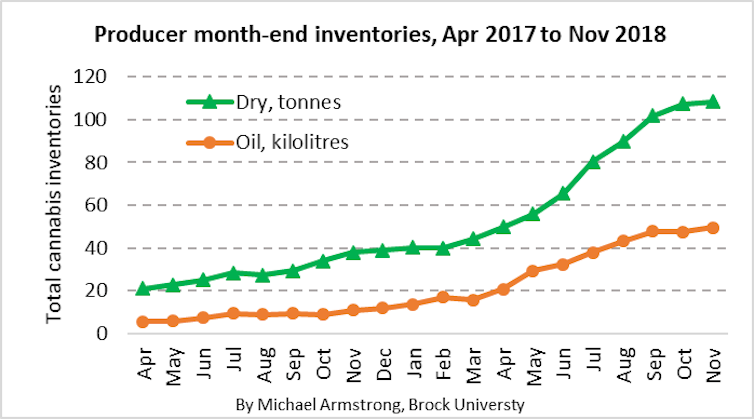
Cannabis producers greatly expanded their stockpiles prior to legalization last year. Between January and September, month-end inventories of “dry” cannabis (flowers and leaves) more than doubled from 40 to 102 tonnes.
Similarly, cannabis-infused oil supplies more than tripled, from 14 to 48 kilolitres. Inventory growth slowed in October as recreational sales began.
Producers’ month-end inventories of oil and dry cannabis. Prepared by author from Health Canada data. Michael Armstrong
So as officials have noted, there was lots of cannabis overall. That doesn’t mean there weren’t shortages.
Medical decline and rebound
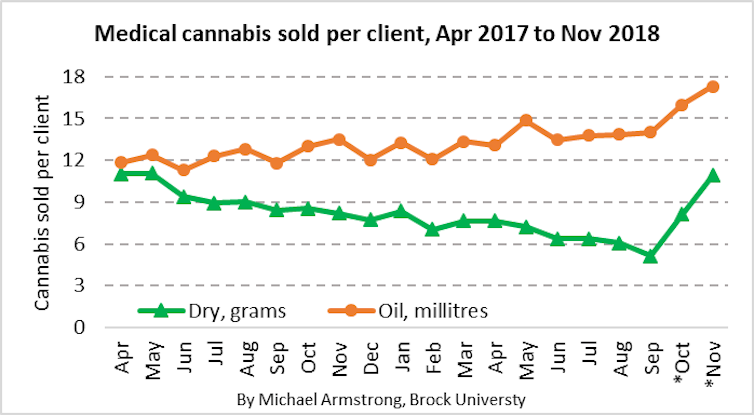
Consider medical cannabis. Between April 2017 and September 2018, oil sales per registered client increased 18 per cent. Meanwhile, dry sales plunged 53 per cent, from 11.0 grams per client to just 5.1.
Medical quantities sold relative to total registered clients. October and November 2018 use September’s client count. Prepared by author from Health Canada data. Michael Armstrong
Dry sales’ steep decline might reflect a gradual medical shift to oils. But shortages also might have contributed.
The post-legalization sales increases support that theory. November’s oil sales were 18 per cent above September’s. But dry sales soared 103 per cent. Medical clients seemingly refilled their dry supplies after legalization made prescription transfers easier.
Differences between oil and dry cannabis also appear in the recreational cannabis data.
Oil flows, dry cannabis struggles
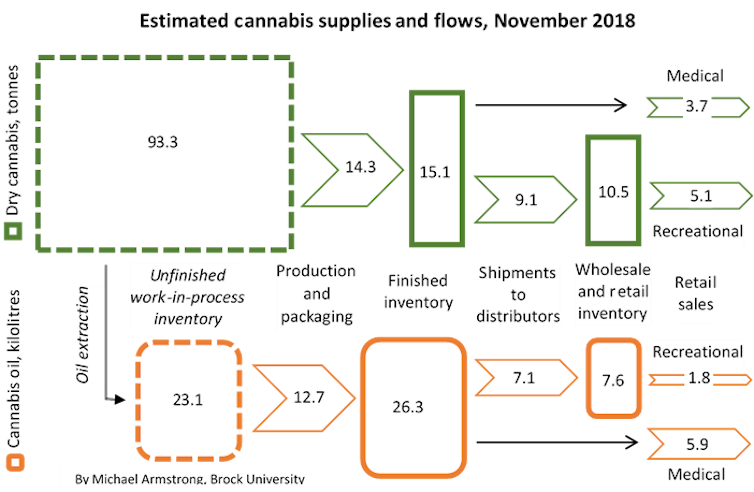
For cannabis oil, recreational sales hit 1.9 kilolitres in November, legalization’s first full month. But comparison to October’s stronger numbers suggests retailers lost sales of roughly 1.8 kilolitres due to shortages. That implies potential recreational demand was around 3.8 kilolitres monthly. Meanwhile, medical sales hit 5.9 kilolitres.
Distributor inventories ended November in good shape. They more than doubled to 7.6 kilolitres. That’s enough to satisfy more than two months of recreational demand.
Similarly, producers ended with 26.3 kilolitres of finished (ready-to-ship) oil. That’s nearly three months of combined recreational and medical demand. Plus, their production and outbound shipping rates both exceeded total end-user demand. That suggests shortages would ease over time.
Rectangles show month-end inventories of unfinished (dashed lines) and finished (solid lines) products. Arrows show the month’s flows of products from producers toward consumers. Green indicates dry cannabis, orange indicates oils. Numbers indicate tonnes of dry cannabis and kilolitres of oil. Estimated by author from Health Canada data. Michael Armstrong
By comparison, dry cannabis struggled in November. Sales were 5.1 tonnes, but lost sales were perhaps about 8.3 tonnes. That put monthly recreational demand around 13.4 tonnes. Medical sales hit 3.7 tonnes.
Distributors’ inventory climbed significantly to 10.5 tonnes. But that’s insufficient for even one month’s demand.
Producer’s finished goods inventory of 15.1 tonnes likewise represented less than a month of combined recreational-medical needs. Production and shipments also trailed demand. That implies shortages would continue worsening.
Explanations?
Several explanations are possible for dry cannabis shortfalls existing despite large total inventories.
One is that 86 per cent of producers’ dry inventory was unfinished and not yet available for sale. Much of that was recent crops being dried and cured. But the large contrast with finished goods suggests possible processing and packaging bottlenecks too.
Another reason is these data add-up inventories across all producers. By contrast, each recreational customer is served by just one provincial distributor.
Suppose one source has a surplus while another has a shortage. Their total inventory could look healthy. But half their users would see empty shelves.
As well, supply and demand are much harder to balance for individual products than for overall product categories. That’s a common retail problem.
For example, imagine visiting a clothing store. Request “a shirt”, and sales staff could show you hundreds. But specify “a long-sleeved, medium-tall, all-cotton, emerald-green shirt” and they might have none to offer, despite huge inventory overall.
Cannabis buyers and sellers likely experienced such mismatches. Medical clients treating conditions like epilepsy would be especially at risk. They’d want specific product formulations, not random substitutes.
One factor that doesn’t look important is cannabis exports. In 2018, those averaged only 2.5 per cent of monthly production. That’s probably too small to significantly affect domestic availability.
Another non-issue was cannabis growing itself. Producers’ unfinished dry stockpiles remained almost unchanged during November. That suggests crop harvesting rates kept up with processing.
Bigger market, bigger challenges
The industry faces larger challenges longer term. Estimates of Canada’s total demand vary widely. But Health Canada’s latest assessment, for dry cannabis and oil equivalents combined works out to about 77 tonnes monthly.
So the legal cannabis industry must not only provide better availability of the specific products users want. To eventually serve every recreational and medical user, it also needs to massively grow its capacity. And it must do that while competing with black markets despite federal restrictions on branding and promotion.
Cancer is the one disease that has, by now, affected nearly every family in the world. It kills somewhere around 8.2 million people each year. And while medical treatments for this vile affliction have been improving over the past few decades, science is still a long way off from developing a definitive cure. There are some who say that marijuana could be the solution, and, believe it or not, there is a small body of evidence to back that up this claim. In fact, a recent study shows that cannabidiol (CBD), the non-intoxicating compound of the cannabis plant, has the ability to improve cancer survival rates in mice when combined with a chemotherapy regimen.
We have known for years that marijuana can be beneficial in helping cancer patients deal with the nasty side effects of chemotherapy. Most recently, the CBD compound itself has been shown to help those undergoing chemo better deal with nausea. Yet, if the latest research coming out of the Queen Mary University of London holds any weight, whatsoever, CBD may also have cancer-fighting properties that could eventually help humans with certain forms of this disease live longer. But let’s not call it a cancer cure. CBD is only showing promise as a supplemental treatment option.
“Cannabidiol is already approved for use in clinics [in the UK], which means we can quickly go on to test this in human clinical trials,” said lead researcher Dr. Marco Falasca.
Unfortunately, scientists in the United States are met with much resistance when it comes to trying to study even non-intoxicating forms of marijuana. Since the herb remains a Schedule I drug on the Controlled Substances Act, it has “no known medical value,” and is considered as dangerous as heroin. For this reason, studies designed to explore the medical benefits of anything derived from the cannabis plant are few and far between.
There could, however, be some improvement with respect to the bureaucracies surrounding CBD research, as the FDA recently approved the first-ever cannabis-based drug – Epidiolex – for distribution in the United States. A recent report from Forbes shows that the DEA must now reschedule the CBD compound in order to GW Pharmaceuticals to bring this product to market. If this happens, researchers would likely have an easier time conducting studies dealing with this particular cannabinoid.
According to the American Cancer Society, pancreatic cancer is one of the most common and aggressive forms of this disease. Dr. Falasca’s study, which was paid for by the Pancreatic Cancer Research Fund, found that mice treated with both chemotherapy and CBD lived an average of 56 days, compared to 20 days for those mice that didn’t receive treatment. Mice receiving chemotherapy alone only survived a little over 23 days.
“The life expectancy for pancreatic cancer patients has barely changed in the last 40 years because there are very few, and mostly only palliative care, treatments available,” Dr. Falasca said in a press statement.
“Given the five-year survival rate for people with pancreatic cancer is less than seven percent, the discovery of new treatments and therapeutic strategies is urgently needed.”
But without immediate access to additional research opportunities, it could be decades before we understand the true healing powers of this plant. There is hope that Canada, which is set to legalize marijuana for recreational use in October, will provide researchers with more opportunities to examine the reach of the cannabis plant.
Okay, so you’ll have to give up any plans for expanding your family, but not having to stress over an unplanned pregnancy is actually why researchers think vasectomies make sex better. Plus, fumbling around with condoms can be a mood killer in itself.
In the study, 294 couples were surveyed. Nearly half of men said their sex lives significantly improved after getting a vasectomy, 12.4 percent said they were having sex more frequently and 4.5 percent said they were having less sex.
According to Men’s Health, this recent study backs up data from a 2015 Stanford study of nearly 6,000 men that found guys with vasectomies “had sex 5.9 times per month, compared to 4.9 times for intact guys.” The study’s author, Dr. David Guo, told Men’s Health that he echoed the new research, saying couples would be more likely to get busy with the risk of getting knocked up off the table.
Sorry, ladies. The study concludes that women perceive no difference in sex after the procedure, only that “the satisfaction of the women was not reduced by the vasectomy.” So, that’s something.
While certainly dainty, maxing out at around 7 pounds, the Yorkie is a true terrier — feisty, brave, and full of attitude. Known for its regal floor length. almost human-like golden locks, it’s no wonder the Yorkshire Terrier became popularized as lapdogs for Victorian women. Today, with a big dog personality bursting inside its toy-sized body, the Yorkie is as popular as ever.
Here, we find a few of the most regal Yorkies of Instagram.
Meal prepping sounds like something only really organized people can accomplish. The act of preparing meals days in advance sounds risky and like you’d have to spend an entire day cooking, which is often true. When done correctly, meal prepping saves tons of time and allows you to eat balanced meals throughout the week, something rare when you’re busy with work and life.
The process of meal prepping varies depending on the person. On average, meals shouldn’t be stored in the fridge for more than four days, but you can freeze proteins if you made a large batch. If you’re picky with how fresh your food is, you can prepare your protein and carbs ahead of time, store them, and pack fresh veggies the day of.
No matter the lifestyle, everyone can benefit from scheduling their cooking, avoiding the pain of having to prepare a meal with whatever’s left on the fridge. Check out some items that will help you ease your transition into meal prepping:
Instead of sweating over four different pans on the stove, you can use a large pan with dividers that saves you some work. This pan is helpful for saving yourself some time while cooking, keeping foods separate from each-other, and narrowing your focus on one stove.
Instant Pots are amazing, allowing you to cook dishes over long periods of time. This device is programmable and can be left unattended while you sleep or are away from home. You only have to pack your food once you wake up, or eat once you get home.
Instead of wasting all of your savings on Ziploc bags, you can purchase reusable silicone bags, which are practical, easy to clean and good for the environment. Good quality storage bags will save you time and frustration, preventing meals from getting spoiled and preserving their taste.
If you’re planning on taking your food to work or to school, you need the appropriate container. You can buy disposable ones in bulk or buy a reusable one with dividers which you can reuse.