Friday, December 19, 2025
Home Blog Page 909

Vaping Is Up, Painkiller Use Is Down In Teens

Back in December, the NIH released a survey that found that vaping e-cigarettes, THC cartridges and flavored vape juice is on the rise in teenagers, while the abuse of painkillers is down. Though the National Institute on Drug Abuse (NIDA) found the cannabis numbers disturbing, what do they really mean?

The study beyond implied that vaping THC cartridges was far more harmful than smoking cannabis the old fashioned way. Not because of the miniscule molecules going into young lungs, not because vaping is itself dangerous, but because the cannabinoids are more concentrated in a pen than in flower form.

There are many sides to this argument. Most cannabis imbibers agree that combusting plant matter is likely worse for one’s lungs (if that’s a concern at all) than vaping. Vape pens are supposed to be the chiller way to toke, discreet, easy to carry and, as long as it’s not turned up too hot, smoother. Others, however, argue that not enough research has been done on this form of ingesting cannabis.

Those arguments, however, are not what the D.E.A. is worried about. 27.8 percent of high school seniors vaped in some form or another in 2017, and though vaping nicotine has been shown to be less harmful than smoking the tar, carcinogens and chemicals in cigarettes, it could still be linked to cancer and addiction. Cannabis products, on the other hand, have never been shown to be detrimental to one’s health, though that information is not D.E.A. related.

There is always going to be concern about the development of young brains and what affects their progress. NIDA and the D.E.A. continue to insist that ingesting cannabis in any form stunts intellectual growth in youth and only time will mend the harshness of reefer madness. Though we would never suggest teenagers smoke anything, those are the years of experimentation and they’re not likely to stop being thus.

The survey also showed that though painkiller abuse was up in adults, that it was dropping in youth circles. It went on to say, “In overall pain medication misuse, described as ‘narcotics other than heroin’ in the survey, past year misuse has dropped significantly among 12th graders since its survey peak in 2004—to 4.2 percent from 9.5 percent.”

These are very encouraging numbers as the opioid crisis has claimed so many lives and doesn’t discriminate against age. And though the NIH survey had its own slant on all topics, at the very least the opiate news is grand.

Here’s Everything You Need To Know About The Marijuana STATES Act

“What do you do?”

When meeting someone for the first time this is a pretty standard ice-breaker. Usually, the responses are pretty innocuous: “I’m in sales” or “I’m in IT”. But if you add “…in the cannabis industry” to those answers, you’re bound to get a number of follow up questions.

When I tell people that I advise businesses, investors, and ancillary service providers in the marijuana industry, without fail the first question that I get is “Aren’t you worried about the federal government?” I then go into a discussion on the Rohrabacher-Blumenauer Amendment (formerly the Rohrabacher-Farr Amendment), the history of the Cole Memo (which although rescinded still plays an important role in banking), and the importance of complying with your state’s cannabis regulations.

Lastly, I talk about the change in the national discussion and perception of the cannabis industry. Gone are the days of the “lazy stoner” stereotypes (although perhaps not for U.S. Attorney General Jeff Sessions). Instead, we have sophisticated cannabis businesses providing products to a large and diverse section of America — with more and more states looking to legalize either medical or adult-use marijuana activities this year.

For those of us who follow cannabis bills in the U.S. Capitol and in our state legislative houses, it’s clear that there is momentum towards ending America’s shortsighted and draconian war on cannabis. While Republicans and Democrats in Congress can’t seem to agree on anything nowadays, support for individual states to regulate cannabis activities as they see fit for their constituents is one of the few areas where bipartisan support exists. Every day, more Republicans in Congress are signing on as sponsors to bills that will support the cannabis and hemp industries (we see yo, Mitch McConnell!). And now we can add to the list of cannabis supporting Republicans: President Donald Trump?

Just last week, the President, while boarding a helicopter for the G-7 summit in Canada, mentioned his support for what Senator Cory Gardner (R-CO) is doing. What exactly is Senator Gardner doing you ask? He, along with Senator Elizabeth Warren (D-MA), and Representatives David Joyce (R-OH) and Earl Blumenauer (D-OR), have introduced the Strengthening the Tenth Amendment Through Entrusting States (STATES) Act. You’ll recall that Senator Gardner didn’t take too well to A.G. Sessions rescinding the Cole Memo, so he vowed to block all Department of Justice appointments in return. After meeting with the President, Sen. Gardner put an end to his blockade (which we covered, here) when the President assured him that “he will support a federalism-based legislative solution to fix this states’ rights issue once and for all.” At the time of the meeting, there was no agreement as to what the “federalism-based legislative solution” would look like. Today there is. Here’s a list of what the STATES Act would and wouldn’t do:

  • It would amend the federal Controlled Substances Act (“CSA”) so that the CSA would not apply “to any person acting in compliance with state law relating to the manufacture, production, possession, distribution, dispensation, administration, or delivery of marihuana.”
  • It would also amend the CSA so that the same exclusion would apply to persons acting in compliance with the law of a federally recognized Indian tribe within its jurisdiction.
  • It would deschedule industrial hemp from the CSA entirely.
  • It would make access to banking easier for cannabis businesses as state legal cannabis sales and transactions would no longer be considered trafficking.
  • It would not change the law in states that continue to criminalize cannabis activities.
  • It would not apply to any of the other substances identified in the CSA.
  • It doesn’t guarantee that President Trump will keep his word.

That last point isn’t actually written into the bill, but it’s the 800-pound gorilla in the room that no one can ignore. The President, to be polite, has had a tenuous relationship with the truth and keeping his word, so it’s far from certain that he will throw his support behind the STATES Act. An off-the-cuff remark before meeting with G-7 allies (or are they adversaries now?) does not constitute unwavering support. We’ll have to see more consistent and direct support from the President before we can feel confident that the STATES Act will become law. The President’s support is necessary because he’s still very popular with the Republican base and can therefore give recalcitrant Republicans in Congress cover if they’ve been cannabis opponents previously.

Let’s keep our fingers crossed that the North Korea Summit meeting goes well (who cares about cannabis legalization if nuclear war’s broken out?), that Congress pushes this one through, and that the President carries that high over to the STATES Act.

Habib Bentleb is an attorney at Harris Bricken, a law firm with lawyers in Seattle, Portland, Los Angeles, San Francisco, Barcelona, and Beijing. This story was originally published on the Canna Law Blog

The Sex And The City Scene HBO Cut Because

0

If you haven’t heard by now, “Sex and the City” is celebrating its 20 year anniversary this year. That’s right. The pilot aired on HBO in 1998. And as tongue-in-cheek as the show was for its time, there was one scene in particular that was too harsh even for even HBO. This is the same network that airs “Game of Thrones” and “Tell Me You Love Me.”

Some of the show’s writers spilled some tea here is the Sex and the City scene cut because. well…

Show-runner Michael Patrick King told Vanity Fair there were only two times HBO censored the series. The first time was in Season One’s “The Monogamists,” a memorable early episode in which Charlotte plays “tug of war” with a man who’s desperately trying to get her to perform oral sex on him. Something she despises.

Related: This Is The ‘Sex And The City’ Scene That Devastated Cynthia Nixon

“It was really the end of the story line,” said Sex and the City creator Darren Star. “He basically was always pushing her head down to give him oral sex. And he had this golden retriever who was always around. In the final scene, she basically let him have it about being offended by his insistence on just wanting a blow job. She accused him of only liking her for that and kind of stormed out. And then she walked back in and saw that his golden retriever was going down on him.”

Writer Amy B. Harris added,

It’s sort of horrifying that we shot that. We shot him putting peanut butter on his penis, and Charlotte walks back in like, ‘Oh, I’m being unreasonable,’ and then she sees that. . . . I can’t believe we even thought about doing it.

The other scene that was censored? That happened in Season Three’s Attack of the Five-Foot-Ten Woman.” And it was a minor adjustment.

Related Story: This City Is Ranked Highest In Multiple Orgasms

Remember the scene where Miranda’s housekeeper, Magda, finds her “goodie drawer” and decides to replace her vibrator and condoms with a statue of the Virgin Mary? In the episode, Miranda confronts Magda who then places some fanned out some condoms on her nightstand. Originally, the script called for the Virgin Mary to be looking over the condoms, but that was apparently too much for network censors. Says King, “People were like, ‘That’s too far!’ So we took Mary out.”

For tons more inside gossip from “Sex and the City” staffers, check out the full article.

Let’s Talk About Justin Trudeau’s Eyebrows

All eyes were on Donald Trump and the G7 summit over the weekend. All eyes, except for the ones that were mercilessly staring at Justin Trudeau’s wayward left eyebrow.

So much for the possibility of a trade war being the main focus.

Some people are speculating that the Canadian Prime Minister was wearing falsies. Because nothing says “take me seriously” like a set of fake eyebrows.

Before the meeting, Trudeau gave a joint press conference with French Prime Minister Emmanuel Macron and then all hell broke loose — much like Trudeau’s left eyebrow seemed to be doing.

Watch for yourself.

https://twitter.com/Doranimated/status/1005707571859283969

And in true Twitter form, Trudeau’s “fake” brows now have their own account.

https://twitter.com/TrudeasE/status/1005805593326751744

But if you look at past photos of Trudeau, his left brow has always looked a bit off.

As this publication points out, another video clip of Trudeau shot at a different angle tells another story entirely. It’s not a fake brow; it’s a brow that has a good and bad side, just like the rest of us!

https://twitter.com/iD4RO/status/1005927516190670848

In the video, as TheJournal.ie explains:

…you can see that Trudeau’s eyebrow looks normal and that there is a slight shadow cast on his left brow from poor lighting on the set. It becomes more noticeable when Trudeau looks down but then disappears when he address the audience straight on.

Canadian journalist Sean Craig notes that Trudeau’s left eyebrow is thicker, which gives off a “sloping” effect from certain angles.

https://twitter.com/sdbcraig/status/1005848918700093440

So, to sum up Trudeau’s brows:

https://giphy.com/gifs/seinfeld-fake-2Faz5pwGrne1B5kvC


Oh, Honey! There’s A Fetish Where People Want To Have Bee Sex

While there are a lot of strange people in this world with freaky sexual preferences, we believe that Melissophilia is the one fetish that’ll shake you to your core. Melissophilia might just be the weirdest, most awkward and most cringeworthy sexual fetish ever, especially for bees. We’re talking about grown humans who want to have sex with bees. Bee sex, if you like.

This sexual deviation is rooted in the attraction to bees and in the arousal their involvement in sex produces. It’s an uncommon fetish because it’s not focused on the pain the bees cause, instead it’s focused on the bees themselves. These people literally want to sleep with bees.

Let’s dive into Melissophilia a little further. The origin of the word is Greek, and it’s a combination of the words “honey bee” and “love”. Don’t worry, it’s not as romantic as it sounds. The bee groupies have different methods of catching their preys and of getting their freak on, but the book “Everything You Know About Sex Is Wrong” explains one process in detail. These people catch the bees in jars, shake them up so they’re drowsy and unable to fly away, and then place them on their genitals, prompting the bees to sting them. Cruelness of method aside, this painful process gets the job done because the bee sting makes the genitals swell and become hypersensitive, which will in turn lead to a stronger and much more intense orgasm. After the penis is stung, the circumference of it grows, leaving people with their senses heightened. Not to mention in a lot of pain, but whatever, we’re not here to judge.

A lot of people enjoy pain during sex and there are known fetishes where they add insects to their sex life so that they can get bitten or stung. The difference between these two groups is that while one focuses on the pain and the emotional rush that it causes, Melissophiliacs are in it for the bees. The pain they cause is just an accompanying factor.

Alexa Recorded This Family’s Conversation And Sent It To A Coworker

One of the biggest issues people have with Amazon’s Alexa is the fact that it’s constantly eavesdropping in on your life. Think about it, how does the device know when you’re calling its name if it’s not constantly listening in on your conversations?

For all the disbelievers, this story proves just how aware Alexa is of everything you say and do. The Huffington Post published a crazy story where a private conversation between a couple in Oregon was recorded by Alexa and  sent to a random contact from their phones. Because the device got confused and thought it heard that command.

KIRO TV spoke with Danielle, one of the owners of the faulty Alexa, who said that she’d had her suspicions about the device who also handled their house’s security, heat and lights. “My husband and I would joke and say ‘I’d bet these devices are listening to what we’re saying,” she said. A few weeks ago, a coworker of her husband called them and said that they had to unplug their Alexa because they’d been hacked. He’d received a recording of a private conversation of the couple, where they were talking about hardwood floors. Luckily the conversation wasn’t scandalous.

The couple contacted Amazon for an explanation, and an Alexa representative began to investigate the issue. Amazon was transparent, claiming that their engineers were able to see the problem thanks to Alexa’s conversation logs. They issued the following confusing statement:

Echo woke up due to a word in background conversation sounding like ‘Alexa.’ Then, the subsequent conversation was heard as a “send message” request. At which point, Alexa said out loud “To whom?” At which point, the background conversation was interpreted as a name in the customers contact list. “Alexa then asked out loud, ”[contact name], right?” Alexa then interpreted background conversation as “right”. As unlikely as this string of events is, we are evaluating options to make this case even less likely.”

While this statement isn’t the least bit reassuring, Amazon apologized to their customers repeatedly, claiming that the incident was extremely unlikely. Their Alexa device simply went crazy.

In the scheme of things it was pretty harmless, and this is a pretty amazing story to add to the roster of “weird things Alexa has done.” At least this family can rest easy now; it’s better to have a faulty Alexa than to be hacked, right?

Pesticides In Your Marijuana: What You Need To Know

As cannabis is legalized for medical and recreational use on a state-by-state basis, safety regulations regarding cannabis products are becoming increasingly important and that includes pesticides in marijuana. One aspect of safety regulations involves setting maximal allowable limits on pesticides. Such regulations are particularly significant given that medical populations, including young and immunocompromised patients, are among the intended consumers of cannabis products.

The cannabis industry has a pesticide problem—actually, many problems. A number of studies have reported high levels of pesticides on cannabis samples taken from the medical markets in Washington and Colorado. There have been cannabis product recalls in both states and in Canada because of pesticide infractions.

The Environmental Protection Agency (EPA) sets pesticide standards and tolerance levels nationally. But the EPA has not approved any pesticides specifically for use on cannabis because it is a federally illegal substance. So, as of now, it’s up to each state to decide on a single “action limit” for each pesticide applied to cannabis. An action limit refers to the maximal allowable level of a pesticide. This limit is reported in units of parts per million (ppm). A 1 ppm limit on a pesticide means that up to 0.0001% of the product’s weight can be from the pesticide.

A state cannot set a pesticide action limit that is more permissive than regulations for general use on food crops established by the EPA. In some cases, the EPA’s limit for food products is adopted by state marijuana regulators. But in other cases a stricter limit is determined by the level of quantification that can be “reasonably achievable by analytical chemists.” In other words, action limits are often based on the ease of detecting chemicals rather than a prioritization of their dangers.

The same limit for a particular pesticide applies whether a product is meant to be smoked, vaporized, or ingested—even though different modes of administration can dramatically change the toxicity of the pesticides. Cannabis is still consumed primarily by smoking. Yet there is next to no information on the health effects of burning pesticides. This information vacuum is likely attributable to lobbying by the tobacco industry. According to the U.S. Government Accountability Office, the “EPA does not assess intermediate or long-term risks to smokers because of the severity of health effects linked to use of tobacco products themselves.”

In other words, because cigarette-smoking is already known to be harmful, federal officials decided that it’s not important to understand the adverse health effects of inhaling combustible pesticides. Consequently, state regulators are lacking crucial information about many pesticides. Two pesticides used in the cannabis industry, myclobutanil (generally sold as Eagle 20) and pyrethrins, underscore the inconsistency of current pesticide regulations.

Pyrethrins

Pyrethrins are a natural family of six pesticides produced by chrysanthemum. They break down quickly in sunlight or heat. They are highly toxic to aquatic life but have low toxicity to warm blooded animals, including humans. The EPA maintains that pyrethrins do not pose a chronic risk for mammals (including humans), except potentially for people who regularly spray them on crops. In commercial products, pyrethrins are generally sold with piperonyl butoxide (PBO), a compound that synergizes with pyrethrins, allowing them to be effective at lower doses. Pyrethrins should not be confused with pyrethroids, synthetic chemicals that are as different from pyrethrins as THC is from synthetic “spice” or “K2” bath salts.1

The action limit for pyrethrins is 1 ppm in every state that has set pesticide regulations for marijuana. California recently released proposed regulations, setting the pyrethrin limit at 0.7 ppm for edibles and 0.5 ppm for other cannabis products.2 Hearings will be held on this proposal four times in the month of June. The regulations can be found here.

But the European Food Safety Administration (EFSA) has concluded that it is safe for humans to ingest up to 0.4 mg pyrethrins per kg bodyweight every day. By this estimate, an average 135 pound human consuming state-approved cannabis could ingest 55 pounds of product in a day without toxicity due to pyrethrins.3 This calculation can be inverted, and an action limit can be determined from the maximal amount of cannabis products used in a day. For example, if one assumes that no one ingests more than 1% of their body weight in cannabis products (about 1.1 pounds for an average human), then 40 ppm is a stringent enough action limit to prevent pyrethrin toxicity, according to the EFSA.

While the European Food Safety Administration’s limit for pyrethrins does not take into consideration the synergistic toxicity between pesticides, it does provide a viable starting point to base action limits on safety.

Burning Pesticides

The toxicity of myclobutanil highlights the importance of considering how a cannabis product is consumed. When heated myclobutanil decomposes into hydrogen cyanide, a toxic compound that causes neurological, respiratory, cardiovascular, and thyroid problems at concentrations of 0.008 ppm. Smoking or vaping cannabis tainted with myclobutanil residue is a bad idea. This pesticide is now banned for use on cannabis in Oregon. However, in Nevada up to 9 ppm of myclobutanil is allowed on cannabis as of January 2017.

Since smoking is still the most preferred method of consuming cannabis, it is essential to know the safety of pesticides when heated. Vaporization leads to temperatures around 200˚C, while burning causes temperatures above 400˚C. Unlike myclobutanil, pyrethrins likely break down into two safer chemicals when heated without burning: chrysanthemic acid and a rethrolone. This breakdown may be reduced in the oily solution of a concentrate. When smoked it is not clear how pyrethrins will decompose and how dangerous these chemicals will be.

There’s ample reason for state officials to be cautious and to err on the side of safety with respect to pesticide regulations. But being stringent without a basis in science may have the unintended effect of pushing cannabis cultivators to use harder-to-detect pesticides that are more toxic.

It is paramount to study the effects of heating pesticides. Lacking pertinent data, regulations should at least be geared toward reducing the use of pesticides that we know burn to highly toxic compounds, and regulations should give some leeway to pesticides and growing practices that are safer. Moreover, regulations need to be malleable, so that as research provides us with a better understanding of pesticide toxicity, regulations follow suit.

Research for this article was supported by CannaCraft, a California-based medical marijuana company.

This story was originally published by Project CBD.

4 Things About The French And Their Views On Intimacy

0

Americans and English speaking people have strange perceptions about the French. These people are seen as alluring and sometimes rude. They’re also smooth and are known for their delicious food. Culture really seems to believe that the French are really romantic and into sex. While most of these are stereotypes, they exist for a reason, and for outsiders the French are very mysterious.

Maia Mazaurette, from GQ France answered a few questions for The Local, clearing up a few beliefs and proving that cultures aren’t all that different when it comes to sex. Check out 4 of main differences between Americans and French when it comes to sex:

Sex Is Pretty Chill In France

While in America we tend to be pretty conservative with the way we portray sex in the media and in our lives, the French are different. According to Mazaurette, there are no “moral hang ups” about having sex in France. She also says that there’s less of a“hook up” culture and thus, no stress over having sex with someone you met a little while ago. In France, first date sex doesn’t take away from the potential of a serious relationship.“We have sex because it’s a cool activity. If something physical is happening, just enjoy it”

What’s Are The Dating Rules?

In America the 3 date rule used to be pretty popular, even though Tinder and dating apps have complicated things further (you can hook up with someone on the first date but it might make you seem like you’re not “the serious type”). In France, “things can happen quickly, especially if people are a little bit drunk. I don’t want to have to wait for sex and play the game if I have a crush on someone. I don’t want to have to wait until the end of the evening for sex, I want to go home immediately.” Of course, this depends mostly on the person and not the country.

Oral Sex Isn’t Expected In France

Women are sometimes expected to give oral sex to men without asking anything in return. Mazaurette is really shocked by this, claiming that she finds it “completely weird that women [from America or UK] would give a guy blow job and get nothing in return. It’s implying that he should be rewarded just for speaking to you. In France you never owe sex to anyone”. That seems smart.

When Do French People Know That They’re In A Relationship?

In France, there’s no such thing as having “the talk.” In America, after people have kissed, slept together, and hung out a couple of times, they have a conversation where they make it clear to each other that they’re dating exclusively. Like children.

French partners will expect you to be faithful from the beginning, deleting your profile from dating sites and such. If you’ve reached the point where you’re having sex with someone without using a condom, then it’s pretty much expected that you aren’t sleeping with other people.

What Happens When You Consume Marijuana On An Airplane

Have you ever heard of the Mile-High Club? No, not the one that involves shedding clothes and bathroom tomfoolery. We’re discussing the club where you’re high while traveling in the air. Here is what happens when you consume marijuana on an airplane.

Well, one Southwest Airlines passenger was so eager to join that Mile-High Club they decided to spark one up mid-flight. That’s right. On Flight 1250, a man ducked into the lavatory to smoke a blunt. You might be thinking this was a particularly long flight to warrant such reckless behavior, but you would be wrong. This was a flight from San Francisco to Los Angeles, with a total travel time of an hour and a half.

RELATED: Airline Passengers Keep Stealing Luxe Bedding From First Class

The pilot diverted the plane for an emergency landing at San Jose Mineta International Airport, about 50 miles south of San Francscio, after announcing a “mechanical difficulty.” Smoking on an airplane is illegal and the man was handed over to law enforcement. The remaining 32 passengers hopped aboard other planes to continue their flight plan. Some passengers said they could smell the weed smoke emanating from the bathroom.

“It looked like that someone needed to smoke a joint on a plane, and he went into the bathroom, smoked his blunt, and set off the fire alarm,” passenger Jonathan Burkes told CBS Los Angeles.

Here’s the official statement Southwest released to FOX News:

Southwest Airlines Flight 1250 with scheduled service from San Francisco to Los Angeles landed safely after diverting to San Jose following indications a Customer was allegedly smoking in the aft lavatory.

The flight landed without incident[,] was met by local law enforcement, and the Customer in question was turned over to local authorities. Our Employees in San Jose worked hard to accommodate the remaining 32 Customers on other aircraft to continue their journeys.

If you’re wondering the penalty involved here, it isn’t cheap. According to 49 U.S. Code 41706, “Civil fines for smoking on an airline flight range from $2,200 for smoking in an airplane seat or cabin to $3,300 for smoking in an airplane lavatory.” We can almost guarantee that’s the most anyone’s paid to smoke a blunt in California this year.

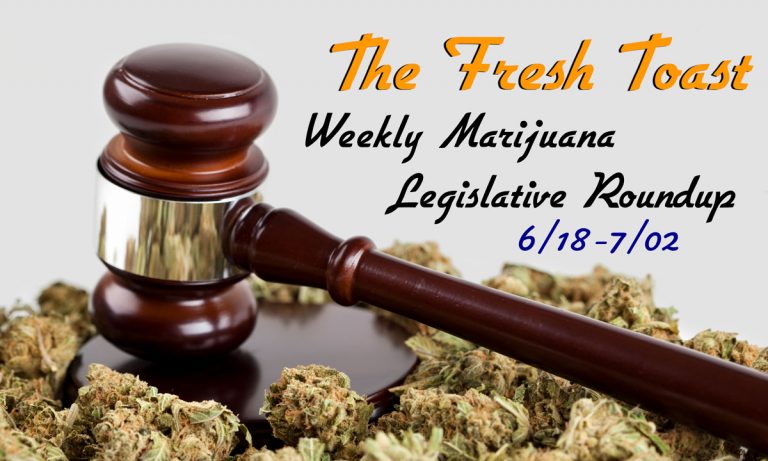
The Fresh Toast Marijuana Legislative Roundup: June 11

Last week was a busy one for cannabis legislative news. On the federal level, a bill was introduced in the Senate to give states more power to establish their own marijuana laws and President Trump says he endorses the plan. In Colorado, legislation that would have allowed “tasting rooms” was vetoed by Gov. John Hickenlooper. News out of California and Florida were a bit more upbeat. Find out more in our weekly marijuana legislative roundup.

National: 

On Thursday, legislation was introduced in the U.S. Senate that would give states more autonomy over marijuana policy and shield state-legal cannabis businesses from federal prosecution. The Strengthening the Tenth Amendment Through Entrusting States Act would allow each state to decide whether marijuana should be legal, while exempting state-legal marijuana programs from federal drug laws. Cannabis businesses in compliance with state law would also be able to take tax deductions like other businesses and put their proceeds in federally-insured banks, with such proceeds considered lawful. While the bill is unlikely to pass anytime soon due to the upcoming midterm congressional elections, it does have bipartisan support and President Trump indicated last week that he would likely sign the bill if it reaches his desk. A companion bill is also being introduced in the House of Representatives.   

Colorado: 

On Monday, Governor John Hickenlooper vetoed legislation to permit so-called cannabis “tasting rooms” similar to those operated by craft breweries in Colorado. The bill would have allowed currently-licensed recreational marijuana retailers to open a separate facility within the same jurisdiction where customers could buy and consume cannabis products on the premises, though smoking would remain prohibited in accordance with state law. Hickenlooper’s veto represents the latest in a series of failures for similar bills in several states that have legalized the plant for recreational use. Colorado would have been the first state to explicitly legalize marijuana social-use clubs on a statewide basis, though some cities such as Denver and San Francisco have recently implemented similar legislation. 

California: 

On Tuesday, the California Bureau of Cannabis Control released a new draft rule loosening restrictions on recreational marijuana deliveries. Under the regulatory package issued in May, cannabis delivery drivers would have been permitted to carry only the amount of product ordered in advance by customers. That was intended to outlaw the so-called “ice cream truck” model, in which delivery vehicles drive around with the equivalent of an entire retail store of product and fulfill orders as they are placed. The new proposal would seem to allow such a system. It now faces public comment before final approval by the end of the year. 

Florida: 

On Tuesday, a Florida state judge handed down a ruling that overturned the state’s ban on smoking medical marijuana, arguing that the ban is unconstitutional. Unless a temporary restraining order is granted by an appellate court, licensed patients will be allowed to smoke medical cannabis starting Monday, June 11, 2018.

Don't Miss Your Weekly Dose of The Fresh Toast.

Stay informed with exclusive news briefs delivered directly to your inbox every Friday.

We respect your privacy. Unsubscribe anytime.