Working from home tends to mean less movement throughout the day. Here’s what you can do to move more without making any big changes in your life.
If you have a fitness tracker, you’ve likely noticed the sudden drop your body experienced when you started working from home. It’s intense. Whether you used public transportation or relied on your car to get you from point A to point B, working from home means that you likely move a lot less, something that affects your waistline to your mental health.
Here are some simple tips that can help you move more when working from home.
Try different workout videos
Photo by Karthik Thoguluva via Unsplash
The good thing about working from home is the large amount of time you have at your disposal. When used productively (easier said than done), this means you can get laundry done, cook some food and even get a workout in before the end of the work day.
Workout videos are useful ways of getting your body to move. There are all sorts of options, from hour long workouts to 15 minute sessions that you can fit in as you take a quick work break. Take advantage of these opportunities and try to move a little bit. The more you do it, the more you’ll like it and reap benefits.
Walk during meetings
Photo by Ben Collins via Unsplash
Aside from getting your steps in, walking allows you to think better and approach problems more creatively. Thanks to Zoom, we rarely have phone calls. Still, when you get a phone call, use that time to walk around, whether you’re indoors or outdoors. Just remember to mute when it’s appropriate.
If you have a dog, you’ll know that walking them is a very useful workout, especially when you take the time to enjoy yourself and spend some time actually walking. Heading to the dog park or simply walking alongside your dog in different directions will give you some much needed space, and will also work for some effective exercise.
The goal of this list is to walk more, by any means necessary. Whether you have a dog or not, it’s important to fit in a walk whenever you can, especially if you’re not working out regularly or commuting to work. Use videos, reminders, and whatever you think might work to keep you motivated and willing to move a little bit more than you used to.
Cannabis is not a quick fix for declining revenues over the short term; it’s an opportunity for the long term.
By Barbara Pastori, Prohibition Partners.
A few weeks ago, Philip Morris CEO Jacek Olczak made the news with a series of seemingly counterintuitive remarks. Namely, that the tobacco giant may soon stop selling cigarettes in the UK, while urging the government to ban smoking altogether. Olczak said the Marlboro brand will “disappear”, and that “the first choice for consumers is they should quit smoking.”
While this might seem like a deliberately provocative stance — to some extent — it’s also broadly in line with the direction the tobacco industry has taken over the last few years. It may also prove to be a sensible business strategy. Most enduring companies do, at some point, have to reinvent themselves to survive.
Photo by Mathew MacQuarrie via Unsplash
Technological developments are a common driver of change, but pressure can also come from wider changes in consumer behavior. It’s more difficult, for example, to find a company still selling the same product after 100+ years than it is to find a company that successfully changed its line of business. In some cases, the best way to protect shareholders’ interest is to imagine different approaches and embrace change, rather than drifting comfortably on a sinking ship.
Tobacco and Cannabis: A Perfect Match
The global exodus of consumers from the tobacco market means this industry is now at a turning point, where alternative or additional product lines are vital to the future security of its companies. Among the many alternatives that the tobacco industry is exploring as part of its broad reimagining of its future, cannabis surely represents an opportunity. Numerous tobacco companies have already made investments in the cannabis industry over the past few years, including Altria, Imperial Brands, and most recently British American Tobacco.
But why does cannabis seem to be particularly appealing for Big Tobacco? The first association that comes to mind is smoking, but there is a lot more to the story. Here are a few key points that, in my opinion, make cannabis a particularly compelling case for tobacco companies.
1. Technological Advances
The two industries have shared the benefits of certain technological advances. Whenever a breakthrough is made in facilitating the consumption of combusted organic material in a more safe and efficient way — as is the case for vaporising and e-liquids — both industries stand to gain.
2. Diverse Products
Big Tobacco’s interest may also go well beyond smokables. Investments are still at an early stage but, from our vantage point, we’re noticing interest in products from the entire cannabis range. Tobacco is looking to offer consumers an alternative to smoking; the cannabis industry’s evolution, which has brought a huge variety of products to the market — like edibles, oils and topicals — can serve as a reference point. At Prohibition Partners, we’re noticing increasing interest in these alternatives. This is quite remarkable for an industry that, for so many decades, thrived on a relatively limited range of products.
3. Production Processes
Cannabis and tobacco rely on similar production processes (i.e. cultivation of a warm-climate crop and subsequent processing). This explains the interest in cannabis of countries such as Andorra or Malawi, who have in the past relied heavily on tobacco cultivation as their prime farming product.
Photo by Jamie Grill/Getty Images
4. Supply Chain and Distribution
Both industries share similar distribution channels as products are usually sold in brick and mortar shops, which sell regulated products, such as tobacconists, off licences and dispensaries. In all of these points of sale, retailers need specific permits and are bound to strict codes of conduct.
Likewise, the marketing for both cannabis and tobacco products is highly restricted as countries and states have specific rules on where (i.e. print, radio, digital communications, television) and how (i.e. health claims, free sample restrictions, sponsorships) companies can advertise. Thus, by having previous experience with heavily regulated products it would be fairly easy for Big Tobacco to transition into the cannabis retail market.
5. Marketing Opportunities
Investing in cannabis could also be a huge marketing opportunity for tobacco brands. After all, fundamental product differentiation in the tobacco industry is slight, so fortunes have been built primarily on iconic advertising. However, in recent years, regulatory crack-downs and changes in consumer perception have made it more and more difficult to promote tobacco brands. Investing in cannabis would not only be a way to spend some marketing budget in a less regulated environment, but the mere association to cannabis could help the industry improve its reputation in some key strategic segments of its target audience, particularly among younger people.
6. Highly-Regulated Markets
The tobacco industry knows how to operate in a complex and heavily regulated environment. Because of that, it has been forced to develop strong public relations and lobbying capabilities — and by applying that influence to cannabis, tobacco could have a significant impact in shaping a regulatory framework that is still nascent. Altria activism in the U.S. is a clear example of that.
7. ESG Rating and Sustainability
Finally, a transition into the cannabis market has its advantages for publicly traded tobacco companies as it would enable them to improve their environmental, social and corporate governance (ESG) ratings. ESG ratings have become increasingly important for publicly traded companies, as investors and analysts factor in these ratings when they are determining the long-term risk of a company’s stock. Adding products such as CBD from outdoors-grown hemp (a carbon negative crop) to their range could improve Big Tobacco’s ESG ratings, and enable them to take part in shaping the progress of the emerging industry towards more positive environmental and social outcomes.
Photo by an dooley via Unsplash
Investing for the long term
When you consider all these factors together, the relationship between tobacco and cannabis could become more than just a marriage of convenience. Tobacco corporations have many of the requisite skills and resources needed to succeed in the world of cannabis, while cannabis manufacturers have overseen a process of transformative innovation that tobacco giants would do well to learn from — the relationship could be symbiotic.
Cannabis cannot and will not be a substitute for tobacco. This is not, however, what the tobacco industry needs. It critically needs new products to diversify its business, so the incorporation of legal cannabis seems like a logical step for tobacco corporations to consider.
Tobacco has a long enough shelf life to remain hugely profitable for some time. Cannabis is not a quick fix for declining revenues over the short term, rather, it’s an opportunity for the long term. It could be a critical forward-looking investment for an industry that wants to remain the lifestyle staple that — for better or worse — it has been over the past 100 years or more, and not become the next great empire to go up in smoke.
As the cannabis industry matures, it begins to face the same issues as traditional retail. Some markets in Canada are now dealing with saturation issues.
High Tide Inc. (TSXV: HITI) (Nasdaq: HITI) just hit a milestone when the Canadian cannabis retailer announced that it has opened over 100 stores. High Tide said that its total number of branded retail locations across Canada numbered 101, and the company has 30 stores in Ontario. In addition to those stats, High Tide also noted that it has launched eight organically-built stores in the month of September alone. While this is a laudable event, could Ontario be reaching dispensary saturation and is that a bad thing for cannabis companies?
Competition is the lifeblood of capitalism. It is survival of the fittest. Retailers that don’t hit the mark will lose customers, while those that can deliver the right products at the right prices in an environment shoppers like will be winners.
Photo by Aditya Chinchure via Unsplash
In the cannabis industry, like other more traditional industries, there are only so many consumers for the product. The industry is limited in its ability to advertise and there is some discomfort at trying to woo new cannabis consumers. The stores are left to wait for the new consumers — often called the “canna curious” — to explore on their own. This has resulted in a plateauing of sales in some areas. Cannabis consumers can only consume so much within a week or month.
Too Much Competition
The Canadian market is beginning to see the effects of market saturation in some areas. Both Fire & Flower (OTC: FFLWF) and High Tide recently mentioned in their earnings announcements that sales were affected by this. Fire & Flower said that its same-store sales decreased 14% for forty-eight (48) stores in operation during the second quarter of 2021 due to a surge in newly licensed retail cannabis stores in Ontario. According to the company, in just three months the number of licenses went from 665 at May 1, 2021 to 981 at July 31, 2021. The company’s sales also dropped — despite the reopening of stores — to foot traffic due to the pandemic. Fire & Flower also pointed out that competitors had engaged in deep discount pricing.
On The company’s earnings call, CEO Trevor Fencott said, “We saw this in Alberta where there was a mass licensing. I think the record at the time was 20 licensed a week. And it expanded. It’s got a lot of kind of mom and pops in the queue that, unfortunately, even though there isn’t really a lot of room for single players anymore in the market, they have to kind of launch to market because they’ve signed a lease. And so, they’re coming, come — no matter what, they’re going to launch. And then, you’ve got the overcrowding and then a pairing back as businesses, unfortunately, can’t compete. So, all these things resolve themselves. I doubt they resolve themselves in a quarter, but they eventually do.”
High Tide noted in its recent earnings call that the number of stores open in Ontario rose to over 1,000 roughly 10 times the number open about a year ago. CEO Raj Grover said, “This increased competition has resulted in it taking longer for new stores to ramp up to the point where they are contributing to consolidated EBITDA. The number of retail licenses in Alberta also increased 60% versus a year ago. And during this time, a few value players have arisen which have driven the retail gross margin for cannabis lower.”
Saturation
As the cannabis industry matures, it begins to face the same issues as traditional retail. Some markets in Canada are now dealing with saturation issues. Grover said in the earnings conference call when asked about saturation, “When you compare the populations between Alberta and Ontario, you’ve got 4.3 million people in Alberta versus 15.5 in Ontario, and Alberta already has 700 stores approximately 700 versus Ontario still has about 1,000 but triple the amount of people. So we still feel that there’s good growth ahead in Ontario. I do agree with you that there are certain markets in Ontario, especially in Toronto, where there’s an extreme saturation of stores.”
His plan is to go into retail plazas with strong anchor tenants to keep his traffic strong. High Tide has also created a customer loyalty program called the Cabana Club to combat discounters.
Deep Discounts
In addition to those moves, High Tide is creating its own deep discount brand called Cannabis Chop Club. Grover said on the conference call, “We are seeing very aggressive pricing from select value players. They’re not profitable today and intend to clean up the market before raising prices to a level where they can be profitable. Unfortunately, this will be at the demise of many independents and small chains.
“We will be positioning our own value brand in more value-sensitive markets and neighborhoods under the Cannabis Chop Club name. This will be done on a micro-market basis depending on the competitive dynamics in each area. We have identified markets where launching our own value brand makes sense. So we can keep our retail concepts differentiated and increase our market share in price-sensitive markets.”
Photo by Matthew Henry via Unsplash
The stores will have a smaller footprint, lower building costs and a different assortment of products and accessories. The locations will be targeting value sensitive areas.
Grover added, “To be clear, we will not be the one starting a price war but we just won’t sit on our hands and lose market share. We will fight fire with fire when necessary. Given our unique positioning in accessories, our lean operations and national scale of growing loyalty plan and our strong capital markets profile and balance sheet strength, we are well-positioned to continue to lead the market regardless of competitive dynamics. And our new Cannabis Chop Club concept will be another tool we have to keep driving value for shareholders.”
Diminishing Returns
Stifel analysts believe the overexpansion of dispensaries will result in diminishing returns for the market. Andrew Carter wrote in a recent report titled September 2021 Cannabis Update, “We outline an uneven environment in which some areas are past the point of saturation, while others have no access: 21% of Canadians live in areas with one store or more per 10,000 residents, while 25% of Canadians live in areas without a licensed dispensary (defined as five miles from the population center).
Expanding legal access is likely to be difficult, with 30% of the addressable market in areas where the Provinces own and operate all retail stores, while municipal restrictions prohibit stores in some areas (most notably Mississauga, Ontario, with over 700,000 residents). For the retail operators, the Canadian market is extremely competitive in some areas, with the average Ontario retailer facing 20 stores within a two mile radius. Absent unlocking underserved areas, continued retail growth will not likely be a tailwind for category growth, given the diminishing returns.”
To be fair, sales are still rising for many. Stifel said that Headset suggested robust growth from the Canadian market as lockdown restrictions are easing. Stifel cautioned that there are elevated retail inventory levels, continued pricing compression, and increasing category fragmentation in what “we regard as a structurally difficult market for private operators.”
Carter wrote, “We count over 200 producers, and the market share outside the top-10 producer has grown to 37% in the latest three months, up 12 ppt from the end of 2020. Through July, we highlight the sequential market share performance across our coverage for the trailing three months: Aurora Cannabis down 145 bps, Canopy Growth down 320 bps, Cronos Group up 34 bps, HEXO down 170 bps, and Tilray down 170 bps.”
Ultimately, Stifel said it has an overall negative bias towards Canadian producers.
In 2019, an earlier version of the bill was vetoed by Gov. Newsom due to confusion related to possible implications connected to allowing cannabis consumption in health facilities.
California Governor Gavin Newsom signed a bill on Tuesday requiring hospitals and other health care facilities to allow terminally ill patients to use medical marijuana, Marijuana Moment reported.
The governor approved the legislation, also known as “Ryan’s Law,” sponsored by State Sen. Ben Hueso (D), who had been pushing for this measure for years.
Photo by National Cancer Institute via Unsplash
“It is inconceivable to me that, in a state where medical cannabis was legalized more than 25 years ago, those in deepest suffering receiving treatment in our state’s healthcare facilities cannot access this proven, effective and prescribed treatment,” Hueso disclosed in a press release. “Instead, terminally-ill patients in California healthcare facilities are given heavy opiates that rob them of their precious last moments with family and friends. This is a simple, yet critical, move that will provide relief, compassion, and dignity to terminally-ill Californians.”
In 2019, an earlier version of the bill was vetoed by Newsom due to confusion related to possible implications connected to allowing cannabis consumption in health facilities.
The issue arose over whether medical facilities in legal marijuana states can legally allow certain patients to use medical cannabis without jeopardizing the facility’s federal funding.
Hueso recently asked the head of the U.S. Department of Health and Human Services (HHS) to clarify the subject.
The Centers for Medicare and Medicaid Services (CMS) responded in a letter to Hueso that there are no federal regulations that specifically address the issue and that the agency was not aware of any cases where funding had been pulled due to a hospital or long-term facility allowing patients to use medical marijuana.
“With this confirmation from CMS and the safeguards in the law, we are confident that healthcare facilities have the necessary authority to implement these provisions while ensuring the safety of other patients, guests, and employees of the healthcare facility, compliance with other state laws, and the safe operations of the healthcare facility,” Senator Hueso said.
Morning routines can be easily disrupted. Here are some tricks that can help you nail them and get to work on time.
Mornings are rough, especially after having worked from home for the better part of the pandemic. If your boss is asking you to return to the office and you’re freaking out because you forgot what it feels like to put pants on, stop spinning — it’s possible to get back on track, you just need to be a little more organized.
The key to a good morning is having a good amount of sleep, something that’s already difficult enough. But, if you plan ahead of time and change some small common behaviors, your mornings might not be well-rested, but they might be quick and efficient, which is all you need sometimes. Here are 5 tricks to help you get ready faster in the mornings.
Plan your morning routine at the start of the week
Photo by Daria Shevtsova via Unsplash
The earlier you start planning the better. Adapt these plans as works best for you, being as thorough as you want to. While it might be annoying and take a good chunk of time, try planning at least three to four outfits during your Saturday, eliminating all of that stress in one swoop. If you want some wiggle room, choose key pieces of outfits and pick the finishing touches the night before.
Making coffee doesn’t take a lot of time, but, in the mornings, when you’re feeling sleepy, you might not want to be making coffee. Programming your coffee maker will allow you to skip that step and will also let you smell coffee first thing in the morning, which is an added perk.
Delay checking your phone
Photo by Retha Ferguson via Pexels
Checking our phone first thing in the morning is something many of us do. But morning phone check-ins can turn into wasted minutes and even hours, something you don’t want when you have a busy day ahead of you. Resist temptation and put off checking your phone until later in the day, whether that’s your lunch break or your commute to work.
Before you start planning outfits, it’s important to know what’s in your closet. Pick a day of your week when you have free time and go through it, taking the opportunity to put stuff away for donation and items that you’d like to wear throughout the week. Knowing what’s in your closet will help you have a better time when picking out clothes and will also let you know of the stuff you need to buy in order to plan cute and functional outfits.
Don’t wash your hair every day
Photo by 955169 via Pixabay
Lastly, there’s no need to wash your hair every day. Aside from being time-consuming, washing your hair every day also ruins your hair, getting rid of the natural oils that make it shine. People who wash their hair every day often have greasier hair, since it tries to make up for all of the oil that its losing with so many repeated washes. According to hair experts, three or four hair washes a week are more than enough.
Move over Amazon, mainstream companies are looking at consumer friendly marijuana companies.
Another mainstream company jumps into the marijuana business. Crain Communications, the century old business publishing company, joins Amazon, Constellation Brands, Molson Coors, Altria, CVS, and others in the marijuana space. Crain announced last week that they have purchased Green Market Report, the most respected business site in the cannabis industry.
Crain’s other thought leader publications include Advertising Age, Automotive Week, Modern Healthcare and business journals in Chicago, Detroit, New York, and other cities.
Photo by Claudia Weingart/EyeEm/Getty Images
“We are excited to add Green Market Report to our now 21-brand portfolio,” said KC Crain, President and CEO of Crain Communications. “They focus on the financial, business and economic side of the cannabis industry, so it’s a natural fit with our other business brands.”
Regarding mainstream giants jumping into the marijuana space, Matt Hawkins, Founder and Managing Partner of Entourage Effect Capital, who has been one of the industry’s top venture funds says, “Overall it is not only a good thing, but an absolute necessity as the industry doesn’t have access to enough growth capital currently to exploit all the opportunities that exist due to the federal illegality. Big corporations entering the game are changing that and hopefully smart legislation will soon follow”
In 2020, the cannabis industry reported $17 billion in sales, roughly the size of Subway Sandwiches. Amazon and CVS each had gross revenue over $200 billion giving them a huge impact on the consumer market, and, more importantly, Washington DC and Wall Street.
Debra Borchardt, Founder, Green Market Report
Green Market Report was founded in 2017 by a team lead by Wall Street veteran Debra Borchardt. The focus on clear, non-biased business information quickly developed a reputation as a no-nonsense article with accurate, cited information/data in a somewhat messy semi-legal environment. They brought traditional media coverage to a very unconventional industry. As a woman, Borchardt often ran up against an old boys’ network while constructing a must read publication for those investing in or building a marijuana business.
The deal comes as more “stoner” focused sites are either struggling or have closed. Niche consumer sites like Dope and Culture have closed while Herb, MassRoots and Civilized accumulate debt and struggle to figure out a viable business plan. High Times, once the leader when it was a bad boy, renegade black market, now has $100 million in debt, have delayed their IPO for four years and hasn’t released financials in two years. Companies that are looking to enter the market are looking for brands that are clean and stockholder friendly.
“After years of remaining as trustworthy and unbiased the team’s integrity paid off. Crain Communications is one of the largest and most respected media conglomerates in the world,” said Cynthia Salarizadeh, co-founder of Green Market Report. “Having their resources to grow the brand to meet its potential is exciting. We could not be more proud to have the Green Market Report brand be part of the Crain’s portfolio with Debra remaining its leader.”
“I am so proud of creating smart, original content for the cannabis industry,” shared Borchardt. “Green Market Report‘s mission was to treat the cannabis industry with the respect given to other more mainstream businesses and we succeeded. Crain Communications recognized our quality journalism, and we look forward to reaching a larger audience with them.”
In addition to the myriad uses for which a smartphone comes in handy, in the near future, another one might be coming down the line: detecting cannabis intoxication in young adults.
A new study, published in the journal Drug and Alcohol Dependence, evaluated the feasibility of using smartphone sensor data such as GPS to identify episodes of cannabis intoxication, which include euphoria, motor skills impairment, time and spatial distortion, or in more severe cases, extreme anxiety panic attacks, hallucinations, and/or chest pains, among others.
Photo by Ketut Subiyanto via Pexels
It is commonly believed that cannabis overuse has been associated with slow response time, which can affect work and school performance or impair driving ability. Current cannabis detection techniques measure blood, urine, or saliva but have their limitations, about which experts, as well as law enforcement agencies, generally agree because levels of impairment cannot be determined by a single measure, unlike alcohol.
This latest study, undertaken by the Rutgers Institute for Health, Health Care Policy and Aging Research, adds to the research by examining daily data collected from young adults in real-life situations who confirmed marijuana use at least twice a week.
The Perfect Combo – Time Features Plus Smartphone Sensor Data
By analyzing time features (tracking the time of the day and day of the week) in combination with smartphone sensor data, researchers achieved 90% accuracy in identifying cannabis intoxication incidents. Time features alone had only 60% accuracy in identifying self-reporting of cannabis intoxication.
The two most valuable phone sensor features for this detection were travel patterns from GPS data (at times when they reported feeling high) and movement data from the accelerometer. The accelerometer tracks different motions including shaking, swinging, tilting, rotation and changing the orientation of the app that was utilized.
Photo by Dmitry_Tishchenko/Getty Images
“Using the sensors in a person’s phone, we might be able to detect when a person might be experiencing cannabis intoxication and deliver a brief intervention when and where it might have the most impact to reduce cannabis-related harm,” said corresponding author, Tammy Chung, professor of psychiatry and director of the Center for Population Behavioral Health at Rutgers’ Institute for Health, Health Care Policy and Aging Research.
The “Higher” Goal
The idea behind this project is to create a detection model that would enable “just-in-time intervention” to reduce possible harm. It was concluded that this model has the potential to reach that goal.
Other study authors include faculty from Stevens Institute of Technology, Stanford University, Carnegie Mellon University, University of Tokyo, Japan and University of Washington, Seattle.
Genes play an important role when it comes to your health, but so does your lifestyle. A new study tracked long term married couples and found a surprising discovery.
Married couples spend a lot of time together, making it reasonable for them to go through the same life experiences. A new study found that long term married couples often suffer from the same medical conditions. While weird, it makes sense since these people often share similar diets and lifestyle choices.
The study, published in the journal Atherosclerosis, tracked over 33,000 couples, using data from two longitudinal studies: one from the Netherlands, containing the majority of data, and another from Japan, which had information on about 5,000 couples. Both studies spanned years, with the Netherlands study collecting data for seven years, and the Japan study tracking its couples for three.
Researchers found that couples who’ve been together for long periods of time act very similarly, sharing similar lifestyle habits like the type of food they eat and whether or not they smoke. These important lifestyle choices then had an influence into their weight, body mass index (BMI), cholesterol levels, blood pressure and more, making the couples more likely to suffer from the same conditions.
The study highlights that while genes are important for determining people’s health and predisposition to a variety of diseases and conditions, lifestyle is just as pivotal, which is why healthy choices matter so much. Partners generally encourage each other to live similar lifestyles, for better or worse. When used for their benefit, these lifestyle choices could help decrease the odds of certain diseases, particularly those that pop up due to environmental factors, including diabetes and hypertension.
“Many of the correlations were between couples with low genetic similarity and high lifestyle similarity, suggesting the importance of healthy choices,” explain the study’s authors. They recommend seeking similar healthcare guidance and setting up a friendly competition that will inspire positive health changes in their every day lives.
Lotteries in general are a problematic tool to deal with scarce goods, as shown in categories from housing to visas. With cannabis, the government both creates and regulates the scarcity in real time.
I was born in Rogers Park, Chicago. When I abandoned college (one of the times), I moved back to work in a Greek and Albanian restaurant and live with my grandparents. I used to enjoy sitting at the breakfast table with them and reading the Tribune, which often carried stories of city and downstate corruption. My grandfather told stories of local aldermen spending $1mm to win $70k jobs (still happening), and recounted the sagas of the state’s jailed governors (there were four in his time). This kind of stuff is endemic to Illinois, the most corrupt state in the nation by evidence and acclamation. It’s Chinatown. Now, you wonder, was the Illinois cannabis lottery rigged. There is big money at stake.
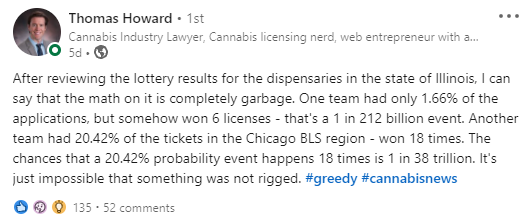
Because these stories of graft and malfeasance are personally interesting to me, and because I’m a cannabis business lawyer, I thoroughly enjoyed this gem of a post last week by Thomas Howard, Esq., on LinkedIn:
Do I trust Mr. Howard’s research, and his math? I want to — he’s a lawyer and “licensing nerd” after all. Of course, nothing I wrote above about Illinois would be admissible as evidence of a lottery fix if we were in court; and neither would anything Mr. Howard wrote (although he is closer). You have to prove it. But the lottery has been rife with problems already, explained away as “clerical oversights” and leading to at least six filed lawsuits. If Mr. Howard’s data are correct, we should see more of them soon on theories spanning from civil rights to administrative process. In the meantime, here are a few takeaways.
Cannabis License Lotteries Are a Bad Idea
Cannabis license lotteries invariably lead to litigation, as a quick Google search will show going back at least as far as 2014 in states like Washington and Massachusetts. Lotteries in general are a problematic tool to deal with scarce goods, as shown in categories from housing to visas. With cannabis, the government both creates and regulates the scarcity in real time, so it’s probably more analogous to visas than housing. Said another way: with cannabis, public policy doesn’t meld with market factors over a long period to create a limited class of goods. The government just says, “we are only going to issue X amount of cannabis licenses, and you all get to fight for them.”
Photo by Pedro Lastra via Unsplash
When a jurisdiction decides to create a limited pool of cannabis licenses, one of three approaches to licensing is typically pursued. These include: 1) competitive licensing (which can also be controversial— we’ve filed these lawsuits); 2) “first to file an application” (always a disaster— e.g. L.A. in 2019; Oregon in 2014); or 3) the lottery. Of these three, competitive licensing and lotteries are attractive to policymakers in that the systems can be designed to favor certain classes of applicants— which is what Illinois was ostensibly trying to do with social equity applicants.
In my view, though, the best approach is NOT to cap license numbers artificially. There are better ways to help social equity applicants and marginalized communities, starting with priority application processing and extending through grants, reduced or waived fees, reinvestment of tax revenues in disproportionately affected areas, automatic expungement, etc. In all other respects, states should treat cannabis businesses like other state-licensed businesses, with zoning laws and local control factors allowed to shape the market. Could you end up like Oklahoma? Sure. But things will even out. The market and not the state should be picking winners here.
Public Records and Transparency Are Essential
We have been writing recently about public records in the cannabis context, spurred by some frustrating experiences here in Oregon. Public records law is crucial in the context of cannabis licensing. Presumably, Mr. Howard extrapolated his data from a review of public records, a valuable tool for auditing government, gathering market information, or even defending cannabis businesses in administrative proceedings.
Some government records, including meetings, are published and available without much effort on the part of the public. Other records take some digging. You may even have to pay a nominal fee to the government body for their time and effort in fulfilling the request; but most information is up for grabs. With the Illinois cannabis lottery, it seems you can find information on the process and program here. But that is not the end of the story. You can bet the state is awash in public records requests related to its cannabis lottery and will be for a while.
“A Couple of Politicians Getting Together in Chicago is a Crime Scene Now”
A federal prosecutor named Jeff Cramer gave us that wonderful quip. Chicago — and Illinois — have always been famously corrupt. But was the lottery rigged? Maybe so! More likely, though, most of these licenses were granted legitimately, and some inappropriately. If that were the case, the scheme would still be consistent with a grand Illinois tradition going back generations— politicians using a state apparatus for personal benefit. Why should cannabis be any different?
Vince Sliwoski is an attorney at Harris Bricken, a law firm with lawyers in Seattle, Portland, Los Angeles, San Francisco, Barcelona, and Beijing. This story was originally published on the Canna Law Blog and has been reposted with permission.
A new study shows that having a previous COVID-19 infection and vaccine immunization gives people an edge when it comes to their safety.
It’s advised that everyone who’s able get the COVID-19 vaccine, but there remains some questions about those who’ve already been infected with the virus. People who’ve dealt with COVID-19 infections have a degree of immunity, one that acts similarly to the protection granted by the vaccine.
Now, new data suggests that those who had COVID-19 and received the vaccine might experience the best immunization of all.
The data was obtained from a study by the Centers for Disease Control and Prevention (CDC) that examined the effects of the Delta variant in a Texas prison, where three-quarters of those incarcerated were infected. Prisons have long been spaces where viruses are rampant, primarily due to poor ventilation and lack of preventions measures.
About 80% of people who were incarcerated were fully vaccinated, which goes to show how common breakthrough COVID-19 is within these contained environments. It also spotlights how important it is for prisons and other closed quarters to use additional COVID-19 prevention measures along with efficient vaccinations.
Photo by Grant Durr via Unsplash
One of the highlights of the study was the joint effect of getting the vaccine and having the natural immunity granted by a previous COVID-19 infection. While having the vaccine granted a significant amount of immunity and prevented severe illness, the people that were most protected were the ones who had dealt with a COVID-19 infection in the past and were later vaccinated.
Despite the wariness that surrounds the topic of having had COVID-19 and then getting the vaccine, the CDC has been advising for months that this is the right thing to do. “Natural” immunity is not safer when compared to vaccine immunity; the latter is more controlled and understood, especially since the pandemic is still ranging and it’s not known how long natural immunity lasts.
But perhaps the most important discovery that the study made was the importance of COVID-19 prevention methods and how they, paired with proper vaccination, are capable of protecting people. While we’re all sick of these mitigation strategies, they remain just as important as they were during the start of the pandemic.