As one of the newly-minted stars in the music industry, there aren’t many talents with more burgeoning careers than SZA. The R&B/pop singer broke out with her debut studio album CTRL in 2017, and the record was rated near the top of many year-end lists. Though she lost out on her five Grammy nominations, her career appears destined for success. Another big part of the news – SAZ shares wild weed brownie conspiracy!
But it wasn’t always that way for the singer. SZA decided to share stories about her retail working days on Twitter, which included True Religion, Lucky Brand Jeans, Sephora, H&M, and Abercrombie. She also had a stint at her hometown pizza shop, and “anywhere else that would allow me to walk in late and moody.”
But it was when SZA revealed she worked at Diesel when things got interesting. Why? Because, says SZA, “they fired me over a weed brownie conspiracy.” Immediately fans flooded her mentions, begging for the full story. And let us tell you—it doesn’t disappoint.
A co-worker had brought in a container of freshly-baked brownies. Everyone starts crowding around, looking for a treat to get through the work day. The woman who brought them, according to SZA, “DONT SAY NUFFIN BOUT NO DRUGS.” From there…well it’s probably better if I let SZA tell the rest of the story.
Everybody takes one (u know when niggas say everybody it’s really 3 ppl) ..mind u I’m new here ..nobody’s eating the whole thing but MY hungry ass eats TWO like mmmm ya free BREAKFASS !!..30 mins pass?
I start to sweat .. I’m looking at niggas across the sales floor they laughing and shit.. I’m like wow I gotta boo boo I’m nauseous I’m ???..mind u I ain’t even KNOW…10 more mins pass ?
Long story short I’m the only one coming out of their actual skin looking like I ATE meth . I get called to the office ? I don’t know why this is happening I tell her I need a doctor. She fires me . I spend the rest of the day in a Mexican restaurant searching for answers #SETUP
The singer probably wouldn’t complain how her life’s turned out, though. Earlier this month, SZA took to Instagram to thank her fans as she crossed two billion streams on her records.
“Today I found out we 2.3 billion streams deep and a bunch a other cool stuff,” SZA wrote on Instagram. “I love my family. I love you all for pressing play at any time. Thank you for this journey.”
https://www.instagram.com/p/BmwXEClDzoP/
Shaking our head at SZA shares wild weed brownie conspiracy.
Some advice for Ethan Hawke: Log off from the internet for the rest of the week. That’s assuming he wants to avoid the wrath of infinitely spawning nerds and trolls forming the wave of backlash in response to some recent comments he made. What did Hawke say to irritate these masses? Simple: He bashed comic book movies.
Perhaps “bashed” isn’t the proper term. In a lengthy interview with The Film Stage, Hawke suggested that we not include superhero films in the same category as regular movies. “Now we have the problem that they tell us Logan is a great movie. Well, it’s a great superhero movie,” he said.
Hawke isn’t necessarily arguing superhero movies aren’t worthwhile enterprises — at least it seems he isn’t making that argument. Instead he’s seemingly positing that superhero movies exist as a separate art form. And we have to say, he kind of has a point.
[Logan] still involves people in tights with metal coming out of their hands. It’s not Bresson. It’s not Bergman. But they talk about it like it is. I went to see Logan cause everyone was like, “This is a great movie” and I was like, “Really? No, this is a fine superhero movie.” There’s a difference but big business doesn’t think there’s a difference. Big business wants you to think that this is a great film because they wanna make money off of it.
Before you get up in arms, here’s a spoiler-y question: Watching Marvel’s Infinity War, the movie event of the summer, did you really feel the emotional resonance of the characters’ deaths? Did it pain you when a surrogate father sacrificed his daughter to achieve ultimate power with the Soul Stone? Did you weep when Spider-Man faded to ash in Tony Stark’s hands — a relationship by proxy symbolizing a son pained to fail his father, and vice versa? Your “yes” answers were likely fleeting, disappearing as soon as you stepped outside the theater when you remembered the big business game being played here.
Hawke’s comments are worth thinking about, if only to recontextualize our relationship to these movies. That statement may attract the ire of the legion of superhero fans unwilling to do so, which is where the advice offered to Mr. Hawke comes in handy: logging off for the rest of the day to avoid trolls.
When retailers measure success, one of their most important tools is the revenue per square foot equation. While Apple topped the world again last year, clocking in at $5,546 per square foot, and, according to the Motley Fool, the fine jewelry retailer Tiffany & Co. came in at a snazzy $2,951 per square foot, MedMen beat them both with their recent revenue report.
The quarter ended for MedMen on June 30, 2018 and their revenue per square foot came in at an astounding $6,541. Meaning, in one stretched sense of the takeaway, that cannabis is more precious than high end tech or perfectly cut diamonds. The more fathomable takeaway is that this was the grand opening of California’s recreational marijuana market and MedMen managed to scored bigtime.
Another takeaway could potentially be that pot for profit is cozying into the once compassionate market. While we’d never begrudge a woman or man their living, cannabis was always about, and for, the people. Perhaps with this new era of big business and towering revenues, cannabis is becoming the cash crop we always said it would be, and now we have to swallow a bitter, expensive pill.
On the other hand, that pill is not so bitter for the millions of people who now have access to legal cannabis and will no longer fear jail time, job loss or a fast fading stigma that, not so long ago, held people back in big ways. It’s also a rather sweet pill for those who rode the wild west showdown to the finale, invested early and big and are now reaping the benefits.
Two sides of the same coin are a given, and let’s just hope that no matter heads or tails, that there are multiple winners with most tosses. Every toss can’t be an across the board winner, but the hope is thrilling.
MedMen has six strategically located stores in California and for them it’s all about branding, ease of transaction and access to the best medicines. That’s a winning combo in cannabis and it’s working for this brand that also has locations in New York, Nevada and soon to be Massachusetts and possibly Florida.
They all resonate as smart moves — and that revenue per square foot is certainly impressive — but as was also pointed out, the shares for MedMen are ridiculously high, even for a showboat brand that makes more per square footage than other, non-cannabis, iconic money-generators. It may not be time to invest, but it’s high time to keep an enthusiastic eye on MedMen, their impressive revenues and what comes next.
Fixing mistakes and errors on our phones is never as easy as it is on a computer. Since laptops and desktops were built for long hours of typing and grinding, Macs and PCs have shortcuts that allow you to quickly fix an error by either pressing Command + Z or CTRL + Z. This comfort is mostly available because of your keyboard, which gives you more control than a 6 inch touchscreen.
In an effort to make smartphones more useful and advanced, developers created gestures as a way of creating a bridge between handheld devices and computers, offering you simple solutions for those moments when you’ve been typing something and make a mistake. Gestures take advantage of the one thing that hand held devices hold over computers: portability and comfort.
The iPhone’s “shake to undo” feature has been around since 2009, yet it’s mainly forgotten and underused, despite the fact that it allows you to take back an error, including auto-correct spelling, by simply shaking your phone.
The poll results at the bottom of this @benlovejoy piece on my Shake to Undo piece are eye-opening. Only 35 percent of responders ever use Shake to Undo, and 85 percent agree that Apple should add an Undo button above the iPhone keyboard.https://t.co/kl0PYDnQ3q
While there are other ways of deleting something, the “shake to undo” feature is quick and cool, and it only requires for you to use it consciously for the first couple of times until you assimilate it, much like using your fingers as pincers to zoom in and out of a photo.
This shortcut is also exclusive on the iPhone, unavailable in Android or other devices with different operating softwares. Take advantage of it; you know you would have loved it if you were a kid.
The legalization of marijuana in Canada comes almost a century after the drug was first declared an illegal substance in 1923, but pot didn’t explode in popularity until the 1960s when a group of rebellious people began promoting it as a shortcut to peace and enlightenment.
One student told them marijuana reveals “a greater sense of the universe.” He enthused that “things you never noticed… now jump out … and every event becomes suddenly deep.” Another touted that cannabis could be the “catalyst to the great Epiphany.”
One participant promised “fantastic benefits” from smoking marijuana and said that it could lead to “a much better way of living.”
In short, many baby boomers believed marijuana use could usher in a new era of experience, enlightenment and joy. Half a century ago, this was utterly new to most Canadians.
Cannabis convictions soar
Convictions for cannabis went from 60 in 1965 to 6,292 in 1970. By the spring of 1970, the Royal Commission on the Non-Medical Use of Drugs suggested that somewhere between 1.3 and 1.5 million Canadians had used marijuana.
A survey of Toronto adults in 1971 showed that 8.4 per cent had used cannabis in the previous year, with higher rates among young people. Thirty per cent of people between the ages of 18 and 25 said they had tried the drug, while only 10 per cent of people aged 25 to 35 had smoked marijuana. From 1968 to 1972, marijuana use at Toronto high schools tripled.
What made this new generation of young people reject the hard-drinking ways of their elders in favor of a new drug? Part of marijuana’s appeal was its illicit status — it allowed baby boomers to reject the rules of the “establishment” and the habits of their parents.
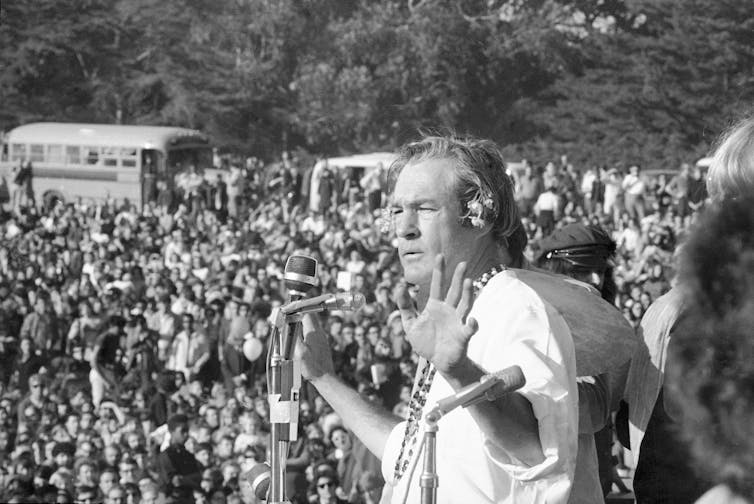
Timothy Leary addresses a crowd of hippies at the ‘Human Be-In’ that he helped organize in 1967. Leary told the crowd to ‘Turn on, Tune in and Drop out.’ (AP Photo/Bob Klein)
It was believed marijuana would open them to new experiences, while alcohol diminished awareness. As the LSD guru, Timothy Leary, put it in his Politics of Ecstasy, alcohol consumption brought about the “State of Emotional Stupor” while marijuana would lead to “The State of Sensory Awareness.”
Marijuana users were well aware that their parents already took a wide array of legal and prescription drugs. They were often highly critical of prescription drugs like barbiturates and tranquillizers. They believed these drugs numbed people to the injustices and inadequacies of North American society.
Promises of enlightenment
By contrast, marijuana promised to open a path to enlightenment. Many baby boomers were interested in Eastern religions and transcendent experiences. As Charles Reich put it in his Greening of America, an ode to the new generation, “using marijuana is more like what happens when a person with fuzzy vision puts on glasses.”
Reich explained that marijuana enabled people to hear new sounds in music and to visualize the world in new ways. It would allow them to understand time differently, thereby releasing them from the unrelenting demands of a capitalist society.
Other marijuana users were influenced by the popular culture of the day to try the drug. The Beatles were getting “high with a little help” from their friends. Janis Joplin spent all her money on drugs in “Mary Jane.” Bob Dylan intoned: “Everybody must get stoned.”
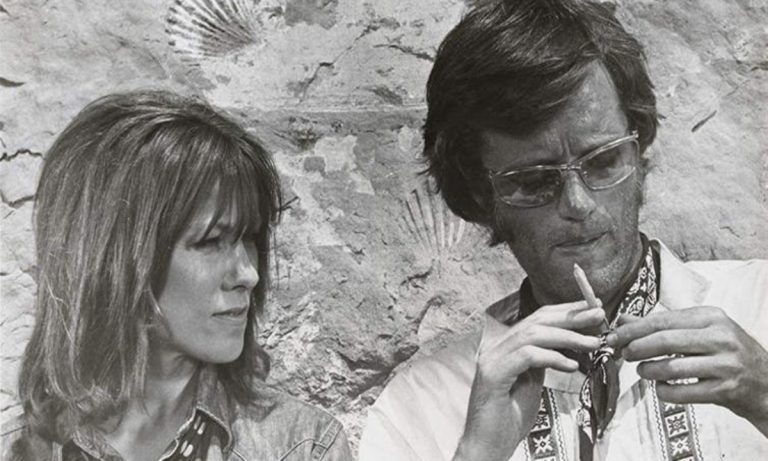
Drug use was also glorified in movies. The Beatles psychedelic cartoon Yellow Submarine premiered in 1968, while the countercultural classic Easy Rider came out the following year. It featured Peter Fonda and Dennis Hopper driving their motorcycles from Los Angeles to New Orleans, smoking dope, taking LSD, visiting a commune and raising the ire of the establishment.
Finding a ‘groove’
Protesters stage a demonstration in Toronto’s Yorkville neighbourhood in the 1960s. Michel Lambeth/Library and Archives Canada, CC BY
From the Mariposa music festival to the coffee shops of Toronto’s Yorkville neighbourhood, marijuana wafted through the air of the late 1960s. Headshops were a vital part of the street life in countercultural communities like Vancouver’s Kitsilano. Stores like the Polevault in Vancouver featured coloured lights beaming through parachutes on the ceiling, while chairs, cushions and ashtrays invited people to stay and “groove.” Countercultural newspapers like the Georgia Straight (Vancouver), Harbinger (Toronto) and Octopus (Ottawa) glamourized marijuana in their pages.
Marijuana proponents did not persuade the Royal Commission that marijuana would usher in a new era of enlightenment. But the Commissioners were persuaded that the costs of marijuana prohibition were too high, both for individuals and the state. They recommended the laws against the prohibition of marijuana be repealed.
Finally, more than 50 years after the “Summer of Love”, cannabis will be legalized in Canada, although the dream of marijuana’s potential to create a new society has largely passed.
Being in a relationship is hard, two personalities, mindsets and wills joined together day after day. Compromise is key along with grace and patience. But there is one small thing men and women value most in a relationship.
There are many health benefits to humor. It decreases stress, lowers blood pressure, and can even relieve pain. And now, according to a new study, it can also be the glue that keeps a relationship together.
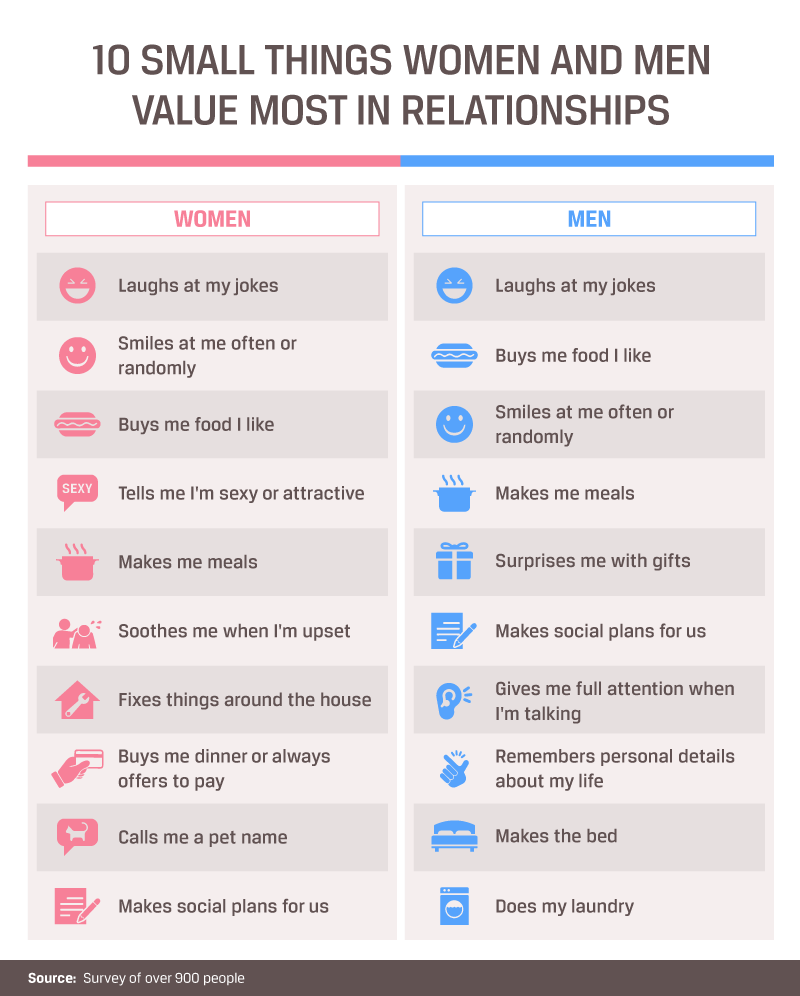
The survey of more than 900 Europeans and Americans aimed to find out which little relationship gestures helped keep the spark alive, and laughter took the top spot.
Nearly 70 percent of both men and women said they ultimately cherish a partner who makes them laugh.
Random smiles and acts of food followed closely behind; 66.8 percent of women preferred a clandestine smile from their partner, while 65 percent of men said the key to their hearts was through their stomach.
According to the survey:
While over 61 percent of women felt receiving a compliment about being sexy or attractive was their most valued relationship perk, that same category did not even make the cut for men. Other sentiments that showed up exclusively for women include being soothed when upset and being called an endearing pet name. On the men’s side, they expressed gratitude for being surprised with a gift and having their partner’s full attention while in conversation.
The survey found that other small gestures became more important over time, like partners who made social plans for the pair. For new couples, only 3.4 percent found this to be an important gesture compared to 10.4 precent of couples who had been together for at least 16 years.
Among women who reached relationship nirvana, 74.2 percent said leaving room to indulge in some “me” time was the best gift their partner could give, according to the survey. And the healthiest relationships? They tend to strike a balance between “together” time and “me” time, which allows both partners time to be independent and nurturing of themselves, which is ultimately necessary for a healthy relationship.
Britney Spears’ time overseas in England during her Piece of Me tour has been quite confusing, for lack of the better word.
Earlier this month, she actually forgot what area she was in while on stage. It happened to be Brighton, where the “Toxic” singer was performing during their annual Pride weekend.
She was back in England on Friday night at the 02 Arena in London (where she’ll be for the next two days), where Britney actually spoke in a fake British accent while on stage.
A fan video caught Britney going from hometown Louisiana gal to full-blown Spice Girl in a matter of seconds when she started talking to her audience during the performance. WATCH
“I feel like if and when, of if they know that some things are for health reasons, then there’s no way that they wouldn’t be okay with it.”
During the French Open, Serena indicated the catsuit helped to improve her circulation. She has suffered from blood clots, including during the birth of her daughter, Alexis Olympia, who turns one next Saturday.
Serena said she spoke Friday with Bernard Giudicelli, president of the French tennis federation, who ignited the controversy when he announced a new dress code for the 2019 French Open and specifically mentioned Serena’s catsuit.
“It will no longer be accepted,” Giudicelli told Tennis magazine. “One must respect the game. I think sometimes we’ve gone too far.”
Those comments seem to suggest he found Serena’s fashion choice disrespectful. But Serena indicated there may be room for negotiation.
“He’s been really amazing, so easy to talk to,” she said. “I’m sure we would come to an understanding and everything will be okay.”
Serena did not wear the catsuit at Wimbledon, where she reached the final before losing to Germany’s Angelique Kerber in straight sets. The All-England Club traditionally insists that players wear white at Wimbledon, which would have prevented a Black Panther-inspired fashion statement.
Even white catsuits don’t pass muster at Wimbledon. In 1985, the tournament banned a skin-tight outfit by American Anne White after her first-round match.
https://www.instagram.com/p/Bm472nfHsTz
Despite Serena’s attempt to diffuse this controversy, the French federation continues to face a torrent of criticism on social media. Celebrities, including mega-producer Shonda Rhimes and actress-director Elizabeth Banks, have taken to Twitter to condemn the decision to ban Serena’s catsuit.
This isn’t the first time Frenchmen in charge of a popular annual event have made a fashion-related decision that prompted charges of sexism. In 2015, the Cannes Film Festival announced that women attending red-carpet events had to wear high heels instead of flats.
Nike, the longtime supplier of Serena’s tennis wardrobe, announced earlier this month that she’ll wear clothing at the U.S. Open from “The Queen Collection,” a collaboration between Serena and fashion designer Virgil Abloh that will feature asymmetrical silhouettes and tutu-like skirts of tulle inspired by her love of dance.
Asked if her Open outfit will do anything to help her circulation, Serena said, “I’ve since found other methods. I wear tights that keep everything going with my blood (to) make sure I’m pretty healthy out there.”
Law enforcement sources tell TMZ … a group of thieves were arrested shortly after we broke the news Demi was out of the hospital and in an out-of-state rehab facility.
We’re told the arrests were not related to Lovato, but upon investigation … cops found electronic communications among the crew about hitting up her house while she was away.
When one envisions going to Pink Floyd and Led Zeppelin concerts, images of a marijuana smoke-filled rock and roll stadium flood the brain. In the scene, smoke meshes with atmosphere, which is in turn transformed into an ephemeral canvas in the sky—colored with psychedelic lights and lasers.
In San Francisco during the 1960s the Grateful Dead infused drug use with the concert experience giving rise to the term “psychedelic rock.” With this notion, the Grateful Dead paved the way for generations of cannabis using musicians and fans alike—those who discover something transcendent in the marijuana fueled concert experience. As we make our way into the 21st century, the combination of live music and marijuana has become a fundamental part of rock and roll culture.
Not into all that smoke? Know that there are multiple ways to consume marijuana, you can eat or drink it, rub it into your skin, vape, smoke and much more. Ask the budtenders at your local dispensary which products have the strains listed and then pick how you want to put it into your body.
For those inquisitive smokers that want to get the most out of their favorite musical performance, here are 10 types of marijuana that are good to take at concerts:
Not only will a couple tokes of this famous sativa strains help you feel comfortable in the middle of a crowded auditorium, it’ll make you want to get up and dance.
Capitalizer
This sativa dominant hybrid was bred to grow to massive sizes under the sunshine in the Sierra foothills of central California. If you want to feel like a rock star, trying smoking this potent strain while practicing your favorite instrument.
OG Platinum
As a highly-revered hybrid strain, OG Platinum has an award-winning nose and immediate high. One puff of this OG will have you playing air-guitar in no time.
Silver Haze
As one of the most popular sativa-dominant hybrids on the cannabis market, Silver Haze balances a solid body buzz with cheerful mood. This is a great strain to smoke if you are going to a concert and you usually get uncomfortable in crowds.
This Durban Poison x OG Kush is celebrated by pop-culture icons. Point being, if your favorite rappers smoke it—Girl Scout Cookies are a sure bet for a blow-out concert experience.
Super Lemon Haze
This sativa-dominant hybrid has a piney smell and looks like it’s been dipped in sugar. Super Lemon Haze’s energetic buzz is sure to get the party started.
Rockstar
Rockstar is an indica dominant cross between Rockbud and Sensi Star. However, don’t let the label intimidate you—Rockstar will have you feeling stress-free at your favorite show without the usual debilitating indica effects.
Jack Herer
This prominent sativa strain is named after one of the most renowned cannabis growers/activists to date. Even more, it’s a great smoke for getting the creative juices flowing, whether on the stage or in the crowd.
Pineapple Express
This pleasantly aromatic sativa is a cross of Trainwreck and Hawaiian. Whether listening to the gentle melodies of island music or getting your face melted at a metal show, Pineapple Express compliments the artistic tastes of most music connoisseurs.
LSD is recognized as an anomaly amongst cannabis enthusiasts as its indica dominant genetics mysteriously manifest a cerebrally intense sativa high. Moreover, LSD is said to induce hallucinations—transporting smokers back tie-dye-clad 1960s psychedelia.
It is one of the many seeming contradictions of cannabis consumption: Yes, marijuana increases the appetite in most consumers, giving may of us the munchies. But marijuana fights obesity too. Find out how.
Researchers from the University of Miami found that women who used marijuana on a daily basis had a 3.1 percent lower BMI and male users had a 2.7 percent lower BMI than those who do not use marijuana.
This study is not the first one to find such a link.
A study published in the American Journal of Medicine in 2013 uncovered how marijuana manipulates the body’s insulin production, transforming the metabolism into a well-oiled machine of sorts to keep obesity at bay. The researchers from the University of Nebraska College of Medicine, Omaha, and the Harvard School of Public Health found that current marijuana use was linked to fasting insulin levels that were 16 percent lower. They also discovered significant associations between the use of marijuana and a smaller waist circumference.
A 2013 study published in the American Journal of Medicine found that cannabis consumers have 16 percent lower levels of fasting insulin and 17 percent lower insulin resistance levels than non-users. The research found “significant associations between marijuana use and smaller waist circumferences.” In essence, the study revealed that marijuana consumption aided metabolism and kept obesity at bay. The researchers from the University of Nebraska College of Medicine, Omaha, and the Harvard School of Public Health also discovered significant associations between the use of marijuana and a smaller waist circumference.
And yet another study published in the American Journal of Epidemiology revealed that “the prevalence of obesity is lower in cannabis users than in nonusers.”
“During the past three decades an obesity epidemic has been responsible for a 77% increase in death rates. The accumulation of excess body fat has been clearly shown to accelerate the progression of many age-associated diseases such as cancer, arthritis, diabetes and dementia. Why? A few years ago it became clear that fat cells produce inflammation by releasing specialized proteins called cytokines. The more fat cells you have the more cytokines get released into your blood. Essentially, obesity is associated with chronic, low-grade, body-wide inflammation, insulin resistance and many of the same metabolic conditions that underlie the aging process itself. The cytokines are capable of inducing shrinkage of brain regions (primarily gray matter- where the neurons live) that are used in the process of learning new things and recalling memories.
So, yes, marijuana will most likely give you the munchies. But research also suggests that you will be carrying around less weight.
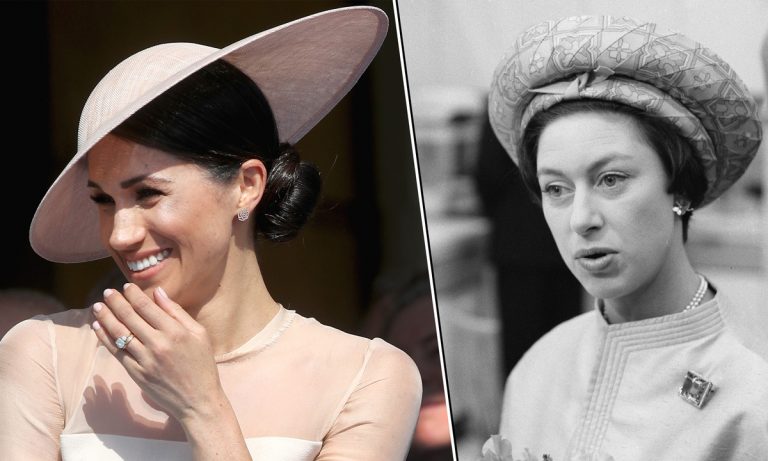
Who is the most popular royal? While Meghan Markle seems to be on the cover of every magazine, another royal is selling out books so fast, even Amazon is struggling to have enough in stock.
The Queen’s late sister is the subject of a new book, Ninety-Nine Glimpses of Princess Margaret by Craig Brown. Unlike a biography, this book shares snapshots of the royal’s unorthodox life, including her shocking divorce from Antony Armstrong-Jones, Earl of Snowdon.
Born before WWII, Princess Margaret was brought up in a world of order, manners and strict protocol a la “Downton Abbey.” Post-war, after her sister ascended the throne, the Princess embraced change, fun and frivolity. In the 60s and 70s, she holidayed in Mustique, ensuring its popularity even today as a playground of the well-heeled jet set. It was there she embarked on an affair with a much younger man.
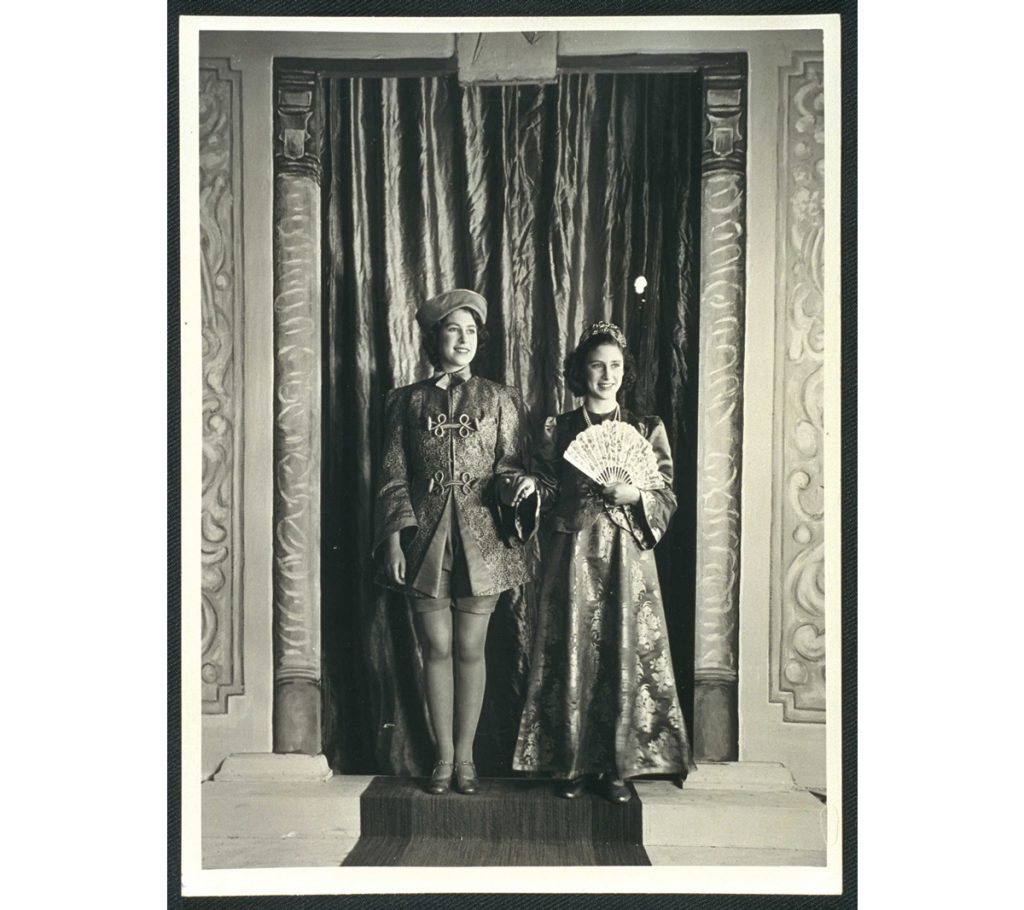
Princesses Elizabeth and Margaret starring in wartime Aladdin, 1943. / Photo courtesy Daily Herald Archive at the National Media Museum/Flickr
Margaret was a complex person who drank, smoked, and flirted. And while she exhibited a a very different personality than her sister, Elizabeth II, the two were devoted to each other.
The Princess made John Lennon blush and Marlon Brando tongue-tied. Andy Warhol photographed her. Jack Nicholson offered her cocaine. Gore Vidal revered her. Francis Bacon heckled her. Peter Sellers was madly in love with her. For Pablo Picasso, she was the object of sexual fantasy. She could throw shade better than Cookie from Empire — once even putting famed sharp tongue diva Elizabeth Taylor in her place.
Jeff Seroy, SVP at the book’s publisher Farrar, Straus and Giroux, shared:
The combination of stellar reviews literally everywhere for this unique and hilarious book, the joyous word of mouth and — it has to be said — the Netflix series “The Crown”, which introduced a new generation or two of readers to Her Royal Highness — propelledNinety-Nine Glimpses of Princess Margaret onto the bestseller lists, and has the book selling as fast as we can print them. It started even before the official pub date and we’re now in five printings less than two weeks after publication, with more sure to come.
If Markle has any leeway with protocol and expectations, it is Princess Margaret who helped pave the way. The perfect end to a summer read.