Tuesday, May 5, 2026
Home Blog Page 1264

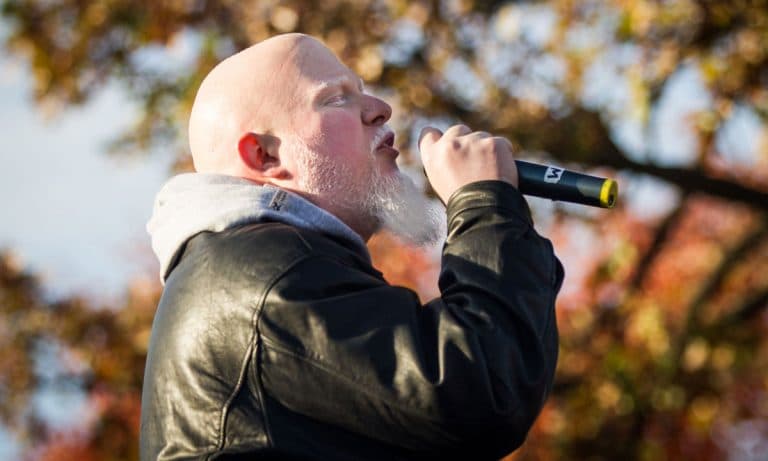
Exclusive Interview: What Brother Ali Found While Recording His New Album

Since his debut album in 2004, Shadows On The Sun, Brother Ali has represented a powerful voice in hip-hop. He’s reflective and eloquent. You can hear his heartbeat pound through his music. He’s the sort of person you’d want to ask advice of, not if you wanted to buy a new car, but if you needed guidance on how to deal with a sick family member.

In his art, Brother Ali spits fire and truth. He raps about abusive neighbors in an apartment building and about building spiritual relationships with God. It’s been written about extensively how Brother Ali was born without pigment in his skin, hair and eyes (he’s albino) and how he’s legally blind. He’s also a Muslim man, speaks softly on the telephone and expresses himself articulately. He talks often about healing, which he thinks is essential. And he laments modernity, which, for him, lacks a sense of tradition and particular human values compared to other periods in human history. Brother Ali is a guiding light and a thoughtful human.

You’re about to embark on a new tour with a new record. Are you relaxing at the moment or working hard?
We’re not relaxing. We start our national tour on Tuesday (May 2) and the album (All The Beauty In This Whole Life) comes out on Friday. When you’re independent there’s a lot of little extra things that we do, like a fan pre-sale for the album where I sign three thousand copies of the record. And we’ll put out teasers for our new video that we’re going to release on Monday, little 32.2 second clips that I edited myself. Details really matter a lot to me. It does feel like work but there’s no other way to do it. We do it ourselves and it’s got to be good, got to be right.

When I listened to your first album, Shadows On The Sun, I heard all this wisdom you’d dispense that seemed like you gleaned from wise folks on the stoop or just hanging out. Now that 13 years have passed, is the wisdom you rap about more earned, lived experience?
I’ve always been reporting. I don’t see teaching as imparting anything that comes from me. Speaking or expression always comes from stuff passed to me and I pass it on. Truth is always something that’s passed like a torch in a relay race. So in terms of the content of what I’m talking about, it’s really like that. I’m a UPS man in that sense. The UPS man doesn’t walk around like, “Look what I’m bringing you.” No, it’s “I’ve been given this to give to you.” It’s an honor and a duty of mine and I have to do it with intention and care. What I’m expressing now may be a little different because what I’m receiving at this time is different. Ultimately, it’s me reporting and sharing what’s been given to me.

You’ve said your music is a result of “pain, growth and healing.” Do you ever feel worn down?
Yeah, absolutely. I think after the last album (Mourning In America And Dreaming In Color), I felt really worn down. The last album was a political one. I was inviting people to become engaged in the world of organizing and activism. Group power to affect change in the world. I was going around the world performing all these places and all these people would come up to me and want to hear what I have to say. The songs impacted them and I definitely had a feeling of curiosity and hope about whether or not this music could be used to coral people to enacting change. One of the things I realized is that that really depends not only on working on the outside world but also working on myself and working on ourselves. It’s not one or the other. Both are constant projects.

Ego is very sneaky. Ego just grows to whatever you think you’re doing. Ego can grow in ways I wasn’t expecting. I started to feel a sense of being let down or almost becoming jaded. Really, that happens when we have expectations that we haven’t really examined. Where do those expectations come from? It’s very slippery. When I’m talking about something important, ego can come in and compromise that. Not that this truth is important, but that I’m actually important. Not that truth should be met with certain resistance but that I should be. I was becoming bitter and resentful. I could tell I was unhealthy, that something was imbalanced inside me. It led me to be more intentional about my spiritual path and being with people. I wanted to be more aware of myself and to become clearer about the ego’s role and how to discipline the ego. And how to purify the intention and renew the intention and stay focused on what the intention ought to be. That’s why I took so long between the last album and this one – really, I put out three albums in 2012 and toured for three years straight – I realized I needed some ways to check in with myself and heal myself.

You talk often about healing. Can you elaborate on what that means to you?
There are these ancient wisdom traditions that have been tested over time – they were what was there before the advent of modernity. Universally, there were certain agreed upon human virtues that were a part of spirituality and living a life of meaning. Those things have been compromised in the modern world for a lot of different reasons. We’re disconnected from nature, our hearts, instincts, families and traditions. We tend to think we’re smarter than our ancestors. These are all new phenomena in the history of the world. With that, we’ve become good at manipulating the material word – this is what modernity is about.

People in power are masters of propaganda and controlling what we take in. There are still people that are connected to wisdom and spiritual traditions that are carriers and bearers and protectors and maintainers of those actual systems that existed before modernity. But you have to really look to find those people. They’re not pastors at a Mega Church, they’re not on the news. These are people in the community that you have to really look for. Within the Muslim world, I’ve connected with people of spirituality – particular people who culturally understand where I’m coming from. They’re peers and elders – people who are further along in their path. They’ve been where you are, they know the ways you’re getting in your own way and know the ways you can soar. They genuinely want to help and guide you and help you heal. To help you travel on the path inward back to the original self.

So it’s not like a Center you go to. Not like a building or college you can go in – though sometimes there’s these people in those places. But a lot of the time, it requires a certain being who is receptive and perceptive. Those things really are a gift. I didn’t even know to ask for this or who to ask or what to seek.

And this is very significant to you.
Absolutely. That’s the only thing I care about. People at Rhymesayers (Ali’s record label), will say I do my best. If there’s something I can do to help myself business-wise, I try to do it. The accountants there will tell you I’m not really focused on myself, though. Truth and healing, that’s really what motivates me.

Why?
It’s a combination. First, it’s of my composition. People are born with certain individuality, a set of who this person is. That’s a big part of it. Also me being born in a very unique physical presentation and having all of the legal blindness that goes along with it and social stuff of having this very, like, physical being that’s noticed right way. I always have to navigate that. I can never just walk in a room as an invisible person. Those two things together. I’ve been given a great gift in terms of that combination. Difficulty and also having a living heart. A lot of people have difficulty and their heart dies. That’s really dangerous. And a lot of people have beautiful hearts but they haven’t been through much. Those people aren’t able to help anyone. If you haven’t gone through what I’ve gone through it’s very difficult for me to be able to trust you and receive from you. I feel really fortunate to be in a place where I have been through certain types of pain and healed and been given the platform to communicate. I hurt, I heal and I’m also in a community of people in terms of my listeners – the real core listeners. Those people help me as much as I help them, if not more. Those people give me the platform to explore these things and express them. We reflect together.

You worked with the Rhymesayers producer, Ant, on this new record. You two have collaborated a lot over your career. How was it getting back together in the booth?
The poet Rumi, who’s one of the great masters of the Islamic spirit, his poetry came because he’d achieve these ecstatic states. He was witnessing the divine in every part of being and he’d start to versify. And he had someone there to write it down, to record it. From the bottom of his heart and the top of his head. People realized Rumi couldn’t achieve that without this person there recording it.

I realized with Ant, there’s certain things I can’t do without him. Something about his being and friendship and sensitivity and sensibilities really allows me the space to explore my heart and my experiences and thoughts. We really process together, that’s what our music is. But before this album, we’d fallen out of sync. I had made some music with Jake One and me and Ant kind of fell out of sync. It was really troubling me, bothering me. We weren’t as close as we once were. We both ended up in the Bay Area, searching for healing. He was there getting physically healthy and we ended up there at the same time. Both hoping to improve on our lives. So we reconnected. The music we made was based on the vibe we have together. A melding of hearts. Ant and I connect on a heart level. We don’t have all the same opinions – for a long time Ant’s lifestyle was outwardly different than mine. But we have a connection on a heart level. That’s what allows us to make the music that we do together.

On the new record you offer a line saying your “heart was broken into.” And a featured artist on the album, Sa-Roc, says we have to allow our love to lead us. Do you think there’s any grey area there when we allow our love to lead but maybe our heart is misguided?
When we say the heart, we mean the core of the person, the core of who we are. But the heart is influenced by things. It’s influenced by the intellect, for one. This is a revolutionary thought, that the heart is the center of the person. Modernity says the head is the center of the person. But the emphasis on heart is a unique idea in the modern world. The heart is influenced by ego, intellect and also influenced by good and evil. So being aware of the heart, the heart’s natural state, is to be empty of things like greed and jealousy and hatred. But holding untrue concepts and ideas, those are the diseases of the heart. Being with those people of spirituality who have healthy, vibrant hearts and who know hearts and can read hearts is amazing.

A lot of times things people dislike about religion are the rules. At Rhymesayers, we have an accountant who says you need to not spend this much, you need to make this much. That’s all true and relevant. But that’s not what’s motivating the creativity of the music. The same is true in religion. There’s certain things you have to do. Like a garden. If you don’t protect it, it’ll be destroyed. You have these rules to build a fence around the garden of a heart. But all these rules never get to the why. When do I start experiencing what I’m on this earth to do? Love and heal and connect. When do we get to the transformation point? A lot of people have different ideas of getting there. That’s what people of spirituality do and are masters of. They exist in every tradition. If you can find them, access them, build a relationship. It’s the most valuable stuff in the world – but it’s hard to do.
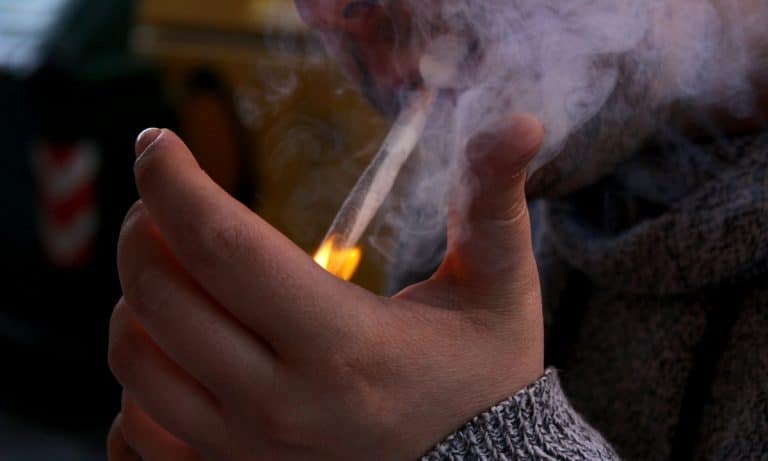
Marijuana Could Be Salvation For American Blue Collar Workers

0

While President Trump continues to lean on traditional industry to bring jobs back to the United States — vowing to create somewhere in the vicinity of 25 million new jobs within the next 10 years – he has failed to consider how a nationwide cannabis industry could help accomplish his objective and bring some much need financial recovery back to a wounded blue collar workers.

But before the cannabis trade has the power to catapult the U.S. worker into a dynamic realm of prosperity, Congress, along with President Trump, will first have to legalize it at the federal level, allowing all things cannabis to be taxed and regulated in all 50 states in a manner similar to alcohol and tobacco. Only then will this new agricultural division have the potential to create millions of new jobs and generate hundreds of billions of dollars in economic activity.

In Colorado, somewhere around 18,000 new jobs have been created since the state legalized recreational marijuana. Not minimum wage positions either – well above average paying jobs in the neighborhood of $15-20 per hour. Some of the more skilled labor force, like grow masters and store managers, can see earnings in upwards of $75,000 to $100,000 per year.

A recent report from Bloomberg shows that legal weed has caused some service-oriented industries, like the restaurant business, to struggle when it comes to finding a workforce. These operations, which typically pay their workers minimum wage and sometimes tips, simply cannot compete with the wages being offered out there in the world of weed.

The latest market analysis from New Frontier Data shows marijuana legalization’s power to create new jobs could be a salvation’s wing for the “middle class,” the pulse of the U.S. economy, by creating more jobs (nearly a quarter of a million) within the next few years than the combined offering of the manufacturing and government sectors.

What’s more is the full job-creating potential of legalization is far from being realized.

Reports show that long before the first gram of marijuana is ever sold in a legal state, money is being made hand over fist by those members of the business community with, perhaps, little to no interest in legal weed. Contractors specializing in everything from construction to heating & air are being called upon in the beginning stages to assemble the various components of the cannabis industry. This situation alone is responsible for putting thousands of people to work – contributing new money to local economies.

Interestingly, Pueblo County Commissioner Sal Pace recently told The Boston Globe that around “40 percent of all construction permits countywide have been attributed to the cannabis industry,” a little snippet of data that so eloquently shows how more food is being put on the table in more homes, ever since the state moved to legalize for recreational use.

It is for this reason that small, blue collar communities in legal states are starting to get ultra-excited about the new opportunities coming their way. Towns in states like Pennsylvania and Ohio, which were once supported by steel and other production sectors, are pushing hard for marijuana cultivation facilities to be built in their neck of the woods. These people understand how the development of this new sect can bring about hundreds of new jobs and contribute greatly to the overall growth of the local economy.

Unfortunately, it does not appear that the potential economic benefits associated with the legalization of marijuana is getting too many members of Congress, or anyone in the Trump administration, for that matter, eager to get the ball rolling on nationwide reform.

But if President Trump is going to make good on his promise to create 25 million new jobs in the next decade, he’s going to need to work some serious magic.

For now, there are still concerns that the new administration may impose a federal crackdown on legal marijuana states — a move that some industry analysts fear could lead to a recession.

[gravityform id=”16″ title=”true” description=”true”]

Employers Struggle Finding Weed-Free Applicants In States With Legalized Marijuana

Just because cannabis is legalized in 28 states doesn’t always mean issues surrounding usage always resound so neatly. Various sectors of private and public life are affected in myriad ways as some previous practices continue to be held, even in states with legalized marijuana.

One way it has affected cannabis users is finding jobs. As a recent Washington Post article illustrated, businesses don’t abide as the same rules and procedures as government bodies, nor are they required to, as the Society for Human Resource Management states. In other words, failing a drug test still matters.

Grocery supplier McLane has had to turn down numerous applicants after failed drug tests in Denver. The state of Colorado is well-known for embracing marijuana in multitude ways. But at McLane, where potential works could be working in warehouse and operating heavy machinery, that’s not necessarily the case.

“Some weeks this year, 90 percent of applicants would test positive for something,” ruling them out for the job,” human resource manager Laura Stephens told the Post.

As Stephens alluded to, rising rates aren’t just for marijuana. Multiple drugs are being detected in workplace testing at a frequency higher than previously.

Via Washington Post:

Job applicants are testing positive for marijuana, cocaine, amphetamine and heroin at the highest rate in 12 years, according to a new report from Quest Diagnostics, a clinical lab that follows national employment trends. […]

The most significant increase was in positive tests for marijuana, said Barry Sample, the scientist who wrote the report. Positive tests for the drug reached 2 percent last year, compared with 1.6 percent in 2012.

Marijuana’s rise in detection isn’t all that surprising considering the progress in legalization it’s undergone in the past four years. But what that means in the workplace varies from state to state.

In Colorado more companies are dropping marijuana from pre-employment drug testing. Meanwhile in California, which passed recreational legalization last year, testing positive for smoking weed can still get you fired from your job.

Though cannabis has taken dramatic steps in public awareness and acceptance recently, it still has a ways to go. If you’re in a state that does have legalized marijuana, make sure you know your employers’ regulations. Otherwise, you might be out of a job.

[gravityform id=”16″ title=”true” description=”true”]

Here’s The One Thing The Marijuana Industry Should Fear Most

Although it could still be decades before marijuana is legalized at the national level, the sale of cannabis products in states that have allowed this newfound industry to operate the same as any other part of legitimate commerce is growing faster with each passing year.

Some of the latest data from the folks at Marijuana Business Daily indicates that recreational marijuana sales could increase by around 45 percent next year, giving way to an economic impact of almost $70 billion by 2021. But the market, while having absolutely no trouble proving its potential as a great American money-maker, is in a volatile state right now, because no one in the cannabis industry has any idea how President Trump and his lead henchman, U.S. Attorney General Jeff Sessions, are going to respond to legal weed.

Earlier this week, Representative Earl Blumenauer, a member of the Congressional Cannabis Caucus that believes Trump is “essentially irrelevant” when it comes to pot progress in the United States, told those in attendance at the Marijuana Business Conference & Expo in the District of Columbia that marijuana would be legal at the national level within the next four years.

However, Chris Walsh, editorial director at Marijuana Business Daily, says that legalizing marijuana at the national level might not be the best course of action.

He says that cannabis investments continue to grow, but no large investors are even dabbling in pot stocks because they are worried that Uncle Sam will bring down the hammer. This situation is providing plenty of opportunities in legal states for more small to medium sized companies to get a piece of the action. In a federally taxed and regulated marijuana marketplace, this would be more difficult to do, Walsh told MarketWatch.

When marijuana prohibition ends nationwide, the cannabis industry is expected to change drastically, he explained.

It could “look like the beer industry where a couple big companies own most of the market and there’s a subset of craft breweries?” Walsh said.

Regardless of the threats coming from the Justice Department signaling the potential for a federal crackdown, many lawmakers believe it would be next to impossible for the Trump administration to sabotage the progress marijuana legalization has made over the past several decades.

“America is not going to go backwards on their policy,” Senator Positive Nelson of the U.S. Virgin Islands told the VI Consortium earlier this week. “The Jeff Sessions talk is just that, talk. What they’ve already seen is the billions of dollars that marijuana has made. America is a capitalistic nation, as we know. Republicans are about the money. The only thing Trump is really venting about is anything that was done under the Obama Administration. But the truth of the matter is America is not going to let this president or any future president roll back on [marijuana].”

Marijuana legalization is likely here to stay– there are just too many variables at work to just cut its head off and wait for it to die. However, as Walsh points out, the real question (or concern) should be more about what the cannabis industry will look like if legalized at the federal level. This should be more of a concern than the actions of the Attorney General.

[gravityform id=”16″ title=”true” description=”true”]

Gossip: Miley Cyrus Says Katy Perry’s ‘I Kissed a Girl’ Is About Her; Kellyanne Conway Secretly Hates Donald Trump

According to Cyrus, she was the inspiration behind Perry’s 2008 smash hit, “I Kissed a Girl.” Explaining she has been friends with the “Bon Appétit” singer for almost 10 years, the former Disney Channel star claimed the sapphic single was written just for her.

“When she came out with ‘I Kissed a Girl,’ I was doing the Hannah Montana movie, and I heard her on the radio, they said, ‘Who’d you write that about?’ And she said me,” she told WKTU radio. If this were true, that would mean Perry — then a 20-something — was singing about making out with a 15-year-old.

However, Perry previously claimed Scarlett Johansson was her muse for the song, telling Steppin’ Out magazine in 2008, “I was with my boyfriend at the time, and I said to him, ‘I’m not going to lie: If Scarlett Johansson walked into the room and wanted to make out with me, I would make out with her. I hope you’re okay with that?’”

In another interview from the same year, the songstress said “girls like Angelina Jolie and Natalie Portman” were the inspiration, noting she would definitely “pucker up” if she ever met them.

Perry also told Howard Stern in an old sit-down she really had kissed a girl, but wouldn’t say who. “It is based on the truth,” she said of the track. “It was actually not one particular girl that inspired the song, but the girl I did kiss I met through a friend.”

Kellyanne Conway Secretly Hates Donald Trump, According to ‘Morning Joe’ Hosts Joe and Mika

According to the co-hosts of MSNBC’s ‘Morning Joe,’ White House senior adviser Kellyanne Conway said that defending then-candidate Donald Trump on TV was so creepy, she felt like she needed a shower afterward.

The hosts made the somewhat surprising allegation on Monday’s show.

via NYP:

“This is a woman, by the way, who came on our show during the campaign and would shill for Trump in extensive fashion,” said Mika Brzezinski, who hosts the show with new fiancé Joe Scarborough.

“And then she would get off the air, the camera would be turned off, the microphone would be taken off and she would say, ‘Blech, I need to take a shower,’ because she disliked her candidate so much.”

“And also said, it was very interesting, also said that, ‘This is just like my summer in Europe,’” Scarborough said during Monday’s show.

“’I’m just doing this for the money,’” Brzezinski added.

“‘I’ll be off this soon.’ I don’t know that she ever said, ‘I’m doing this for the money,’” Scarborough said. “But she said, ‘This is just my summer vacation, my summer in Europe and basically I’m just going to get through this.’”

“‘But first I have to take a shower because it feels so dirty to be saying what I’m saying.’ I guess she’s just used to it now,” Brzezinski said.

Scarborough then mentioned the infamous recording of Trump crudely telling “Access Hollywood” host Billy Bush that he could grab women “by the p—y” and get away with it because he was “a star.”

Trump also boasted about hitting up a married woman, saying,“I moved on her like a b—h, but I couldn’t get there,” according to the recording, which was made just months after he married his third wife, Melania.

Conway rushed to CNN to vigorously defend her client after the Washington Post released the recording.

“I have to assess people based on what I see in totem,” she said.

“And this is a man I’ve been alone with many times who’s never been anything but gracious and gentleman and elevated me to the top level of his campaign, the way he’s elevated women in the Trump organization for decades, because he respects women,” she said.

“That’s when she started referring to Donald Trump as—” he began.

“Her client,” Brzezinski interjected.

“‘My client,’” Scarborough said. “Separating. ‘I don’t believe in this guy. He’s just my client. It’s just a paycheck.’”

Kellyanne Conway was banned from appearing on ‘Morning Joe’ back in March because Joe &Mika said she lacked credibility after making a series of false statements to the media.

Love the fresh dirt we bring over daily from Naughty Gossip? Let us know in the comments!

Secret Marijuana Garden At Kennedy Compound? Book Reveals All

Was cannabis grown on the famous Hyannis Port Kennedy compound in Massachusetts? A new book, published last week, spills the beans on the  secret marijuana garden.

In a new memoir titled “Jackie’s Girl: My Life with the Kennedy Family” by Kathy McKeon, who was the former first lady’s assistant from 1964 to 1977, Jacqueline Kennedy discovered the illegal weed was being grown secretly among the flowers in her garden.

The book is far from a scandalous tell-all from a bitter former employee. Amazon describes the 320-page book as an “endearing coming-of-age memoir by a young woman who spent thirteen years as Jackie Kennedy’s personal assistant and occasional nanny—and the lessons about life and love she learned from the glamorous first lady.”

So how did the marijuana-patch-hidden-inside-the-flower-patch story get told?

McKeon wrote that she was curious as to why a bunch of Kennedy cousins routinely visited the flower patch. To McKeon, there was something suspicious about the teen-agers infatuation with flowers.

“I went to investigate after the kids wandered off one afternoon but didn’t see any evidence that they’d been back there sneaking beers or cigarettes or anything like that. The flowers hadn’t been trampled.”

After eliminating booze and tobacco, McKeon’s curiosity persisted. And then …

“That’s when it hit me. I went to find Jack Dempsey, the retired Cape [Cod] police chief who often hung out at the Secret Service trailer.”

McKeon goes to tell Dempsey what he suspected. The two of them trekked back to the secret garden and that is when the former police chief confirmed the hunch: It was the evil weed.

McKeon details how Dempsey left to immediately inform the former first lady. But McKeon got their first and it was she who informed Jackie. Her response, according to McKeon was surprise. And then fear of the family’s reputation.

“Are you kidding me?” Oh my God, this can’t get out. What should we do?”

After consulting with Dempsey, the former first lady agreed to let the Secret Service agents pull out the plants from the secret garden that same day.

Who planted the illegal plants? Now, THAT remains a mystery.

“John and Caroline were much too young to have had any role in it,” McKeon wrote of the two children of John and Jackie Kennedy. “And while we all had a pretty good idea which cousins did, there was no confrontation, and no one got in any trouble.”

Gossip: Kanye West Gone Into Hiding; Real Reason Kris Jenner Is Producing Scott Disick’s New Show

Kanye West has deleted his social media accounts as he plans to step away from the spotlight for an indefinite amount of time.

“Kanye never found the happiness he was looking for by being famous. In fact, if anything, the spotlight made him unhappier. He has decided to take a break and step away for a while,” sources tell Straight Shuter. “Not going to the Met ball was a big deal for him. He loves that event and thinks of himself as a serous designer. He has just had enough and doesn’t care if he is never photographed again.”

Let’s hope someone has told Kim this!

Real Reason Kris Jenner Is Producing Scott Disick’s New Show

Kris Jenner is branching out producing a show starring Scott Disick, daughter Kourtney Kardashians, ex. And don’t expect mommy to stop anytime soon – even if that means working with old lovers and family members.

“Kris is a businesswoman and business comes first. If she can come up with an idea for Khloe’s ex, Lamar Odom, or one of Kim’s exes, she would do it. Kris would even produce a show starring her ex-husband, Bruce, who is now Caitlyn Jenner,” sources tell Straight Shuter. “Her kids don’t mind. They have lived with Kris for a long time and know who she is. Plus, they would rather have an ex back on TV in a show controlled by their mom than by someone else. This way Kris can make the money and protect them at the same time.”

Genius, if you think about it.

Love the fresh dirt we bring over daily from Naughty Gossip? Let us know in the comments!


[gravityform id=”13″ title=”false” description=”true”]


I’m A Millennial Addicted To Avocado Toast And It Ruined My Life

They say the first step to solving a problem is writing a lengthy post on the internet minutely detailing your tiny struggles so strangers you’ll never meet can virtually pat you on the back and say, “Me too, man,” which will magically fix everything. So here it goes: I am addicted to avocado toast.

You ever feel a tingling behind the neck? A sensation that something or someone is watching you, discussing your name, plotting against you? I felt that this week and looked around, suspicious, only to remember I live alone and have no friends or enemies to speak of. “Dodged a bullet on that one, dude,” I said to myself, isolated from everyone I’ve ever loved.

Once in that positive state of mental health, I wanted to snowball that momentum further, rushing to a place full of constructive nutrients and well-informed individuals eager to give helpful advice—the internet. Scrolling through my social media feeds, I was so very happy to see all these authentic people living such amazing, unattainable lives I could never afford. It made me feel real good about myself.

But it didn’t last. Because I saw a tweet that sent me into a tailspin.

Wow. Witnessing those super true words, finally seeing them on a screen, has my fingers trembling. Experts say addiction creeps up on you, swallowing you whole before you realize it’s too late, but that wasn’t my experience. Every time I spent $19 for smashed avocados on toast, I knew I was living a lie. I knew by eating avocado toast that my #goals, like owning a house, were slipping further away.

Who cared that home ownership possibly represented outdated ideals from a byzantine capitalistic empire whose very thirst for perceived success almost bankrupted this nation? (Um, yeah, I’ve seen The Big Short; I get the mortgage crisis, okay?) I didn’t wish to see the world, experience various foods and “adventures,” connect with cultures outside my own, and potentially grasp my tiny place in this complex universe. What I wanted was a damn mortgage I couldn’t pay. Loan payments and property taxes was what I dreamed of laying awake at night as a child, a picture of Our Royal Queen by my bedside.

Photo by Brendan Bures

My whole life my dad was like, son, get yourself a degree and find your passion. Tap into what makes you special and what you can offer this world. Travel if you can. And I always said, “No, Dad. Stop trying to make me live life my own way. Let me have what you had. I want a mortgage. A mortgage keeps you strong, keeps you healthy, keeps you trapped in endless monthly payments. Only through a mortgage could I find meaning in my existence.”

Parents never understand.

But because of my avocado toast addiction, every morning the cycle began anew. An insatiable craving deep in my belly demanding to be fed. It wasn’t hunger (it was kind of hunger); this was deep-rooted addiction, with ailments like pounding migraines, physical weakness, and mild insecurity I couldn’t stunt on these hoes.

What avocado toast symbolized—to me—wasn’t success or royalty. It wasn’t bourgeois hipster culture literally spoon-fed into my mouth as a means to fulfill trends and declare my wokeness. It wasn’t even about the anti-aging properties, or healthy fats, or any of that nutritional garbage.

Avocado toast just looks really tasty. I mean…

Photo by Brendan Bures

How could I deny such a beauty? I didn’t care how avocado toast made me feel, I loved how it made me look. You couldn’t understand such an addiction, unless you were a douchebag millionaire who literally builds luxury-style property that feeds into this toxic aspirational, gentrifying lifestyle where avocado toast fucking thrives and lives.

Perhaps, if you were someone like that you would understand why so many like myself are afflicted with this avocado toast addiction and might possess the bravery to speak on it. I’m so glad a random Australian millionaire did. Honestly, it’s the hardest struggle of my life.

I once tried to overcome that struggle. Like a zombie, I entered this café, mumbling my order, sliding my card as if I were in no possession of my very body, watching my dreams of a mortgage slipping away. I sat down, trying yet again to deny my addiction, to take back control.

I hovered over the toast, granting myself just a whiff.

Photo by Brendan Bures

I knew if I were to beat this demon it would require a massive confrontation, the likes of which I couldn’t fathom. Was I capable? What abilities did I have to defeat this monster? As a millennial whose every action stems from sustaining this massive ego of mine—a.k.a. the giant void inside me I can never fill—my skills were limited. I could develop my #brand, hit the perfect selfie angle and lighting, complain about my problems online, and spend money. (This is all millennials can do, right?)

My talents were restricted to the basic millennial starter kit. I couldn’t buy the deluxe packages—including, but not limited to: sweet Europe backpacking pics, athleisure digs, and a useless grad school liberal arts degree your parents paid for—because I kept spending all my funds on avocado toast. I didn’t have much, but to eradicate this addiction once and for all, I had to confront this thing head-on at the height of its powers.

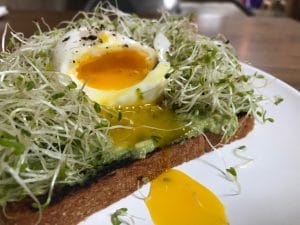
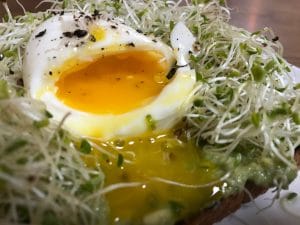
So I broke the yolk.

Photo by Brendan Bures

Oh no.

Food porn at its most dangerous….

It’s so creamy, and runny, and yellow…

Please, sir, could I just peek a little closer?

Photo by Brendan Bures

Like that, it was over. I cut off one bite, just to remember how it tasted. Then I had another and another and another. Soon I was lost in the sauce. The mouthfeel overpowered every other sound appeal. My love of avocado toast knew no boundaries. This was no casual dalliance. One bite meant seven hundred more.

That day I ordered 47 pieces of avocado toast.

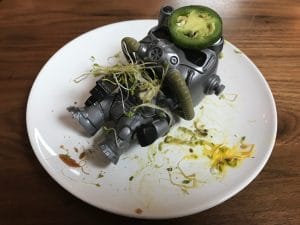
Afterwards, with no funds left to afford a down payment, I did as I always would and laid down with the remains of my pain. I wanted the whole café to witness my shame.

Photo by Brendan Bures

Now you know my struggles. You’re here now. And I need your help. Please assist me in defeating this avocado toast addiction crippling millennials everywhere. This avocado toast addiction is the sole reason none of us buy houses, I promise you. Someone you know is struggling against this right now. Alone we are weak and stand no chance. Together…well together we just might qualify for an FHA housing loan.


[gravityform id=”13″ title=”false” description=”true”]


Spiked Mofongo: Make This Caribbean Classic With Marijuana

It can be hard to find a diverse selection of Latin and Caribbean foods outside of Northeast cities. Ironically that also lines up with most of the stricter marijuana policy states, so your chances of having such foods lovingly laced with another Caribbean favorite are waiting in the wings of congress.

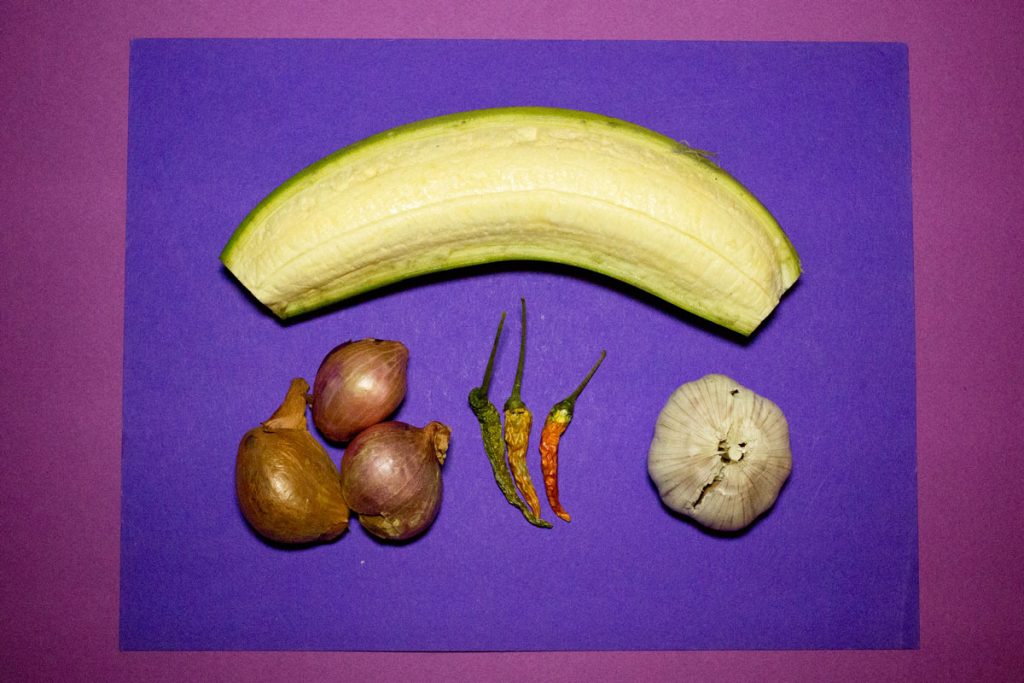
Though many cultures and especially Caribbean cultures use the banana-esque plantain as a starch source in their meals, the Dominican Republic and Puerto Rican Mofongo is one of the most delicious ways to have the green, unripe fruit, known to some as cooking bananas. These starchy friends of our sweet snack bananas are tasty when fried, roasted, and in this case, smashed with garlic and cannabis oil.

When served with broth for soaking and a generous sprinkle of cilantro, you can understand why some people are hesitant to eat any outside their neighborhood enclaves where this food is available, affordable, and of highest quality. A sequel to tostones, which are fried and smashed pancake-like plantains, you can use leftovers or some roasted or grilled plantains to make the next step: tasty tasty mofongo.

Green Mofongo

Based on Clara Gonzalez of DominicanCooking.com’s recipe
Makes 4 servings; 14mg THC per serving

Photos by Maria Penaloza
  • 3 unripe green plantain
  • 1 head garlic
  • 2 shallots
  • 4 c vegetable broth
  • 2 Tbsp cannabis infused olive oil*
  • 1 cube vegetable bullion
  • Sofrito/salsa (optional)
  • Salt and pepper
  • Oil for frying
  • Cilantro for garnish

In a small saucepan, add a drizzle of the cooking oil. Crush half of the garlic and one of the shallots and Heat til translucent. Pour over the broth and add one cube of bouillon to add some stronger flavor. Meat broths can be used too, but you will still have to season them with garlic, pepper, and some herbs if desired. Allow to simmer while you prepare the plantains.

Photos by Maria Penaloza

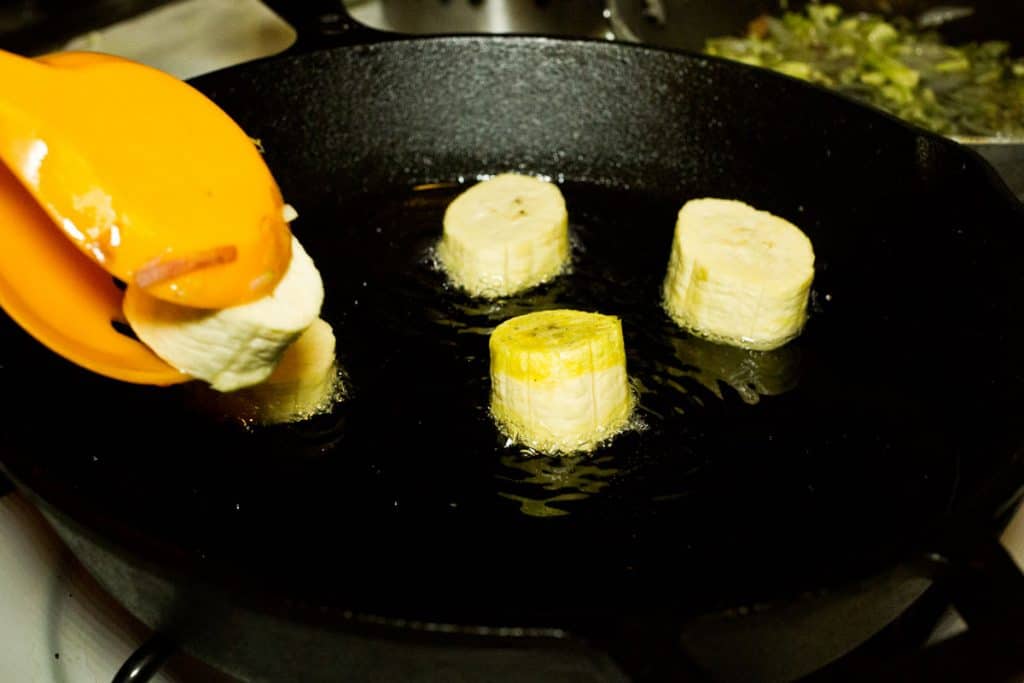
Cover the bottom of a heavy bottomed pan with oil and preheat, reserving 1tbs of cooking oil for your knife, cutting board, and hands. Rub the oil in pretty well, this allows you to handle and break down the plantains without the sticky sap getting all over everything. The easiest way to prep this hardened banana cousin is to chop off each end, make a cut down a vein, and peel off with your fingers. Chop the fruits into 1-1.5” pieces for frying, since you are eventually mashing them, they don’t need to be super thin.

Photos by Maria Penaloza

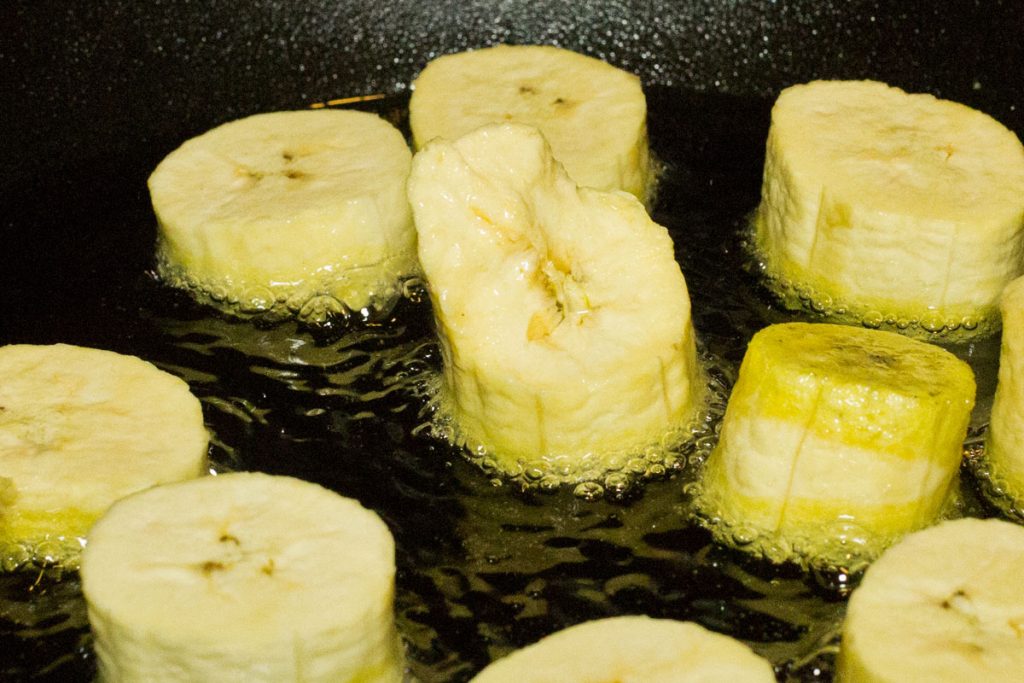
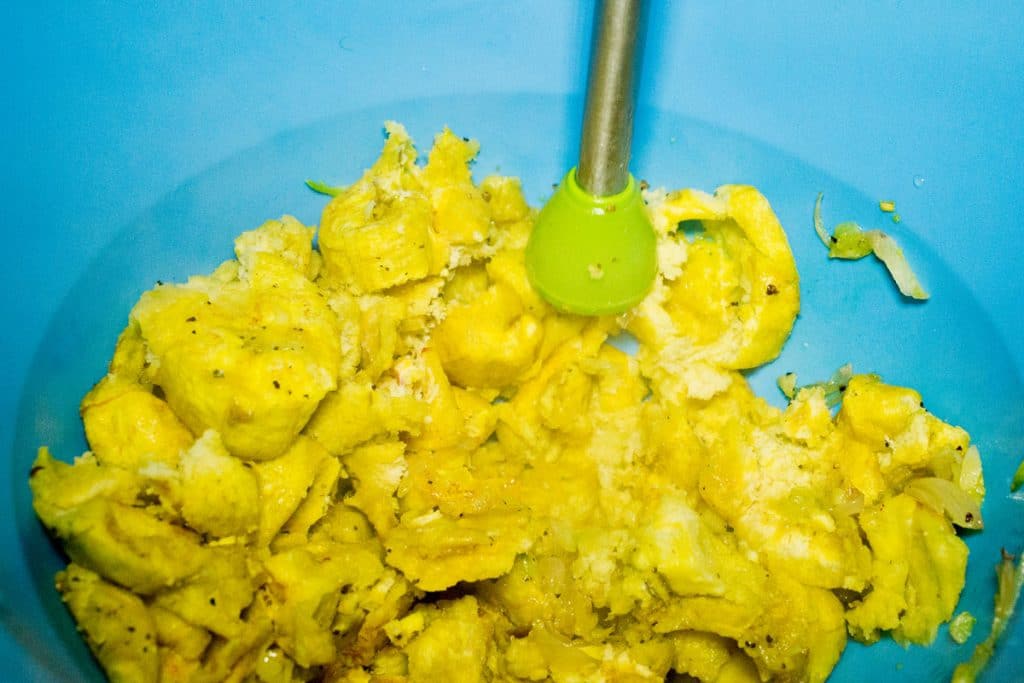
Fry the pieces for 2-3 minutes per side until lightly browned, allow to drain on paper towels. Once you are done frying, crush the remaining garlic and shallot lightly, fry quickly to soften, and put in a heatproof bowl. Add the plantains, infused oil, salt, pepper, and some sofrito if desired, and mash with a potato masher or pestle.

Add a splash of the broth if it seems too dry, but everything should maintain a chunky texture, it won’t be smooth like mashed potatoes and you don’t want it to be!

Photos by Maria Penaloza

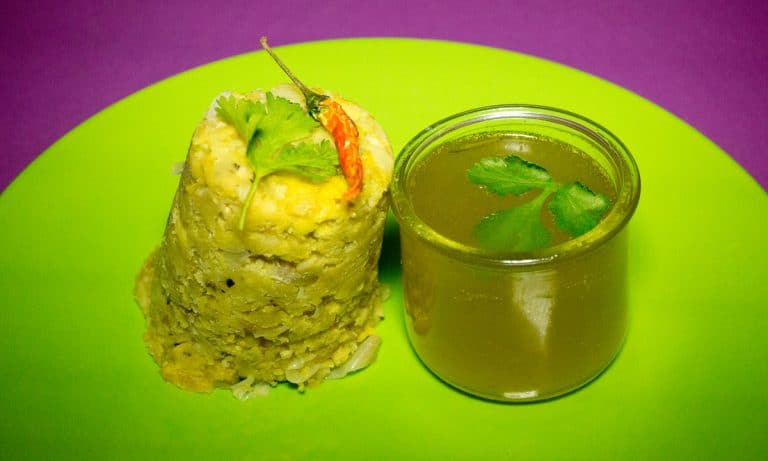
Form into a small bowl or mug and invert on a plate to form a little tower. Then fill this bowl with broth. Garnish both with cilantro and serve with hot sauce. Traditionally this has meat, which you add in the mashing stage, and many use anything on hand, from shrimp to shredded chicken. Dip bites of the salty, garlicky yum into broth before wolfing, it’s a taste you crave once you try for the first time.

*Cannabis Infused Olive Oil

Decarboxylate 3.5g of finely ground cannabis at 225 degrees for 20 minutes in a tightly sealed, oven safe container. Put in lidded mason jar or vacuum sealed bag with cannabis and four ounces of Olive oil. Heat in water bath just under boiling for at least 1 hour. Strain and chill to use in recipes

Latinx Caribbean food and Afro Caribbean food may be a staple in my city as a hub of Caribbean immigration, but if given the chance to take root elsewhere, this would be a go-to for so many of us. Plantains are cheap even imported, and they keep for ages. Even ‘rotten’ yellow ones make breathtaking sweet plantains or a killer twist on banana bread.

Photos: Maria Penaloza


[gravityform id=”13″ title=”false” description=”true”]


New California Law Would Make This Marijuana-Infused Edible Illegal

Cannabis-infused gummy bears are endangered in California after the state assembly approved a bill designed to ban any “candy if it is in the shape of a person, animal, insect, fruit, or in another shape normally associated with candy.”

Assembly Bill 350 seeks to strengthen the rules around edibles included in last November’s victorious Proposition 64 ballot measure, which legalized recreational marijuana consumption and sales in the state. Prop 64  specifically “prohibits marijuana products that are designed to be appealing to children or easily confused with commercially sold candy or foods that do not contain marijuana.”

But California lawmakers hope the tighter regulation will keep children from accidentally consuming marijuana edibles.

Assemblyman Rudy Salas introduced AB350 and for him, it’s personal. “When you want to market a product toward children, unsuspecting children, and do them harm, yes i take that personally,” Salas told CBS13 in Sacramento.

In February, the Senate passed similar legislation — Senate Bill 663 —that would ban packaging that features cartoon characters or “resembling any candy, snack food, baked good, or beverage commercially sold without marijuana.”

Edibles are one of the fastest growing segments in the nascent legal cannabis industry. Because California will not officially begin its legal market until next year, sales data are sketchy. But in the state Washington, the edible market has skyrocketed 121 percent in sales in just one year, according to data from Headset Inc., a cannabis analytics firm.

In 2015, legal cannabis in the U.S. hit $5.4 billion, according to ArcView Market Research. Analysts have determined that edibles and other infused products make up at least half of the total.

For many medical patients, edible cannabis is the preferred method for ingesting the herb. While it takes longer for intoxication to occur, the sensation lasts much longer. For those battling chronic pain, PTSD and other longer-lasting ailments, edibles are much more effective than smoked marijuana.

“You’re seeing that edibles are actually 43 percent of the market share, so it’s increasingly growing every day that people are trying different form of cannabis,” Waylon Broussard, co-founder of Edibles magazine, told CBS13.


[gravityform id=”13″ title=”false” description=”true”]


Don't Miss Your Weekly Dose of The Fresh Toast.

Stay informed with exclusive news briefs delivered directly to your inbox every Friday.

We respect your privacy. Unsubscribe anytime.