Tell me if you heard this one before: A South African man cannibal suspect told police he was “tired” of eating human flesh. He said this to officers after “brandishing a woman’s leg at them.”
The man is one of four suspects charged with murder by South African authorities. He also sounds like he needs to go on a serious juice cleanse.
“When he was questioned, he produced part of a human leg and a hand. Further investigation led police to a house in the Rensburgdrift area in Estcourt where police were met with a foul smell, and more human remains were found,” spokesperson Colonel Thembeka Mbhele told News24.
Added Mbhele: “It is alleged that the suspects raped, killed and cut up the body of a woman, which they then consumed. The allegations by the suspect are that they would rape and kill the victims before they could cut them into pieces and eat their parts.”
Officers discovered more body parts when the man took police to a nearby house where the suspect had allegedly eaten the flesh.
Two of the suspects are traditional healers. Authorities told BBC this concerned them their actions may be part of a larger syndicate.
As we’re all nonstop deluged with media content we need to consume Right Now!, perhaps you’ll be relieved that rushing to hear Taylor Swift’s new single is wholly unnecessary. I don’t say that because you’ll likely hear it a thousand times through radio and TV outlets in the coming weeks, or because it’s a bad song (though it is). No, it’s not worth your time to play Taylor’s “Look What You Made Me Do” because, without ever spinning this record, you’ve already heard it before.
The new super “OMG” edgy and vengeful rebrand Taylor seems keen on going through with (Who wronged Taylor again? Oh right, the faceless and fabricated HATERS. My apologies. How could I forget?) exposed its derivative makeup with this new single. “Look What You Made Me Do” isn’t derivative because Taylor dipped into the Max Martin mega-pop single factory one too many times or anything of that nature. Its electro-clash, Yeezus-lite production sounds borrowed as does Taylor’s phoenix pose of rising from the ashes of (made-up) celebrity drama.
It’s almost like Taylor watched the massive successes of contemporaries like Rihanna’s middle-finger flippancy on ANTI and Beyoncé’s unhinged-yet-poised Lemonade airing out of dirty laundry and Lorde’s, yes, Melodrama and assumed that’s where her career should go next. Though make no mistake—Taylor previously had constructed a convincing formula of drifting into celebrity relationships and dramas she could later use to contextualize her music. Whether you believed any of it as genuine is irrelevant. It worked.
That narrative relied upon Taylor playing the good-girl victim somehow caught up in negative situations. She didn’t want to be the heartbroken, she didn’t want to be the awards-stealer, and didn’t want bad blood with other celebrities; that’s just how it happened to go. But she presented herself as striving beyond it, finding a stronger attitude in these adverse environments, which is what so many found relatable and why they rooted for her.
Two important moments occurred, though: a) within the past year everyone realized that Taylor seeks the drama, instead of the other way around, thanks to one-to-many, so-blatantly-fake romantic dalliances (Hiddleswift, really?) and b) Taylor tried to outmaneuver Kim Kardashian, a celebrity savant mastermind, and got played on a very public stage. The latter event reinforced the former notion—you can’t play the victim when everyone knows that’s your intention.
I mean, goodness. How damaging was it to hear Taylor tell Kanye, “It’s like a compliment,” regarding the reference in his song “Famous” that went “For all my Southside n—– that know me best / I feel like me and Taylor might still have sex”? Kim releasing that footage bankrupted her long con of victimhood.
So of course Taylor struck back on this single. Small shots like “I don’t like your tilted stage” (Kanye’s Pablo tour featured a floating, tilting stage) and the voicemail recording that interrupts the bridge of the song: “I’m sorry, the old Taylor can’t come to the phone right now / Why? Oh, ’cause she’s dead!” clearly calling back to her Kanye-Kim feud. Other lyrics reference the long-standing, why-is-this-still-going-on beef with Katy Perry, all of which aren’t worth dissecting.
Because this whole song sounds so entirely forced. It’s like Taylor Swift casted herself to replace Rosamund Pike in Gone Girl or Uma Thurman in Kill Bill, and it’s unbelievable because the audience knows she’d die in the first moment of violence. You know Taylor isn’t a bad ass bitch because she’s spent her entire career reminding you otherwise. That doesn’t mean she isn’t strong. Far from it. Look at it this way: She’s a survivor, not a killer.
And since Taylor can’t naturally manufacture the character she wants to portray on “Look What You Made Me Do,” she borrows from other, more credible acts. I mean this quite literally. For some reason Taylor doesn’t attempt to hide the assembly line of influences to build this Frankenstein song.
That chorus of “Ooh, look what you made me do” is like a bad Fergie impression, but if done by Gwen Stefani cover artist. Listen to Fergie’s hook on “My Humps” and tell me otherwise. There’s a dash of Meghan Trainor’s “No” in there, too, except after hearing “Look What You Made Me Do” I’m certain Taylor couldn’t pull off the bland, aggrieved attitude Trainor can in that hook. But the song Taylor’s chorus most reminds me of is Right Said Fred’s “I’m Too Sexy.” Once you hear it, it’s kind of undeniable.
At least when you hear this knockoff trash zombie song a thousand times over the next two months you can giggle imagining Taylor singing “I’m too sexy for my shirt” instead of “Look what you made me do.” Because no one made you do anything, Taylor. In fact, most of us really wish you hadn’t done this song.
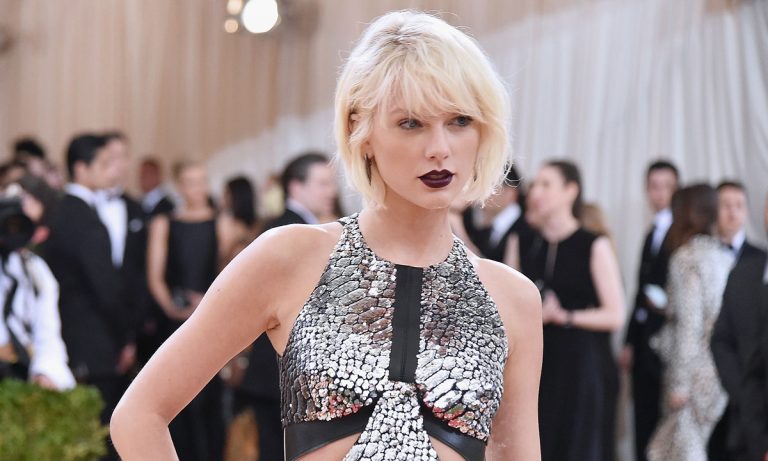
Taylor Swift is back with her first new solo material in three years, and it sounds like a clear dig at her old enemy/friend/enemy Kanye West and his wife, Kim Kardashian.
It’s clear that Swift is in no mood to make nice. “I don’t like your little games/Don’t like your tilted stage,” she says, in what is most likely a reference to the innovative tilted stage that West showcased on his “Saint Pablo” world tour.
“It’s been in the cards since Kanye released “The Life of Pablo” in 2016. The album included the track “Famous,” which featured the line “I feel like me and Taylor might still have sex/Why? I made that b – – – h famous.”
Swift slammed the lyrics shortly after the song’s release, but in July 2016, Kardashian released Snapchat videos of West in the studio during the recording of the track, reading the “sex” lyrics to Swift over the phone. Swift apparently gave her blessing, although the reference to her as a “b – – – h” was not discussed in the clips.
Even that incident gets a nod in the song, with a spoken-word sequence that features Swift coldly stating into a phone, “The old Taylor can’t come to the phone right now … ’cause she’s dead.”
Shania Twain On Brad Pitt’s Naked Photos
For the first time since releasing the confidently twangy “That Don’t Impress Me Much” two decades ago, Shania Twain has finally come clean about incorporating actor Brad Pitt’s name in the lyrics. The No. 7 Billboard Hot 100 hit from 1997’s Come On Over, still the second best-selling album of the Nielsen era (1991-present), sarcastically pokes fun at a narcissistic suitor’s penchant for caring too much about his looks in the second verse before Twain memorably sings, “OK, so you’re Brad Pitt? That don’t impress me much.”
But what left Twain, who was 32 when the album came out, so unimpressed with Pitt, who was 33? Apparently, his nudes. When Billboard mentioned Pitt’s career longevity during a recent interview with Twain at Spotify HQ in New York City this month, she revealed the true inspiration for the Pitt lyric.
“You want to know the truth about this story? I’ve never told this before. I’m going to say it now,” said Twain, 51, building suspense. “I remember I had a girl friend visiting me and it was near Christmas and we were baking cookies. I was writing this album and there was a scandal of [Pitt] and Gwyneth [Paltrow] where there was naked photos of him [in Playgirl magazine, which Pitt later successfully sued for publishing the paparazzi photos]. And this was like all the rage. I just thought ‘I don’t know what all the fuss is about.’ I’m like, well that don’t impress me much, I mean what is all the fuss. We see people naked every day. That’s really what I thought. I wasn’t picking on Brad Pitt. But that was just the association in that moment and things we make fusses about and whatever. Of course, it could have been any gorgeous guy.”
[From Billboard]
Love the fresh dirt we bring over daily from Naughty Gossip? Let us know in the comments!
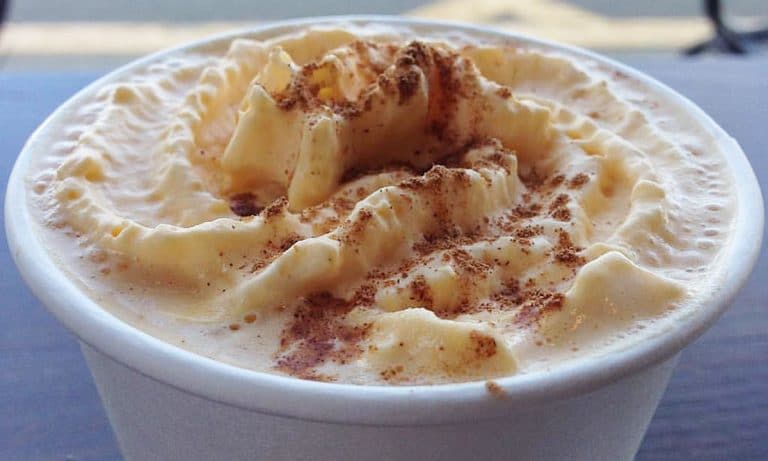
That right there. That jug of Pumpkin Spice Latte in its most concentrated form sparked something inside people — specifically Starbucks baristas — that was a mix of PTSD and “Thank the lawd for the end of Frapp season!” Surprisingly, most Starbucks baristas seem to really enjoy the PSL, whether it be the autumnal sensation or the fact that blenders aren’t required to make them.
Officials at a Japanese zoo were worried when a giant tortoise escaped from the premises and went missing for two weeks. To encourage local residents to assist in searching for the missing tortoise, zoo officials put up a cash reward.
Soon enough, a man and his teenage son discovered the female Aldabra giant tortoise named Aboo. Where you might ask? Aboo was hiding about 140 meters away from her getaway point in some bushes. According to zoo worker Yoshimi Yamane, Aboo was in great condition with zero injuries.
“I feel relieved. From now on, we’ll make sure to take perfect care of our animals,” Yamane told Japan Times.
Aboo had been allowed to roam freely in an unenclosed area earlier this month and hadn’t tried to escape since arriving at the zoo in 2004. Since a tortoise moves at, ahem, a glacial pace, zoo officials suspected she’d been kidnapped. Thanks to the man and his son, who remain anonymous, Aboo is home and safe. According to officials, she is “one of the popular animals at the zoo.”
As far as processed foods go, I don’t see a major difference in choosing animal meat or meat analogue products as long and you aren’t sacrificing taste. The truth of the matter is that both are, well, processed! For those of us who stay away from animal flesh for the most part, a plant based diet sometimes requires creativity to hit the spot. Making your own vegan sausages is really satisfying, since you can not only customize the flavor to anything you wish, you can add weed to them for a fatty, crumbly dose of faux pork, chicken, or beef anytime.
Just like as good bowl of ramen, a hearty dose of fat is going to help mimic the taste and texture of meat. Like all sausages, generous seasoning is also key to flavoring everything the way it should taste. Adding cannabis is a genius hack for last minute medicated snacks and all manner of dinners from lazy to gourmet.
Vegan Cannabis Sausages
Danielle Guercio, 2017; Adapted from Post Punk Kitchen Sausages + Chickpea patties Makes 5 large sausages; 5mg THC per sausage estimated
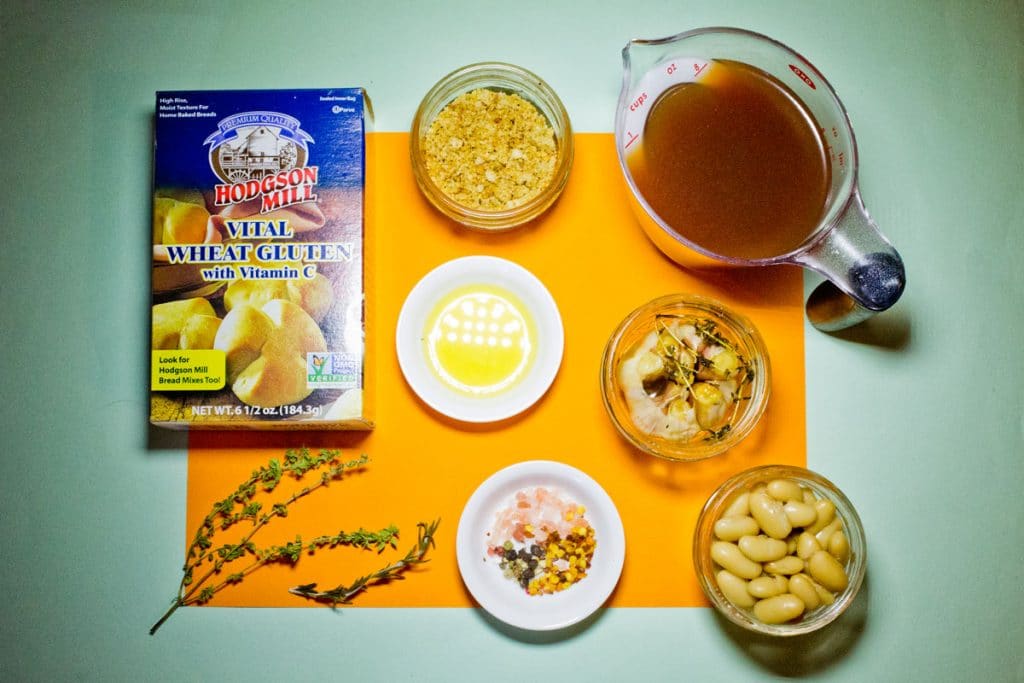
1 cup breadcrumbs
1 cup vegetable broth
1 cup white cannellini beans, rinsed canned or cooked dry
1 cup vital wheat gluten
1 head roasted garlic
1 Tbs nutritional yeast
1 tsp salt
Pepper to taste
Dried herbs
2 Tbs Cannabis Olive Oil*
Photos by Maria Penaloza
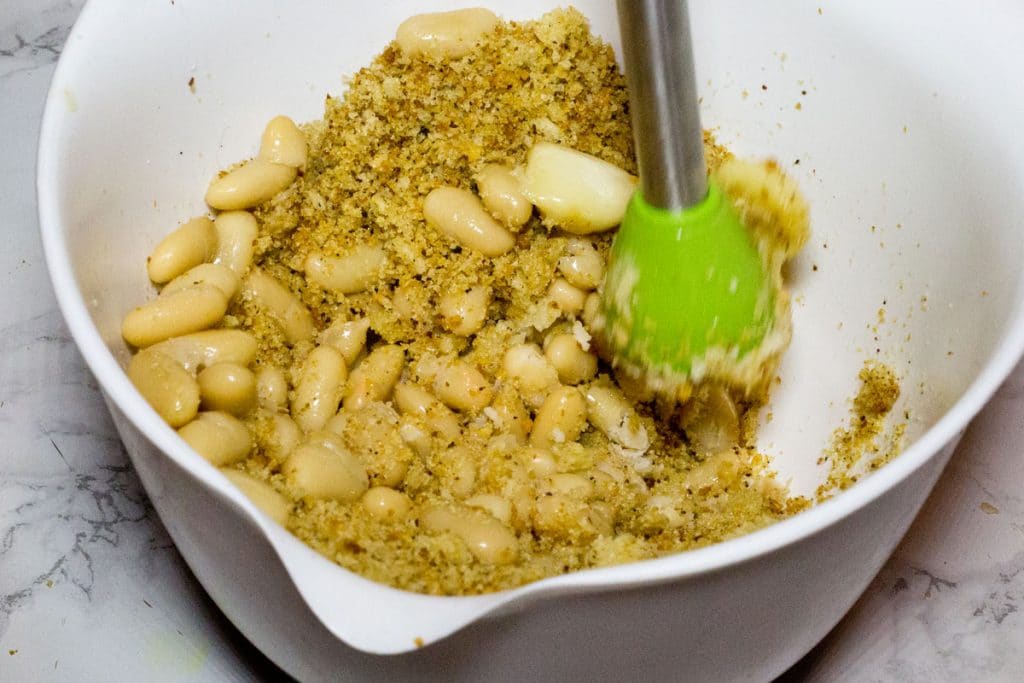
It may seem like a messy process, but this is a one-bowl-one-fork operation. To make the sausages, you are primarily mashing beans before mixing them into a dough with the dry and wet ingredients.
Unlike bread or flour dough, vital wheat gluten is a concentrated gluten that helps adhere the beans and other components of the sausages into a bouncy, meat like texture when cooked. Typically this ingredient is used to make homemade bread come out better and last longer, so look in the baking aisle.
Photos by Maria Penaloza
In a large bowl, mash beans with a mortar until they are completely smashed, but leave a little bit of texture, you don’t want hummus. Next mix in the seasonings, breadcrumbs, and oil before mixing with a fork. Add the remaining ingredients and stir with the fork until it makes a sticky, stiff dough.
Photos by Maria Penaloza
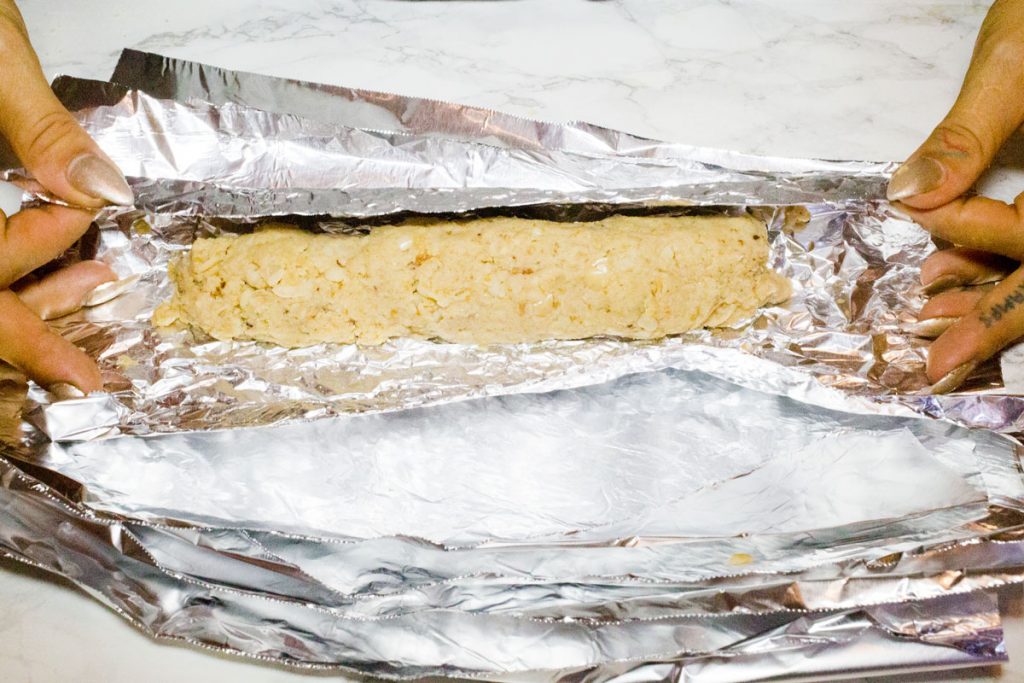
Cut strips of foil that are roughly 5” long and the full width of the roll. Scoop a hefty portion of the dough onto the foil and shape into a log. This will be hilariously similar to rolling a joint, and the irony is omnipresent.
Photos by Maria Penaloza
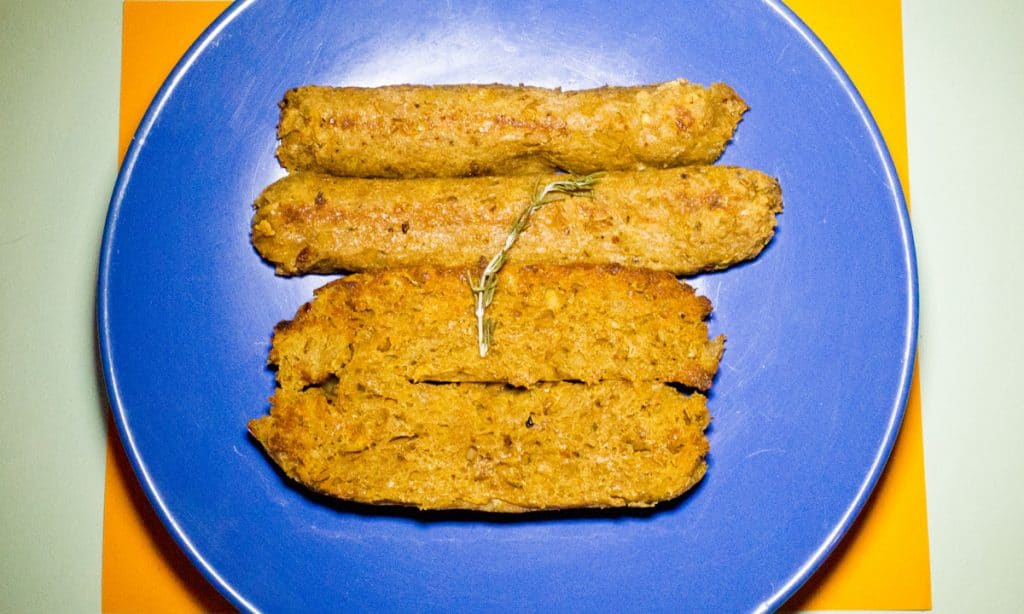
Steam for 40 minutes to create the shape, they will pull together and you don’t need to obsess over the shape. You will definitely want to sear them to get a crispy exterior before further eating, whether you make into a sandwich or continue into sausage and pepper territory as I have.
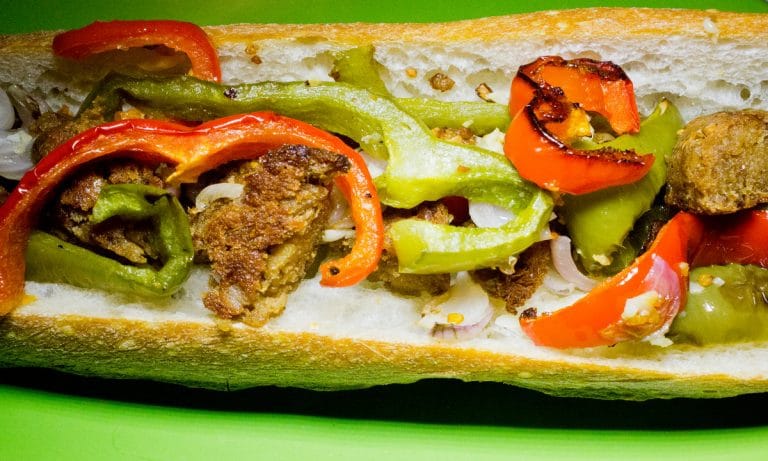
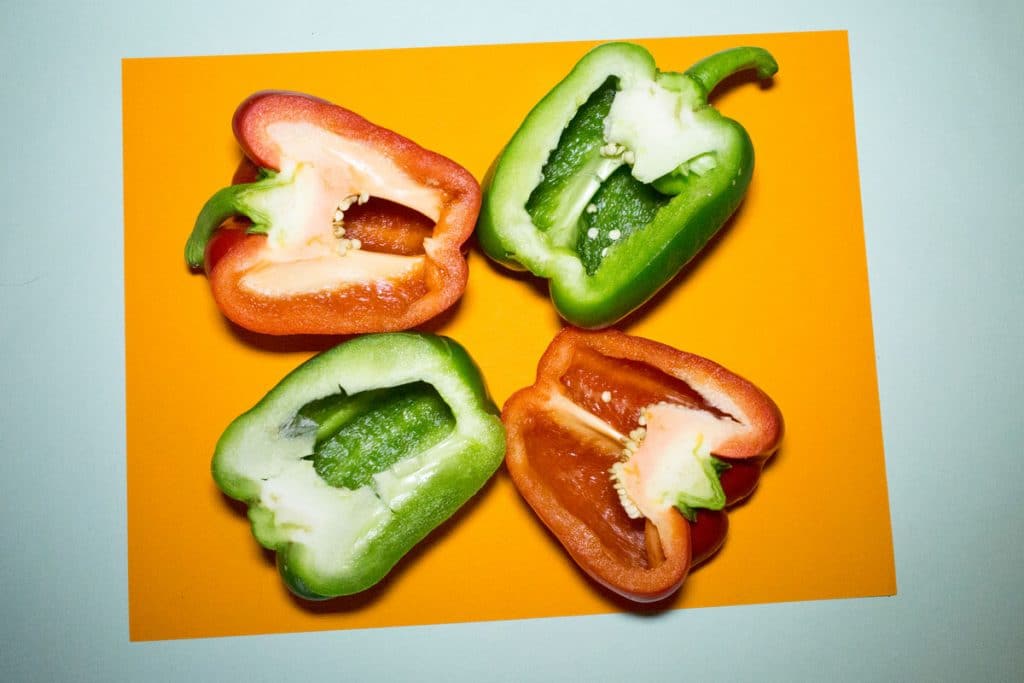
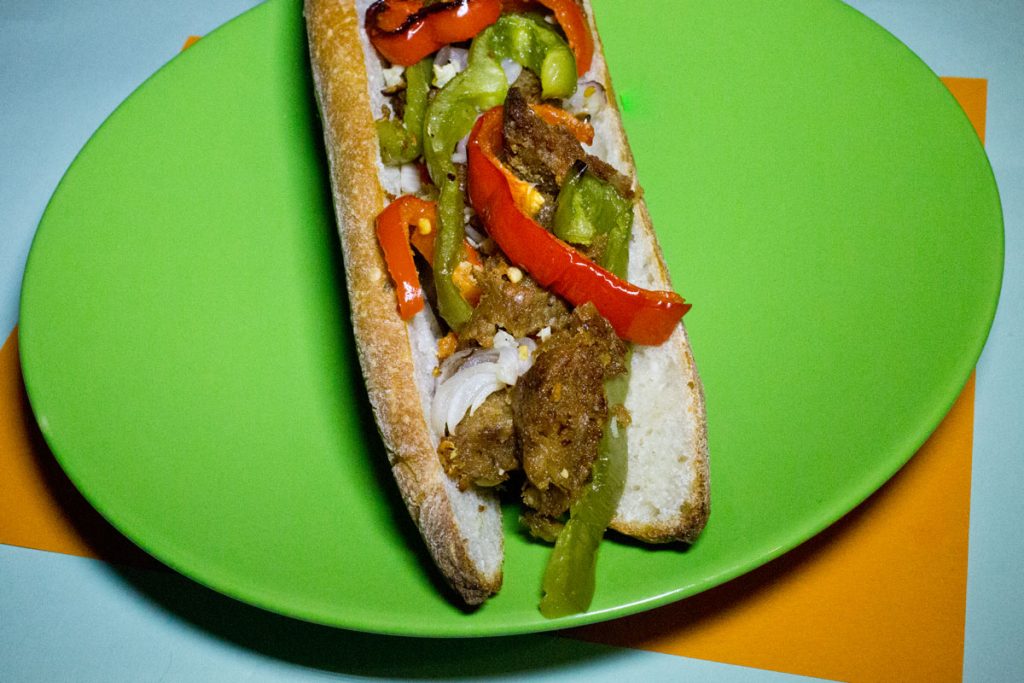
To turn a few sausages into an Italian American classic, cut in half and crisp in the oven with some oil. Remove from the oven and add 2 chopped red and green peppers, shallot and onion to taste with salt, pepper and olive oil. When the veggies are wilted add the chopped up sausage and heat through. Serve on a roll like the carnival pros do.
Photos by Maria Penaloza
*Cannabis Olive Oil
Decarboxylate 3.5g of finely ground cannabis at 225 degrees for 20 minutes in a tightly sealed, oven safe container. Put in lidded mason jar or vacuum sealed bag with cannabis and four ounces of olive oil. Heat in water bath just under boiling for at least 1 hour. Strain and chill to use in recipes
Photos by Maria Penaloza
Don’t be shy about customization! You can make them small for appetizers, breakfast link size, or even one giant pinwheel like we do in New York. Flavor play is also key here, try some maple and thyme or some pepperoncini and parsley, the choice is yours! Simply sear and serve for the (almost) real thing at a moment’s notice.
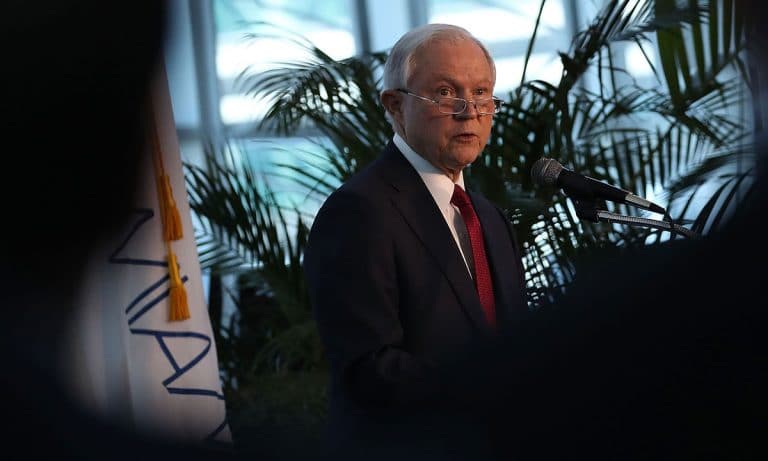
Oregon Gov. Kate Brown is the latest leader from a legal marijuana state to reject ill-informed marijuana claims by U.S. Attorney General Jeff Sessions.
Sessions, one of the most extreme anti-marijuana zealots in the Trump administration, has been sending out letters to governors in pro-marijuana states claiming he has “serious questions about the efficacy of marijuana ‘regulatory structures.’ ”
Earlier this year, the governors of the first four states to legalize recreational cannabis — Colorado, Washington, Oregon and Alaska — asked Sessions to “engage with us before embarking on any changes to regulatory and enforcement systems.” In response to the reasonable request, Sessions sent letters back to the governors using flawed, incomplete or old data in order to raise questions about the new laws.
Sessions attempted to demonstrate that legalization poses dire public health and safety issues. “Congress has determined that marijuana is a dangerous drug and that the illegal distribution and sale of marijuana is a crime,” Sessions wrote.
On Tuesday, Oregon’s Gov. Brown fired back with her own letter back to Sessions:
Despite the concerns surrounding legalization of marijuana, there can be no denying that Oregon has beneftted from this industry. Oregon has already realized $60.2 million in revenue and created over 16,000 jobs for Oregonians. Tax revenue from the marijuana industry is used to fund schools, to provide mental health and drug treatment and to assist both state and local law enforcement. This does not even take into account cost savings to the criminal justice system. As stated in the April 3, 2017 letter, a dismantling of the Cole Memorandum would have the opposite effect, driving existing lawful product into the unregulated black market and funding criminal enterprise.
Brown’s response is similar to the one from Washington Gov. Jay Inslee. “Unfortunately, he [Sessions] is referring to incomplete and unreliable data that does not provide the most accurate snapshot of our efforts since the marketplace opened in 2014,” Inslee wrote.
The governor and attorney general of Alaska sent Sessions a terse response last week. “The report simply does not speak to the success or failure of the new regulatory framework,” the letter said.
Sessions nor the Department of Justice has responded to the feedback from the states.
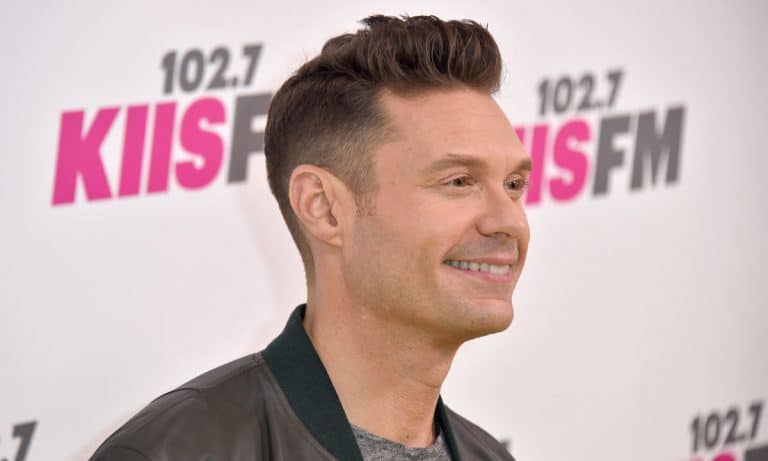
“Ryan has hired Nate Berkus’s husband, Jeremiah Brent, to make his new $70,000-a- month rental house perfect. Part of the additions have been a gold phone and a tiny throne for Ryan to sit on like a king,” one source who has seen his new space tells Straight Shuter. “All the furniture is small. He has two white leather chairs with black piping in his living rooms that are very low to the ground. His white marble coffee table is also very low. He also has the smallest black candle on the table that you have ever seen. In fact the only thing in the place that is big is his huge golden phone.”
Jennifer Lopez Teaching Alex A Sexy New Trick
Jennifer Lopez thinks she has found the almost perfect man in Alex, but there is one thing she wants him to do a little better –and it so happens that that little something is something she can help him with!
“Jennifer is teaching Alex how to dance. He has great rhythm and can move those Latino hips, but he needs a few lessons to take the floor at his wedding with one of the greatest dancers of all time,” sources tell Straight Shuter. “Jennifer is teaching him. She is patient and loves showing him a few killer moves. He is a brilliant student and if he’s going to dance with his lady he knows he could do with a little help.”
Love the fresh dirt we bring over daily from Naughty Gossip? Let us know in the comments!
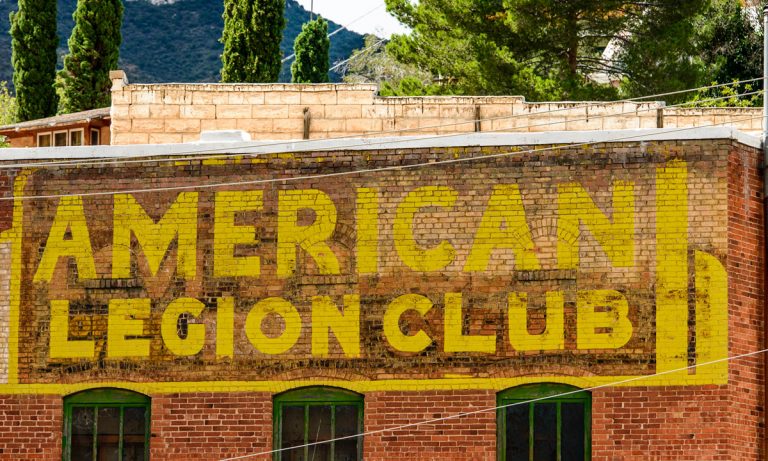
The American Legion is a highly respected group in our nation, one that Trump called “powerful” during his speech at the Reno convention.
On August 24th, the American Legion adopted a resolution to approach the Federal Government with new urgency to let Veterans Affairs doctors discus medical marijuana with their patients and, in states where it’s legal, recommend the herb. This is an effort in a long line for the American Legion, which has been trying to get access to medical cannabis for veterans who so desperately need it.
The resolution was passed at the national American Legion convention held in Reno, NV on the 23rd. It was written by Rob Ryan, member from Blue Ash, Ohio. Ohio has one of the highest rates of overdose deaths in the nation due to opioid use. Ryan’s motivation came from the many veterans he’d spoken to who use cannabis in place of opiates.
The American Legion is a highly respected group in our nation, one that Trump called “powerful” during his speech at the Reno convention. They have a real chance of grabbing the nation by the ears, especially on the issue of being able to speak to one’s doctor. Our veterans more than deserve ears to hear them.
Ryan’s resolution started at the local level, then county, district and state before it was brought out at the convention. It passed with wide support.
The American Legion represents over two-million veterans across the nation. They took their first swing at dated marijuana laws last summer, when they went headlong into trying to get cannabis out of the Schedule I category of drugs, which include heroin and LSD, all of which are considered to have no medicinal value.
The group has reportedly also asked Trump for meetings on several occasions to discuss the issue.
This past May, Veterans Affairs Secretary David Shulkin stated that he was open to exploring new evidence that cannabis can be used to treat veterans, however, VA policy adopted in 2011 keeps doctors from even discussing the plant with veterans. Over recent years, attempts have failed to change this in Congress.
Though the “Veterans for Equal Access” measure passed both the House and Senate last year with plenty of votes, the amendment was taken away during negotiations between the two entities. The Senate could yet approve it in the VA appropriations legislation. We may find out as soon as September, when Senators return from recess.
In the meantime, we can only thank the American Legion and all our veterans. Not only for their service, but for speaking up when they see injustices in our country.
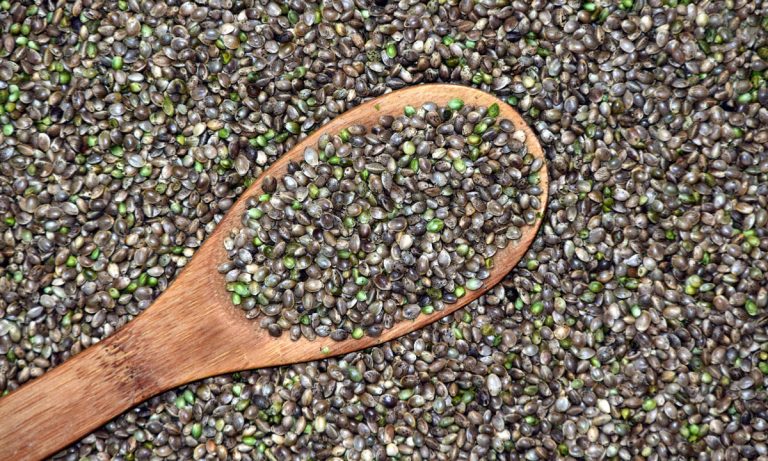
The immediate future is bright for the hemp marketplace.
The data company Brightfield Group estimated that companies selling hemp-derived cannabidiol (CBD) generated $170 million in revenue in 2016. But in a new study published by Brightfield, the group estimates the hemp CBD market could become a billion-dollar marketplace within the next three years.
Though the data is located behind a paywall, a Forbes article revealed many of the compelling statistics. For example, the report states that 64.5% of hemp CBD sales stemmed from online sales while 17.8% of products were bought in smoke shops. Coming in third were dispensaries with 9% of sales, as health stores and doctor’s offices rounded out the top five.
The top 20 brands averaged sales of $2.1 million per year per company for 2016. However, some brands are much more successful with sales of $9-12 million. CW Hemp, made by CW Botanicals owns 7% of the market, followed by PlusCBD Oil made by CV Sciences with 5% of the market. The next three names are tied with 2% market share and they are Elixinol, HempMeds by Medical Marijuana Inc. and CannazALL by Hemp Life Today. An indication of the fragmentation of this market is that 79% of the market is made up of companies with very low sales comparatively.
“Essentially everyone is trying to do hemp, but only a handful are doing it well,” Bethany Gomez, the Director of Research at Brightfield Group, told Forbes. “It’s seen as easy because it can be sold online but, with restrictions on traditional marketing, it is very difficult to connect with your core consumer and even communicate why they need your product.”
Hemp-derived CBD is an approachable product for many users. However, as consumers become more familiar and comfortable within the cannabis marketplace, they sometimes will opt for cannabis-derived CBD. This is especially true in states that have legalized recreational marijuana.
So the immediate future is bright for the hemp marketplace. But Brightfield noted that hemp makers will have to fight in maintaining their place with consumers as more states legalize recreational marijuana.