Wednesday, June 17, 2026
Home Blog Page 906

Why Your Wine Glass Now Larger

We often turn to wine glasses for many things — to erase our day, to put us to sleep, to enjoy the company of others, to… anything, really. But British researchers turned to wine glasses, specifically their size evolution, to help explain why people are drinking more wine in England.

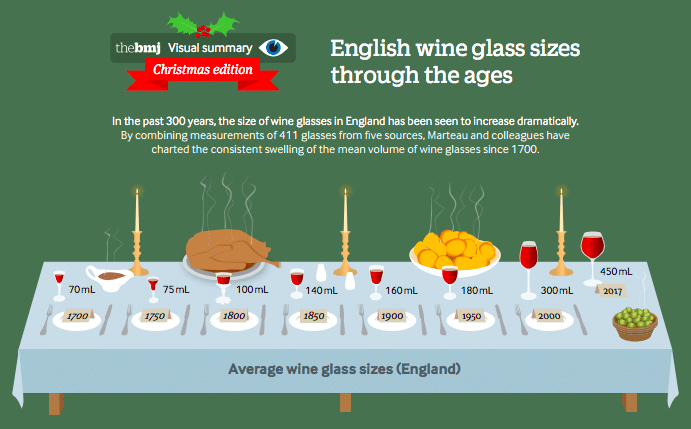
By comparing the measurements of 411 wine glasses from several sources, including eBay, the Ashmolean Museum at the University of Oxford, the Royal Household, historic catalogs from English glassware maker Dartington Crystal, and the John Lewis department store, they found that today’s wine glasses are nearly 7 timex larger than the ones 300 years ago.
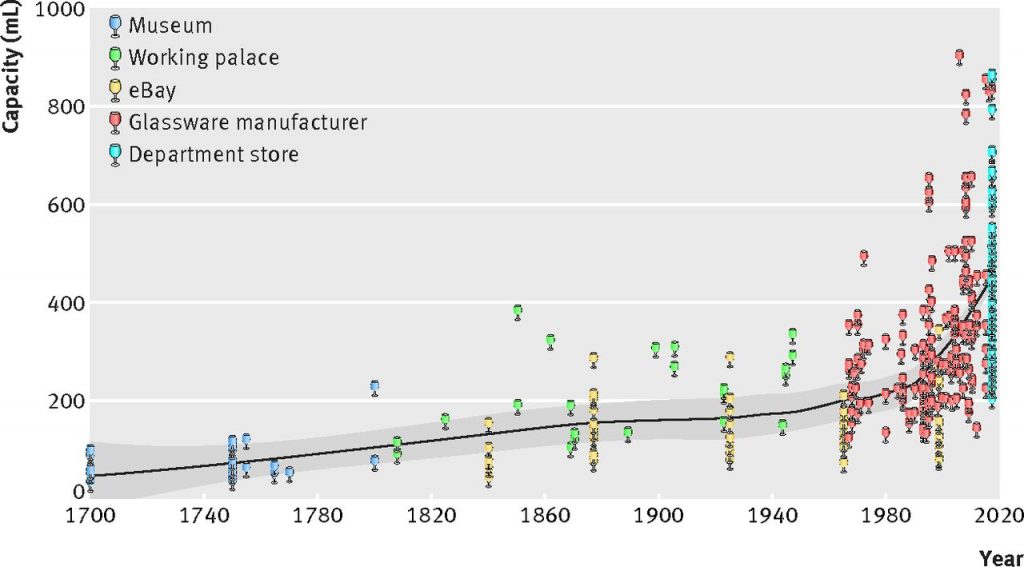
Around 1700, the typical wineglass could hold 66 milliliters (about two ounces). By 1990 or so, the average wine glass grew to more than 15 ounces (449 ml). That’s half a bottle of wine!

Related: Red Wine Is The Best Alcohol For Great Sex And Here’s Why

The authors of the study conducted by the BMJ (British Medical Journal) suspect the growing glass size could have something to do with the rise in wine consumption, along with other factors. According to the BMJ:

Increased drinking since the mid-20th century reflects greater affordability, availability, and marketing of alcohol products, and more liberal licensing has led supermarkets to compete. Environmental cues such as the design of drinking glasses—particularly their size—may also have contributed to increased drinking, particularly of wine.

Studying wine glasses’ capacity over time is an initial step in considering, firstly, whether any changes in their size may have contributed to the steep rise in wine drinking seen in the past few decades and, secondly, whether reducing wine glass size may help cut consumption.

Related: How To Taste Wine Like A Professional In 10 Easy Steps

Back in 1746, the “glass excise” tax was levied and eventually led to the production of small glassware. But when it was abolished a century later in 1845, glass production became more automated and, thus, larger in the 19th century. And, as the study astutely speculated, larger wine glasses have the potential to increase the pleasure of drinking wine, which could increase the desire to drink more. Yep, that all sounds about right.
The study calls out two changes in the 20th century that likely led to even larger glass sizes:

Wine glasses started to be tailored in shape and size for different wine varieties, both reflecting and contributing to a burgeoning market for wine appreciation, where larger glasses were considered important. From 1990 onwards the US market’s demand for larger wine glasses was met by an increase in the size of glasses manufactured in England, where a ready market was also found.

Bars and restaurants are also thought to have helped skew glass sizes larger:

If wine sales increased when it was sold in larger glasses this may have incentivised vendors to use them more. Larger wine glasses can also increase the pleasure from drinking wine, which may in turn increase the desire to drink more.

The takeaway from this study and all of its glassware is that reducing the size of wine glasses across the board could reduce consumption. That seems like a conclusion even someone inebriated could have come up with.

https://giphy.com/gifs/amy-schumer-E3L5goMMSoAAo
Does Cannabis Legislation Represent The Return Of American Federalism?

A very simplistic way to categorize the federal government’s current policies toward marijuana is through the prohibitionist label. While cannabis has been legalized in some form in 30 states across the country, the feds seemingly enact measures to cause confusion and consternation about the plant whenever possible. This is most clear through the actions of Attorney General Jeff Sessions, who rescinded the Cole Memo, an Obama-era policy that protected state legalizing marijuana from potential federal persecution.

The STATES Act—which stands for Strengthening the Tenth Amendment Through Entrusting States—could provide a federal solution to marijuana. Introduced by Sens. Elizabeth Warren and Cory Gardner, the potential bill would allow states to enact and regulate cannabis regulation free from federal overreach. President Donald Trump says he’ll probably end up supporting the STATES Act while a dozen bipartisan governors have urged Congress to pass the potential legislation. The bill also has seven bipartisan co-sponsors within Congress.

In other words, the STATES Act has a real chance of passing. Obviously, this is potentially exciting news within the cannabis industry. But as The Weekly Standard recently argued, the STATES Act could signal a potential return of federalism in American politics. As Collin Roth explains, that presents some promising returns moving forward.

Via Weekly Standard:

Federalism results in fifty different solutions, lowering the stakes for “losers” on policy decisions and providing a valuable laboratory of experimentation for other states to observe. It is, in many ways, far better than a single national solution imposed by Congress or the courts. Federalism has the benefit of alleviating the heightened alarm in American politics by promoting competition and embracing diversity. Lawmakers of both parties too often look for big, one-size-fits-all solutions that turn our national politics into an existential zero-sum game over controversial issues. If Republicans and Democrats can agree, in principle, on a federalist solution to marijuana, it just might open the door to more federalist solutions on other hot-button issues.

On a small scale, the STATES Act represents Republicans and Democrats agreeing to disagree about cannabis. But the STATES Act could also pave the way for experimenting with long-gestating problems like universal health care and immigration reform on the state level similar to cannabis legalization. Then we can pick what works and discard what doesn’t at the state level and implement on the federal level.

It’s an invigorating idea, and cannabis legalization might just be the guinea pig that pushes the federalism wheel forward.

Millennials Would Rather Give Up This For A Month Than Their Phones For A Week

If you asked a Millennial if they’d rather give up their pets or their phone for a week, what do you think they’d say? The app-based phone service Visible recently conducted a survey of more than 1,000 phone users aged 18-34 to find out just how addicted they are to their mobile devices.

“In a game of ‘would you rather,’ the today’s consumers would give up plenty to feed their cell phone addiction, but pets and personal hygiene are where they draw the line,” says the survey.

The majority of respondents have a soft spot for their furry friends, with 72 percent saying they’d rather give up their cell phone for a week than put their pets aside for the same amount of time. Of those who would actually send their pets packing, men (34 percent) were more likely to do so than women (24 percent). Surprised?

Nearly all of those surveyed (83 percent) would not agree to stop brushing their teeth just to have their cell phones by their side. After all, what’s the point of waiting for Bae to Snapchat if they’ve already left you for someone with clean teeth and fresh breath?

More surprisingly, 77 percent of respondents would easily give up caffeine for a week if it meant having their phones around for a more tech-driven pick-me-up. Nothing jolts you awake like the sound of an incoming text.

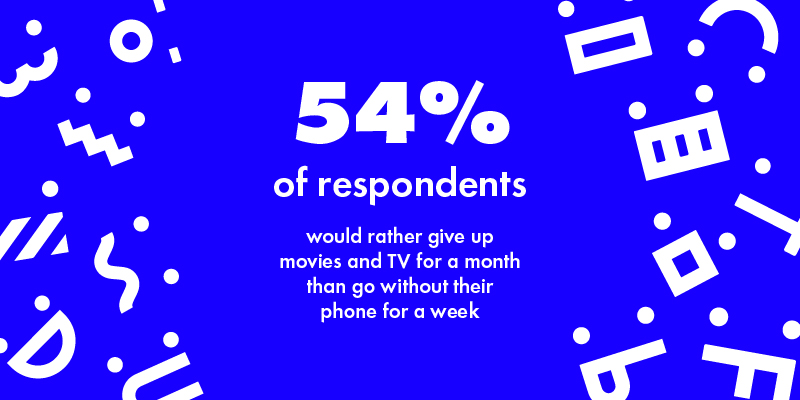
Now, here’s the kicker. Streaming devices seem to have nearly equal power over the Netflix generation as smart phones. A little more than half (54 percent) of respondents would rather give up movies and TV for one month than go without a phone for one week.

So, what are these people willing to use their battery power on? 77 percent would prefer to use it to talk with a loved one instead of rideshare services (35 percent), Spotify streaming (21 percent), and social sharing (11 percent) combined. Next in line for that battery power is a mix of traffic apps, like Waze or Google Maps (44 percent).

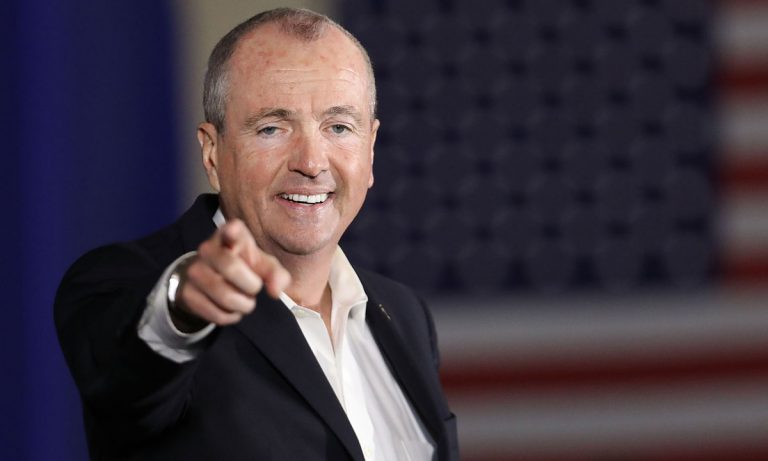
Gov. Phil Murphy And Marijuana Legalization: The Latest

June was a hectic month for Trenton, NJ lawmakers. They had to scramble to get the budget passed, thus narrowly avoiding government shutdown. However, glaringly missing from the budget was any form of cannabis legalization legislation.

A big part of Gov. Phil Murphy’s platform was the legalization of cannabis in the Garden State; it was part of his “first 100 days” plan. He did expand the medical marijuana program to encapsulate common cannabis relieved conditions, such as anxiety and chronic pain, yet NJ is still without fully legalized weed. Why?

For one thing, cities and towns aren’t lining up to support the idea. Over 20 towns have taken action to keep cannabis related businesses outside their borders, while just three towns have said that they would welcome a recreational marketplace.

New Jerseyans may have turned on a dime, having elected the democrat Murphy after eight long years of conservative Chris Christie, who did everything in his power to keep medical marijuana from flourishing and to keep recreational from happening. However, other state leaders are not onboard with Murphy’s liberal stance on cannabis, and their votes matter.

There just aren’t enough pro-pot votes in the Legislature to have New Jersey open the doors to recreational cannabis yet. Still, no matter one’s politics, it is mostly agreed upon that the social aspects of legalization should stand or be reformed. For example, people should not be getting arrested for simple possession, especially when the arrest rates are disproportionate between white and black and brown persons.

Though legalization didn’t make it into the June budget, the fact of the matter is that it didn’t have to. A bill in support of legalized cannabis can be signed at any time, if only NJ state lawmakers could agree on the terms.

Last month, a bill that combined further expansion of the medical marijuana program and a laid out plan for legalization was submitted, however, Sen. Joseph Vitale, (D) Middlesex made it clear that he would not sign any such bill. New Jersey residents can email or call Vitale’s office to express their opinion on the matter and hopefully change his heart. Every voice is a potential difference and another bit closer to cannabis freedom and normalization.

Gov. Murphy says that he hopes to sign a cannabis legalization bill by January 1, 2019.

Are Artificial Tanners Really Safer Than The Sun?

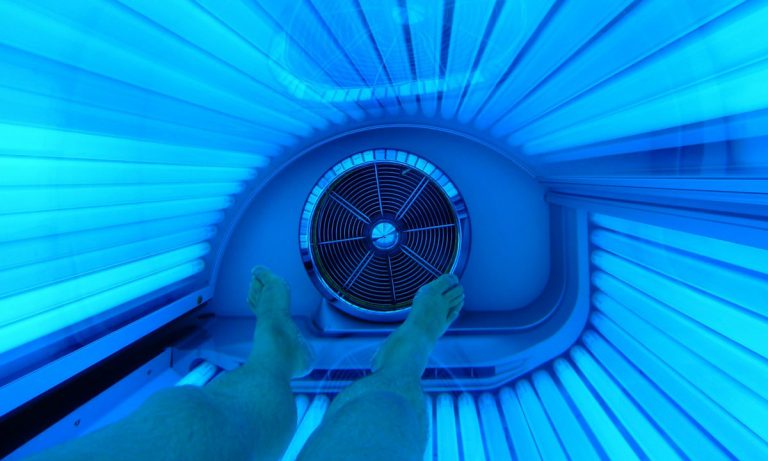
It can be argued that nothing beats nature; natural things are healthier and more effective than fabricated ones. When it comes to tanning, it’s a little more complicated than that. Research has proven that tanning under UV rays, whether they come from a machine or from the sun, is bad for your skin, considerably raising the risk of developing skin cancer.

According to experts, the safest option when it comes to tanning comes from sunless tanning lotions. So, in conclusion, it’s best to just paint your skin.

Popular Science explains that natural tans damage the DNA inside the cells of the outer layer of your skin, making your body produce more melanin. The production of this natural pigment helps dissipate the UV rays, protecting your skin from more damage, which should be good, but sadly this protection is not enough. Experts claim that producing melanin gives your skin around 2 to 4 SPF protection; the minimum amount of SPF your skin needs is 15.

Suntan lotions contain DHA, an FDA approved ingredient that makes your skin form melanoidins. This compound causes your skin to temporarily change color in a way that’s safe and that doesn’t damage your cells.

If you enjoy tanning – who doesn’t? – make sure to protect your skin with sunscreen, preferably with 30 or more SPF. If your skin is very fair, then you have to be even more careful since your skin produces less melanin and is at a higher risk of developing skin cancer and serious burns. It’s also important to manage your time under the sun, tanning gradually and not risking overexposure to UV rays.

How To Take Amazing Photos Of Fireworks From Your Phone

We’ve all tried to take pictures of an eclipse with embarrassing results. Fireworks are similar. How do these events look so nice in real life, but so bad on your device’s camera? The reality is that it’s tough to capture these sort of things on camera, especially if your taking pictures with your dumb iPhone.

RELATED: 5 Morning Activities To Help You Feel Happier

If you’re looking for ways to capture some great images on 4th of July without buying a DSLR, never fear; it is possible, even though you have to practice a lot and get creative. Here is how to take amazing photos of fireworks form your phone.

Use Apps

https://giphy.com/gifs/ted-mosby-dtXv4ITtTbb2w

Don’t be afraid to use apps that can help you take better pictures, especially those that contribute with your phone’s low lighting mode. Slow Shutter Cam is a great option for firework pictures, because it allows you to take long exposure images. Adobe Lightroom and VSCO are great for adding cool effects and filters to your images, giving you different editing and lighting tools that are not available on Instagram and other social media apps.

Practice With Different Camera Modes

https://giphy.com/gifs/NashvilleCMT-cmt-nashville-l0HlPDb9tNVla5DjO

The iOS camera has several settings that give you a lot of room to play around with. Time-lapse, slow motion and panorama modes are great for firework images and videos, allowing you to do something different with the lights. Burst mode is also helpful for when you want to take a lot of pictures in a short period of time, giving you different options that you can later edit and use.

Take Hands-Free Images

https://giphy.com/gifs/cat-XvGCpXOXxN7Ik

Use your headphones, Apple Watch or a remote control to take hands-free images, which allow your device to be completely still when pressing the shutter. Smartphone tripods are also great for this, giving your camera a better angle, allowing you to rest your arms and enjoy the light show.

RELATED: The Most Popular Marijuana Flavors

Play With Your Camera’s Settings

https://giphy.com/gifs/asian-asianmen-american-history-month-xUPGcCtftuzNdConN6

Try taking images with different settings. When taking pictures of fireworks, it’s best to turn off your flash so the lights on the image look brighter and the dark colors look richer. Use your phone’s lock focus feature and play with your exposure. You might get some ugly images here and there, but they’ll be much more interesting than a random shot you took with your automatic smartphone settings.

Scientists Discover Complex Organic Molecules In One Of Saturn’s Moons

Traces of complex organic molecules captured by a space probe demonstrate that a moon orbiting Saturn has all the necessary requirements for life.

Enceladus, one of Saturn’s moons, has long been the interest of scientists due to the fact that it has a warm ocean that contains minerals and molecular hydrogen. This latter compound is very important because it produces chemical energy, which is needed for natural life.

New research published on Nature journal deepens these beliefs, demonstrating that Enceladus contains complex organic molecules in its ocean. “Complex organic molecules do not necessarily provide a habitable environment, but on the other hand they are a necessary precursor for life,” said Dr Frank Postberg inan interview with The Independent.

This information makes Enceladus the only other body besides Earth that’s known to satisfy all the basic requirements of life as we know it.

All of this data was gathered by Cassini, a space probe from NASA that’s been operating for 20 years and has been orbiting Saturn for 13 of them. Enceladus’ surface sometimes cracks, releasing plumes of vapor and ice which were captured and analyzed by the space probe.

As Cassini’s final mission, the probe dove deep into Saturn’s atmosphere and sent all of the data it gathered to Earth before burning up and disintegrating like a meteor.

While there are no more missions for Saturn in the near future, Dr. Postberg says that in the next five years NASA will come to a decision on weather or not they should keep pursuing alien life on this distant planet. “We have a habitable environment there and we have the means to probe it to find whether there is actual life or not.”

Joe Rogan Gets Heated With Ted Nugent Over Marijuana Usage

To label Ted Nugent’s political opinions as “controversial” would be underselling the point. He is, after all, someone who once called former President Barack Obama a “subhuman mongrel” and only apologized after some pressure from his political friends. If you think that’s bad, um, don’t look into his other past commentary on rappers, the Civil War, or homosexuality.

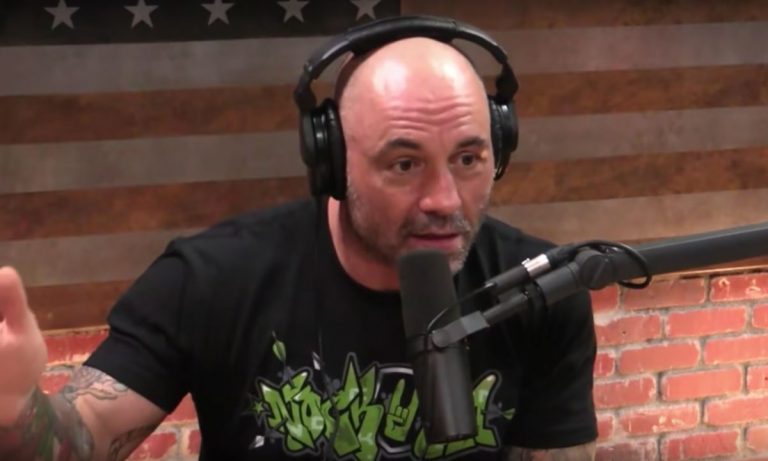
So maybe Nugent’s views on recreational marijuana shouldn’t come as a surprise. The “Cat Scratch Fever” singer recently appeared on Joe Rogan’s podcast and the two butted heads over cannabis usage. Vehemently arguing against recreational marijuana users, Nugent claimed that people are their “superior, definitive best without any outside influence,” whether that’s marijuana, alcohol, or other drugs.  Well, the interview went a bit south and Joe Rogan gets heated with Ted Nuget over marijuana usage.

RELATED: Dear Mainstream Media: Stoner Stereotypes Are No Longer Relevant

Nugent mostly posited outdated “stoner” stereotypes, that cannabis makes you “numb” and careless. Rogan pushed back, stating that lazy stoners represent “a discipline thing, not the marijuana.”

What might surprise you, however, is that Nugent is a proponent of medicinal marijuana. In fact he’s been pro-medical marijuana since 2015, when he wrote in a Daily Caller op-ed to “take a toke on the hippie weed if you need it.” Nugent also told Rogan he’s “on a new council…working with President Trump to legalize medical marijuana nationwide.”

“I’m all for that. I deal with a lot of terminally ill kids, and there’s nothing that’s off limits to take away that suffering, so I need to fight for that,” Nugent explained on the podcast.

RELATED: Why Joe Rogan Decided To Quit Marijuana For October

It appeared that Rogan got through to Nugent when he compared the “lazy stoner” stereotype to those who view hunters as barbaric drunkards, not highly enthusiastic sportsmen. Nugent, a devoted hunter, understood the comparison all too well.

“What I’m saying is I know a lot of people who use—whether it’s psychedelics or marijuana—and they use it to enhance their perspective,” Rogan said. “It doesn’t become the primary focus of their life. It doesn’t consume their life. They don’t allow it to consume their life. There’s a whole other world of disciplined marijuana enthusiasts.”

You can watch their whole conversation above.

6 Quenching Beers That Go Great With Summer Grilling

It’s a hot day. Sweat forms and then slips down your forehead. You have a spatula in your hand. Of course you do, it’s summer and you love to grill. And it just so happens to be your wife’s sister-in-law’s baby shower and you’re in charge of grilling the burgers, corn-on-the-cob, hot dogs and chicken patties. You got this. But you need just one more thing to get you through the hot, smoky task: a great beer. But which brew will carry you furthest, which will quench your charcoal-induced thirst best? Don’t worry. We got you.

While You’re Cooking: Go for something light. You don’t want your cooking acumen to be bogged down by a heavy belly. Not yet. The food coma comes later when everything’s done.

Session IPA

Try a Session IPA, something with hop and some citrus flavor (preferably grapefruit) to whet your whistle. Seattle’s Fremont Brewing, California’s Firestone Walker or New Jersey’s Carton Brewing all have great versions. But really, you can’t go wrong with any brand attempting this style.

https://www.instagram.com/p/BW20VJ1AyFP/

Blonde IPA

If you can get your hands on a good version of these, you’re ahead of the chef-in-the-sun game. Blonde IPA’s are a bit softer on the palate than Session IPA’s. They’re lighter; think: down pillows versus foam. The best we’ve had comes from pFriem Brewing in Oregon.

While You’re Eating: Now that you’re at the table about to bite into some burgers, a more middle of the road beer is appropriate.

Bock Ale 

The Shiner Bock is a dark ale with a good amount of caramel malt flavor to accompany your favorite BBQ sauce or meaty meal. Try Spoetzl Brewery’s Shiner Bock from Texas.

https://www.instagram.com/p/BW0_NYuhRfV

Imperial Red Ale

Taking it a step further, a good Imperial Red Ale will have a bold body but also a sharp and big finish. One of our favorites comes from Oregon’s Double Mountain Brewery, which produces a perfect IRA to pair with a chicken sandwich topped with a little Monterey Jack cheese.

Amber Ale

If you want something in this same spectrum, but you want a beer lighter than a Bock or IRA, shoot for an amber.

There are many good Amber Ales, like the Arrogant Bastard or the Odin’s Gift, but just remember: whatever you’re getting in dependability in an Amber, you’re likely losing in wow factor. It’s often the ground-rule double of brews.

https://www.instagram.com/p/BV8GX2dBKt4/

Post Meal: Now you can let your palate go wild. Try whatever you want.

Cold Porter

If you’re stuffed but still want a brew, go for a light Pilsner or Lager. But if you’re ready for more flavor exploration, we suggest an ice cold Porter.

Our favorites come from Deschutes Brewing and Stoup Brewing in the Pacific Northwest, but if you hunt in your local grocery store, we’re sure you can find the right punctuation to a perfect BBQ day of cooking, friends and exultation.

https://www.instagram.com/p/BXOkQgTBz_f

Legal Weed In Nevada: One Year Later

This month, July 1 to be specific, marks the one-year anniversary of recreational cannabis sales in Nevada, eight months after voters made their high-minded decision. And though social clubs have yet to happen and imbibers must do so in private, legal cannabis sales have surpassed projections.

The program itself seems to have been a fairly easy one to implement, with little drama and without negative social impact as a whole. Of course, advocates want to see more out of the law and opponents want to see stats and maintain safety, like keeping an eye on increased drugged driving, which has yet to see a spike.

The recreational market was implemented much more quickly than the original medical marijuana law, which was voted on in 2000 and put into practice in 2003 with actual storefronts to purchase one’s medicine.

Now, recreational sales have made it past the Department of Taxation’s predictions, generating over 55 million in tax revenue in the first 10 months (the most current available data), whereas the Department had projected around 50 million for the entire year.

So aside from creating thousands upon thousands of jobs in the cannabis sector, from budtender to grower to distributor and beyond, the recreational program has also created state jobs in the way of administrators and regulators, just to keep up with the rolling changes.

And the bigger numbers and increased jobs come after a couple early hiccups. There was the two-week gap in sales right at the beginning due to a lack of distributors, and, of course, the state survived along with other medical and recreational states when Attorney General Jeff Sessions tried to put the brakes on cannabis, period.

Experts say that Nevada has had the best first year out of all recreational states, but we’ll see if that holds up once California hits her one-year mark. For the time being, Nevada and its residents have a lot to be thankful for due to recreational cannabis. Especially the employees of Caesars, which stopped their drug testing program back in May.

Issues that are left, such as social clubs, opponent concerns and, very importantly, how the moneys collected via tax revenue will be distributed, are going to be addressed at the next legislative session.

Don't Miss Your Weekly Dose of The Fresh Toast.

Stay informed with exclusive news briefs delivered directly to your inbox every Friday.

We respect your privacy. Unsubscribe anytime.