It’s been reported that the royal Duchesses, Kate Middleton and Meghan Markle, are feuding, causing a riff between their husbands. But as it turns out, the tension between the two couples may actually be stemming from Prince William and his brother Harry. At the very least, it’s adding fuel to the already growing fire.
The Sun‘s Dan Wootton reports exclusively that the bonded brothers are having such a hard time being around one another, they “cannot even stomach keeping their charitable projects together as they separate their households.”
The death of their mother, Princess Diana, cast both young men into the spotlight. But now, Harry is in the spotlight for a completely different reason: his Hollywood wife. Wootton says as a result, “a gulf” has developed between the brothers “since Meghan empowered Harry to be the new-age celebrity royal he’s tried to become for years.”
As a future king, William wants to take a more serious approach, anchored in realism and keeping away from gimmicks.
Wootten says we can expect things to escalate, specifically the bid for media attention, after Meghan has her baby and returns from maternity leave later this year.
“I’m all for it,” says Wootten. “At least Wills seems to want to show up for work at the moment, even if it is to beat his bro.”
Although the latest pool of Democratic presidential candidates has come out in support of marijuana legalization at the national level, there is some concern that many of them are bandwagon jumpers and will not actually bring about any substantial change if they were to take office.
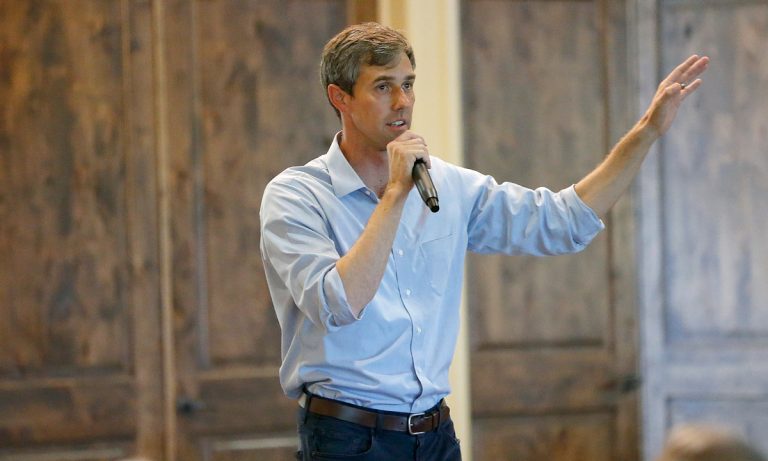
But some of them, including Beto O’Rourke, have been huge supporters of drug reform long before it was cool to do so.
A recent report from Vox shows that O’Rourke’s earlier support for pot reform goes as far back as 2009 when he called for “an honest, open national debate on ending the prohibition of narcotics” as a member of the El Paso City Council. He was one of the driving forces behind a resolution demanding that Congress take a serious look at the legalization of drugs as a means for weakening Mexican cartel operations linked to increased violence, including a slew of murders.
“If our drug laws were different, I will absolutely guarantee you that our body count would be different,” he said.
In 2011, O’Rourke and council colleague Susie Byrd published a book called Dealing Death and Drugs: The Big Business of Dope In the U.S. and Mexico, which not only pointed out how the War on Drugs has been an absolute failure, but it also detailed their support for marijuana legalization.
“The only rational alternative to the War on Drugs is to end to the current prohibition on marijuana,” the book reads.
In the past, O’Rourke has gone up against City Council members who opposed a more progressive approach to drugs and has cosponsored nearly two dozen drug reform bills during his political career.
In fact, his work in the area of drug reform has landed him above average ratings with nation cannabis advocacy group NORML. The group even endorsed him as a candidate during his bid for Senate.
While O’ Rourke was unsuccessful in beating Senator Ted Cruz last year for a spot in the upper chamber, he is now gunning to become the next president. And if that happens, he wants to make nationwide marijuana legalization a priority. The United States “should end the federal prohibition on marijuana,” he said last week in Iowa.
It is important to point out that O’Rourke is only interested in legalizing marijuana. He said last year that “heroin and cocaine and fentanyl” should remain outlaw substances.
Ariana Grande decided it was time for “always” to get an upgrade.
During the pop singer’s whirlwind romance with comedian Pete Davidson last year, the two got several matching tattoos, including the word “always” in the other person’s handwriting.
Now Grande has decided to add on to hers with a branch of leaves across the left side of her ribcage, which she showed in an Instagram post on Sunday.
She captioned the photo: “post run thrus, 3 am with @girlknewyork not a cover up just evolvin also, our show opens tomorrow. i love u and i’m so grateful. see u soon.”
Jessica Simpson shared a shocking photo of her massive baby bump and it looks like the singer is about to pop at any minute!
Sporting shades and a tiny bikini top several sizes too small, the pregnant star shared a photo gently placing her right hand on her growing belly and captioned the snap “Jess-tation.”
It’s safe to say Brad Pitt isn’t planning to join his estranged wife, Angelina Jolie, and their six kids on a red carpet anytime soon.
“Brad isn’t thrilled that Angie takes the kids to movie premieres, but it’s not going to trigger any actions,” a source tells Us Weekly exclusively. “Angie has always chosen to be more public with the kids than Brad has.”
The 43-year-old Maleficent: Mistress of Evil actress has stepped out with Maddox, 17, Pax, 15, Zahara, 14, Shiloh 12, and 10-year-old twins Knox and Vivienne on multiple red carpets in recent months, including at The Boy Who Harnessed the Wind premiere in New York City on February 25. Less than two weeks later, Jolie and her four youngest kids were all smiles at the premiere of Dumbo on Monday, March 11.
According to an eyewitness, the kids enjoyed “plates of assorted corn dogs and hot dogs, bags of candy, cupcakes and chili cheese fries” during the family outing.
Squeezing out black markets is a key goal of cannabis legalization. Legalization also lets governments tax cannabis production and consumption. Canada has achieved limited progress so far toward those potentially conflicting goals. But some provinces have made good starts.
Statistics Canada says that during 2018’s fourth quarter, consumer cannabis spending totaled $1.478 billion. Unfortunately, only 21 per cent of that went toward legal cannabis: $155 million for medical and $152 million for recreational. Product shortages were mainly responsible for the small percentage.
Legal products’ market share is even lower when calculated by product volume—that is, when considering the fraction of cannabis that was legal rather than the percentage of dollars spent on legal cannabis. That’s because illegal pot’s $6.51 per gram average price was a third lower than legal products’ $9.70.
Adjusting for price indicates only 15 per cent of purchases involved legal products. But some provinces did much better.
Provincial market shares
For example, New Brunswick had 117,400 cannabis users last quarter, about 2.5 per cent of Canada’s total. That suggests its overall cannabis market was worth around $37 million quarterly.
The province had $8.5 million in legal retail sales that quarter, or 5.6 per cent of Canada’s total. Health Canada data suggest New Brunswick residents buy 2.8 per cent of the country’s medical cannabis. That’s roughly $4.4 million quarterly. So, legal cannabis purchases there totalled about $12.9 million.
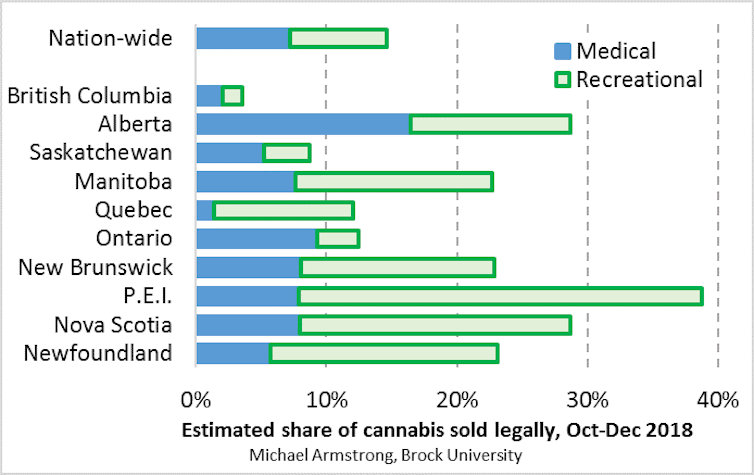
Adjusting for price differences indicates medical cannabis constituted eight per cent of New Brunswick’s market. Legal recreational products captured another 15 per cent. Altogether, legal products grabbed 23 per cent of the province’s market, well above the national average.
Other provinces’ legal market shares ranged from British Columbia’s four per cent to Prince Edward Island’s 39 per cent.
Percentage of cannabis bought legally by recreational and medical users, October to December 2018. Estimated by author using government data. Michael Armstrong
Explaining sales differences
The wide variation is partly due to differing availability of cannabis shops. That’s because cannabis consumers prefer stores over online shopping.
Alberta and the Atlantic provinces offered relatively convenient shopping. They each had at least seven stores per 100,000 cannabis users.
By contrast, other provinces had fewer outlets. Ontario had none.
Pricing is another factor. Quebec’s cannabis agency charged only $7.27 per gram on average, less than elsewhere. That made its legal products more competitive with black market cannabis.
Meanwhile, P.E.I. credited good product supplies for its chart-topping recreational sales.
Medical sales also mattered. Ontario and Alberta together have 78 per cent of Canada’s registered medical cannabis clients. Their purchases boosted those two provinces’ sales.
The amount of cannabis excise and sales tax each government collected last quarter also varied widely.
Federal revenues
At the federal level, the five per cent goods and services tax would have generated $15 million from the country’s $307 million in retail sales.
Its excise tax on cannabis producers is $0.25 per gram or 2.5 per cent of wholesale value, whichever is higher. Producers sold 20.3 tonnes of medical cannabis last quarter. They also apparently shipped 42 tonnes of recreational cannabis to distributors. These numbers imply Ottawa received some $16 million of excise revenue.
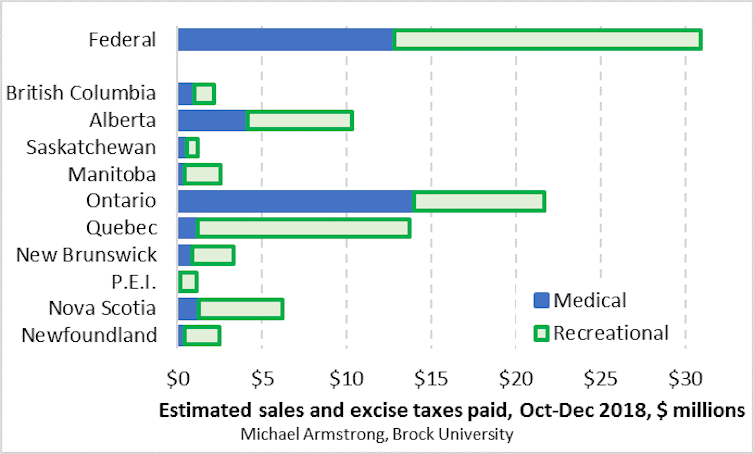
So altogether, Ottawa likely got about $31 million in cannabis excise and sales taxes last quarter.
Provincial taxes
Similar calculations apply to each province. For example, New Brunswick’s excise tax is $0.75 per gram or 7.5 per cent of value. Its harmonized sales tax share is 10 per cent. Those rates imply the province received about $3.3 million in combined taxes.
Among the other provinces, estimated taxes range from P.E.I.’s $1.1 million to Ontario’s $22 million.
Excise and sales taxes on recreational and medical cannabis, October to December 2018. Estimated by author using government data. Michael Armstrong
Altogether, these federal and provincial taxes totalled around $96 million. That’s $62 million from excise taxes and $34 million from sales taxes. Put another way, recreational customers paid $59 million while medical clients paid $37 million.
Taxing medical treatments!?
That last number is controversial. Users and producers argue medical cannabis should be tax-free like regular medicines. Taxing products that help ailments like epilepsy seems unfair.
But governments worry tax exemptions could tempt recreational users. Some might seek medical prescriptions to save money.
Here’s a potential compromise: Eliminate taxes on medical purchases of only cannabis oil. Keep taxing dry (smokeable) cannabis, along with cannabis foods and drinks when they arrive.
This could work because medical and recreational users prefer different products. Last quarter, almost three-quarters of medical purchases involved oils. Conversely, dry cannabis constituted 72 per cent of recreational sales.
Exempting medical sales of cannabis oil would help most medical clients while tempting few recreational consumers. That approach would also align with provincial medical benefits covering oils but not smokeable cannabis. The federal government could include the change in this week’s budget.
Ottawa also should simplify its unwieldy excise tax structure. Producers now deal with eight different tax formulas and 13 different tax stickers. The right sticker and formula depend on shipping destinations and product values. If products get redirected, the stickers and calculations need redoing.
Finally, the federal and provincial governments should delete the combined $1 per gram minimum excise tax. Simply charging 10 per cent of value would not only make calculations easier, it would also help industry offer “value-priced” products.
That matters, because legal vendors must compete with illegal suppliers who don’t pay taxes. So not only does legal cannabis’ market share affect tax revenues, taxes in turn affect success against black markets. Governments consequently must ensure their policies support legal suppliers in that challenge.
Work in an office long enough and concepts like boozy lunches or work-sponsored afternoon happy hours can become part of the routine as much as anything else. The thought process is you can have a buzz on and still adequately finish your work. Well, it appears cannabis users in legal states have taken that notion and ran with it.
According to a new poll from DHM Research and funded by marketing communications firm Quinn Thomas, one in four marijuana users have admitted to getting high at work. One in four consumers have also gotten high before work, though the survey doesn’t specific if these are the same one in four users. The survey polled 300 people each from Washington, Colorado, and Oregon to create a representative sample of 900 cannabis users, reports the Seattle Times.
“There is a lot of information out there about the cannabis industry and its regulatory structure, but not much is known about consumers,” Zach Knowling, vice president at Quinn Thomas, told the Seattle Times. “We felt our experience researching and reaching unique audiences could build greater understanding of who they are.”
With legalization, it seems that marijuana has entered into the mainstream. Indeed, the survey data show that recreational-cannabis consumers look pretty much like the average American. They are a close match to the U.S. average for household income and educational attainment. In the three states that were surveyed, pot users match the general population breakdowns in terms of race and ethnicity, age, political-party affiliation and other demographic factors.
The survey also found that 79 percent of users still found marijuana has a lingering social stigma attached to it, while only half admit to openly disclosing their marijuana use to friends and family. In addition, a quarter of users said they used cannabis as an alternative for alcohol. A majority of participants said the two most common reasons they use cannabis is to reduce pain and to reduce stress/anxiety.
However, those who participated also emphasized a need for more clear and reliable information around safe cannabis use. Around half of survey respondents said they trusted their dispensary retailer for that while only 38 percent would trust their health care provider to relay such information.
Approximately 1.6% of adults in the U.S. suffer from Borderline Personality Disorder (BPD), a condition characterized by difficulty regulating emotions, impulsivity, low self-image, and problems creating and maintaining personal relationships. BPD is notoriously difficult to treat. Medications don’t often provide relief from symptoms, only intense and specifically-designed psychotherapy has proven any help.
Cannabidiol (CBD), however, shows promise as a possible treatment option for those who struggle with BPD.
Borderline Personality Disorder Symptoms
People with BPD exhibit most or all of the following symptoms:
Frantic efforts to avoid real or imagined abandonment by friends or family
Unstable personal relationships that alternate between extreme idealization and devaluation
Because BPD is a personality disorder, treatment options are limited. Behavioral therapies like Cognitive Behavioral Therapy (CBT) and Dialectical Behavioral Therapy (DBT) are the most effective treatment options for BPD. There are no medications designed specifically for BPD, but antidepressant, anti-anxiety, and antipsychotic medications are often prescribed to Borderline patients to address certain symptoms like depression, anxiety, dissociation, paranoia, and intense anger. The benefit of these medications for people with BPD, however, remain unclear, and talk-therapy is often the first line of treatment for BPD.
How CBD Can Help
This is where CBD comes into the picture. When you ingest CBD, you ingest certain plant-derived cannabinoids, which act like the endocannabinoids your body produces naturally. The Endocannabinoid System (ECS) produces endocannabinoids to regulate the body’s internal functions and control how we think, feel, and react to things happening in the world around us.
Endocannabinoids do not follow what is considered the typical path of a chemical synaptic signaling, which is for a neurotransmitter to flow from a presynaptic neuron to a postsynaptic neuron and bind to a specific receptor. Instead, endocannabinoids flow backward from postsynaptic neurons to presynaptic neurons in a process called retrograde inhibition.
Endocannabinoids are sent throughout the body by the ECS to achieve and maintain the body’s internal homeostasis, or balance, among all of is working parts. In many psychiatric disorders, symptomatic or episodic behaviors can be traced back to overactive neurons, which send too many neurotransmitters from presynapse to postsynapse and overload receptors.
Since endocannabinoids follow the inverse of this process, they actually block and mediate the transfer of neurotransmitters to ensure the appropriate amount of neurotransmitters are being sent and binding to receptors. And, since the plant-derived cannabinoids that enter your body when you use CBD act like the endocannabinoids your body produces, they also work to mitigate the transfer of neurotransmitters and to combat overactive neural transfer associated with many of the BPD symptoms like anxiety, anger, impulsivity, and even paranoia.
One of the endocannabinoid receptors that CBD activates are 5-HT1A serotonin receptors. Serotonin, informally known as the “happy chemical,” is a chemical the body produces that’s important for mood regulation. People suffering from depression and anxiety, for instance, seem to exhibit lower levels of serotonin that do people who are not. People with BPD exhibit the same lowered serotonin levels. When CBD activates the 5-HT1A serotonin receptors, they bind to 5-HT serotonin neurotransmitters and increase serotonin production, which in turn combats the negative effects of depression and anxiety that come along with BPD.
Products To Use
CBD products made from or with hemp oil can also be beneficial to people struggling with BPD. Hemp oil is high in Omega-3 Fatty Acids, which could have an anti-inflammatory effect on the brain and help cognitive function. And many psychiatric disorders, including BPD, correlate with a deficiency in Omega-3 Fatty Acids in the body. Research on Omega-3 Fatty Acid supplementation found it to be an effective treatment method for both children and adults with BPD.
There is no single, miracle fix for BPD. Managing BPD is incredibly difficult and requires hours of therapy and hard work. With the right treatment combination, though, people with BPD can still lead wonderful and fulfilling lives. This article is not to suggest that CBD can replace existing BPD treatment, or to guarantee that CBD will even work for everyone with BPD who tries it.
Everybody’s different, and so the way BPD manifests in different people and the way CBD affects different people is entirely relative to the individual. But CBD looks promising for BPD patients as a possible treatment option to supplement talk therapy and to target specific BPD symptoms that get in the way of everyday life.
According to sex therapists and experts, communication is a huge part of having good and fulfilling sex. Although it sounds like great advice, in practice it’s more complicated than simply asking for what you want and getting it. There’s egos to balance, and there’s also the challenge of how to let someone know they could improve.
Feedback is important because everybody is different and you can’t expect a new sex partner to know what makes you tick during your first sexual encounter. Being open and receptive to your sexual partner makes a ton of difference — in some instances even making or breaking a sexual encounter. Here are five effective tips that’ll help you communicate and provide positive feedback during sex.
Learn the difference between feedback and instructions
Instructions are clear cut and with no room for interpretation, perfect for assembling a table from IKEA but not really lending themselves for sex. Use feedback as a way of being supportive and of getting the best out of your sexual encounter. Be relaxed and provide orientation for your partner, especially if you notice that they’re a little lost.
Before you give out feedback it’s important that you know your body and the things you enjoy. Practice on your own and grow comfortable with your body and with your attitude during sex. It’s not easy but the more you practice the better and healthier the outcome.
Communicate in a way that’s comfortable and natural for you
If you’re a quiet and shy person, it’s a lot to ask for you to transform into a porn star the minute you get naked with someone. Don’t do that. Always try to look for comfort, taking it easy and relieving yourself of any pressures and expectations that aren’t necessary. Be open about your personality and communicate in a way that feels natural, be that through touch, full sentences or simple sounds.
If giving feedback mid-sex isn’t your thing, make an effort to communicate positively after sex. This gives you the opportunity to discuss the things you enjoyed, what you’d like to do in the future and your expectations of sex. The afterglow of sex creates a much more relaxed environment than the one that exists before or during sex.
Again, feedback should be used as a way of encouraging the positive aspects of your sexual relationship, not as a way of tearing someone down. Use feedback as an opportunity to deepen your relationship with someone, sexual or otherwise, and get some fun and good laughs out of your experience.
You can remind people John Boehner was “unalterably opposed” to cannabis reform during his tenure as Speaker of the House. You can remind them of Boehner’s voting records against any pro-marijuana amendments. And you can remind them Boehner only transformed into our unlikeliest marijuana spokesman once the money came rolling in.
But as he proved with a keynote speech beside Acreage CEO Kevin Murphy at the South by Southwest Conference last week, Boehner is here to stay in the cannabis conversation. Thanks to his longtime political connections and his position on the board of Acreage Holdings, it appears those within the cannabis industry have accepted the potential hypocrisy in all this as a simple change of heart, a position Boehner himself has pushed.
“I feel like I’m like your average American who over the years began to look at this a little differently and I think over the last five years my position, it has kind of softened up and softened up,” Boehner said during his appearance.
Boehner credits his evolution with talking to American veterans about how cannabis has helped them PTSD and other ailments. He was also moved by stories of how the plant benefited children with intractable epilepsy.
“He’s passionate about the people in this country,” Murphy said about Boehner in previous comments to The Daily Beast. “And when asked what really had an impact on swaying his views, he came forth with one of the best answers I’d ever heard. ‘The people changed my mind.’”
And so the problem fits within the larger issue perpetuating throughout our politics—do we define public figures by their past, or are they allowed to change and grow in their views? Some chose the former at SXSW. The Equity First Alliance, an activist group that advocates for social and racial equality in the burgeoning cannabis industry, were seen heckling Boehner’s speech.
None of this, however, has influenced Boehner to try marijuana. However, the former House Speaker admits to using Advil PM every night before bed, and that maybe there’s a future where cannabis could replace his Advil PM usage.
“I’ve never used the product,” he said. “I smoke cigarettes, I drink red wine, I have a little bourbon. Not to say I’ll never use [marijuana,] but I haven’t yet.”
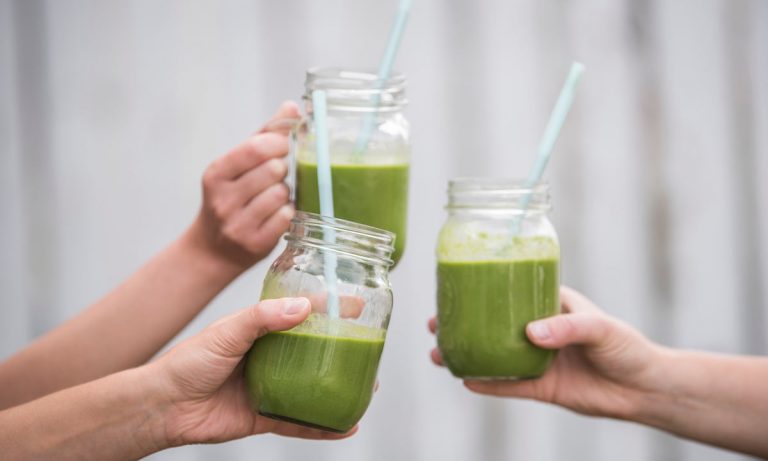
Smoothies may already be your current go-to breakfast in the morning, or post-workout refuel in the evening. You probably already love them for the energy, protein, and nutrients they provide. Well, after hearing about the latest smoothie ingredient superstar—CBD—you’re going to be tempted to kick start your blender into overdrive.
Some of the benefits of adding CBD oil to your smoothies may include:
soothe pain
ease anxiety
reduce inflammation
recover from exercise
It doesn’t take much to enjoy these benefits. Most recipes, including the ones below, call for about a teaspoon CBD oil per 1-2 servings. Happy blending!
When you think smoothie, you might automatically think fruit. That doesn’t mean you can’t make them a little more indulgent now and again, though. Take this mint chocolate chip version for example. It borderline tastes like a milkshake, but is actually just made with not so bad for you ingredients like avocado, banana, tofu, peppermint extract and chocolate chips. Save this one for when you want dessert but don’t want the guilt.
Looking for a healthy way to boost your mornings? Whip up this delicious blueberry smoothie. Blueberries are often considered a super food because they are so antioxidant-rich. That means they can help protect you from aging, cancer, and can even help lower your blood pressure. Combined with just a teaspoon of CBD hemp oil, almond milk, a banana, and a dab of honey, this makes for a creamy and relaxing way to start your day.
CBD-Infused Peanut Butter, Chocolate, and Banana Smoothie
Need a smoothie recipe for after the gym? Try this winning peanut butter, chocolate, and banana combination. It is packed with protein from the peanut butter and almonds, so your muscles can recover and get stronger. Plus the CBD isolate it calls for will help reduce any inflammation and tension you might have post-exercise.
Smoothies aren’t just for the glass anymore. Smoothie bowls are another delicious way to enjoy your favorite fruit blend topped with more fresh fruit (yep!) and other toppings like granola or coconut flakes—usually for breakfast. But this gorgeous hemp strawberry and cherry bowl is actually meant to be a pre-bed treat. The cherries are packed with melatonin (which helps you get sleepy) and the hemp oil will ease your anxiety so you can dream soundly.
Die-hard cannabis advocates would like to convince the population marijuana legalization will be the magical cure-all for the opioid epidemic. It’s the same group that proselytizes weed as a panacea for cancer and other ailments that claim hundreds of thousands of lives on an annual basis.
This spiel about cannabis being a miracle elixir is the new reefer madness—a plant that previously earned users labels of stoners and potheads is suddenly all we need to live longer, healthier lives.
But at least where opioid addiction is concerned, medical experts are not convinced that cannabis has the power to change the world for the better.
A few studies have surfaced over the past couple years that suggest opioid use is down in states that have legalized marijuana for therapeutic purposes. There is some proof that, when they can, a percentage of patients will substitute prescription painkillers with cannabis products. There have also been studies showing that just putting opioid addicts on medical marijuana, as opposed to methadone and other traditional drug treatments, would likely have detrimental and even life-threatening effects.
So while people who use opioids as a way to escape chronic pain might be able to use a cannabis alternative, those locked into the grips of hardcore addiction may not be so easily saved.
Still, a small body of evidence suggest cannabis medicine might be beneficial in treating opioid addicts.
A paper from Cannabis and Cannabinoid Research shows the herb might help addicts through the worst of the withdrawal symptoms. This means a cannabis alternative might be a substantial first step in addiction therapy.
“The reason that cannabis can be helpful in this way is that biologically, the human cannabis and opioid systems interact very closely,” Jonathan Stea, Ph.D., wrote in a recent article for Scientific American.
“This is exciting because it means that there is much promise for the development and use of cannabis-based medicines in the treatment of opioid addiction,” he added.
On the other hand, cannabis could never take the place of opioids entirely. There are those who are suffering from more severe pain conditions than the ones often used as a reason to get on medical marijuana. Patients that have endured trauma and battlefield injuries, not to mention surgeries, are not likely going to smoke themselves into comfort. The same goes for a lot of cancer patients.
While marijuana might help ease the pain for some people, it does not work the same kind of magic as opioids. The two substances do not provide the same effects obviously. Furthermore, contrary to the exposition of cannabis use in recent years, some people just don’t enjoy the effects of marijuana.
So while cannabis might be a part of the answer, Stea says “because the opioid crisis is a multilayered and multi-causal problem that demands an equally multipronged solution” it would be naïve to think that it can snuff it out entirely. “It is unhealthy to think otherwise,” he wrote.
Although research will probably indicate one day that cannabis has a positive role in combating certain pain conditions, more science is needed before that understanding becomes clear. It could be years before this happens. First, the U.S. government must eliminate the plant from the confines of its Schedule I classification on the Controlled Substances Act. From there, anything is possible.



 not a cover up just evolvin
  also, our show opens tomorrow. i love u and i’m so grateful. see u soon.”