Consider Mötley Crüe. Even the use of umlauts was excessive in the 1980s. That’s just one reason it’s known as the decade of excess, and nowhere was that more evident than in the grocery aisle. Snack foods were more fun than functional, and hydrogenated oil was basically a vitamin. Here are 7 foods we as a nation collectively ate with abandon, but that probably should’ve been packaged in caution tape.
Hostess Pudding Pies
Reimagined today as Hostess Crème Pies, these were once deep-fried pies filled with vanilla or chocolate pudding, and then coated with chocolate icing. There was usually more pudding than pie, creating a pudding explosion with every bite. But hey, if it’s good enough for Joey Lawrence.
Frank ‘n Stuff
Hotdogs are unhealthy all by themselves. Stuffed with cheese and chili? Say bon appetite to a heart-attack in a bun.
Jolt Cola
Worse even than Pepsi A.M., this cola made headlines in the ’80s for containing enough stimulants to make your gums bleed. It was marketed towards kids, who loved the idea of not sleeping, but many parents were not psyched about the cola’s “all the sugar and twice the caffeine” slogan.
https://www.instagram.com/p/2sl8aAkJOl/
GatorGum
There was so much beverage-inspired gum in the ’80s (A&W Root Beer, Dr. Pepper, 7-Up), and none more useless than Gatorade gum. It was supposed to quench your thirst, but after about 30 seconds of chewing this tart lemon-lime flavored substance, you mostly just became way thirstier than before.
https://www.instagram.com/p/BEBiagrtsys/
Betty Crocker Pudding Roll-Ups
Pudding was big in the ’80s in all forms, including roll-ups. Because who needs the rich and creamy mouth feel satisfaction of eating real pudding when you can eat a much drier, flatter version?
https://www.instagram.com/p/4XsjTHshzv/
Hubba Bubba Soda
This bubble gum flavored soda proved once and for all that kids will drink anything.
https://www.instagram.com/p/BpZL_XxA9oa
White Mountain Coolers
Artificially fruit flavored (with pulp!) malt beverages that were brewed like beer and marketed towards those who don’t like the taste of beer. Shockingly, this product did not last.
Here is a professional opinion on why aren’t more congressional candidates embracing marijuana reform.
In the lead up to the 2018 midterm elections, cannabis advocates are going through a familiar routine: throwing their hands up in frustration as to why more candidates are not embracing cannabis reform. It’s an important question for the movement and one that, based on public opinion polling, suggests a disconnect between the public and their elected officials. However, new polling shines a light on why this disconnect happens and it all boils down to congressional primaries.
Public opinion around cannabis reform has changed dramatically over the past two decades. Support for medical cannabis hovers somewhere above 80 percent (sometimes well above that), and recent polling shows that two-thirds of Americans support adult-use cannabis reform. So, why hasn’t the D.C. establishment embraced such a popular issue? I have written elsewhere that there is a disconnect between support and salience. That is, while many people support cannabis reform, an overwhelming number of Americans just don’t care about it. Most Americans are not regular users, and most feel it is an issue that doesn’t affect them. Cannabis policy has never entered the top 20 issues Americans care most about according to Gallup. This means that Americans are unlikely to vote against a candidate based on that position, and that candidates are unlikely to stake out a position on it. We have seen that play out in election after election.
However, national polling misses an important facet of American politics and a major part of the calculus that elected officials use when forming issue positions. Increasingly—and especially in House races—candidates appeal to their primary electorate. In an era in which gerrymandering is a common tradition for both parties, there are a significant number of House races in which the primary is the race to watch and the general election is just a formality. Congressional primaries have embarrassingly low voter turnout, meaning tiny minority of voters are making the biggest decisions about who ultimately gets elected.
So, if candidates are running largely to appeal to a primary base of voters, it is important to understand what those voters believe on a host of issues. Unfortunately, we don’t have a good idea what the congressional primary electorate thinks about policy. Until now.
Over the past few election cycles, the Primaries Project at the Brookings Institution has been conducting some of the nation’s first ever exit polling of congressional primaries. We put exit polls into the field in some of the nation’s competitive congressional districts in 17 states—those districts in which interest and turnout would naturally be higher and where turnout would be somewhat more reflective of an electorate that turns out in November (relative to non-competitive districts). And this year, for the first time, we asked about cannabis reform.
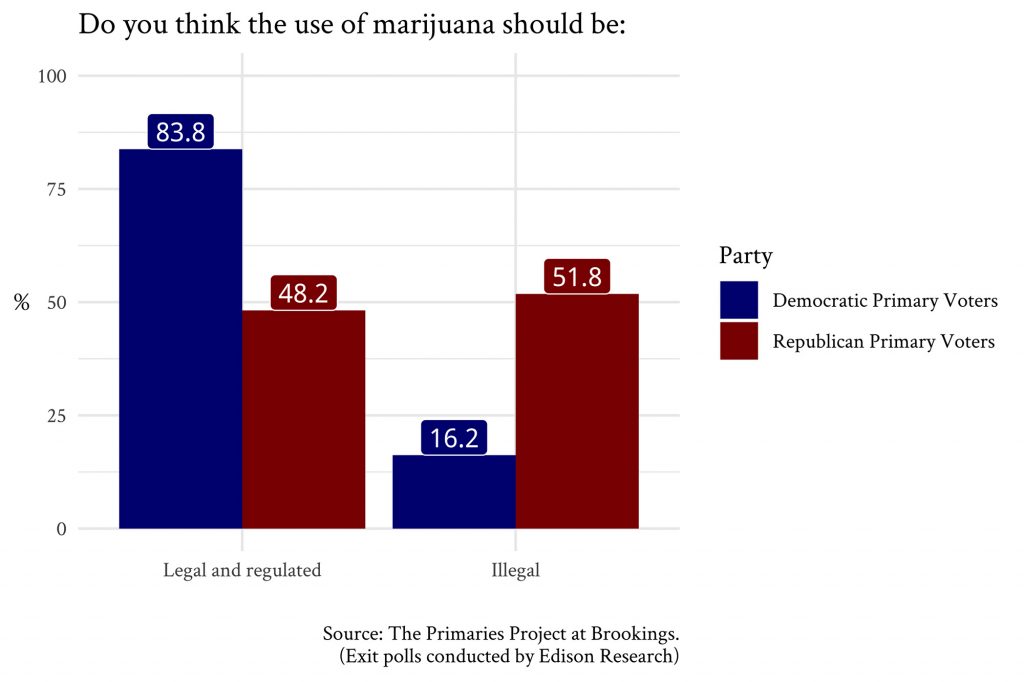
The results were striking. We asked simply “Do you believe marijuana should be legal and regulated or illegal?” As the chart below shows, Democratic primary voters polled overwhelmingly supported cannabis reform. Nearly 84 percent of Democratic primary voters said that they believed cannabis should be legal and regulated. However, among Republican primary voters polled, the issue is quite controversial. A majority—nearly 52 percent of Republican primary voters—believed that cannabis should remain illegal.
While some national polling has shown recently that Republicans are coming around on the issue of cannabis reform, even indicating a majority of Republicans nationally support reform, the primary electorate may be different. It is important to note that we did not poll in every Congressional primary. And from district to district, race to race, results could vary. However, in 20 of this year’s competitive primaries, cannabis reform is controversial for Republicans. Combining those poll results with an understanding that cannabis is not a salient issue, Republicans are unlikely to stake out a position on it. Why engage a controversial issue if you can simply avoid it?
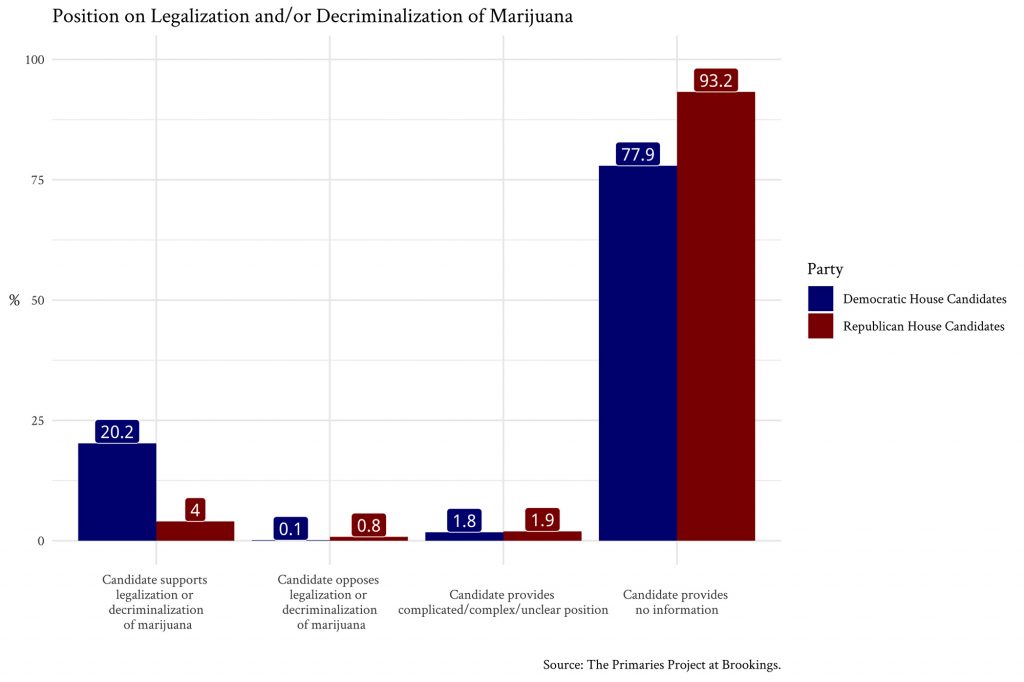
The next chart illustrates that issue avoidance in action. In addition to conducting exit polling, Brookings’ Primaries Project also coded the websites of every candidate running for the U.S. House nationwide — whether they were serious candidates or not. If a candidate filed to run for office and maintained a campaign website, we collected data from that website. Candidates’ positions on cannabis was one such issue we coded for.
What we found was that, by and large, candidates remained silent on the issue—a reflection of a topic that is not salient among the public. Unsurprisingly, Democrats were much more likely to discuss it with over 20 percent of candidates saying that they supported legalization or decriminalization of cannabis. However, about 78 percent of Democratic primary candidates and over 93 percent of Republican primary candidates provided no information on their position on cannabis.
These data offer some important takeaways for cannabis reform in the context of Congressional elections. First, there is little reason Democrats are not staking out strong, pro-cannabis reform positions. In races in which candidates are appealing to the primary electorate, cannabis is a winning issue. (We also know from general polling that it’s a winning issue for Democrats among all of their party’s voters, too.) It is embarrassing that only 20 percent of Democratic House candidates endorse cannabis reform on their campaign website.
Second, it makes sense that Republicans avoid this issue and are not embracing cannabis reform. Our data suggest that in some of the nation’s competitive congressional primaries, cannabis reform remains deeply controversial. If those numbers are reflective of Republican congressional primary voters more generally, that controversy is something Republicans want to distance themselves from. And although voters and even debate commentators are asking candidates about cannabis reform more frequently than in the past, over 93 percent of Republican House candidates refuse to post a position on their campaign website.
Ultimately, while Americans may broadly believe in cannabis reform, and the issue seems like a no-brainer for candidates and elected officials, the realities of American politics suggest the issue is more complex. Among Republican primary voters who turn out to vote and for the voters who Republican congressional candidates pay the most attention to, cannabis remains a controversial issue and one in which they can get away with remaining silent about. The solution for motivating elected officials on the issue of cannabis is for the reform community to remain more engaged, hold candidates’ and elected officials’ feet to the fire, and actually turn out to vote—not just in November every four years, but in primaries and general elections every year. Right now, cannabis advocates’ votes don’t matter to most politicians, and the advocacy community needs to show candidates that it’s time to take cannabis policy seriously.
British spiritual person Amethyst Realm made the news last year when she announced that she’d slept with over 20 different spirits and that she preferred them over living men. Good for her. Now, she’s making headlines again by announcing that she’s done gallivanting with ghosts and that she is tying the knot with, you guessed it, a very special spirit.
Realm says that she’s very happy with her choice in partner and that they’d met while she was traveling in Australia. “I’d not had a phantom fling for a while and as I was away on business, starting a new relationship was the last thing on my mind. Then one day, while I was walking through the bush, enjoying nature, I suddenly felt this incredible energy. A new lover had arrived,” she explains in an interview with The Sun.
Realm fell in love fast, claiming that her new relationship is much more exciting than the one she had with her previous human fiancé. “I was happy and excited — so excited that we had to do something about it. So we headed to the plane loo and, well, I am now a member of the Mile High Club,” she said. Who wants to tell her that’s not how the Mile High Club works?
Although Realm and her ghost had been in a relationship for a couple of months, she claims that she’d never heard the ghost speak, not until he (it?) finally proposed. “There was no going down on one knee — he doesn’t have knees. But for the first time, I heard him speak. I could actually hear his voice and it was beautiful. Deep, sexy and real.”
Realm says that her friends and family are understanding of her situation and that they accept her choice in partner. The couple is currently organizing a pagan ceremony to hold on the day of their wedding. How will she know if she’s been left at the altar?
A man is so stressed out that a living, breathing alien-thing grows inside of him and starts walking around in the world. Out of that plot synopsis we get scenes like this:
Honor Anton Yelchin’s memory and give this horror rom-com a spin. When his overbearing ex dies in an accident, he thinks his problems are solved — until she comes back to haunt him.
Five-star quote: “Hey baby, you ever bang a zombie? Once you go undead, it’s never been better in bed.”
Mutant spiders take over the NYC subway, which, granted, is a legitimately horrifying notion. What’s scarier is the year 2000’s bad CGI and dramatic effects.
Five-star quote: “This is creepy… like a bad science fiction movie.”
You’ve probably read this a thousand times this year already: cannabis is going mainstream by the minute. In the past couple of months, we’ve seen Jim Cramer weigh in on pot stocks on Mad Money, witnessed the debut of a few cannabis companies on major stock exchanges like the NYSE and several multi-million dollar acquisitions close, learned that a heir to Anheuser-Busch is debuting his own weed brand, and even had a former MTV executive take over the CEO role at a cannabis-focused media company.
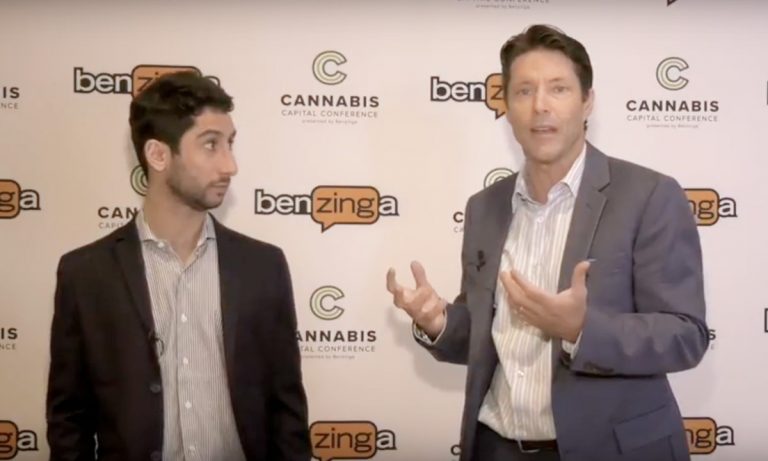
Taking cannabis yet another step closer to the mainstream, Tim Seymour, founder and Chief Investment Officer of Seymour Asset Management, best known as the co-host of CNBC’s Fast Money, led a marijuana-focused investment panel at the Benzinga Cannabis Capital Conference in Toronto, Canada. Alongside Seymour, discussing the state of the cannabis industry, the transition of weed products toward the consumer packaged goods category, and other related topics, were:
Viridian Capital Advisors Vice President Harrison Phillips.
Arcview Ventures General Partner Jeanne Sullivan.
Tidal Royalty CEO Paul Rosen.
Merida Capital Partners Managing Partner Mitch Baruchowitz.
Fortunately, The Fresh Toast was there to catch the interesting panel, and had the chance to have a one-on-one chat with Seymour afterwards. See the video above, and find some highlights below.
Emerging Markets
Off camera, Seymour explained the reason for him to be hosting a panel at the Benzinga Cannabis Capital Conference. Tim is an asset manager who’s been focused on emerging markets for two decades. As such, he was drawn to the marijuana industry a few years ago due to the “tremendous growth” it offers. “This is a new asset class, this is what gets me excited,” he told The Fresh Toast.
Ultimately, investing in emerging markets, especially those in their earlier stages, “is about understanding your macro… and understanding the tailwinds from those macro trends,” he explained.
Check out how this applies to cannabis in the video above.
A Word Of Caution
According to Viridian Capital Advisors’ Cannabis Deal Tracker, more than $7.6 billion have been invested into cannabis companies in 2018 – and this is before counting the yet-to-be-closed $4 billion investment Constellation Brands is making into Canopy Growth. In this context of huge money flows, Seymour recommended investors to be cautious.
His top piece of advice for investors was: do your work. “Get as much insight into the balance sheets and the operations of the company [as you can]… But ultimately, right now, especially in early-stage companies, it’s truly all about the management team.”
The other very important thing, he added, is understanding how cannabis stocks trade, as many trade by appointment or have very little liquidity.
What About ETFs?
Finally, we asked Seymour about ETFs, or exchange-traded funds, which aggregate a number of stocks that investors can buy into at once, relieving them from the heavy duty of picking stocks.
An ETF is “a diversified portfolio [so] you’re not placing your bet in two, three or four stocks… Ideally, you’re placing your bet in 25 to 40 stocks… So, ETF investing in the cannabis sector, I think it makes a lot of sense,” he concluded, noting that while current options in the cannabis space seem a bit immature, there is no reason to be really critical, and adding that investors should look for actively managed ETFs when picking one.
Soft drink giant Coca-Cola is making marijuana news again, this time saying that it has absolutely no intention of getting involved with the cannabis industry – at least not at this time. Rumors that the company was on the verge of a major development deal with the Canadian pot firm Aurora cannabis to create a line of CBD-infused beverages have been circulating ever since sources toldBloomberg last month that the two companies were in “serious talks” about working together.
However, Coke CEO James Quincey has denounced the gossip, according to the latest Wall Street transcripts.
On Tuesday, during a call to investors, Quincey said, “we don’t have any plans at this stage to get into the space” when asked by Cowen & Company analyst Vivien Azer about whether the company was planning to create a CBD product. “So that’s kind of where we are,” he added, leaving the subject flat.
There is so much speculation happening right now concerning the cannabis-infused beverages market, it can be difficult for investors to determine what is real and what is just wishful thinking. Ever since Constellation Brands and Molson Coors officially signed deals to produce pot beverages for the Canadian cannabis market, it almost seems that every other week another unconfirmed report from an anonymous source is being published suggesting the possibility of another major beverage company joining in. But so far, there has been a lot of talk and not much action. No definitive contacts have been signed by any other major beverage firms other than the two mentioned above.
In the case of Coca-Cola, the company essentially told everyone last month not to get too excited about seeing a Coke of cannabis anytime soon. “We have no interest in marijuana or cannabis,” the company said in a statement released in September. “Along with many others in the beverage industry, we are closely watching the growth of non-psychoactive CBD as an ingredient in functional wellness beverages around the world. The space is evolving quickly. No decisions have been made at this time.”
What is true is that soft drink companies are struggling to find new revenue streams to attract health-conscious consumers who have given up sugary beverages. For the past couple of decades, soda sales have dropped more than 25 percent since their heyday between the 1960s and 1990s, reports the New York Times. This decline is expected to continue as more people adopt a healthy lifestyle.
Considering the popularity of CBD, which is often touted for its therapeutic benefits, this sector should be a no-brainer for soda companies. But they are likely holding out, according to financial experts, because they can. Simply put: Soda companies do not have to be nearly as competitive in the cannabis space as those selling booze.
“Unlike the beer, wine and spirits sector, cannabis or CBD-infused beverages are not an imminent threat to non-alcoholic beverages sales, so it makes sense that a large, multinational, non-alcoholic beverage manufacturer like Coca-Cola would to take a wait-and-see approach,” Jason Wilson, president of Budding Equity Asset Management and a partner in the ETFMG Alternative Harvest ETF, told Market Watch. “In contrast, the sales of alcoholic beverage producers and distributors are under more immediate threat of cannibalization, which is why we have seen companies like Constellation Brands and Molson Coors… enter the cannabis space.”
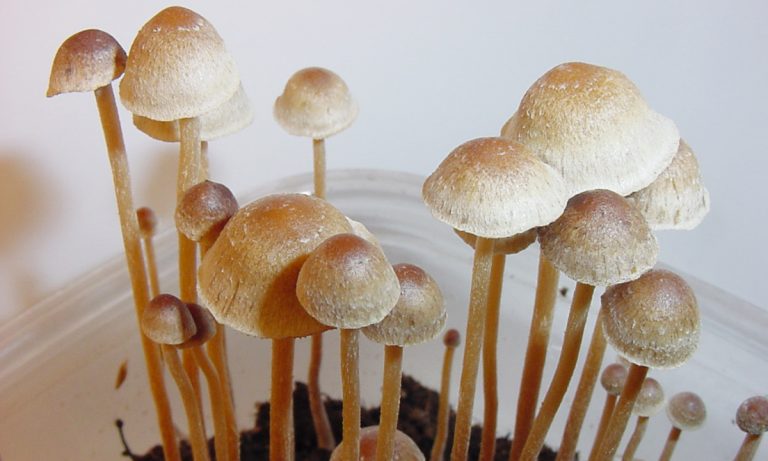
Psilocybin mushrooms like cubensis do more than make a Dead show fantastic and otherworldly. For decades now, a slew of therapists, psychiatrists and botanists have known that their properties go well beyond a good or bad trip. Magic mushrooms have been found to be an effective treatment for depression, anxiety and even addiction and have now been endorsed by researchers at John Hopkins University, according to the New York Times.
The researchers call for the rescheduling of psilocybin so that it may be used in therapeutic sessions that are guided by a professional in the realm of psychedelics. The hurdles that lay before said sessions should take around 5 years to leap and will include thorough studies and trials to work out dosages, efficacy and safety.
It’s suggested that the mushroom component be moved from Schedule I, which is the category for no known medical uses and high potential for abuse, to Schedule IV, which is slated for substances with a low potential for abuse and includes Xanax, Klonopin and Valium. Could it be that psychedelic mushrooms may turn into the new mother’s little helper?
In the lengthy researcher’s review, highlights include, “Psilocybin mushrooms have been used for millennia for spiritual and medical purposes,” and “Animal and human studies indicate low abuse and no physical dependence potential,” and “Psilocybin may provide therapeutic benefits supporting its development as a new drug.”
Though in the communities trying to legalize psychedelics for therapeutic benefits, the perks of taking hallucinogenic mushrooms are and have been well known. The activist association MAPS has been working on MDMA, mushroom and other psychedelic treatments to be freed for decades, with progress to show. It’s safe to say that without their boldness, John Hopkins University wouldn’t be recommending magic mushrooms be loosened from their scheduling.
From microdosing in Silicon Valley to the “bad trip” tent at Burning Man, psychedelics have far reach and have been the catalysts to epiphones, breakthroughs and full blown realizations for many imbibers. Psilocybin is well documented on the site Erowid and Dr. Matthew Johnson of John Hopkins told the Times that the FDA had already approved numerous trials of psilocybin. If it is indeed accepted as a treatment for patients, he said, “I see this as a new era in medicine.”
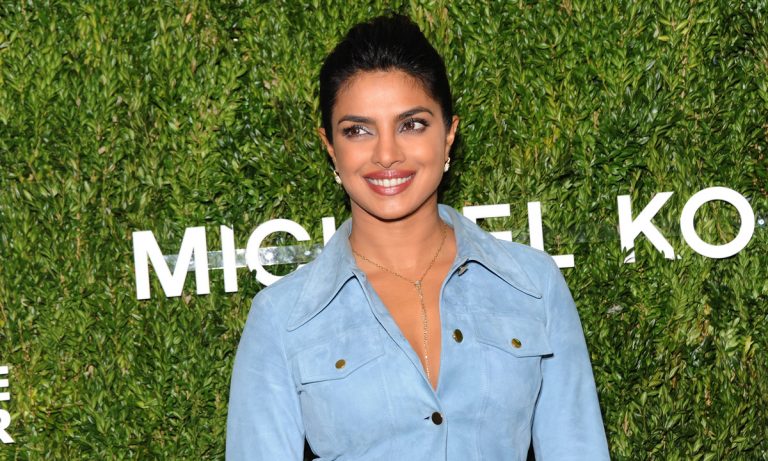
“This is the first time I was comfortable with being with someone who is such an incredible partner, so it just felt natural,” Chopra told PEOPLE at the Bumble India launch on Monday (the actress is an investor in the company). “And plus there was a ring on it! I always said that when there’s a ring on it I’ll talk about it because you’re single until you’re married.”
“I’ve never been public about my relationships. But that was a decision I took when I was very young,” Chopra explained. “Especially in entertainment because women have such public lives, we always end up being reduced to a plus one or ‘blahblahblah’s’ girlfriend. And I wanted to give myself enough time where I’m able to stand on my own two feet and have my identity as well.”
Dewan’s new fling is Broadway actor and singer Steve Kazee. Dewan and Kazee have been dating for a couple of months now, and if their romance were a musical, it would be scored with peppy music. “[Jenna’s] really happy,” said a source close to the dancer and actress.
The duo was allegedly spotted together at the Casamigos Halloween party in Beverly Hills, where they “showed off PDA.” Then, on October 29, Dewan and Kazee had a festive date at the Los Angeles Haunted Hayride. Already celebrating Hallloween together, eh? Must be serious!
In the meantime, Channing is reportedly dating singer Jessie J, who — again, just sayin’ — bears some resemblance to his ex. Here’s evidence.
The singer is ready to keep fighting her addiction, with the 26-year-old planning to stay in rehab ‘for the remainder of the year’ according to ET Online.
‘Demi is thankful she’s still alive and is doing whatever she can to never get to that point again,’ a source told the website Tuesday. Demi recently celebrated 90 Days of sobriety.
November’s new moon is occurring on the 7th, landing in Scorpio. And according to astrology, it’s a perfect time to embrace the dark and bright aspects of your life, because it encourages you to do some clean up in order to kick off the month with positive vibes.
Elite Daily explains that new moons in Scorpio bring out the lightest light and the darkest dark, which sounds confusing, but sort of understandable. It’s a very intense mix of energies, lending itself for meditation and introspection. Bustle compiled a list of meditations that pair perfectly with November’s new moon. Check out 5 of our favorites:
This guided meditation is all about helping you let go of things that are angering you and holding you back, encouraging you to forgive those that have hurt you. Even if you think you’re over something on a surface level, this meditation was built in order to help people heal wounds and issues they may still exist on your subconscious.
Self love
This 10 minute guided meditation encourages you to face your personal problems and embrace them, encouraging you to come to terms with your past, the issues you’ve faced, and the things you’d like to accomplish in the near future.
Dealing with conflict
This short guided meditation encourages you to face the conflicts you’ve had with important people in the past, especially those that still weigh on you. This meditation encourages you to calm down, especially during the times when you feel like your emotions are getting the best of you.
This three hour meditation helps you let go of negative vibes and embrace peace and relaxation. Since it’s so long and relaxing, it’s a great way to let go of the day and help you go to sleep.
New moon
This meditation was designed for new moons, encouraging change and manifestation, helping you visualize your goals and how you can achieve them.
Halloween is a time when ghosts and spooky decorations are on public display, reminding us of the realm of the dead. But could they also be instructing us in important lessons on how to lead moral lives? Here is how believing in ghosts can make you a better person.
Roots of Halloween
The origins of modern-day Halloween go back to “samhain,” a Celtic celebration for the beginning of the dark half of the year when, it was widely believed, the realm between the living and the dead overlapped and ghosts could be commonly encountered.
In 601 A.D., to help his drive to Christianize northern Europe, Pope Gregory I directed missionaries not to stop pagan celebrations, but rather to Christianize them.
Accordingly, over time, the celebrations of samhain became All Souls’ Day and All Saint’s Day, when speaking with the dead was considered religiously appropriate. All Saint’s Day was also known as All Hallows’ Day and the night before became All Hallows’ Evening, or “Hallowe’en.”
Christian ghosts
Not only did the pagan beliefs around spirits of the dead continue, but they also became part of many of early church practices.
During the Middle Ages, beliefs around souls trapped in purgatory led to the church’s increasing practice of selling indulgences – payments to the church to reduce penalties for sins. The widespread belief in ghosts turned the sale of indulgences into a lucrative practice for the church.
It was such beliefs that contributed to the Reformation, the division of Christianity into Protestantism and Catholicism led by German theologian Martin Luther. Indeed, Luther’s “95 Theses,” that he nailed to the All Saints Church in Wittenburg on Oct. 31, 1517, was largely a protest against the selling of indulgences.
Subsequently, ghosts became identified with “Catholic superstitions” in Protestant countries.
Debates, however, continued about the existence of ghosts and people increasingly turned to science to deal with the issue. By the 19th century, Spiritualism, a new movement which claimed that the dead could converse with the living, was fast becoming mainstream, and featured popular techniques such as seances, the ouija board, spirit photography and the like.
Although Spiritualism faded in cultural importance after World War I, many of its approaches can be seen in the “ghost hunters” of today, who often seek to prove the existence of ghosts using scientific techniques.
An elaborate model house is being guided into the ocean as an offering to wandering ghosts during the beginning of the Ghost Month Festival in Taiwan. AP Photo/Chiang Ying-ying
Along with many Asian countries such as Japan, Korea, China and Vietnam, Taiwan celebrates a “Ghost Month,” which includes a central “Ghost Day,” when ghosts are believed to freely roam the world of the living. These festivals and beliefs are often tied to the Buddhist story of the Urabon Sutra, where Buddha instructs a young priest on how to help his mother whom he sees suffering as a “hungry ghost.”
As in many traditions, Taiwanese ghosts are seen either as “friendly” or “unfriendly.” The “friendly” ghosts are commonly ancestral or familial and welcomed into the home during the ghost festival. The “unfriendly” ghosts are those angry or “hungry” ghosts that haunt the living.
Role of ghosts in our lives
As a scholar who has studied and taught ghost stories for many years, I have found that ghosts generally haunt for good reasons. These could range from unsolved murders, lack of proper funerals, forced suicides, preventable tragedies and other ethical failures.
Ghosts, in this light, are often found seeking justice from beyond the grave. They could make such demands from individuals, or from societies as a whole. For example, in the U.S., sightings have been reported of African-American slaves and murdered Native Americans. Scholar Elizabeth Tucker details many of these reported sightings on university campuses, often tied in with sordid aspects of the campus’s past.
In this way, ghosts reveal the shadow side of ethics. Their sightings are often a reminder that ethics and morality transcend our lives and that ethical lapses can carry a heavy spiritual burden.
Yet ghost stories are also hopeful. In suggesting a life after death, they offer a chance to be in contact with those that have passed and therefore a chance for redemption – a way to atone for past wrongs.
This Halloween, along with the shrieks and shtick, you may want to take a few minutes to appreciate the role of ghosts in our haunted pasts and how they guide us to lead moral and ethical lives.